
Most of the expensive surprises I see in Spanish property purchases were visible, or at least discoverable, before anyone signed anything. The trouble is that the building and the paperwork are usually checked by different people, at different times, and sometimes not at all. The real decision is not whether to inspect, but what to inspect, whom to hire and how to time those checks so you still have choices when the findings arrive.
A property inspection in Spain should combine an independent assessment of the building’s condition with legal checks on ownership, debts, planning permissions and permitted use. Arrange these checks before signing a binding agreement or paying an unprotected deposit. A mortgage valuation, energy certificate or notarial appointment does not replace a buyer’s inspection.

Your Property Inspection Checklist Before Signing
A sensible property inspection in Spain follows a sequence, because each check depends on the one before it. This is the order I recommend, with who normally does what and the evidence you should be holding at the end of each step.
- Appoint independent advisers. You instruct an independent lawyer and, where the property justifies it, a technical inspector who is not paid by the seller, the agent or the developer. Evidence: signed engagement letters stating each adviser’s scope and fees.
- Identify the property and the seller. Your lawyer confirms the exact registered property, its cadastral reference and that the person selling has authority to sell, including every co-owner, heir or company signatory. Evidence: current registry information, identity documents and any powers of attorney.
- Collect the documents. The seller or agent supplies the deed, plans, permits, energy certificate, IBI receipts and, for apartments, community records. Evidence: a dated list showing what has arrived and what is still missing.
- Inspect the home and the shared building. Your technical professional examines the accessible parts of the property and, for apartments, the common elements the community lets them see. Evidence: a written report with photographs and a severity rating for each finding.
- Reconcile records with reality. Your lawyer and inspector compare what was actually built with what the registry, the Catastro and the town hall describe. Evidence: a written note of every discrepancy and the enquiry it needs.
- Assess costs and intended use. You and your lawyer check running costs, repair exposure and whether your plans, such as letting or extending, are permitted. Evidence: actual bills, community figures, repair quotations and written planning or licensing answers.
- Resolve findings and contract conditions. Your lawyer negotiates repairs, price changes or conditions before you sign the binding contract. Evidence: agreed clauses, deadlines and written repair commitments.
- Recheck before completion. Your inspector revisits agreed repairs and your lawyer refreshes registry, debt and tax checks shortly before the notary appointment. Evidence: a reinspection note and updated searches dated close to completion.
Timing matters as much as content. An offer is usually a proposal, but a reservation agreement can create genuine obligations in Spain, depending on its wording, so never assume it is a harmless formality. The contrato de arras is the private deposit contract most buyers sign next; it normally fixes the price, the completion date and the consequences if either side pulls out. Completion happens when the escritura, the public deed of sale, is signed before a notary and the price is paid. Let me put it plainly: by the time you reach the notary, the inspection should be ancient history, not a job for the morning of the signing.
Survey, Valuation and Legal Checks: The Differences
Buyers often assume that because somebody has looked at the property, it has been inspected. Here’s where people usually come unstuck: each of the checks below answers a different question, and none of them answers all of them.
| Check | Purpose | Professional | Evidence produced | Limitations |
|---|---|---|---|---|
| Viewing | Judge layout, light, location and obvious problems | You, often accompanied by the agent | Your own notes and photographs | Not a technical assessment; in most sales the agent acts for the seller |
| Technical inspection (survey) | Assess the visible condition of the building and its installations | Arquitecto técnico (aparejador) or architect | Written report with photographs and priorities | Usually non-invasive; hidden areas and concealed services are excluded unless agreed |
| Specialist structural assessment | Investigate suspected movement, cracking or structural alterations | Structural engineer or suitably experienced architect | Specialist report, sometimes with monitoring or tests | Commissioned separately; opening-up needs the owner’s consent |
| Tasación hipotecaria (mortgage valuation) | Estimate value as security for the lender | Valuer from a valuation company approved by the Bank of Spain | Valuation certificate for the bank | Prepared for the lender’s purposes; not a defect survey |
| ITE / IEE | Periodic statutory assessment of a building, where local rules require it | Competent technician appointed by the owner or community | Inspection report, sometimes with required works | Addresses the building’s regulatory condition, not your purchase questions; may be out of date |
| Certificado de Eficiencia Energética | Rate energy performance for sale or letting | Qualified certifying technician | Registered certificate and energy label | Not a condition survey; validity limits apply |
| Legal review | Check title, charges, debts, planning, licences and contract terms | Independent lawyer (abogado) | Due diligence report and contract advice | Does not assess physical condition |
An independent pre-purchase survey is generally optional in Spain: no national rule obliges a buyer to commission one before buying a home. Separate statutory duties can still apply to the building itself, such as a regional or municipal requirement for an Inspección Técnica de Edificios (ITE) or an Informe de Evaluación del Edificio (IEE), or the seller’s obligation to provide an energy certificate. The notary checks identities, the legality of the deed and the registry and tax formalities, but the notary does not inspect the building. The bank’s tasación protects the lender’s loan, and a house can value perfectly comfortably while needing a new roof. A lender-ordered valuation cannot replace the buyer’s own technical assessment, because it was never designed to find defects for you.
Choosing an Independent Inspection Professional
The usual first choice for a pre-purchase inspection is an arquitecto técnico, also called an aparejador: a building professional trained in construction, materials and building pathology. An architect (arquitecto) may suit questions about design, extensions or planning drawings, while a structural engineer is the right person when movement or load-bearing alterations are suspected. These qualifications overlap, but they are not interchangeable for every task, so match the professional to the property’s likely problems. Before you instruct anyone, check the following points.
- Membership of the relevant professional association (colegio profesional), which you can confirm with the colegio directly.
- Current professional indemnity insurance that covers pre-purchase reports.
- Independence: no commission, family or business link with the seller, the agent or the developer.
- Relevant experience with your property type, whether a 1970s block in Benidorm, a rural finca in Mallorca or a hillside villa above Estepona.
- A written scope listing rooms, roof, terraces, plot, pool, outbuildings, equipment and any shared areas to be inspected.
- Stated exclusions, including areas that cannot be safely or lawfully reached on the day.
- The equipment to be used, such as moisture meters or thermal imaging, and what those readings can and cannot show.
- A report in English, or with an agreed translation, containing dated photographs, defect severity, likely further tests and recommended specialist follow-up.
- A section in the final report recording what actually happened on the day: rooms or roof areas that were locked or unsafe to reach, utilities that were switched off, equipment such as the boiler, pool pump or air conditioning that could not be tested, how those gaps reduce confidence in the findings and whether a return visit is needed.
That last point matters more than buyers expect. A report that simply says “no defects observed” is far less reassuring once you discover the water was disconnected and the loft was padlocked. Most pre-purchase inspections are non-invasive: the inspector looks, measures and uses portable equipment but does not lift floors, drill walls or dismantle installations, because the property still belongs to the seller. An inspector can flag that wiring looks dated or that a boiler seems poorly vented, but a general inspection is not a certification of electrical, gas or pool installations, and it does not automatically include structural calculations. If those matters concern you, ask for the specialist checks to be quoted separately and in writing.
What to Check During a Spanish Property Viewing
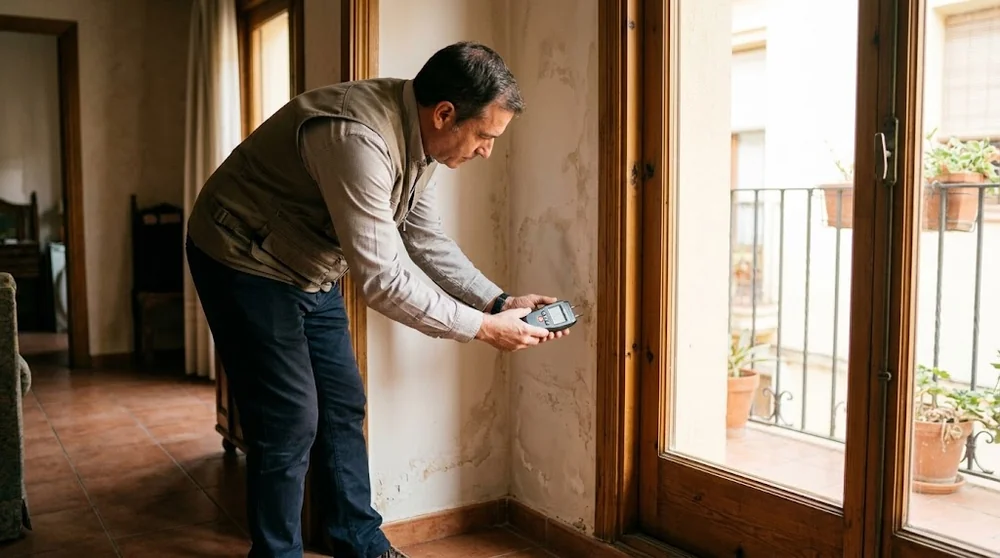
A viewing is your chance to collect questions for the professionals, not to reach conclusions. Go more than once, photograph anything that bothers you and, if you can, return at a different time of day and after rain. A sunny August viewing in Marbella tells you remarkably little about how a north-facing bedroom feels in February, and as a Mancunian I can confirm that Spain has damp too; it is simply better at hiding it under fresh paint.
Structure and envelope
- Cracks in walls and ceilings, around door and window openings and where an older section meets a newer one; note their location and pattern rather than trying to judge them.
- Freshly painted patches on a single wall or ceiling, which may be cosmetic or may cover damp or cracking.
- The roof as seen from the ground or a safe window: slipped tiles, sagging lines and stained eaves.
- Terraces and flat roofs showing standing water, lifted tiles, blocked outlets or staining on the ceiling below.
- Doors and windows that stick, which can follow movement, poor fitting or simple swelling.
Water and drainage
Use your nose as well as your eyes. Musty smells, tide marks, white salt deposits and mould behind wardrobes all deserve a note, whether the cause turns out to be condensation, a leak or water rising from the ground; telling those apart is the inspector’s job. Run two taps at once to get a feel for water pressure, ask how long hot water takes to arrive and find out the age and type of the water heater. On rural plots, ask whether the house is connected to mains drainage or relies on a septic tank, and look at whether the garden slopes towards the walls.
Electrical installations and climate control
Ask how old the electrical installation is and whether an installation certificate exists. Check that air-conditioning and heat-pump units actually run, and for apartments ask whether external units on the façade were authorised by the community. Note any flickering lights or tripping you notice, but do not open the distribution board, remove socket covers or test the installation yourself; that work belongs to a qualified installer.
Daily comfort and included fixtures
- Noise from roads, bars, pool pumps, lifts and neighbours at different times of day and week.
- Ventilation in bathrooms and the kitchen, and signs of condensation on windows.
- Persianas (roller shutters) and mosquito screens that open, close and lock.
- Which furniture, appliances and air-conditioning units are included, recorded in writing in the contract.
- Orientation, sun and shade in summer and winter.
A word on safety. Do not climb onto pitched or fragile roofs, step onto unguarded terraces, open electrical equipment or tap walls to decide whether they are load-bearing. Tapping tells you nothing reliable about structural safety, and an ill-judged ladder can turn a pleasant viewing into an afternoon in urgencias. Your role is to observe and record; the qualified professional diagnoses.
Nota Simple, Catastro and Planning Documents
The physical property and the paperwork have to tell the same story. In Spain that story is spread across offices that do not always talk to each other. The Registro de la Propiedad (Land Registry) records ownership and charges. The Catastro is a tax database describing location, physical features and cadastral value, identified by a referencia catastral. The Ayuntamiento (town hall), through its urbanismo (planning) department, holds licences and planning status.
| Document | Issuer | Question answered | Limitation | Reviewer |
|---|---|---|---|---|
| Nota simple (current registry information) | Registro de la Propiedad | Who is the registered owner, and are there mortgages, embargoes or other charges? | Informative only; a registry certification is the evidential version, and neither is a technical or planning clearance | Your lawyer |
| Title deed (escritura) | Notary, then registered | How did the seller acquire the property, and how was it described? | The description may be old or incomplete | Your lawyer |
| Seller authority | Notarial records, registry, Mercantile Registry for companies | Can this person or company lawfully sign the sale? | Powers can be limited or revoked; every co-owner must consent | Your lawyer |
| Catastro record and referencia catastral | Dirección General del Catastro | What does the tax record show for location, built area and use? | Cadastral inclusion does not prove lawful authorisation | Lawyer and inspector |
| Plans and building permits | Ayuntamiento (urbanismo) | Were the house, extensions, pool and outbuildings authorised? | Archives can be incomplete; works may exceed what was permitted | Lawyer, with an architect where needed |
| Occupation or habitation evidence | Ayuntamiento or regional authority | Has the building been authorised for occupation as a dwelling? | Names, requirements and formats vary by region and period | Your lawyer |
| Certificado de Eficiencia Energética | Certifying technician, registered with the regional body | What is the energy rating? | Says nothing about defects | You and your inspector |
| IBI receipts | Ayuntamiento or its tax collection agency | Is the municipal property tax paid, and what does it cost each year? | An IBI bill does not establish planning legality | Your lawyer |
Occupation evidence deserves particular care. Depending on the region and the age of the building, it may be a licencia de primera ocupación (first occupation licence), a declaración responsable submitted to the town hall, or a cédula de habitabilidad (habitation certificate), so ask your lawyer which document applies locally rather than hunting for one specific piece of paper. On energy certification, as of October 2026, the current consolidated national rules in Royal Decree 390/2021 on the BOE, including an amendment effective in July 2026, set a maximum validity of ten years, reduced to five years for properties rated G.
Then reconcile everything with what you saw: plot size, built and usable areas, boundaries, the number of bedrooms and bathrooms, parking spaces, trasteros (storage rooms), terraces, pools and extensions. A discrepancy between the property and its records requires investigation, not an automatic verdict of illegality. Cadastral areas are often measured differently, and old deeds can be vague. But a terrace enclosed as a living room, or a casita that appears on no record at all, needs checking with planning. Equally, registration, cadastral inclusion or an IBI bill does not prove planning legality. Always ask for the nota simple before you commit, make sure it is current rather than the faded copy in the agent’s folder, and have your lawyer refresh the relevant searches shortly before completion.
Apartments: Community Debts, ITE and Derramas
When you buy an apartment, you buy a share of a building as well as the flat itself. Every owner belongs to the Comunidad de Propietarios (owners’ community), which maintains roofs, façades, lifts, garages, pools and gardens and divides the costs among owners. Ask your inspector to look at whatever common elements are accessible, because a pristine kitchen does not help much if the building’s roof membrane has given up.
From the community’s administrator or secretary, request a certificate of debts for the flat, the most recent approved accounts and budget, the reserve-fund position, the building insurance policy and the minutes (actas) of recent general meetings. Ask too for any ITE or IEE report and any remedial orders from the town hall. Minutes are where the truth tends to live: arguments about leaks, quotes for façade repairs and plans to install a lift all leave a paper trail.
Separate three things clearly. Existing arrears are sums the seller already owes. An approved derrama is an extraordinary levy the community has agreed, often payable in instalments over months or years. Proposed works are discussed but not yet approved. Your contract should state who pays each instalment of an approved derrama, including those falling due after completion, because without that clause you and the seller have nothing agreed between yourselves.
Here’s where people usually come unstuck, though: that clause binds you and the seller, not necessarily the community. As of October 2026, Article 17.11 of the national Horizontal Property Law says that levies for improvement works are payable by whoever owns the flat when each amount becomes due. So if an instalment falls due after completion, the community can normally ask you, the new owner, for it, even if the seller agreed to pay. Your lawyer should therefore turn the private clause into something enforceable: a reimbursement obligation, a sum retained from the price at the notary, or simply a price reduction. Regional civil law can change the picture, so that check needs to be done for the specific building.
As of October 2026, Article 9.1(e) of the national Horizontal Property Law (Ley 49/1960) on the BOE makes the flat answerable for community arrears attributable to the year of acquisition and the three previous calendar years, and requires the debt certificate to be issued within seven calendar days of the request. That national rule does not apply everywhere: Catalonia regulates horizontal property in its own Civil Code, so purchases in Barcelona and elsewhere in Catalonia need the Catalan regime verified separately. Inspection rules for buildings also vary, and there is no single nationwide age or interval at which every Spanish building must pass an ITE; your lawyer or inspector should confirm what the region and municipality actually require.
My view: on resale apartments, I would rather read three years of meeting minutes than look at thirty photographs of the living room. The photographs show you the flat; the minutes show you the building’s future bills.
Regional Rules, Coastal Risks and Intended Use
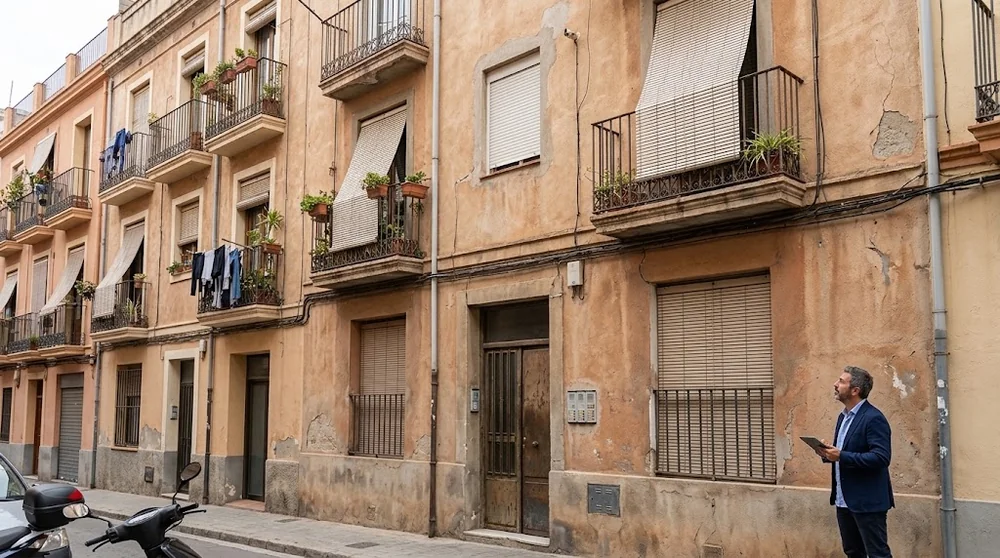
Spain has national laws, seventeen autonomous communities and thousands of municipalities, and property rules sit across all three levels. A checklist that works perfectly in one town can miss the point entirely in another, so treat the examples below as prompts for local enquiry rather than as the law of each place.
Regional documents and planning status
In Barcelona, the cédula de habitabilidad and the Catalan civil-law framework need checking alongside the city’s own building inspection requirements. In Madrid, municipal rules on building evaluation and the city’s licensing records are the starting point. In Valencia and Alicante, Valencian regional law governs occupation documents and land classification, which matters on inland rural plots. On the Costa del Sol, Andalusian rules apply in Malaga and Marbella, and Marbella’s planning history, including the court annulment of its 2010 general plan, means local planning status deserves particular care. Mallorca brings Balearic rules on rustic land and habitation certificates, while Tenerife falls under Canary Islands planning and tourism legislation. In every case, ask your lawyer to confirm the occupation-document terminology, the planning status and the applicable ITE or IEE rules locally.
Andalusia also uses a status called asimilado a fuera de ordenación (AFO). It applies to qualifying completed buildings that were built irregularly but for which the period the authorities had to take planning-restoration action has expired. AFO is not a legalisation certificate, and it is not blanket immunity either: it does not override other proceedings, such as criminal cases, and it does not stop the courts issuing or enforcing judgments, including demolition orders. AFO status can also restrict the works you may carry out and may affect utilities, finance, insurance and resale, so its practical consequences need explaining property by property.
Coastal and environmental checks
The Sistema Nacional de Cartografía de Zonas Inundables (SNCZI), Spain’s national flood-zone mapping system published by the Ministry for the Ecological Transition (MITECO), is a useful starting point. MITECO itself cautions that the mapping is incomplete, so the absence of a mapped flood zone does not establish that a property is safe from flooding. Ask your inspector about surface drainage, nearby dry riverbeds, retaining walls on sloping plots and signs of past water damage. Near the sea, the Ley de Costas (Coastal Law) can place land within the public maritime-terrestrial domain or its protection easements, which restricts works; your lawyer should check the official coastal demarcation. Rural properties also need verified legal access, not just a track everyone has always used. Before committing, ask an insurer about flood and storm cover; Spain’s Consorcio de Compensación de Seguros covers certain extraordinary events through ordinary policies, but terms and exclusions still matter.
Foreign-buyer and rental-use checks
If you plan to let the property, check rental permissions independently with the regional register and the town hall. A holiday-let registration or licence does not transfer automatically with the property, and some areas restrict new registrations. In buildings governed by the national Horizontal Property Law, a change that took effect on 3 April 2025 means that, as of October 2026, a new tourist let in an apartment needs the community’s express prior approval, voted by three-fifths of the owners who also represent three-fifths of the participation quotas. Lets already operating lawfully before that date may fall under transitional provisions, and Catalonia applies its own regime, so your lawyer should confirm how the rules apply to your building. Since Brexit, British buyers are non-EU nationals: owning a Spanish property does not in itself give you any right to live in Spain, and residence needs separate specialist advice. Finally, as of October 2026, Law 8/1975 restricts acquisitions by foreign nationals in designated defence-interest areas, so affected British and other non-EU buyers need a plot-level check for any required military authorisation.

Inspection Costs, Timelines and Repair Exposure
Inspection fees depend on scope, so ask for a written quotation rather than a figure over the phone. The main price drivers are the property’s size and type, the plot, any pool or outbuildings, shared areas to be inspected, travel time, report depth and specialist tests such as thermal imaging or drainage surveys. There is no official national tariff, and any range you see quoted online describes one firm’s scope, not a market standard. Get two or three written quotations for the same scope and compare like with like. As of October 2026, VAT on professional services is generally charged at 21% on the mainland and in the Balearics, while the Canary Islands apply IGIC instead, so check how tax is shown on any quote.
Keep separate budget lines for each type of cost: the inspection, the bank’s valuation if you take a mortgage, legal fees, purchase taxes, repairs and running costs. Purchase taxes depend on the region and on whether the property is new or resale, so get a written estimate from your lawyer or tax adviser rather than relying on a headline percentage. For running costs, ask for actual records instead of the agent’s estimate: recent IBI receipts, the community fee and any approved derrama, and twelve months of electricity and water bills where available. A villa with a large garden and pool can surprise you in July.
Once inspection, legal fees, taxes and realistic running costs are on the table, it often becomes clearer which areas and property types genuinely fit your budget and buying goals.
Bear the completion-day mechanics in mind as well. As of October 2026, Spanish Tax Agency (AEAT) guidance requires the purchaser to withhold 3% of the price when the seller is not tax resident in Spain and to pay it using Modelo 211 within one month of the transfer. That withholding is part of the price, not an extra tax for the buyer, and it turns on tax residence rather than nationality, so a British seller living in Spain may not be affected. There is no nationwide deadline for receiving a survey report: agree the access date, report delivery date and a window for follow-up questions in writing, and make sure they fit inside any contract deadline.
Inspection Findings and Your Arras Contract
A report is only useful if it changes what you do next. The table below maps common findings to the evidence, specialist and contractual action they usually call for.
| Finding | Additional evidence | Responsible specialist | Proposed action |
|---|---|---|---|
| Damp of unknown origin | Moisture mapping, drainage or plumbing checks, repair history | Arquitecto técnico, plumber or waterproofing specialist | Diagnose the cause, obtain repair quotations, then negotiate repairs or price |
| Suspected structural movement | Structural assessment, monitoring, any previous reports | Structural engineer | Postpone binding commitment until the specialist reports |
| Undocumented extension or pool | Town hall licence search, planning status, historic imagery | Lawyer, with an architect | Seek explanation, regularisation evidence or a price and risk decision |
| Approved or proposed community works | Meeting minutes, quotes, derrama schedule, ITE/IEE orders | Lawyer and community administrator | Allocate payments in the contract, secure reimbursement or retention, or adjust the price |
| Uncertain permitted use | Licence status, regional register, community statutes | Lawyer | Obtain written confirmation or decide whether to proceed on that basis |
The contract is where findings become protection. If you must sign something before the inspection, ask your lawyer to negotiate access for the inspector, a reporting deadline, objective criteria for what counts as an adverse finding, and clear refund consequences if those criteria are met. Add a finance condition if you need a mortgage, written repair commitments with a specification, and a reinspection before completion. No buyer has an automatic right to withdraw and recover a deposit simply because an inspection found problems; refunds and withdrawal depend on what the agreement says and the applicable law. Article 1454 of the Spanish Civil Code on the BOE, for example, lets a buyer withdraw by forfeiting the deposit, and a seller by returning double, only where the parties have agreed that penitential framework.
Hypothetical scenario: a coastal villa. Imagine buyers viewing a resale villa near Mijas. The survey records high moisture readings in a lower-ground bedroom, and the glazed porch and a garden casita appear in neither the Catastro record nor the licence file. The sensible response would be a drainage and waterproofing investigation, a planning search by the lawyer and a written decision on price, repairs or withdrawal under agreed terms before any unconditional deposit changes hands.
Hypothetical scenario: an apartment facing building works. Now imagine an older apartment in Alicante where the minutes show the community discussing façade repairs required by an inspection report. Before signing arras, the buyer’s lawyer would request the report, quotations and any derrama schedule, then draft a clause allocating approved and future instalments, backed by a retention or price adjustment in case the community bills the new owner.
If you have a reservation or arras draft in front of you and want to talk through how inspection deadlines and conditions might work for your particular purchase, a short one-to-one conversation can help you prepare the right questions for your lawyer.
Whatever is agreed, put it in writing with dates, and do not accept an informal promise that the seller will sort out a problem after completion. Spoken assurances have a habit of evaporating once the keys change hands.
New Builds, Snagging and Hidden Defects
New-build inspection is different from inspecting an older home. Snagging means checking a newly completed property for defects and unfinished work, such as cracked tiles, poorly sealed windows, faulty drainage falls or air conditioning that never quite cools. Ask for the completion documents, including the occupation evidence applicable in that region, the final works certificate, the building’s user and maintenance documentation and details of guarantees and insurance. Test systems where safe, inspect shared areas such as garages and pools, and record follow-up evidence with dated photographs and written acknowledgements from the developer.
As of October 2026, Articles 17 and 18 of the Ley de Ordenación de la Edificación (LOE) on the BOE, Spain’s Building Act, distinguish liability periods of one year for finishing defects, three years for habitability defects and ten years for structural defects. Those periods run from acceptance of the works without reservations or, where reservations were recorded, from the date those reservations were corrected. Under Article 6, acceptance can also happen tacitly if the developer does not formally accept or object within the legal period. So ask the developer for the acceptance record (acta de recepción) and any record showing when reservations were corrected; without them, nobody can tell you when your clock started. A separate two-year period applies for bringing the relevant claims after the damage appears. The LOE clock does not restart when a later buyer purchases the property. Insurance cover also varies with the type of project and its exceptions, so verify what actually exists rather than assuming a policy covers everything.
Where the national Civil Code regime applies, the hidden-defect actions in Article 1490 must be brought within six months of delivery, although that deadline applies to those specific actions rather than every possible claim. Regional civil law can provide different rules and periods; Catalonia, for example, has its own conformity remedies for sales. Ask your lawyer to identify which regime governs your purchase before anyone calculates a deadline. Post-purchase remedies are slow, uncertain and dependent on evidence, which is exactly why they are no substitute for inspection. If you discover a defect, take prompt legal and technical advice.
My view: a new build’s guarantees are a safety net, not a reason to skip snagging. It is far easier to get a developer to fix something before completion than to argue about it a year later.
Property Inspection in Spain: Frequently Asked Questions
Do I need a survey to buy property in Spain?
An independent pre-purchase building survey is generally optional in Spain, but it can be valuable for any buyer and particularly for older, altered, rural or complex properties. Mandatory building inspections may apply separately. A mortgage valuation, energy certificate or recent refurbishment does not establish that the home is free from defects.
Who can carry out a property inspection in Spain?
Buyers commonly commission a suitably qualified arquitecto técnico, also known as an aparejador, or an architect with relevant inspection experience. Suspected structural problems may require a specialist engineer. Confirm professional credentials, insurance, independence and the written scope. Your lawyer handles title, contractual and planning-law questions alongside the technical professional.
What documents should I check before buying property in Spain?
Request current registry information, the seller’s deed and authority to sell, cadastral details, relevant plans and permits, applicable occupation or habitation evidence, the energy certificate and IBI records. For apartments, add community debt evidence, accounts, meeting minutes and building inspection reports. Have specialists compare those records with the actual property and intended use, as requirements vary locally.
How much does a property survey in Spain cost?
There is no single nationwide survey tariff. The quotation depends on the property’s size, location, age, complexity and the agreed inspection depth, including pools, land or specialist testing. Ask for a written price stating VAT, travel, report contents and exclusions. Compare equivalent scopes rather than choosing solely by the lowest headline fee.
Should I get a survey before signing an arras contract?
Arrange the survey and legal review before making an unconditional contractual commitment whenever possible. If the seller requires an earlier reservation or deposit, ask your lawyer to negotiate inspection access, deadlines and clear consequences for adverse findings. A survey condition or refund right is not automatic merely because you intend to inspect later.
What happens if an inspection finds defects?
Ask the inspector to explain the defect’s seriousness, investigation needs and repair implications. Your lawyer should assess any related planning or contractual issue. Depending on the evidence and agreed terms, you may seek repairs, renegotiate, postpone or withdraw. Obtain written remedies and verify completion; do not rely on an informal promise or assume a deposit is refundable.
Conclusion
Before you sign anything binding, you should be able to say yes to six points: the property and seller are clearly identified; the technical inspection has been completed within an agreed written scope; legal and planning findings have been answered in writing; inspection, legal, tax, repair and running costs are understood; your intended use, including any letting, has been checked; and the contract protects you with clear deadlines and conditions.
Any unresolved material issue justifies pausing for specialist advice, however keen the agent is to fix a date. Ten years on the Costa del Sol have taught me that the buyers who wait a fortnight for a proper answer rarely regret it, while the ones who sign first and ask later often do. My advice to every British buyer is simple: send the property’s documents and your inspector’s report to your independent lawyer and ask for a written list of outstanding points before you sign.
This article is general information as of October 2026 and does not replace property-specific legal, tax or technical advice from qualified professionals.