
Buying off-plan in Spain can get you a brand-new home, a better choice of unit and a payment plan spread over the build. It also means handing over real money for something that, on the day you sign, may be little more than a hole in the ground and a very glossy brochure. I’m David, a Mancunian who moved to Marbella over ten years ago, and these are the ten questions British buyers ask me most often, answered as plainly as I can.
Buying off-plan in Spain means agreeing to purchase a home before it is completed and usually paying the developer in stages. Before committing, check the building licence, contract and protection for advance payments with an independent Spanish lawyer. Budget for taxes and completion costs, and confirm the delivery date and occupation requirements.
1. How does buying off-plan in Spain work?
Buying off-plan in Spain means signing a contract to buy a home from a developer before construction is finished, paying part of the price in advance and the balance when the public deed is signed. You choose a unit from plans, a show flat or a model, and you take legal ownership only at completion. Until then, you hold contractual rights against the developer and, if the conditions are met, statutory protection for your advance payments.
One distinction matters from day one. A sales brochure may say “delivery spring 2028”, but the date that counts legally is the delivery date written into your private purchase contract, together with any extension the contract permits. A marketing estimate is a hope; a contractual deadline is something your lawyer can enforce.
A typical sequence looks like this, although every development sets its own order and timings:
- Shortlist and reservation. You choose a unit and may pay a reservation fee to take it off the market. Decision point: do not pay until you know who receives the money and in what circumstances it is refundable.
- NIE and independent lawyer. You obtain a foreigner identification number (NIE) and instruct a Spanish lawyer who is independent of the developer and the agent.
- Due diligence. Your lawyer checks the land registry extract (nota simple), the building licence (licencia de obra), plans, the specification sheet (memoria de calidades) and the draft contract. Decision point: proceed, renegotiate or walk away.
- Private purchase contract. You sign the contract and pay the first contractual instalment, normally into a special account, and you should receive individual guarantee documentation for your advances.
- Staged payments during construction. You pay further instalments according to the contract, keeping every receipt.
- End of works and occupation paperwork. The architect signs the final works certificate and the developer obtains the first occupation licence or the documentation the local rules require instead.
- Snagging and notarial deed. You inspect the home, sign the public deed (escritura) before a notary and pay the balance and taxes.
- Registration and utilities. The deed is registered at the Land Registry, and water, electricity and other supplies are put into your name.
In my own experience, many off-plan purchases take somewhere between 18 months and three years from reservation to keys. Treat that as an illustrative observation that varies by project and location, not a market norm; your contract sets the actual timetable.

2. Is buying off-plan in Spain safe?
Buying off-plan in Spain can be done safely, but it is never risk-free, and independent legal checks reduce the risk rather than remove it. Let me put it plainly: most of the horror stories British buyers tell over a pint involve money paid before anyone checked the paperwork.
The main risks are these:
- Developer insolvency: the company runs out of money and the project stalls or is sold on.
- Delay: works run well past the contractual delivery date.
- Unlicensed or non-compliant construction: building starts, or is marketed, without a valid licence, or the finished home does not match what was licensed.
- Financing failure: your mortgage is refused near completion, or the developer’s own finance collapses.
- Specification changes: materials, layouts or communal facilities differ from what you were sold.
- Hidden charges: debts or mortgages registered against the land that are not dealt with at completion.
The pre-licence question nobody asks
Here’s where people usually come unstuck: the reservation. Under Ley 38/1999 de Ordenación de la Edificación, the developer’s duty to guarantee the return of advance payments runs from the grant of the building licence (as of October 2026). A reservation paid before the licence is granted does not automatically enjoy the statutory guarantee. It may still be protected by the contract, by a voluntary guarantee or by other legal remedies, but that depends on the documents and the facts. Before you sign or pay anything, work through these questions with your lawyer:
- Has the building licence been granted? If yes, ask for a copy and check it covers your block and unit.
- If not, who receives the reservation money: the developer, the agent or a client account, and is it held separately?
- What exactly makes the reservation refundable: a failed legal check, a mortgage refusal, no licence by a set date?
- What written protection exists for this payment now, and what will exist once the licence arrives?
- The safest course is to wait until the licence is granted and appropriate protection is in place. If you still consider paying earlier, have an independent lawyer assess the arrangement and the potential loss first, and only pay an amount you could afford to lose: a small payment is not necessarily a protected one.
3. How much deposit and cash will I need?
There is no national deposit percentage for off-plan purchases in Spain; the reservation amount and every instalment are set by the developer’s contract, not by law. In the developments I see, many ask for somewhere between a fifth and a half of the price before completion. That is an illustrative observation that varies by project and location, not a norm, so model your own figures from the actual contract.
The table below uses an entirely hypothetical €300,000 mainland home where the developer requires 30% before completion. The €5,000 reservation is credited towards that 30%, so it is counted once. It assumes the 10% IVA rate for a qualifying new residential home (as of October 2026). It also assumes that the reservation is an advance payment towards the taxable purchase price, received by the developer under terms that trigger IVA at that stage. A refundable reservation, or one held by an agent or other intermediary, may be treated differently and needs its own tax analysis.
| Stage (hypothetical) | Price paid | IVA at assumed 10% | Cash out |
|---|---|---|---|
| Reservation (assumed advance on the price, credited to it) | €5,000 | €500 | €5,500 |
| Private contract and construction instalments (to reach 30%) | €85,000 | €8,500 | €93,500 |
| Subtotal paid before completion | €90,000 | €9,000 | €99,000 |
| Balance at the notarial deed | €210,000 | €21,000 | €231,000 |
| Total price plus IVA | €300,000 | €30,000 | €330,000 |
| AJD stamp duty on the deed (assumption) | Assumes a €300,000 taxable base and Andalusia’s general rate of 1.2% (as of October 2026); have the actual base and any relief checked | €3,600 | |
| Contingency reserve (hypothetical) | Illustrative 3% of the price for currency swings, furniture and delays; not a prescribed percentage | €9,000 | |
| Total cash target (hypothetical) | Price plus IVA, AJD example and reserve | €342,600 | |
| Independent lawyer | Not included above; agree a written fee quote before instructing | ||
| Notary and Land Registry | Not included above; regulated fees that depend on the price and the documents | ||
| Mortgage costs (valuation, bank fees, possible broker) | Not included above; only if you borrow | ||
So the honest headline for this example is a cash target of around €342,600 before legal, notary, registry and any mortgage costs, not €300,000. The reserve is my illustration, not a rule; size yours to your own exposure to currency movements and delay.
On tax timing: under Spanish VAT rules, IVA generally becomes due on advance payments as they are made, so each instalment usually carries its own IVA, as shown above. That is the general position; your lawyer or tax adviser should confirm the treatment for your transaction, including the reservation, before you transfer money. AJD, by contrast, is normally paid after the deed is signed. My advice to every British buyer is to put this table into a spreadsheet with your own dates next to each row, so you can see exactly when sterling needs to become euros.
4. What does an off-plan bank guarantee cover?
An off-plan bank guarantee is a document by which a bank or insurer undertakes to return a buyer’s qualifying advance payments, plus applicable taxes and legal interest, if the home is not started or not completed and delivered within the agreed period. The rules sit in the first additional provision of Ley 38/1999, as amended (as of October 2026), and you can read the consolidated text on the official BOE page for Ley 38/1999.
In outline, the law expresses the developer’s duty to guarantee repayment as running from the grant of the building licence: from that point, a developer that collects money from buyers for housing under construction must guarantee its return through either a joint bank guarantee (aval bancario) or a surety insurance policy (seguro de caución). Separately, the law requires advances covered by the provision to be received through a credit institution into a special account (cuenta especial) kept apart from the developer’s other funds. It also requires the developer to give each buyer a document showing the guarantee for the specific amounts that buyer will advance. If any money is being asked for before the licence, have your lawyer assess that arrangement on its own terms rather than assuming these protections already apply.
An aval is issued by a bank and makes the bank jointly liable for repayment. A seguro de caución is an insurance policy under which an authorised insurer pays the buyer. Both are permitted; the difference lies in who you claim against and the claim procedure in the policy or guarantee wording.
| Document | What it shows | What it does not prove | What to check |
|---|---|---|---|
| Collective project guarantee (master policy or line of guarantees) | That a bank or insurer has recorded an arrangement for the development; its existence and wording still need checking | On its own, that any specific buyer or payment is covered | Guarantor name, maximum amount, development and licence details, and how individual cover is issued under it |
| Individual certificate | Cover linked to you, your unit and the amounts you will advance | That repayment will be automatic or trouble-free | Your name, unit, amounts, taxes, interest, delivery period and guarantor |
| Special account details | Where advances must be paid, separate from the developer’s other funds | That the guarantee exists or is valid | Account holder, bank, and that it matches the contract |
| Proof of each payment | That you paid a specific amount on a specific date | That the payment is covered | Transfer receipts quoting the unit and contract, paid into the special account |
An individual certificate is strong evidence of protection, but it is not proof that recovery is guaranteed, because any claim still depends on the legal conditions, the guarantee wording and the facts. If you have paid into a development and never received your individual certificate, pause further payments and speak to an independent lawyer before sending another euro. Its absence does not necessarily wipe out every remedy. Spanish courts have, in some cases, held the receiving bank responsible where it accepted advances without requiring the guarantee, but whether that applies depends heavily on the facts.
5. What should I check before signing?
Before signing either a reservation or a private contract, an independent Spanish lawyer should check the developer, the land, the licence and every page of the contract. Ten years on the Costa del Sol have taught me that the best time to find a problem is before you are emotionally attached to the sea view. Always ask for the nota simple before you commit.
- Developer identity and authority: the correct company name and tax number, and proof that the signatory has power to sign for it.
- Nota simple: who owns the land, and any mortgages, embargoes or other charges registered against it.
- Building licence and planning status: a copy of the licence covering your block, plus any conditions or pending appeals.
- Project plans: the licensed plans for your unit, block and communal areas, not just the brochure drawings.
- Memoria de calidades: the specification sheet attached to the contract, listing materials, kitchen, windows and air conditioning.
- Unit details: built and usable area, terraces, parking space and storage room, each identified clearly.
- Price and tax: whether the price is stated with or without IVA, and what is included.
- Payment triggers: what event triggers each instalment and which special account receives it.
- Refund terms: when the reservation and later advances are returned, and within what period.
- Delivery date: a firm contractual date, any permitted extension and its limits.
- Permitted changes: what the developer may alter without your consent, and your rights if changes are significant.
- Guarantee documents: the collective guarantee and the commitment to issue your individual guarantee documentation.
Ask your lawyer to report on each item in writing before the reservation and again before the private contract, because drafts have a habit of changing between the two.

6. What are the taxes and extra costs?
A qualifying first sale of a new home by a developer in mainland Spain or the Balearic Islands generally attracts IVA at 10% (as of October 2026), plus regional stamp duty (AJD) on the deed. The Agencia Tributaria sets the IVA rules, while each region sets its own AJD rate and reliefs; the Agencia Tributaria’s IVA section is the official starting point for IVA questions.
Several exceptions matter. Certain officially protected housing can carry a lower IVA rate, and a garage or storage room is generally treated with the home only when sold together with it under the applicable conditions. A home that has already been used or rented may not count as a first delivery at all. A resale between private individuals usually pays regional transfer tax (ITP) instead of IVA and AJD.
| Situation | Main purchase tax | Deed tax | Notes |
|---|---|---|---|
| New home, mainland Spain or Balearics, first delivery by developer | IVA, generally 10% (as of October 2026) | AJD, rate set by the region | Andalusia’s general AJD rate is 1.2% (as of October 2026) |
| New home, Canary Islands such as Tenerife | IGIC instead of mainland IVA | Regional deed tax, check locally | Rate and exemptions must be verified for the transaction |
| Typical resale between individuals | ITP, rate set by the region | Usually no separate AJD on the transfer | Andalusia’s general ITP rate is 7% (as of October 2026) |
| Professional and other costs (any purchase) | Lawyer, notary, Land Registry, possible valuation and bank fees, currency transfer costs | ||
A word on Tenerife and the other islands: the Canary Islands use their own indirect tax, IGIC, rather than mainland IVA. Do not copy a mainland calculation into a Canary Islands budget. Ask a local tax adviser to confirm the IGIC rate, any exemption and the deed tax for your specific purchase. Regional reliefs for young buyers or large families exist in some places, but they generally depend on residence and other conditions that many non-resident British buyers will not meet.
7. Can British buyers get a mortgage?
British buyers can apply for Spanish mortgages as non-residents, but a lender usually makes its binding decision close to completion, long after most off-plan advances have been paid. That timing gap is the single biggest cash-flow trap in off-plan buying, so it deserves careful thought.
A preliminary affordability check, sometimes called an approval in principle, tells you roughly what a bank might lend today. It is not a binding offer. The bank will normally carry out its formal valuation and full underwriting near the end of the build, when it can value a finished home, and the amount and conditions can change if your income, the exchange rate, the bank’s policy or the valuation change. In the hypothetical example above, you would have paid €99,000 including IVA before any mortgage money arrived. If the final finance falls short, you still owe the balance. Lenders set their own loan-to-value limits for non-residents, so treat any percentage quoted at a property show as a starting point, not a promise. The Banco de España’s bank customer portal explains the pre-contractual information Spanish lenders must give borrowers.
Currency is the other quiet risk. If your savings and income are in pounds, a weaker pound between reservation and completion makes every euro instalment more expensive. Some buyers fix part of their exchange through a regulated currency provider; whatever you choose, build a buffer into your contingency.
Paperwork-wise, you will need an NIE before signing the deed and opening most Spanish bank accounts. If you cannot travel for each signature, a power of attorney lets your lawyer sign on your behalf. A Spanish notarial power can be arranged in Spain; one executed in the UK or elsewhere may need an apostille and an official translation, depending on the document and the country. Have your Spanish lawyer confirm the exact formalities before you sign anything, and give the power only to someone independent, limited in scope.
Finally, remember that buying and staying are separate questions. Owning a Spanish home gives you property rights, not residence rights. British visitors without Spanish residence can generally stay in the Schengen area for up to 90 days in any 180-day period without a visa (as of October 2026); the UK government’s Spain entry requirements page sets out the current rules. Spain’s property-investment “golden visa” route closed to new applications in April 2025, so a purchase no longer opens that door. Some areas of strategic defence interest can also require military authorisation for buyers from outside the EU, which your lawyer should check against the exact location before you commit.
A quick checklist for British buyers
- Stay limit: without Spanish residence, plan visits within 90 days in any 180-day period across the Schengen area (as of October 2026); the home itself gives no right to stay longer.
- Military authorisation: ask your lawyer whether the plot sits in an area of defence interest that requires authorisation for non-EU buyers.
- Mortgage timing: assume the binding offer comes near completion, and make sure you could pay every advance and its IVA without it.
- Sterling-to-euro exposure: map each instalment date against your currency plan and keep a buffer for a weaker pound.
- Canary Islands tax: if you are buying on the islands, budget with IGIC and the local deed tax, not mainland IVA and AJD.
None of these replaces specialist advice: your lawyer handles the legal checks, a mortgage broker or bank the finance, and a tax adviser the tax position for your purchase.
8. What if the developer is late or insolvent?
If an off-plan development in Spain runs late, your options depend on the contractual delivery date, any valid extension, the guarantee documents and how quickly you act. Delay and insolvency are different problems, and neither produces an automatic refund. Here is a practical sequence:
- Check the deadline. Read the contract for the delivery date, any permitted extension and what counts as “delivery”. Many contracts allow a short grace period.
- Preserve evidence. Gather the contract, the memoria de calidades, every payment receipt, the individual guarantee certificate, the special account details and all correspondence, including emails and messages.
- Instruct an independent lawyer promptly. Ask for an assessment of whether the developer is in breach and what the realistic options are.
- Choose between termination and extension. Under Ley 38/1999, where the home is not completed within the agreed period, the buyer may generally choose to terminate with return of the advances plus legal interest, or to grant the developer an extension, which should be documented in a written addendum (as of October 2026).
- Make a formal demand. If you choose to terminate, your lawyer will normally send a formal, provable demand to the developer requiring termination and repayment of the advances.
- Assess a guarantor claim. The law provides that if the developer does not repay within 30 days of that formal demand, the buyer may claim against the insurer or the guarantor bank, provided the statutory conditions are met. It also permits a direct claim against the guarantor or insurer where a prior claim against the developer is not possible (as of October 2026). Your lawyer should assess the evidence and the right procedure for your case.
Timing matters. For a bank guarantee (aval bancario), the first additional provision of Ley 38/1999 expressly states that the guarantee lapses if two years pass from the developer’s breach of the guaranteed obligation without the buyer requiring the developer to terminate the contract and return the advance payments (as of October 2026). Surety insurance (seguro de caución) is governed by a separate set of provisions and by the policy itself, so if your protection is an insurance policy, do not assume the same lapse rule applies automatically; get legal advice on that policy’s conditions and deadlines. Either way, ask an independent lawyer to assess the guarantee, the starting date and the form and timing of the demand immediately, because a missed deadline can be expensive.
Insolvency adds another layer. A developer entering insolvency proceedings does not, by itself, trigger repayment, and the outcome depends on the contract, the guarantees and the court process.
If your development is running late or you are unsure what your guarantee documents actually cover, a short conversation about your timeline and paperwork can help you decide what to ask your lawyer.
I can talk you through the practical side and help you organise your documents, but the legal decision on termination or a claim belongs with your independent Spanish lawyer.
9. What happens at completion and snagging?
Completion of an off-plan purchase in Spain involves several separate steps, and the day you sign the deed is not necessarily the day the lights come on. It helps to keep each document and event distinct:
- Final works certificate: the project architect and site director certify that the building has been finished in accordance with the project.
- First occupation documentation: the licence, certificate, responsible declaration or other documentation required under the applicable regional and municipal rules; ask your lawyer to check its status and any conditions before completion.
- Public deed (escritura): signed before a notary, when you pay the balance and become the owner.
- Key handover: physical delivery of the home, usually at or just after the deed.
- Land Registry registration: the deed is registered to protect your ownership against third parties.
- Utility connection: supply contracts for water and electricity in your name; do not assume these are live on completion day. In my experience connections can take anything from days to several weeks, depending on the supplier and the location.
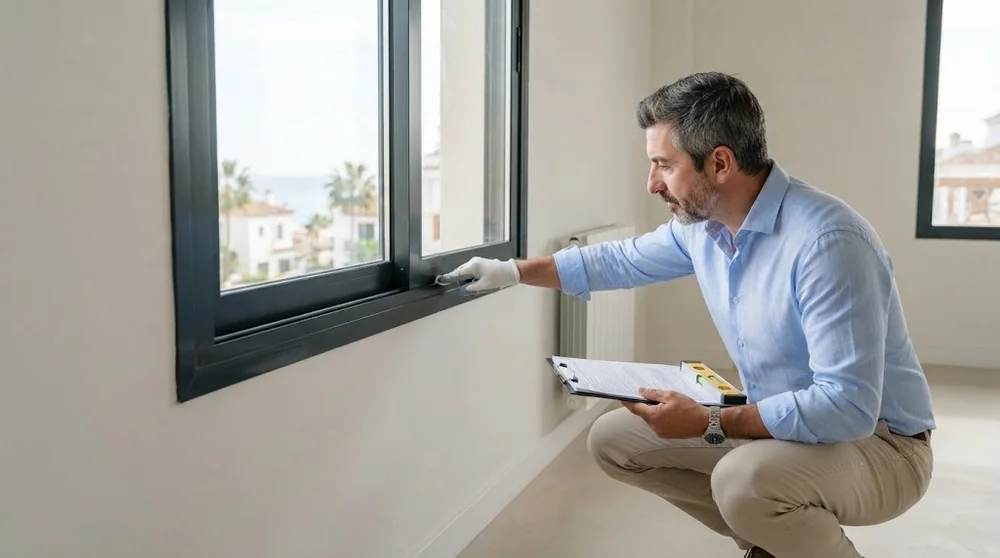
Arrange an independent inspection before the deed if the developer allows access, and certainly at handover. Produce a dated snagging list with photos, send it in writing and agree how and by when the developer will fix each item. Minor snags are normal in new builds; it is the unrecorded ones that get forgotten.
Your lawyer should also check what happens to the developer’s construction mortgage. That loan is often secured over the whole development and split between units. Unless you are deliberately taking over your share as your own mortgage, the developer’s charge over your home should be cancelled or discharged at the deed, with the paperwork to prove it.
Defects after you move in
Ley 38/1999 sets three statutory liability periods for building agents, measured from the reception of the works, which is the formal handover of the building from the builder to the developer and can predate your own completion (as of October 2026):
- One year for defects in finishes.
- Three years for defects affecting habitability, such as damp or poor insulation.
- Ten years for structural defects affecting stability.
These are the periods within which the damage must appear. The deadline for actually bringing a claim is a separate limitation period, generally two years from when the damage arises under the same law (as of October 2026), and it can be interrupted in some circumstances. If you spot a defect, see a lawyer promptly to establish your deadline and whether it has been interrupted. Ask, too, for the date of reception of works so you know how much time is actually left.
The advance-payment guarantee is separate from defect liability. Under Ley 38/1999, cancellation generally requires the relevant occupation certificate, first occupation licence or equivalent document and evidence that the home has been delivered; the law also addresses a buyer’s refusal to accept delivery once the conditions are met. Both are also separate from the ten-year structural insurance the law requires for new housing.
10. Is an off-plan home right for me?
An off-plan home suits buyers who value choice and a new build more than certainty and speed, and who can carry staged payments without relying on a mortgage that is not yet confirmed. The comparison below is a general guide; individual developments and transactions vary.
| Factor | Off-plan | Completed new-build | Resale |
|---|---|---|---|
| Certainty | Generally lower; you commit from plans and specifications | Generally greater certainty about the finished property | Generally greater certainty; you can see the home and neighbourhood as they are |
| Choice of unit and finishes | Potentially wider choice early in the sales process | Usually limited to remaining units | Whatever is on the market |
| Timing (illustrative) | Often 18 months to three years | Often months | Often months |
| Financing | Advances usually paid before final mortgage approval | Mortgage usually aligned with completion | Mortgage usually aligned with completion |
| Main tax | IVA or IGIC plus deed tax | IVA or IGIC plus deed tax | Usually regional ITP |
| Inspection | Full inspection usually possible near completion, subject to access | Usually possible before you commit | Usually possible before you commit, with a survey |
A simple go/no-go checklist before you reserve:
- Is the building licence granted, or do you fully understand the risk if it is not?
- Will you receive individual guarantee documentation covering all qualifying advance payments, applicable taxes and legal interest, and has your lawyer checked it covers the complete payment schedule?
- Has an independent lawyer reviewed the nota simple and contract?
- Can you pay all advances, taxes and a contingency without the mortgage?
- Can you live with the delivery date slipping by several months?
- Does the home fit your intended use: holidays, retirement or letting under local rules?
Here’s a hypothetical scenario. A retired couple from Cheshire compare a two-bedroom off-plan apartment near Estepona, due in two years, with a finished resale flat in Fuengirola. The off-plan unit offers a south-facing terrace and modern energy standards, but they would need to send roughly a third of their budget to Spain years before they can use it. The resale flat can be surveyed now, but needs a new kitchen. On tax, a typical resale in Andalusia may attract the general 7% ITP rate, while a qualifying new-build generally attracts 10% IVA plus AJD (as of October 2026); they should compare the actual tax bases and any applicable reliefs before deciding which purchase costs less. Neither answer is “right”; it depends on whether they value certainty or the new-build features more, and how comfortable they are with the wait.
That kind of side-by-side thinking is exactly where an honest shortlist helps, because the best development on paper is not always the best fit for your budget, region or plans.
If you would like to compare off-plan, new-build and resale options against your own budget, preferred area and reasons for buying, a short questionnaire is a sensible place to start.
I am happy to help you compare developments and ask the awkward questions on site, while your independent Spanish lawyer handles the legal review of anything you decide to pursue.
Frequently asked questions
Is it safe to buy off-plan property in Spain?
It can be, but never risk-free. The two questions that settle most of the risk are simple: has the building licence been granted, and will every payment go into a special account backed by an individual guarantee in your name? If either answer is unclear, do not pay yet. Ask an independent Spanish lawyer to confirm both in writing first.
How much deposit do you need for an off-plan property in Spain?
No law fixes the figure; each developer sets its own reservation and staged payments. Rather than asking for a percentage, ask for the full payment schedule with dates, add IVA to each instalment, and check you could pay all of it without your mortgage. Confirm in writing whether the reservation is credited to the price and when it is refundable.
What happens if an off-plan property in Spain is delayed?
Nothing happens automatically. Your first step is to compare the actual position with the delivery date and any extension in your contract. If the deadline has passed, you may be able to terminate and reclaim your advances with legal interest, or agree a new date in writing. Gather your receipts and guarantee documents and see a lawyer quickly, because time limits apply.
Can British citizens buy off-plan property in Spain after Brexit?
Yes, generally. Brexit changed how long you can stay, not whether you can buy. Without residence, visits are generally limited to 90 days in any 180-day period (as of October 2026), and a purchase no longer leads to a golden visa. Before reserving, ask your lawyer whether the location needs military authorisation for non-EU buyers.
What taxes do you pay on a new-build property in Spain?
On the mainland and in the Balearics, a qualifying first sale by a developer generally carries 10% IVA (as of October 2026), paid with each instalment, plus regional AJD on the deed. In the Canary Islands, budget with IGIC instead. Add lawyer, notary and registry fees on top, and ask a local tax adviser to confirm the figures for your purchase.
Conclusion
Buying off-plan in Spain can work very well for buyers who go in with their eyes open. The essentials are simple to say and easy to skip: check the building licence before you pay, insist on individual guarantee documentation covering all qualifying advance payments, applicable taxes and legal interest, paid into a special account, read the contract’s delivery date and refund terms, and budget for IVA or IGIC, deed tax, fees and a contingency on top of the headline price.
In my experience on the Costa del Sol, the buyers who sleep well during a two-year build are not the ones who found the cheapest unit; they are the ones who had an independent lawyer, a realistic cash plan that did not depend on an unconfirmed mortgage, and the patience to walk away from a development that could not answer straight questions. That is my opinion rather than a rule, but it is one I would give my own family.
If the licence, guarantees, timetable and numbers all line up for you, an off-plan home can be a lovely way to get exactly what you want; if any of them are wobbly, a completed new-build or a well-surveyed resale may suit you better, and there is no shame in choosing certainty. This article is general information based on rules verified as of October 2026, not personalised legal, tax or financial advice; laws, rates and regional procedures change, so please consult an independent Spanish property lawyer and a qualified tax adviser before making any decision.