
A viewing is your best chance to look properly before money and paperwork take over, yet most buyers spend it admiring the terrace and the light. I’m David, and I work with English-speaking buyers, many of them British families and retirees, who are purchasing property in Spain. Many of the problems that cause real trouble later were visible, or at least hinted at, on the first visit. This guide sets out ten warning signs, the question to ask about each one, the evidence that answers it, the independent specialist who should check it and the point at which you should proceed, renegotiate or stop.
Property viewing red flags in Spain include damp, suspicious cracks, unverified alterations, failing utilities, missing documents, unclear ownership, community debts, unresolved occupation, environmental risks and pressure to pay immediately. Record what you see, request supporting evidence and arrange independent legal or technical checks before signing or paying a deposit.
Property viewing red flags in Spain: the checklist
Most viewing checklists stop at “look for damp” or “check the paperwork”. That advice is fine as far as it goes, but it leaves you with an uneasy feeling and no plan. A warning sign during a viewing is a reason to investigate, not proof of a defect. The table below links each of the ten red flags to a specific question, the evidence that should answer it, the professional who should verify it, the next step to take and the threshold that should be met before you commit.
| Warning sign | Evidence or question | Who verifies it | Immediate next step | Proceed only when |
|---|---|---|---|---|
| 1. Damp, staining or patchy repainting | Repair history, invoices, previous reports | Independent technical professional | Photograph with permission; request a moisture assessment | Cause, remedy and cost are documented; renegotiate if repairs are needed, stop if the cause cannot be identified |
| 2. Cracks, distortion, tired shared structures | When did cracks appear? Any monitoring or reports? | Arquitecto técnico or structural engineer | Commission a condition survey with an agreed scope | A written survey explains the movement and the repair cost is known; stop if active structural movement is unresolved |
| 3. Extensions not matching records | Municipal permissions, nota simple, Catastro data | Property lawyer plus technical professional | Compare physical layout with every record | Legality is confirmed or regularisation is a written contract condition; stop if enforcement risk remains open |
| 4. Utilities failing or untestable | Recent bills, supply contracts, maintenance records | Surveyor, licensed installer, lawyer for rural supply | Ask for supplies to be connected for a second visit | Services have been demonstrated or inspected and any lawful rural supply is confirmed in writing |
| 5. Missing occupancy or energy papers | Which occupation document applies locally? | Lawyer, town hall or regional authority | Obtain written confirmation of local requirements | The applicable document exists or obtaining it is a written condition of the contract |
| 6. Unclear ownership or charges | Current nota simple, seller identity and authority | Independent property lawyer | Request registry extract before any payment | Every owner signs or is validly represented and charges have an agreed cancellation plan |
| 7. Community debts or derramas | Debt certificate, minutes, budget, approved works | Lawyer, community administrator | Agree written allocation of special assessments | A formal debt certificate is received and every approved instalment has an agreed payer |
| 8. Restricted access or unclear occupation | Who lives there, on what legal basis? | Independent property lawyer | Make vacant possession a written contract condition | You have seen every room and lawful occupation and handover are confirmed; pause until then |
| 9. Hidden location risks | Flood mapping, insurer questions, local enquiries | Lawyer, insurer, technical professional | Check official maps and revisit at different times | Insurance is available on acceptable terms and the site-specific risk is understood |
| 10. Pressure to pay immediately | Written terms, payment recipient, refund conditions | Independent property lawyer | Pause until the agreement has been reviewed | Your lawyer has reviewed the written terms and the recipient of the money; walk away if checks are refused |

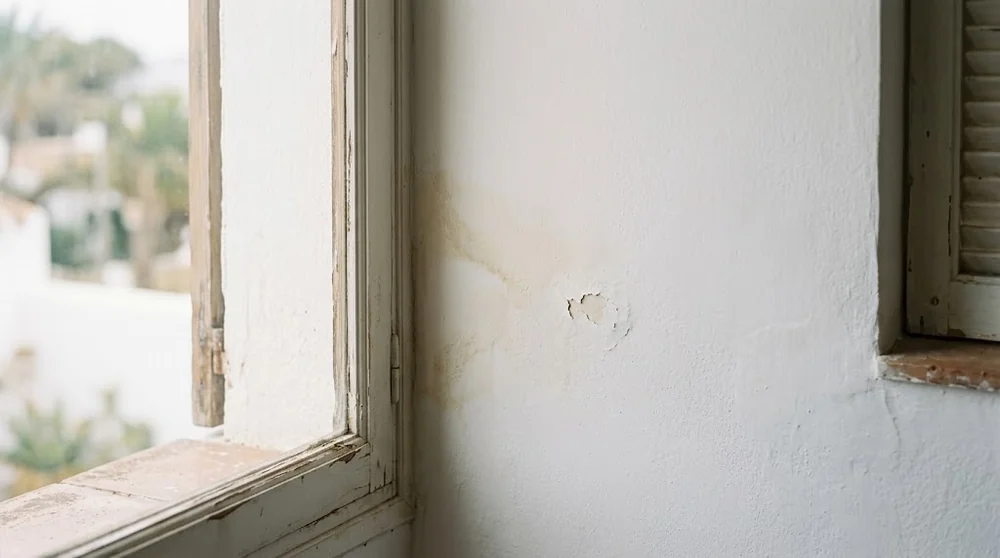
1. Damp smells, staining or suspicious repainting
Your nose is a surprisingly good surveyor. A musty smell in a bedroom, a wardrobe or a ground-floor storeroom suggests that moisture is present somewhere. Look at window reveals, skirting boards, ceiling corners and the backs of built-in cupboards for staining, black mould spots or white powdery salt deposits on plaster. Furniture pushed hard against a wall, or a single patch of fresh paint in an otherwise tired room, is worth a polite question.
Let me put it plainly: fresh paint does not prove concealment, and a stain does not tell you its cause. Condensation from poor ventilation, a leaking roof or terrace above, a plumbing fault and moisture rising from the ground all look broadly similar on a wall, yet each needs a different remedy. Coastal apartments that sit closed up for months often show condensation marks, but ventilation and dehumidification are the right response only once an assessment has confirmed condensation and ruled out water ingress or other causes. A terrace membrane failure, for instance, is a different matter entirely.
Ask the seller or agent when the marks appeared, what caused them, what repairs were carried out and whether invoices or reports exist. Ask permission before photographing affected areas. If the answers are vague or the problem looks active, refer it to an independent technical professional for a moisture assessment before you go any further. My threshold is simple: proceed only when the cause, the remedy and the likely cost are documented in writing.
2. Cracks, distortion and neglected shared structures
Cracks are common in buildings of many ages, and fine hairline cracks in plaster or render can simply reflect finishes expanding and contracting in the summer heat. That is an observation, not a diagnosis. The ones that deserve attention are cracks that run diagonally from the corners of doors and windows, cracks that have been filled and have reopened, and gaps where walls meet ceilings or floors. Doors that stick or swing open on their own, floors that visibly slope and tiles that have lifted or cracked in a line are further clues.
Look up and around as well as inside. Balconies with rusting exposed steel, spalling concrete or loose railings, bulging garden retaining walls on hillside plots and shared roofs with obvious missing tiles or ponding water all affect what you would be buying, even when the defect sits in a communal area. I would not give you a crack-width rule, because no visual threshold can replace an engineering assessment of a specific building.
Keep your own checks visual and safe: look from the ground, from windows and from accessible terraces only. Never climb onto roofs or into unsafe spaces. Ask when cracks appeared and whether they have been monitored, then commission an arquitecto técnico, a building technical specialist who commonly carries out condition surveys in Spain, or another appropriately qualified professional. A mortgage valuation will not answer this question for you. If the survey cannot explain the movement, or finds it is still active, that is a reason to stop rather than to hope.
3. Extensions that do not match the records
Here’s where people usually come unstuck: the property looks wonderful because of features that may never have been authorised. Glazed-in terraces, swimming pools added years after construction, garages converted into bedrooms and roof rooms or solariums built on top of villas are all common on the Costa del Sol and beyond. Some have the necessary permissions. Others do not, and the difference matters for future works, resale, insurance and potentially enforcement.
Three sets of records answer different questions. The Registro de la Propiedad records ownership and registered rights; the Catastro records the property for tax and mapping purposes; the town hall holds planning permissions. Your lawyer should compare the physical property with the registry description in the nota simple, the cadastral description and municipal licences, while a technical professional compares layouts and areas.
Be fair about differences. Built area, which includes walls and sometimes a share of communal parts, and usable area, which measures the floor you can actually walk on, legitimately produce different figures. A discrepancy is a question, not automatically an illegality. Equally, a feature appearing in a cadastral entry or registry description does not by itself establish that it complied with planning law. Age is not a magic eraser either: whether an older unauthorised structure can still face action or be regularised depends on the type of land, the applicable regional and municipal rules and the facts. Only an independent lawyer, working with a technical professional, should reach that conclusion.

4. Utilities that fail or cannot be tested
Services are dull until they fail in August. With the owner’s or agent’s permission, you can carry out a few ordinary user checks during a viewing without touching anything technical:
- Water: run the kitchen and bathroom taps and note whether the flow is reasonable and the water runs clear after a moment.
- Drainage: watch whether basins, showers and sinks drain freely, and notice any sewage smell indoors or near outside manholes.
- Leaks: look under sinks and around the water heater for staining, drips or corrosion.
- Hot water: ask for the hot tap to be run and see how long warm water takes to arrive.
- Heating and cooling: ask for air-conditioning units or heating to be switched on briefly using their normal controls.
Do not open electrical panels, remove covers or attempt to diagnose wiring; leave that to a qualified installer. Disconnected supplies are common in empty homes, but a property where nothing can be demonstrated needs a second visit with services connected, plus recent bills and maintenance records. For rural homes, ask how water is lawfully supplied, whether a well or borehole has the relevant authorisation and how wastewater is handled, whether by mains connection or a septic system. Your lawyer should check the legal side and a technical professional the condition.
5. Missing occupancy or energy documentation
Spain does not have one nationwide occupancy certificate issued under a single procedure, which confuses many buyers. Occupancy and habitability requirements vary by region, by municipality and by property. A licencia de primera ocupación is a municipal document confirming that a newly built or substantially altered property matches its building licence and can be occupied. A cédula de habitabilidad is a certificate of habitability used in regions such as Catalonia and the Balearic Islands. Some regions, Andalusia among them, now accept a responsible declaration for certain occupation procedures, and terminology and accepted documents differ from place to place.
Three separate questions are often blurred together. Residential occupation evidence is one thing. Authorisation to let the property to tourists is a different regional and often municipal matter, and a buyer should never assume that an existing tourist registration can simply be taken over. Energy performance is a third matter: as of October 2026, Real Decreto 390/2021 governs the certificado de eficiencia energética, the energy performance certificate. The decree applies to the sale of buildings and homes within its scope, subject to listed exemptions, such as certain buildings bought for demolition or major renovation. For an ordinary covered sale of an existing home, the seller must provide the registered certificate, and the certificate and energy label accompany the sale contract.
An energy certificate rates expected energy consumption and emissions. A certificado de eficiencia energética does not certify structural safety, legality or general condition. If occupation or habitability evidence is missing, ask your lawyer to obtain written confirmation from the town hall or regional authority of what actually applies to that property, and treat the answer as a condition of proceeding.
6. Unclear ownership or unexplained registered charges
Always ask for the nota simple before you commit. A nota simple is an information extract from the Registro de la Propiedad showing the registered owner, the property description and recorded charges such as mortgages, seizures or rights of way. It should be current, which means obtained recently by your own lawyer rather than a copy that has been sitting in an agent’s folder.
Your independent lawyer should check that the person selling is the registered owner or has proven authority to sell, for example through a valid power of attorney. Co-ownership matters: if a property is registered to a couple, to several siblings or to an estate, every owner with rights must take part or be properly represented. Probate situations need particular care.
A registered mortgage is common and is not automatically a reason to walk away. An existing mortgage can normally be dealt with through a properly arranged cancellation at or before completion, with the outstanding amount settled from the purchase price under terms your lawyer controls. What matters is that the arrangement is agreed in writing and verified.
Equally, a clean nota simple is incomplete reassurance. The extract does not tell you about damp, unauthorised extensions, unpaid community fees, local tax status or who is living in the property. It is one important piece of evidence among several.
7. Community debts and unexplained derramas
Most apartments and many villas on urbanisations belong to a comunidad de propietarios, the owners’ community responsible for shared areas such as gardens, pools, lifts and roofs. Ordinary community fees fund routine running costs. A derrama is a special assessment, an extra payment approved by the community for specific works or costs, such as a new lift or façade repairs. Peeling communal paint, a scaffolded neighbour’s block or a noticeboard announcing a general meeting are all reasons to ask questions.
Request four things: a certificate confirming the seller’s payment status, minutes from recent general meetings, the current budget and details of any approved or proposed works. Under the national regime, as of October 2026, the debt certificate is issued by the person acting as secretary of the community, with the president’s approval (visto bueno). The law allows a buyer to expressly waive the certificate, but I would not do so casually; without it, you are relying on the seller’s word. In Catalonia, the certificate should also identify approved ordinary and extraordinary expenses not yet due and contributions to the reserve fund. Community arrears, approved special assessments and likely future works are three separate issues, and each needs its own answer.
For arrears, the legal exposure is tied to the property rather than being an unlimited transfer of every seller debt. The applicable regime depends on where the property is:
| Regime (as of October 2026) | Legal provision | Arrears the property answers for | Practical check |
|---|---|---|---|
| National rule, most of Spain | Ley 49/1960 de Propiedad Horizontal, Article 9.1(e) | Qualifying community debts for the elapsed part of the year of acquisition and the three preceding calendar years | Debt certificate signed by the secretary with the president’s approval before signing |
| Catalonia | Código Civil de Cataluña, Book Five, Article 553-5 | Qualifying common-expense debts for the elapsed part of the current year and the four preceding years | Lawyer confirms latest consolidated wording and obtains a certificate that also covers pending approved expenses and reserve-fund contributions |
A derrama approved before completion but payable afterwards is a separate question from arrears. Under the national regime, as of October 2026, Article 17.11 of the Ley de Propiedad Horizontal places assessments for improvements on whoever owns the property when the amounts become payable. In practice, the community may look to you for an instalment that falls due after completion, even if the works were approved while the seller owned the flat. A clause in which the seller agrees to cover those instalments does not change whom the community can pursue; it gives you a right to reimbursement from the seller. Works that are not classed as improvements, and regional rules such as Catalonia’s, can be treated differently, so your lawyer should check the applicable regime and the exact wording of the meeting resolution.
My advice to every British buyer is to have your lawyer agree that allocation in writing, with a retention from the price where appropriate, before any deposit changes hands.
Ask the lawyer to verify the status of IBI, the annual municipal property tax, separately; IBI debts can also affect a property, and the lawyer should check receipts and the position with the local tax office rather than rely on a rule of thumb.
8. Restricted access or unclear occupation
Every so often a viewing comes with a locked door. “The owner keeps personal things in there” may be completely innocent, but you are being asked to buy a room you have not seen. Ask for full access, at a second visit if necessary, before you make an offer that relies on its condition.
Pay attention to signs that someone else lives in the property: clothes, food, toiletries or belongings that do not fit the seller’s description, or a viewing arranged around an occupant’s schedule. None of this is sinister in itself. A lawful tenant has rights under a tenancy agreement that may continue after a sale, depending on the contract and the applicable law. Unauthorised occupation is a different and more difficult situation. Treat neither as a reason for alarm, but treat both as reasons for clarity.
Ask directly who occupies the property, on what legal basis and until when. Request any tenancy agreement, notices given and the seller’s written plan for handover. Pause until lawful occupation and the handover date are confirmed in writing.
A verbal promise that the property will be empty on completion is not a substitute for a contractual vacant-possession condition. Your independent lawyer must examine occupation rights and draft delivery conditions so that you are not paying the full price for a home you cannot move into.
9. Location risks hidden by viewing conditions
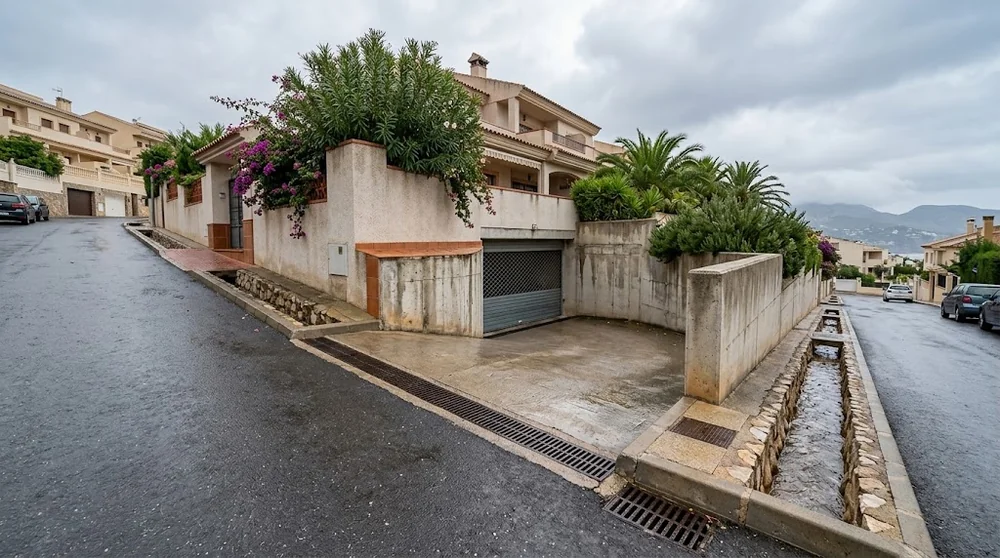
A viewing on a sunny Tuesday morning in May shows you a property at its best. Look for clues the weather cannot hide: drainage channels running towards the house, tide marks or staining in basement garages, sandbags or flood barriers stored in a utility room, dry riverbeds nearby and steep access roads with visible erosion. The October 2024 floods in Valencia province were a painful reminder that water follows the landscape, not estate agents’ descriptions.
Check the Sistema Nacional de Cartografía de Zonas Inundables, the national flood-zone mapping system published by MITECO, the Ministry for the Ecological Transition, together with any regional or municipal risk maps. Ask the town hall and neighbours about past flooding. A location without mapped flood coverage is not proof that the location is safe, because maps model particular scenarios and do not cover every small watercourse or drainage problem. Ask insurers whether cover is available, at what terms and with which exclusions.
I am not suggesting that whole towns are unsafe. Parts of Alicante province, Marbella hillsides with seasonal streams and areas of Mallorca crossed by torrents simply call for site-specific questions rather than generalisations. Revisit at different times: a weekday evening for traffic and bar noise, a Saturday night in August for holiday-let activity, and a winter afternoon, if you can, to see how much sun reaches the living room once the sun drops behind the block opposite. Ten years on the Costa del Sol have taught me that a suspiciously quiet viewing slot sometimes tells you more than the brochure.
10. Pressure to pay before independent checks
“Another couple is viewing this afternoon, so if you transfer a reservation fee now we can take it off the market.” Sometimes that is true. Sometimes it is a sales technique. Either way, urgency is never a reason to skip independent checks.
A reservation agreement and a contrato de arras, the private deposit contract commonly signed before completion in Spain, create obligations whose precise effect depends on their written terms. Under one common form of arras, associated with Article 1454 of the Código Civil, a buyer who withdraws may lose the deposit and a seller who withdraws may have to return it doubled, but the wording of the specific contract decides the position. No automatic refund or universal cooling-off period applies to Spanish resale purchases, and there is no fixed deposit percentage you should simply accept. Before paying anything, have your lawyer review who receives the money, whether it is held by a third party, which checks remain outstanding and the exact refund conditions.
Be wary of sellers or agents who resist written answers or refuse an independent inspection. Roles differ: an agent markets the property and is usually paid on completion; your lawyer represents you; a lender’s valuer assesses value for the bank; a notary formalises the deed and checks certain legal requirements. Neither a mortgage valuation nor a notarial signing replaces your own legal investigation and condition survey. If you are unsure what a particular reservation document commits you to, get a one-to-one answer before transferring a single euro. A short delay costs far less than an unrecoverable deposit.
What to do before making a commitment
Spotting a red flag is the start of a process, not the end of a purchase. The workflow I suggest is deliberately simple:
- Record the sign. Note what you saw, where and when, and take photographs only with permission.
- Ask a specific question. “When did this stain appear and what was done about it?” is better than “Is there damp?”
- Request the evidence. Invoices, reports, licences, certificates, minutes or contracts, in writing.
- Refer it to the correct professional. Technical issues go to a surveyor or arquitecto técnico; legal and documentary issues go to your independent lawyer.
- Obtain findings and cost implications. Ask for written conclusions and, where relevant, repair quotations from contractors.
- Decide. Proceed, renegotiate the price or terms, or stop.
The following situations are illustrative examples of decision-making, not real client cases or legal conclusions.
Illustrative situation: moisture. A buyer notices a musty bedroom and a freshly painted wall. The surveyor finds condensation linked to poor ventilation rather than a leak. The buyer obtains a quotation for ventilation improvements and decides whether to proceed at the agreed price or renegotiate.
Illustrative situation: record mismatch. A villa’s pool and enclosed terrace do not appear in the registry description. The lawyer requests municipal records and a technical report. Depending on the findings, the buyer might proceed with regularisation as a contract condition, renegotiate, or withdraw.
Illustrative situation: community works. Minutes show an approved façade repair payable over two years. The buyer’s lawyer negotiates a written clause stating which instalments the seller pays, and the buyer reflects the remainder in the overall budget.
Once the technical and legal picture is clear, the remaining question is whether this particular home still fits your budget, preferred area and reasons for moving. If the evidence makes you doubt the property, it is far easier to compare it calmly with alternatives than to argue yourself into a purchase.
Spain property viewing FAQs
Should I get a building survey before buying in Spain?
An independent condition survey can help you understand defects, likely repairs and issues requiring specialist investigation before you commit. A mortgage valuation serves a different purpose and should not be treated as a building survey. Agree the inspection scope with a suitably qualified professional, such as an arquitecto técnico, particularly for older homes, altered buildings or properties showing damp or cracking.
How can I check whether an extension is legal?
Ask an independent lawyer and an appropriate technical professional to compare the extension with municipal planning permissions, relevant completion or occupancy evidence, the Land Registry description and cadastral information. A registered or cadastral entry alone does not establish planning legality. Differences need investigation, and the possibility of regularisation depends on the property and applicable local rules.
Can I inherit unpaid community fees when I buy?
As of October 2026, Article 9.1(e) of the national Horizontal Property Law attaches qualifying community arrears to the property for the elapsed acquisition year and three preceding calendar years. Catalonia’s Article 553-5 covers the elapsed year and four preceding years. Ask your lawyer to confirm the applicable regime, review the debt certificate and check special assessments separately.
Does a clean nota simple mean the property is safe to buy?
A nota simple provides information about registered ownership, the property description and recorded rights or charges. It does not replace a condition survey, municipal planning checks, occupation checks or verification of community and tax matters. A reassuring extract is one part of the evidence your independent lawyer and technical adviser need to assess before you commit.
Should I pay a reservation deposit during the viewing?
Have an independent lawyer review the proposed agreement, payment recipient, checks still outstanding and written refund conditions before paying. A verbal assurance that a deposit is refundable may not reflect the contract. Pressure to transfer money immediately, missing documents or resistance to independent checks are reasons to pause and investigate before any money leaves your account.
Conclusion
A red flag at a viewing is a reason to gather evidence, not a verdict on the property. Damp, cracks, a glazed-in terrace or a locked spare room may turn out to be minor, or they may change the price, the contract terms or your decision altogether. The difference only becomes clear once a specific question has been answered with documents and an independent professional has looked at the evidence.
Unresolved material risks should be checked before you sign anything or pay a deposit. Instruct an independent Spanish property lawyer for ownership, debts, planning, occupation and contracts, and a suitable technical professional for condition. Use the thresholds in the checklist: proceed when the cause, remedy and cost are known, renegotiate when they change the value, and stop when a key question cannot be answered.
Then decide on facts rather than hope. A home that survives a proper investigation is one you can buy with confidence, and one that does not has probably saved you a great deal of money and stress.
Disclaimer: this article is general information, reflects legal research up to October 2026 and is not legal, tax, financial or technical advice. Rules vary by region and municipality and can change. Obtain advice on your specific property from qualified independent professionals.