Tag: Marbella

  • Penthouse vs Apartment in Marbella: Costs & Verdict

    Penthouse vs Apartment in Marbella: Costs & Verdict

    The penthouse vs apartment in Marbella decision usually comes down to one blunt question: will you actually live on the terrace? Ten years on the Costa del Sol have taught me that the honest answer separates a happy purchase from an expensive disappointment. This guide compares both property types at the same budget, covering taxes, running costs, terrace rights and holiday-rental rules as at November 2026. The aim is to tell you which type deserves your precious viewing days.

    A penthouse in Marbella usually offers more outdoor space, privacy and open views, but costs more to buy and can bring higher maintenance expenses. A luxury apartment often provides better value, easier upkeep and similar communal amenities. Choose a penthouse for terrace-led living; choose an apartment when practical space, accessibility and running costs matter more.

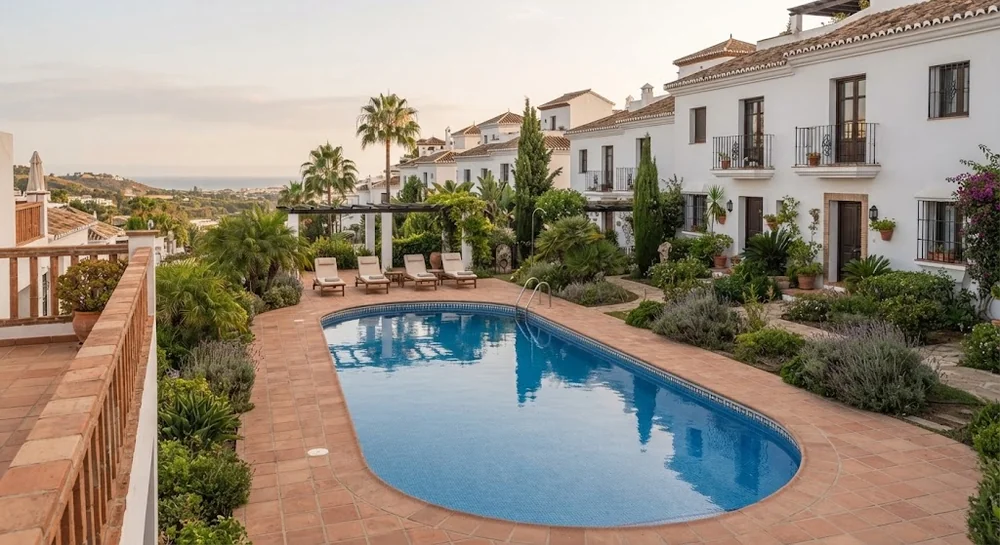
    Property adviser discussing a Marbella penthouse terrace with buyers overlooking nearby apartments and the Mediterranean Sea

    Penthouse vs Apartment in Marbella: Key Differences

    The table below compares typical tendencies for a penthouse (ático) and a mid-floor luxury apartment of similar quality. Individual buildings break these rules constantly, so treat each row as a question to ask at the viewing rather than a verdict.

    CriterionPenthouse (ático)Luxury apartment (typical mid-floor)
    Location within buildingUppermost residential floor, often set back from the facadeAny floor from ground to just below the top
    LayoutOften larger terraces than interior; some are duplex with internal stairsUsually a single level with a regular floor plan
    TerraceLarge terrace or solarium, sometimes with exclusive roof accessCovered balcony or modest terrace; garden terrace on the ground floor
    PrivacyNo neighbours above; may be overlooked by taller neighbouring blocksNeighbours above and below; terraces may face other balconies
    Sunlight and viewsStrong light and open outlook, with more exposure to sun and windVaries by floor and orientation; more shelter, sometimes less view
    AccessibilityLift-dependent; stairs inside duplex unitsLift-dependent above the ground floor; easy step-free access on lower levels
    MaintenanceRoof, waterproofing and terrace surfaces are more exposedLess weather exposure; fewer outdoor surfaces to keep up
    CostsHigher purchase price; running costs often higher in my experienceLower price per home of similar interior size; simpler running costs
    Buyer suitabilityTerrace-led living, entertaining, buyers who want open viewsRetirees, practical households, lock-up-and-leave owners

    One point often lost in glossy brochures: a luxury specification does not define the floor of the dwelling. Marble bathrooms, smart-home systems, concierge service and a spa can all appear in a first-floor apartment, while a top-floor flat in a tired block can carry the word “penthouse” in its advert with little else to justify it.

    What counts as a penthouse in Spain?

    Spanish law does not give “penthouse” a tidy statutory definition. The word is a market description of a home’s position and configuration, so the label tells you very little until you see the registered documents. These are the terms you will meet in Marbella listings:

    • Ático (penthouse): a dwelling on the top residential floor, usually with terraces larger than a standard balcony.
    • Dúplex ático (duplex penthouse): a top-floor home spread over two levels joined by internal stairs, often with a solarium (roof terrace) upstairs.
    • Top-floor flat: a home on the highest floor that may have no setback terrace at all, yet is sometimes marketed as a penthouse.
    • Luxury apartment: a quality category covering finishes, services and amenities, which can sit on any floor.

    Let me put it plainly: luxury describes how a home is specified, while penthouse describes where it sits and how it is arranged. The two overlap often, but one does not guarantee the other.

    Which is better for which buyer?

    A simple decision rule works well here. If you expect to spend most evenings outdoors for at least eight months of the year, and you can live with the extra upkeep, a penthouse deserves viewings first. If you value shelter, step-free daily life and predictable bills, start with luxury apartments and add a penthouse viewing only if the terrace is genuinely usable.

    The Real Advantages and Drawbacks of Marbella Penthouses

    A good Marbella penthouse is a wonderful thing. A poorly chosen one is a roof-shaped repair bill with a view. These are the points I walk buyers through before they fall in love with a photograph.

    What penthouses do well

    • Private outdoor living: a large terrace works as a second living room for lunches, evenings and guests, and it is the main reason people pay the premium.
    • No upstairs neighbours: no footsteps, furniture dragging or terrace parties overhead, which matters more than most buyers expect.
    • Views and light: height often brings sea, mountain or golf outlooks and bright interiors for much of the day.
    • Resale appeal: well-documented penthouses with usable terraces are easy to describe and photograph, which helps marketing. I would not treat that as a promise of price growth.

    What brochures tend to skip

    • Summer heat: a top floor sits directly under a sun-baked roof. In July and August, an unshaded terrace can be uncomfortable from late morning until early evening, and the apartment’s air conditioning works harder.
    • Coastal wind: higher floors catch the levante and poniente winds. Furniture needs weighting or storing, glass screens may be needed, and some terraces are too breezy for comfortable dining.
    • Weather exposure: a penthouse takes the rain, sun and salt air first. Waterproofing membranes, drainage outlets and terrace surfaces age faster than interior finishes.
    • Leaks: a roof or terrace waterproofing failure shows up in the top home first. Always ask who pays and who is responsible.
    • Lift reliance: if the lift fails, a top-floor owner is the most inconvenienced, particularly with shopping, luggage, a pushchair or reduced mobility.
    • Duplex stairs: internal stairs are lovely until knees, small children or a mobility aid enter the picture.
    • Outdoor furnishing upkeep: teak, cushions, awnings and planters age quickly in sun and salt, and replacing them is not free.

    A summer-versus-winter usability test

    Visit the property twice, if you can, or ask for photographs and a written description of conditions at different times of year. In winter, check whether the terrace has sun between about noon and 4 pm, whether it is sheltered enough for a coffee outside, and how much of the day it is in shade. In summer, check when the sun leaves the terrace, how much natural shade exists, and what a pergola, awning or screen would cost and require in permissions.

    A terrace is too exposed to be useful when it faces west with no shade at 5 pm in August, when wind funnels between two blocks, or when a neighbouring tower looks straight onto it. In those cases a smaller, sheltered balcony on a lower floor can give far more real outdoor hours.

    Why “penthouse” does not mean complete privacy

    Having nobody above you is not the same as being unobserved. Taller buildings nearby, shared roof access for maintenance engineers and common-area terraces can all create overlooking. In some developments the community has a right to enter roof areas for lift machinery, aerials or solar panels. Check where the access is, and how often it is used.

    Here’s where people usually come unstuck: they judge a penthouse on a sunny viewing at 11 am in April. Go back at 5 pm on a windy day in November, then think about August, and you will learn more in an hour than any brochure will tell you.

    Spacious penthouse terrace with outdoor seating and coastal views in Marbella

    Why a Luxury Apartment May Be the Better Buy

    An apartment on a mid-floor often delivers more everyday comfort per euro than a penthouse, and it does so with less drama. A well-designed apartment with a deep, covered balcony can feel like a proper outdoor room, usable in April and October, with shade built in rather than added later at your cost.

    The single-level floor plan is the second big advantage. Everything sits on one floor: bedrooms, kitchen, living area and terrace, with no internal stairs. For retirees and for households with young children or guests of mixed ages, that simplicity is worth real money. A penthouse with a small interior and a vast terrace can leave you paying for outdoor space while the indoor rooms feel cramped. A buyer comparing two homes at the same price will often find the apartment offers more usable interior area.

    Communal amenities also tend to be equal. In a gated complex, the pools, gardens, gym, padel courts, security and concierge normally serve every resident, whichever floor they live on. A penthouse owner may pay a larger community contribution for the same access, depending on the building’s participation coefficients.

    Weather exposure matters too. A mid-floor apartment is shielded by the floors above and below from a lot of heat and rain, so cooling bills are often lower and roof leaks are somebody else’s problem. For owners who leave the property empty for several months, that lower exposure is a quiet benefit.

    Two cases where a mid-floor apartment beats an ático

    First, a hypothetical retired couple who plan to live in Marbella year-round and want to keep the home easy to manage. A third-floor apartment in a building with two lifts, a covered balcony and a pool downstairs suits them better than a duplex penthouse with a steep internal staircase and a roof terrace they would use for two hours a day. Second, a hypothetical working family that wants to lock up for the summer months and travel. A mid-floor home has no roof to inspect and fewer exposed surfaces to deteriorate in their absence.

    When the apartment is the wrong choice

    Lower floors have their own traps. Ground-floor homes can suffer from damp, limited privacy and noise from paths, pools or car parks. A terrace overlooked by other balconies can feel like a stage. A home on a busy road or beside a restaurant can be noisy late into the evening. Poor orientation, such as a north-facing living room in a shaded complex, can leave a luxury finish feeling dim. Visit at different times of day, and pay particular attention to street noise, bin stores, ventilation and where the sun actually falls.
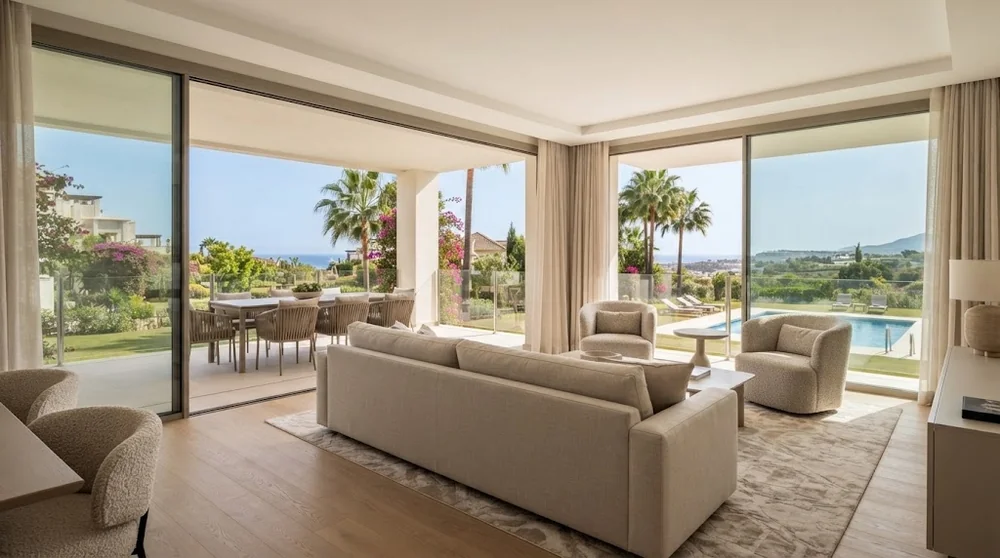
    Luxury Marbella apartment living room opening onto a covered balcony above a communal garden

    Penthouse and Apartment Prices in Marbella in 2026

    Price evidence for Marbella penthouses is patchy, and the headline numbers you see online come from very different samples. I use them as dated market examples, not as authoritative statistics. Always separate three things: asking prices (what sellers want), actual sale prices (what buyers paid) and broad market indices (averages across all property types).

    Current price evidence

    Source and dateWhat it measuredFigureWhat it does not tell you
    Marbella Wire, 5 September 202687 penthouses advertised at €3 million or more across Marbella and BenahavísMedian asking price of €4,299,500Excludes everything under €3 million; asking prices, not sales; includes Benahavís
    Inmolux, 1 November 202623 penthouses listed by one agency in MarbellaMedian asking price of €1,475,000One agency’s inventory, not the whole market; asking prices, not sales
    Muse Selection, 30 October 2026Zone medians for the Golden Mile, Nueva Andalucía and Puerto BanúsCovers all residence typesNot penthouse-only; cannot be read as a penthouse price

    The first two samples are not interchangeable. One is a premium segment above €3 million, the other is a single agency’s mixed inventory, and neither is a completed-sale median for Marbella as a whole. Reading the €1,475,000 and €4,299,500 figures as a range for “a Marbella penthouse” would be a mistake. The Muse Selection zone medians are useful for sensing how the Golden Mile, Nueva Andalucía and Puerto Banús differ from each other, but they blend apartments, villas and penthouses together.

    You will also see third-party claims that quote luxury running costs of €15,000 to €40,000 per year, or a penthouse premium of 30% to 50%. Those are segment-specific claims from individual publishers, built on particular buildings and definitions. Treat them as prompts for your own calculation, not as market laws. Community-fee estimates vary just as widely, because they describe different buildings, sizes and service levels.

    How to calculate a genuine penthouse premium

    The only reliable premium is a matched one. Compare two homes in the same development with the same bedroom count, similar internal usable area, similar condition, the same orientation and the same parking and storage rights. Then look at what the penthouse adds: terrace rights, height, view and privacy.

    Be careful with price per square metre. Calculate interior €/m² and outdoor areas separately, because terrace square metres are not valued like interior square metres. A hypothetical illustration shows why. Suppose an apartment has 150 m² of interior space and sells for €1,000,000, which is €6,667 per interior m². A penthouse has 150 m² of interior plus an 80 m² terrace and is priced at €1,150,000. Divided by interior space alone it is €7,667 per m², roughly €1,000 more per interior m². Divide it by interior plus terrace (230 m²) and it looks cheaper at €5,000 per m². Neither figure is the “true” premium; the useful question is what the extra €150,000 buys that you will actually use.

    Never assume a fixed percentage premium for penthouses. Prices reflect the specific building, location, finish and demand at the time of sale, and no source I trust can promise future appreciation.

    Best Marbella Areas for Penthouses and Apartments

    The right micro-location matters at least as much as the property type. A mid-floor apartment two minutes from the sea and shops can deliver a stronger daily experience than an exposed penthouse that needs a car for every errand. Compare the actual street, development and walking route, not the prestige of an area name.

    AreaEveryday feelStrengthsWatch-pointsOften suits
    Golden MilePrestigious belt between Marbella centre and Puerto BanúsClose to beaches and Marbella centre; many gated complexes with sea viewsHeavy traffic on the main road at peak times; some stretches are not walkableHoliday buyers, second-home owners, those wanting central luxury
    Puerto BanúsMarina, yachts, restaurants and a lively nightlife sceneWalkable services, marina atmosphere, rental demand in summerNoise and crowds in summer; parking pressureHoliday and rental-focused buyers; less suited to a quiet retirement
    Nueva AndalucíaResidential valley with golf courses and a village feel in placesGolf, green spaces, family-friendly layout, near Puerto BanúsSlopes and car dependency; check walking routes to shopsFamilies, golfers, permanent residents
    Marbella CentreOld Town, promenade and everyday amenitiesWalkable shops, restaurants, services and beaches; strong year-round lifeLimited parking; older buildings; some noisy streetsRetirees, permanent residents, those who dislike driving
    Marbella EastQuieter coastal residential areas east of the centreBeach access, more space for the money in many cases, relaxed daily lifeVariable walkability; check each development individuallyFamilies, permanent residents, buyers seeking a calmer setting

    Beach and resort lifestyle

    For beach days and a resort feel, the Golden Mile, Puerto Banús and parts of Marbella East stand out. A beachside apartment with a short walk to the sand can beat a more expensive hillside penthouse for daily use. In Puerto Banús, check noise levels at night before falling for a terrace overlooking the marina, because that same view usually comes with the soundtrack. Summer traffic on the Golden Mile can turn a five-minute trip into a half-hour one, so test the route at the hour you would actually travel.

    Golf and family living

    Nueva Andalucía is the classic choice for golf and relaxed family routines, with gated communities, green spaces and fairways. Slopes and distances can be tiring on foot, and many daily trips need a car. Several international schools sit within a short drive of Nueva Andalucía and Marbella East, but admissions and fees vary, so check the school first and the home second. In family-oriented areas, a lower-floor apartment with a garden terrace can be more practical than a penthouse for small children, with direct access to the pool and no stairs.

    Everyday convenience and retirement

    For retirees and permanent residents, convenience tends to win. Marbella Centre offers walkable pharmacies, supermarkets, medical services and restaurants, and many Old Town and nearby apartments are close to the promenade. Flat walking routes, lift reliability and nearby parking matter more than a rooftop view. In my professional view, a well-located mid-floor apartment usually suits this group best, with a penthouse worth considering only if the building has dependable lifts and the terrace is genuinely sheltered.
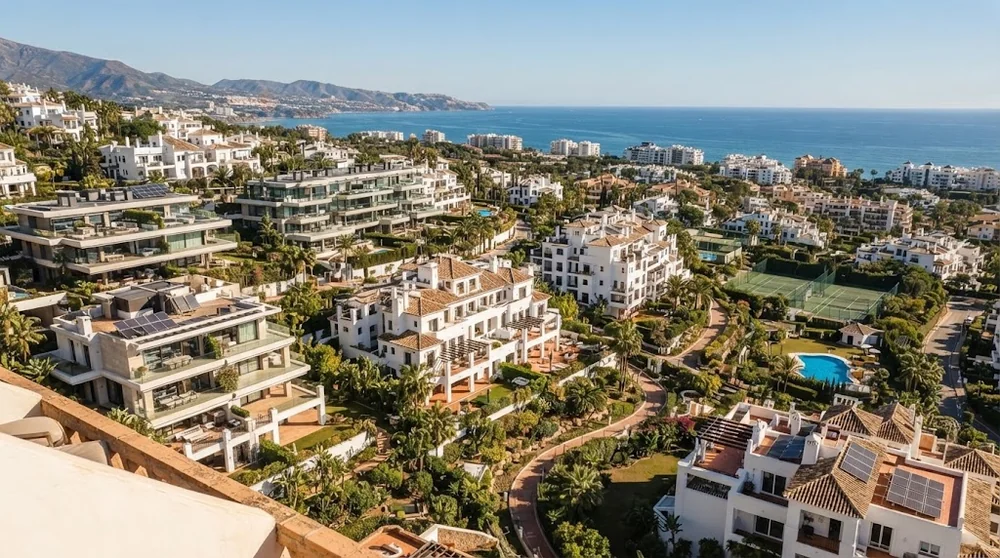
    Modern apartment and penthouse developments in a Marbella coastal neighbourhood

    Buying Costs: Penthouse vs Apartment in Andalucía

    The label on the brochure has no effect on the tax. Spanish transfer taxes depend on the characteristics of the transaction, not on whether the home is a penthouse or an apartment. What matters is whether you are buying a resale home from a private seller or a qualifying new home from a developer.

    ItemResale homeQualifying new-build (first delivery)
    Main purchase tax (as at November 2026)ITP (Impuesto sobre Transmisiones Patrimoniales): general Andalusian rate of 7%IVA (Impuesto sobre el Valor Añadido, VAT): general rate of 10% for qualifying new dwellings
    Stamp dutyNot charged on top of ITPAJD (Actos Jurídicos Documentados): general Andalusian rate of 1.2% where applicable
    Illustrative tax on a €1,000,000 base€70,000€100,000 IVA plus €12,000 AJD = €112,000
    Illustrative tax as a share of price7.0%11.2%

    This calculation is illustrative. It assumes a €1,000,000 taxable base for both cases and ignores legal, notary, registry and other charges. Case-specific rules, exemptions and reduced rates may apply, and the tax base can differ from the price you negotiated. For ITP and AJD, the authorities can use a reference value for the property, so the taxable base may be higher than the declared price. The Spanish tax authority, the Agencia Tributaria, and the regional tax authorities of Andalucía publish the current rules, and your lawyer should confirm which apply to your purchase.

    Other purchase costs to budget for

    • Notary fees: charged for the public deed (escritura) under a regulated scale.
    • Land registry fees: for registering the property in your name.
    • Legal fees: an independent lawyer should check title, debts, planning and community documents.
    • Technical survey: optional but wise for a penthouse with a large terrace or an older building.
    • Mortgage costs: valuation, arrangement and related charges if you borrow.

    Deadlines matter. As at November 2026, the general ITP and AJD declaration period in Andalucía runs for two months, starting the day after the taxable event. Your lawyer or gestor normally handles filing, but you should confirm who is responsible and when. Seller-side taxes, such as the municipal capital gains tax (plusvalía municipal), are a separate matter and are usually negotiated or allocated under the contract.

    Annual Costs and a Five-Year Ownership Comparison

    Running costs are where penthouses and apartments quietly diverge. The table below uses two hypothetical homes bought at the same €1,000,000 price, to isolate recurring costs. Every figure is an assumption for illustration, not an official market average, and your own numbers depend on the building, size and services.

    Annual cost (hypothetical)ApartmentPenthouseAssumption
    Community fees€4,200€5,400Penthouse carries a larger participation coefficient
    IBI (property tax)€1,500€1,700IBI is the Impuesto sobre Bienes Inmuebles, set by cadastral value
    Insurance€900€1,200Higher rebuild and contents cover for the penthouse
    Utilities, including air conditioning€4,800€6,000Larger glazing and top-floor heat gain
    Terrace care€300€1,800Deck, planting, irrigation, waterproofing checks
    Repair provision€3,000€5,000Set-aside for unplanned repairs
    Total per year€14,700€21,100Sum of the rows above
    Five-year running costs€73,500€105,500Annual total × 5, with no inflation applied

    Now add the purchase. Both homes cost €1,000,000, the general resale ITP of 7% adds €70,000, and I have assumed €20,000 for notary, registry, legal and survey costs on each. This hypothetical excludes financing and resale proceeds.

    Five-year cash outlay (hypothetical)ApartmentPenthouse
    Purchase price€1,000,000€1,000,000
    Resale ITP at 7%€70,000€70,000
    Other purchase costs (assumed)€20,000€20,000
    Five years of running costs€73,500€105,500
    Total cash outlay€1,163,500€1,195,500

    Sensitivity: what if the penthouse costs more upfront?

    In real life, a penthouse rarely sells for the same price as a comparable apartment. The next table keeps the running-cost gap of €32,000 over five years and adds a penthouse price premium of 0%, 10% or 20%. I hold other purchase costs at €20,000 for simplicity, though legal fees can rise slightly with price.

    Penthouse premiumExtra purchase priceExtra ITP at 7%Extra running costs (5 years)Extra outlay vs apartmentPer year
    0%€0€0€32,000€32,000€6,400
    10%€100,000€7,000€32,000€139,000€27,800
    20%€200,000€14,000€32,000€246,000€49,200

    The extra purchase price is not simply “lost”, because you may recover part of it on resale. I have not modelled resale value, and I will not assume appreciation, because nobody can promise it. The table shows the cash you commit, and you decide whether the terrace is worth it.

    Community coefficients and special levies

    Community costs in Spain follow the participation coefficient (coeficiente de participación) fixed in the title documents of each property. A larger home with a larger coefficient pays a larger share of the approved budget, but amenities, services and the building’s age also matter. Always ask for the latest accounts, the budget, and any approved or planned special levies (derramas) for roofs, facades, lifts or pool works. A fee that looks modest can hide a large levy waiting for the next meeting. Under the Ley de Propiedad Horizontal, communities must also hold a reserve fund, and the figure to check is the current balance.

    Terrace Ownership, Roof Rights and Planning Permission

    Terrace rights are the part of penthouse buying that buyers most often misunderstand. The advert says “private roof terrace of 90 m²” and the buyer assumes the terrace is theirs to rebuild as they please. In Spain, that assumption can be wrong, and finding out after completion is expensive.

    Does the penthouse terrace legally belong to you?

    Three situations look similar on a viewing but are legally different:

    • Registered private terrace: the terrace is part of your registered property, described in the title deed (escritura) and land registry entry with its own surface area.
    • Exclusive use of a common element: the terrace or solarium is a common area of the building, but you have the exclusive right to use it, often under the community statutes or constitutive title (título constitutivo).
    • Shared structural roof obligations: even when you own or use the terrace, the roof structure and waterproofing may be a community responsibility, or may be split between you and the community under the statutes.

    The working documents are the nota simple from the property registry, the title deed, the community statutes and the building plans. Always ask for the nota simple before you commit, and compare it with what the advert claims. Your lawyer can request one from the property registry, or you can apply for it directly. The consolidated Ley de Propiedad Horizontal (Horizontal Property Law, Ley 49/1960) sets the general rules for communities; as at November 2026 the consolidated text includes updates published in October 2026, so your lawyer should confirm the version that applies to your purchase.

    If a particular terrace, enclosure or title deed leaves you unsure, a short one-to-one conversation before you sign can save a great deal of grief.

    Ask a question on WhatsApp

    Terrace disputes tend to follow the same pattern: someone enclosed a terrace years ago, nobody registered it, and the buyer inherits the problem. A good lawyer will compare the registered surface area, the cadastral record and the advertised size, and will flag any mismatch before you pay a deposit that is hard to recover.

    Can you enclose a terrace or install a pool?

    Do not take blanket permission for granted. Glazing a terrace, adding a pergola, fitting a jacuzzi or building a rooftop pool can change the structure, the facade or the load on the building. Depending on the work, you may need community approval under the Ley de Propiedad Horizontal, a municipal licence from Marbella’s town hall and a technical project signed by an architect or engineer. Structural load capacity, waterproofing and fire or safety rules all come into play, and coastal and building restrictions can limit what is allowed on a roof.

    Here’s where people usually come unstuck: a hypothetical listing shows an attractive glazed terrace, yet the nota simple describes a much smaller dwelling. If the enclosure is not registered and was built without permission, the new owner may face planning issues, community objections and difficulties with mortgages and insurance. Ask your lawyer and an independent architect whether the enclosure is legal, whether it can be regularised, and who would bear the cost.
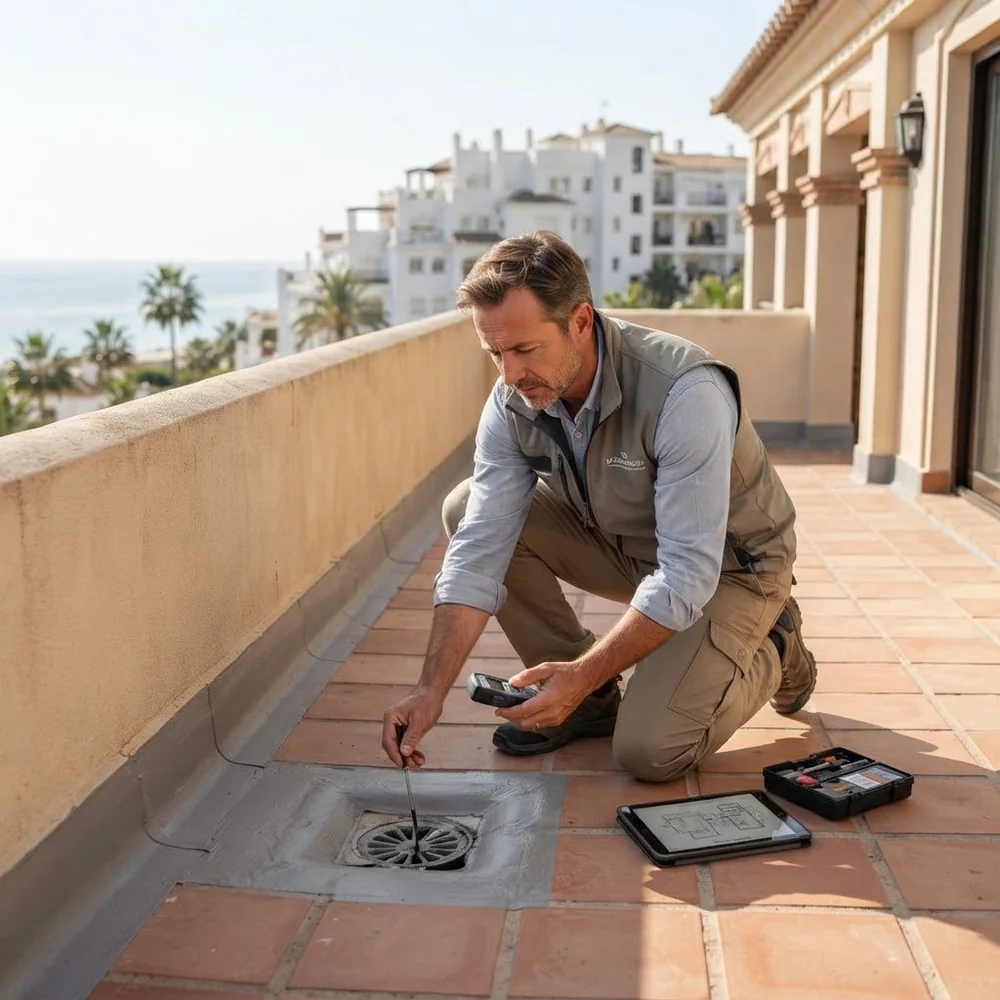
    Building surveyor inspecting terrace drainage and waterproofing on a top-floor apartment

    What to Check Before Viewing or Reserving a Property

    The cheapest moment to find a problem is before you pay a non-refundable deposit or agree to binding terms. Use the checklist below in order, and ask the agent or seller for each document at the start, not the end.

    1. Obtain a nota simple from the property registry to confirm the owner, any mortgages, embargoes or other charges, and the registered description.
    2. Compare registered, cadastral and advertised areas. A large gap between the title surface and the marketing figure is a warning sign.
    3. Verify the terrace. Is it a registered part of the property, or exclusive use of a common element? Check the title deed, statutes and plans.
    4. Confirm parking and storage rights. Are the garage space and storage room registered with the property or only informally allocated?
    5. Request a community debt certificate confirming the owner has no unpaid community fees, since the buyer can be liable for arrears from the current and previous year.
    6. Read the community meeting minutes for at least the last three years, looking for disputes, planned works and complaints.
    7. Check the community budget and reserve fund and ask whether special levies are approved or being discussed.
    8. Inspect the roof and waterproofing. Ask for dates of the last repairs and any guarantees.
    9. Look at drainage and terrace surfaces for pooling water, cracks, damp stains on ceilings and failing sealants.
    10. Test the lift and access. How many lifts serve the building, how often do they break down, and what is the maintenance contract?
    11. Check the air conditioning and ventilation units, including age, capacity and any roof-mounted equipment.
    12. Search for illegal alterations such as enclosed terraces, extra rooms or changed layouts that differ from the registered plans.
    13. Ask about noise at different times: neighbours, pool areas, restaurants, traffic and building services, in both summer and winter.
    14. Commission an independent survey from a technical architect or surveyor where the terrace is large, the building is older or you see damp.
    15. Have an independent lawyer review everything before you sign a reservation agreement or private purchase contract.

    Professional roles matter. A lawyer should review registry title, debts, contracts and tax. An architect or technical surveyor should assess structure, waterproofing, damp and the legality of any alterations. The agent can help gather documents but should not be your only adviser, since the agent is paid on completion.

    [CTA: Request a curated Marbella property shortlist]

    Rental Income, Resale and Long-Term Value

    Rental and resale arguments deserve the same scepticism as price claims. Three distinctions keep expectations honest. Asking prices are what sellers hope for, sale prices are what buyers paid, and the two can differ. Gross rental yield is annual rent divided by price, while net cash flow is what remains after management, voids, running costs, insurance and tax. Seasonal demand also cuts both ways: summer weeks can be busy while winter can be quiet.

    Penthouses with terraces and views can attract higher nightly rates, and families like the extra outdoor space. Maintenance exposure and a narrower pool of buyers can make resale slower in some cases. Apartments often have broader appeal and lower running costs, though rates are usually lower. I cannot give you a market-wide yield benchmark, because none I trust exists for like-for-like Marbella properties.

    A hypothetical rental illustration

    The table below is a labelled hypothetical, not a forecast. Both homes are assumed to cost €1,000,000, be let for 150 nights a year, and carry the running costs from the five-year example. The assumed average nightly rates are €350 for the apartment and €420 for the penthouse. Management and platform fees are 20% of gross rent and cleaning and linen are 8%. The tax line assumes a non-EU/EEA non-resident owner taxed at 24% on gross rental income without deductions, which is how I understand the general rule as at November 2026. Your own position may differ, so confirm it with a tax adviser.

    Annual line (hypothetical)ApartmentPenthouse
    Gross rent (150 nights)€52,500€63,000
    Management and platform fees (20%)€10,500€12,600
    Cleaning and linen (8%)€4,200€5,040
    Owner running costs€14,700€21,100
    Net before income tax€23,100€24,260
    Income tax at 24% of gross€12,600€15,120
    Net after tax€10,500€9,140
    Gross yield on €1,000,0005.25%6.30%
    Net yield after tax1.05%0.91%

    The lesson is the gap between the gross and net lines. A higher nightly rate does not guarantee a better outcome once costs and tax are deducted, and the penthouse’s higher revenue may not compensate for its higher running costs. A sober approach is to model several occupancy levels and treat any single figure from an agent with caution.

    VUT registration, community consent and municipal limits

    Holiday letting in Andalucía normally requires registration as a vivienda de uso turístico (VUT), meaning a tourist-use dwelling. Marbella’s town hall can also apply its own planning and urban rules, so check the current municipal position for the specific building. The owners’ community must also be considered. Under the Spanish reform whose revised community approval framework took effect on 3 April 2025, new holiday-rental activity in a divided building faces a stricter community approval requirement under the Ley de Propiedad Horizontal, which as I read it involves a qualified majority of owners. Existing lawful activity may be treated differently under transitional rules.

    Never assume a holiday-let licence transfers to you or remains valid after purchase. Ask your lawyer to verify the registration number, the community statutes, any vote or ban, and the municipal rules before you rely on rental income in your budget.

    What British Buyers Need to Know After Brexit

    Brexit changed residence and travel rules, not the basic right to own Spanish property. This is where my own move from Manchester helps: I have been through the paperwork myself, and the same questions come up constantly.

    • Ownership versus residence: British nationals can generally buy residential property in Spain without being resident, but ownership does not create any right to live in Spain.
    • The 90-in-180 rule: as at November 2026, British visitors without a residence permit are usually limited to 90 days in any 180-day period across the Schengen area, subject to relevant residence rights and exceptions. Owning a penthouse does not extend that limit.
    • No immigration advantage: the property-linked investor visa route was withdrawn in 2025, so I would treat any sales pitch that links a purchase to residency with suspicion. Speak to an immigration specialist about your own situation.
    • NIE: you need a Número de Identidad de Extranjero (foreigner identification number) to buy property, pay taxes and sign at the notary.
    • Mortgages: Spanish banks assess non-resident borrowers more cautiously. In my experience, loan-to-value ratios for non-residents are often lower than for residents, so confirm affordability early.
    • Non-resident taxes: owning a second home can bring annual tax obligations, including IBI and, for non-rented homes, a non-resident imputed-income charge. Rental income is taxed separately, and the rate depends on your residence.
    • Independent legal representation: use your own lawyer, not the seller’s or the developer’s.

    My advice to every British buyer is to settle the residence and tax questions before choosing between property types. An Atlantic-facing penthouse you can use for 90 days a year has a very different cost per night of enjoyment than the same property lived in year-round.

    Which Marbella Property Fits Your Lifestyle?

    No property category wins automatically. The matrix below summarises how the two types tend to fit different households, using a simple scale where more ticks suggest a stronger general fit. It reflects my professional judgement, not a formula.

    Buyer profilePenthouseLuxury apartmentDeciding factors
    RetireesFair, if lifts are reliable and stairs are avoidedStrongSingle-level layout, step-free access, predictable costs
    Families with young childrenFair; duplex stairs and exposed terraces need careStrong, especially with a garden terraceSafety, pool access, school distance
    Remote workersStrong if the interior has a quiet office spaceStrongInternet quality, quiet, a terrace for breaks
    Permanent residentsGood with a sheltered terraceStrongYear-round comfort, walkable services, running costs
    Holiday-home usersStrong for terrace-led summersStrong for lock-up-and-leaveMonths of use, maintenance exposure, security
    Rental-focused buyersPossible, subject to licence and community rulesPossible, subject to licence and community rulesVUT status, net cash flow, management

    Hypothetical buyer case A: the terrace-led second-home owner

    Imagine a buyer with a budget of around €1.5 million who plans to spend about four months a year in Marbella, mostly from May to September. They entertain often and want a place for long evenings outside. A penthouse with a sheltered, west-facing terrace and a registered solarium could justify the premium, provided the nota simple confirms the terrace rights and the community has no major levies pending.

    Hypothetical buyer case B: the year-round downsizer

    Now imagine a retired couple with a budget of about €900,000 who plan to live in Marbella all year and want easy daily life. They need step-free access, a covered balcony and shops within walking distance. A mid-floor apartment in or near Marbella Centre will probably serve them better than a duplex penthouse, and the saving in running costs may fund travel home to see family.

    If you would like a shortlist of Marbella apartments and penthouses matched to your budget, preferred area and plans, the short property quiz is the quickest route.

    Get a property selection for Spain

    My conditional recommendation is simple. Choose a penthouse if you will use the terrace for most of the year, the legal rights are clear and you accept the higher running costs. Choose a luxury apartment if indoor space, accessibility, shelter and cost control matter more than outdoor drama.
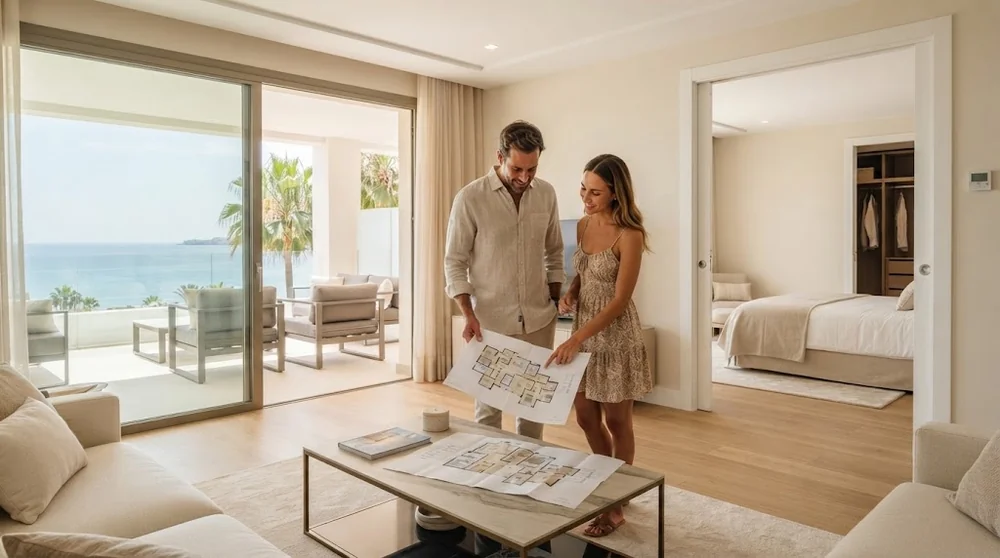
    Couple viewing a spacious Marbella luxury apartment with an adjoining sheltered terrace

    [CTA: Compare Marbella apartments and penthouses matched to your budget]

    Frequently Asked Questions

    What is the difference between a penthouse and a luxury apartment in Marbella?

    A penthouse (ático) sits on the uppermost residential floor and usually comes with a substantial terrace, open views or a duplex layout. A luxury apartment describes quality, not position, so it can be on any floor with equally fine finishes and communal facilities. The real differences are the floor plan, legally documented outdoor space, access, privacy and price.

    Is a penthouse worth paying more for in Marbella?

    A Marbella penthouse can justify a higher price if you will use the terrace regularly, value open views and like having no neighbours above. It is much less compelling when the terrace is windy, overheated or costly to maintain. Compare two similar homes in the same development, then add the purchase premium to five years of expected running costs.

    How much does a luxury penthouse cost in Marbella?

    Luxury penthouse prices in Marbella vary widely by address, size, condition and facilities. One agency’s 23 listed Marbella penthouses had a median asking price of €1,475,000 on 1 November 2026, while a separate sample of 87 penthouses advertised above €3 million in Marbella and Benahavís had a €4.30 million median in September 2026. Both are asking-price samples, not completed-sale averages.

    Do penthouses have higher community fees than apartments?

    Penthouses do not automatically have higher community fees. Community charges depend on a property’s participation coefficient (cuota de participación), the approved community budget, shared amenities and any special levies. A large penthouse may pay more than a smaller flat in the same building, but the calculation is property-specific. Ask for the coefficient, recent accounts, meeting minutes and written confirmation of outstanding fees.

    Can I build on or enclose a penthouse terrace in Spain?

    You cannot automatically build on or enclose a Spanish penthouse terrace. Exclusive use of a terrace does not necessarily include ownership of the structural roof or permission to alter the building. Glazing, pergolas, jacuzzis and pools can require community approval, municipal authorisation and technical assessments. Before buying, ask an independent lawyer and architect to check the registered title, community rules, planning requirements and structural capacity.

    Can a British buyer purchase and holiday-let a penthouse in Marbella?

    British nationals can generally buy residential property in Marbella, but ownership does not confer Spanish residency. Holiday letting is separate: it depends on Andalusian tourist registration, municipal limits and the owners’ community. New tourist-rental activity faces community approval rules introduced in April 2025, with transitional treatment for existing lawful activity. Verify permissions before projecting rental income.

    Final Verdict: Penthouse or Luxury Apartment?

    A penthouse is worth the extra money when the outdoor living and the views are things you will use for most of the year, the terrace rights are clearly documented and the building is well managed. A luxury apartment is the smarter buy when practical interior space, easy access and tighter cost control matter more than a large roof terrace. On my illustrative €1 million example, the penthouse added roughly €32,000 in running costs over five years before any purchase premium, which is a useful yardstick for what the terrace must be worth to you.

    Ten years of helping buyers has convinced me of one rule above all others: compare two actual properties, not two labels. Put the nota simple, community accounts, terrace documents and survey findings for a specific penthouse next to those of a specific apartment, and let the figures and your own habits decide. If the numbers and the lifestyle point the same way, you have your answer.

    [CTA: Get a personalised Marbella property shortlist]

    Disclaimer: This article is general information as at November 2026 and does not constitute legal, tax or financial advice. Tax rates, community-law rules, holiday-rental regulations and market data change, and every purchase has individual circumstances. All calculations marked as hypothetical or illustrative are assumptions, not forecasts or market averages, and no profit or price growth is promised. Consult an independent Spanish lawyer, tax adviser and technical surveyor before committing to any purchase.

  • Townhouse Prices in Marbella 2026: Costs by Area

    Townhouse Prices in Marbella 2026: Costs by Area

    The price on a Marbella townhouse listing is only the first line of your budget. Taxes, legal and notary costs, community charges and the odd roof or kitchen can add a good deal more, and the amount depends on whether the home is a resale or a developer’s first sale. I’ve written this to help you compare asking prices honestly, area by area, and then work out what a townhouse would really cost you to buy and own.

    Townhouse prices in Marbella vary substantially by neighbourhood, size, condition and community facilities. Compare current townhouse asking prices within each area rather than applying a citywide property average. Your total budget must also cover purchase taxes, professional fees and ongoing ownership costs; resale and developer first-sale homes follow different tax regimes.

    A property adviser and buyers outside a terraced townhouse community in Marbella

    Alt text: ‘A property adviser and buyers outside a terraced townhouse community in Marbella’.

    How Marbella Townhouse Prices Are Compared

    A townhouse in Marbella is usually a casa adosada, a terraced home that shares side walls with neighbours. A casa pareada is a semi-detached house that shares only one wall. Agents often use the two labels loosely. Semi-detached homes usually have more light and privacy, so I keep them out of any terraced-townhouse comparison.

    Every price in this article means an asking price, not a completed sale. Completed prices are recorded in notarial deeds and often differ from the advert after negotiation. I have not published a transaction statistic, because I could not verify one for townhouses alone.

    My research on 29 October 2026 turned up townhouse inventory pages, neighbourhood comparisons and purchase-cost guides. It did not turn up a clean, deduplicated, townhouse-only dataset for each area. The Idealista indicator for Marbella in September 2026 covers mixed property types, and the page notes a methodology change from July 2026. A mixed-property indicator is not a townhouse price, so I have not converted it into townhouse bands. One inventory page showed different counts and typical prices in its search extract and its opened version, and it included semi-detached homes. I have used neither snapshot.

    My standard for publishing a range is at least five distinct, deduplicated listings per area. They must be the same property type, with bedrooms, condition, floor-area definition and observation date recorded. A smaller sample can illustrate asking prices, but it cannot show what a typical townhouse costs.

    Floor area needs care too. Superficie construida (built area) usually includes walls and a share of shared space. Usable internal area is smaller. Terraces, gardens, basements and solariums should be listed separately. Never multiply a district’s mixed-property price per square metre by a townhouse’s floor area.

    Townhouse Prices in Marbella by Area

    As of 29 October 2026, I could not establish a reliable townhouse-specific price range for any of the areas below. The table therefore compares areas qualitatively and leaves the price cells open rather than filling them with guesses. Treat each broad area as internally varied, because a gated community in one pocket can price very differently from a street a few minutes away.

    Marbella townhouse areas compared (evidence status checked 29 October 2026)
    AreaObserved townhouse asking-price bandBedrooms and conditionSample sizeObservation dateKey trade-off
    Nueva AndalucíaNot establishedNot recordedNo verified sample of five or more distinct terraced listings29 October 2026 (no dataset)Wide choice of communities; quality and charges vary a lot
    Golden Mile and NagüelesNot establishedNot recordedNo verified sample29 October 2026 (no dataset)Prime position; usually fewer townhouses to choose from
    San Pedro de Alcántara and GuadalminaNot establishedNot recordedNo verified sample29 October 2026 (no dataset)Everyday town services; check each community’s walking distances
    Elviria, Cabopino and Reserva de MarbellaNot establishedNot recordedNo verified sample29 October 2026 (no dataset)Larger, greener plots in places; car use is common
    Marbella townNot establishedNot recordedNo verified sample29 October 2026 (no dataset)Walkable lifestyle; fewer true townhouses

    Nueva Andalucía

    Nueva Andalucía sits behind Puerto Banús and has many gated townhouse communities, several near golf courses. In my professional judgement, it offers the widest range of townhouse styles and ages in Marbella. That is exactly why a single “Nueva Andalucia townhouse price” misleads. Compare communities one by one, and check how far you can actually walk to shops and school routes.

    Golden Mile and Nagüeles

    The Golden Mile and Nagüeles run between Marbella town and Puerto Banús, where location is usually the main driver of price. Townhouses exist here, often inside private complexes, but I would expect less choice than in the larger residential areas. Do not assume a beachside label guarantees a short walk or sea views. Measure it.

    San Pedro de Alcántara and Guadalmina

    San Pedro de Alcántara is a proper town with year-round services, and Guadalmina brings gated, golf-linked living nearby. This is a sensible place to look if you want daily life that does not depend on the tourist season. Do not call it cheaper without comparable listings, because that depends on the specific community and condition.

    Elviria, Cabopino and Reserva de Marbella

    East of town, Elviria and Cabopino have many established urbanisations, and Reserva de Marbella is a gated, golf-oriented area. Plots and gardens can be generous in places, but you will probably drive for most errands. Check community facilities and the age of the development, because ageing pools and roads can lead to levies.

    Marbella town

    The old town and central streets are mostly apartments and older village-style homes. True terraced townhouses are fewer, so a sample may be too small to compare. Where townhouses do appear, confirm they sit within Marbella’s municipality.

    Optional comparison note: Benahavís and Estepona are separate municipalities, not part of Marbella, even when agents market them as “Marbella area”. Their local taxes and rules differ, so verify the property’s municipality from its registry and cadastral details before comparing prices.

    What Changes a Townhouse’s Asking Price?

    Two townhouses on the same street can carry noticeably different asking prices. These are the features that usually explain the gap:

    • Renovation standard: a refreshed kitchen, bathrooms, windows and wiring cost less to live with than a dated interior needing work.
    • Usable space and stairs: three floors plus a solarium means a lot of climbing. Retirees often prefer fewer stairs even at the same bedroom count.
    • Actual walking access: measure the route to shops or the beach. Straight-line distance on a map hides hills and main roads.
    • Road noise and orientation: a south-facing terrace sounds lovely until a busy road runs beneath it.
    • Parking: a private space or garage is worth more than a hopeful street spot.
    • Garden ownership: a private garden brings upkeep. A shared garden brings community rules.
    • Pool arrangements and services: private pool, shared pool, security, concierge and gardening all affect the asking price and the charges.
    • Terraced or semi-detached: semi-detached homes often command a premium for light and privacy, so compare them separately.

    A sea view or beachside label is not a standard percentage premium. Its value depends on how much of the view is genuinely yours and what stands in front of it.

    Here is a clearly hypothetical comparison. Imagine two three-bedroom terraced townhouses in the same area with identical asking prices. House A has been refurbished, has one parking space and a quiet aspect. House B has a dated kitchen, no parking and a community voting on a roof repair. At the same advertised price, House B is the weaker offer once repairs and levies are counted, and you should expect to negotiate accordingly.

    A Marbella townhouse terrace beside a private garden and communal walkway

    Alt text: ‘A Marbella townhouse terrace beside a private garden and communal walkway’.

    Buying Costs: Resale Versus New Build

    Let me put it plainly: the advertised price and the cash you need on completion are different numbers. As of October 2026, Andalucía’s general transfer tax (ITP) on a resale home is 7%, set by the region’s Ley 5/2021 (the consolidated text is published on the official state gazette, boe.es) and confirmed in the Junta de Andalucía’s tax guidance. A qualifying developer first sale instead carries IVA (Spanish VAT) at 10% under the national VAT rules, plus 1.2% Actos Jurídicos Documentados (AJD, stamp duty) on the deed. The national tax authority publishes its own guidance at agenciatributaria.es.

    Purchase taxes and costs, resale versus qualifying developer first sale (rates as of October 2026)
    ItemResaleQualifying new buildNature
    Main purchase taxITP 7%IVA 10%Statutory general rate
    Stamp duty (AJD)Not charged separately1.2%Statutory general rate
    Tax baseHigher of price and valor de referencia, in the legal rule I checkedConsideration under VAT rules; AJD base to be confirmedMust be checked per property
    Legal feesQuotation, plus 21% IVA on the feeQuotation, plus 21% IVA on the feeQuotation
    Notary and registryPer notary and registry scalesPer notary and registry scalesQuotation or estimate
    Survey, valuation, buyer-service feesIf instructed or contractedIf instructed or contractedQuotation
    ContingencyYour own reserveYour own reserveDiscretionary

    The tax base needs checking rather than assuming. For resale ITP, the legal rule I checked says the base is the property’s valor de referencia (the Catastro’s reference value), unless the declared value or agreed price is higher. If your price is below that reference value, the tax can be assessed on the higher figure. Ask your lawyer to check the reference value before you sign. VAT, by contrast, is calculated on the consideration under the VAT rules, and the AJD base should be confirmed with the notary or tax adviser.

    Here’s where people usually come unstuck: a “new” home is not automatically a first sale. A qualifying first delivery comes from the developer, and a recently renovated resale from a private owner is still a resale. Check who is selling and what the contract says.

    Professional fees carry 21% IVA, so a quoted lawyer’s fee should say whether it is before or after VAT. Seller liabilities should not be transferred to you by default. Municipal capital-gains tax (plusvalía), for example, is normally the seller’s, unless you agree otherwise in writing.

    Two Worked All-In Purchase Budgets

    These are hypothetical examples. They assume the relevant tax bases equal the agreed price, the new-build price is quoted before IVA, and the professional costs are my assumptions, not quotations.

    Hypothetical all-in budgets (October 2026 general rates; fees assumed)
    Line€600,000 resale€900,000 qualifying new build
    Agreed price (before IVA for new build)€600,000€900,000
    ITP 7%€42,000–
    IVA 10%–€90,000
    AJD 1.2%–€10,800
    Tax subtotal€42,000€100,800
    Legal fee (assumed)€6,000€8,000
    IVA 21% on legal fee€1,260€1,680
    Notary and registry (assumed)€2,000€3,500
    Survey or snagging inspection (assumed)€800€900
    Administration (assumed)€600€600
    Other fees subtotal€10,660€14,680
    Acquisition total€652,660€1,015,480
    Refurbishment or snagging reserve (assumed, outside total)€40,000€10,000

    The resale adds €52,660 to the price, about 8.8%. The new build adds €115,480, about 12.8%. Those percentages belong to these assumptions only, not to every purchase.

    Deposits are part of the agreed price, not an extra cost. A reservation or stage payment simply reduces what is left to pay at completion. For financing, upfront cash equals the acquisition total minus the loan proceeds your lender has confirmed. If a lender confirmed €300,000 on the resale example, you would need €352,660 plus any mortgage-related costs, which I have not modelled. I am not suggesting any loan-to-value figure, because that is the lender’s decision.

    Annual Townhouse Costs and Community Liabilities

    Ten years on the Costa del Sol have taught me that the running costs get less attention than the asking price. They should not, and I cannot give you a universal bill. Ask for the real documents for the actual property:

    • Community charges: the comunidad de propietarios collects these for shared pools, gardens, security and roads. Ask for the current fee, the last accounts and the budget.
    • Special assessments: a derrama is a one-off levy for works. Ask whether any is approved or proposed, and read the meeting minutes.
    • IBI: the municipal property tax, issued by the town hall. Ask for the latest receipt.
    • Waste charges: separate municipal charges that also appear on receipts.
    • Insurance: home and contents cover, quoted for the specific property.
    • Utilities: electricity, water, internet and any gas, based on past bills.
    • Private garden and pool maintenance: if the plot or pool is yours, upkeep is yours.
    • Tax advice: your own tax residence can create annual filing duties, so take advice from a suitable tax specialist.

    As general information as of October 2026, under Spain’s Horizontal Property Act (the text is available on boe.es) a buyer’s property can answer for unpaid community charges from the current year and the preceding year. Keep recurring annual costs separate from one-off repairs and mortgage repayments in your spreadsheet, so each line shows what it really is.

    A shared swimming pool and gardens in a Marbella townhouse community

    Alt text: ‘A shared swimming pool and gardens in a Marbella townhouse community’.

    Checks Before Reserving a Marbella Townhouse

    My advice to every British buyer is to do these checks in order, before any money leaves your account:

    1. Appoint an independent Spanish property lawyer who works for you, not the seller or developer.
    2. Request the nota simple. This registry extract shows the owner, charges and mortgages. Always ask for the nota simple before you commit.
    3. Confirm planning and occupation status: that the home was legally built and has the licence or certificate to be lived in.
    4. Check any alterations: extra floors, enclosed terraces or converted basements often lack permission.
    5. Obtain the community debt certificate and minutes to find unpaid charges, disputes and planned works.
    6. Compare title and cadastral records: discrepancies in size or description should be explained and, if needed, corrected.
    7. Commission a survey where the age or condition warrants it.
    8. Read the reservation terms: deposit amount, refund conditions and deadlines.
    9. Check rental restrictions only if you plan to let, including community statutes and local rules.

    Keep three things separate. Being able to buy property, being allowed to stay in Spain and qualifying for a mortgage are different questions. British visitors can generally stay up to 90 days in any 180-day period without a visa, and entry formalities have been changing, so check the UK government’s foreign travel advice for Spain on gov.uk before each trip. Buying a townhouse does not by itself give you residence.

    Build a Shortlist Around Your Total Budget

    Work backwards from the all-in figure, using the property-specific taxes and quoted fees, then match each trade-off to how you will actually live. Families usually weigh stairs, the school run and how far everyday services are from the front door. Retirees often prioritise fewer stairs, year-round services, parking and low maintenance. Occasional-use buyers should look hard at community charges, security and who keeps an eye on the property while they are away.

    If you would like a shortlist, send your total budget, preferred areas, number of bedrooms and intended use (full-time, part-time or holiday home). I will not claim live availability or specific savings, but those four details are enough to start narrowing things down sensibly.

    Marbella Townhouse Prices: Frequently Asked Questions

    How much does a townhouse in Marbella cost in 2026?

    There is no single reliable price. Asking prices depend on area, bedrooms, condition, floor area and community facilities, so you need dated townhouse listings from the same area and specification. A mixed-property indicator or one agency’s inventory figure does not show what townhouses cost.

    Which Marbella areas should I compare on a tighter budget?

    Include San Pedro and eastern Marbella alongside Nueva Andalucía and the Golden Mile. I cannot rank them for affordability without comparable stock. Judge each townhouse on condition, stairs, parking, walking distance and community charges, because refurbishment or levies can cancel out a lower asking price.

    How much extra should I allow for purchase taxes and fees?

    As of October 2026, Andalucía’s general resale ITP is 7%, and a qualifying developer first sale generally carries 10% IVA plus 1.2% AJD. Legal, notary and registry costs come on top. Ask for an itemised calculation, because the tax base and professional charges may differ from headline percentages.

    Is buying a new-build townhouse cheaper overall than buying a resale?

    Not necessarily. Compare the agreed price, taxes, specification, delivery arrangements and likely refurbishment costs. An older resale may need work, while a new development may carry substantial community charges. Tax treatment and age alone do not decide which purchase offers better value.

    What annual costs should I check before buying a townhouse?

    Ask for current community charges, recent accounts, meeting minutes and any approved or proposed special assessments. Add IBI, waste charges, insurance, utilities and private garden or pool upkeep. Use the actual property documents and specialist tax advice rather than another development’s figures.

    Can I buy a Marbella townhouse as a British citizen?

    British nationality does not itself prevent a residential purchase, but buying a home and permission to live in Spain are separate matters. Have an independent lawyer confirm identification, title, planning status and contract terms. Check current immigration rules for your stay, and get lender confirmation before relying on a mortgage.

    The Short Version for Your Budget

    Compare Marbella townhouses within the same area, type and specification, using dated asking prices rather than mixed-property averages. As of 29 October 2026, I could not verify a townhouse-specific range for any area, and I would rather say so than invent one.

    Then build the full budget. In my worked examples, a €600,000 resale came to €652,660 and a €900,000 qualifying new build to €1,015,480 before any refurbishment reserve. Your numbers will differ, so ask for itemised quotations on the actual property.

    Last, read the nota simple, the community minutes and the planning documents before you reserve anything. Those checks take a few days and can save you from the expensive surprises.

    This article is general information only, current as of 29 October 2026, and is not legal, tax, mortgage or investment advice. Tax rates, immigration and entry rules can change. Take advice from an independent Spanish property lawyer and a suitable tax or mortgage specialist before you commit to a purchase.

  • Negotiating Property Offers in Spain: Deposits & Norms

    Negotiating Property Offers in Spain: Deposits & Norms

    If you are about to make an offer on an older flat in Barcelona, a family apartment in Madrid or a resale villa in Marbella, the number you put in your first email matters less than most buyers think. What really decides the outcome is the evidence behind that number, the legal position of the property and the exact wording of whatever you sign before any money moves. This guide explains how offers, reservation payments and arras deposits work in these three very different markets as of October 2026, and how to protect yourself at each step.

    Negotiating property offers in Spain means comparing local asking prices, checking the property’s legal position and agreeing written terms before paying a deposit. Barcelona, Madrid and Marbella have different market conditions, so no fixed discount applies. Reservation payments and arras deposits are negotiable; refund rights depend on the contract. Independent legal checks should precede commitment.

    Property agent discussing a residential purchase offer with buyers beside large apartment windows

    Can You Negotiate Property Prices in Spain?

    Yes. In Spain, an asking price is the seller’s opening position, not the price the property will necessarily sell for. A seller who receives your offer can accept it, reject it or come back with a counteroffer, and several rounds of counteroffers are perfectly normal in Barcelona, Madrid and Marbella alike. Whether a seller moves, and by how much, depends on property-specific evidence: comparable sales, condition, legal status, time on the market and the seller’s own circumstances.

    Price is only one lever. You can also negotiate the completion date, which furniture and fixtures are included, the size and timing of the deposit, and the protective conditions written into the contract. A seller who needs to complete quickly may value a fast, well-financed buyer more than an extra €10,000, while a buyer relying on a mortgage may value a financing condition more than a small price cut.

    If you are reading this, I assume you are close to making an actual offer rather than idly browsing portals on a Sunday evening. So here is the starting point: a sensible offer begins with an affordability ceiling and a legal-risk checklist, not an arbitrary discount. Work out the maximum you can pay once taxes, fees and a contingency are included, then decide what the property is worth to you after the checks.

    David’s professional observation, based on experience rather than statistics: the buyers who negotiate best are rarely the ones who open lowest. They are the ones who can explain their number calmly, show proof of funds and sign quickly once the paperwork checks out.

    Barcelona vs Madrid vs Marbella: Negotiation Norms

    Barcelona, Madrid and Marbella are three distinct property markets with different housing stock, buyer profiles and pressure points. The table below uses idealista’s advertised averages for September 2026. These figures are asking prices per square metre, not achieved transaction values, and idealista changed its price methodology in July 2026, so comparisons with figures published before that change should be treated with caution.

    Advertised asking prices and negotiation context in three Spanish markets, September 2026
    CityAdvertised average (Sept 2026, idealista)Annual change in asking priceRepresentative submarketsPossible sources of buyer leverageKey risks to check
    Barcelona€5,462/m²+5.8%Eixample, Gràcia, Sarrià-Sant GervasiRenovation needs in older buildings, unresolved paperwork, long-listed flatsBuilding-wide works, community levies, licence and tourist-use restrictions
    Madrid€6,458/m²+2.4%Salamanca, Chamberí, outer districtsCertainty of financing, flexible completion, properties priced above local evidenceCompeting offers, valuation shortfalls, outdated installations
    Marbella€5,967/m²+3.2%Golden Mile, Nueva Andalucía, Marbella PuebloTechnical defects, planning history, overpriced listings, seller timingUnregistered extensions, planning irregularities, pool and terrace legality

    The city averages hide enormous variation. In Barcelona, a renovated corner flat on a chamfered Eixample street and a dark interior flat in a 1960s block in the same district may sit at very different price levels, and an older building may carry pending façade or lift works that a buyer can legitimately price in. Gràcia attracts strong demand for character flats, while Sarrià-Sant Gervasi tends towards larger family homes.

    Madrid’s prime areas such as Salamanca and Chamberí often see well-presented apartments attract interest quickly, so a buyer’s leverage may come from speed and verified finance rather than a deep discount. Outer districts offer a different mix of stock and competition. In Marbella, the Golden Mile, Nueva Andalucía and the old town of Marbella Pueblo are practically separate markets: a well-priced prime villa may draw little room for manoeuvre, while a villa needing a new roof or carrying an undeclared extension is a different negotiation altogether.

    My view is simple: no city-wide average tells you what a particular seller will accept. Rising asking prices in Barcelona, for instance, do not mean every Barcelona seller is inflexible, and slower annual growth in Madrid does not mean Madrid sellers are desperate.

    Historic apartment buildings and balconies on a tree-lined Barcelona street

    How Much Below Asking Price Should You Offer?

    There is no correct percentage. The first step is to separate four different numbers: the asking price advertised today; any asking-price reductions the seller has already made; the negotiated discount between final asking price and agreed price; and the registered transaction price eventually declared in the public deed. Only the last one shows what buyers actually paid, and it is the strongest evidence you can use.

    Published estimates of negotiating margins vary. An article from September 2024 attributed a 10% negotiation margin to Alfa Inmobiliaria, while a March 2026 report on research by Tecnocasa and Universitat Pompeu Fabra described an average margin of 6.2%. These figures come from different organisations, dates, samples and definitions, so they cannot be compared directly without examining methodology. Neither the 2024 10% estimate nor the 2026 6.2% finding is an automatic opening bid for a property in Barcelona, Madrid or Marbella.

    A defensible offer instead follows a comparable-property method:

    1. Obtain genuinely comparable properties. Use recent sales where available, plus current listings in the same building, street or urbanisation, of similar size, floor, orientation and age. Treat portal listings as the weakest evidence.
    2. Adjust for condition and legal status. Deduct realistic renovation costs and price in any documentary problems, such as an extension missing from the Registro de la Propiedad or a terrace closure without a licence.
    3. Consider market exposure and seller motivation. A property listed for many months, re-advertised at lower prices or sold by heirs who need to divide proceeds may justify a firmer approach than a fresh, well-priced listing.
    4. Set three numbers before you speak to anyone. Decide your opening offer, your preferred ceiling and your walk-away limit, and keep your walk-away limit below your affordability ceiling.

    Illustrative calculation (hypothetical): a flat is advertised at €500,000. Your comparable analysis suggests a value of roughly €480,000 to €490,000. You open at €475,000, which is €25,000 or 5% below asking. Your preferred ceiling is €485,000 (3% below), and you walk away above €490,000 (2% below).

    David’s opinion: an offer supported by three sold comparables and a builder’s quote will get a far more serious reply than a round number pulled from a forum thread.

    How to Make a Property Offer in Spain

    Making a property offer in Spain works best as a sequence, with money moving only at the very end. This is the order I recommend to buyers in all three markets:

    1. Establish your total budget. Include purchase taxes, notary, registry, legal fees, any mortgage costs and a contingency, not just the headline price.
    2. Request a nota simple and essential documents. A recent nota simple from the Registro de la Propiedad, which can be requested online through the land registry’s official service, shows the registered owner, description and recorded charges. Also ask for the cadastral reference, energy certificate, community-fee position and the last IBI receipt.
    3. Check the property and the selling authority. Confirm that the person selling, or the agent instructing you, is authorised by every registered owner.
    4. Review market comparables. Apply the four-step method above.
    5. Communicate a conditional written offer. Send it through the agent or your lawyer, stating clearly that it is subject to contract and to satisfactory checks.
    6. Negotiate price and other terms. Expect counteroffers on price, timing, contents and deposit.
    7. Have an independent lawyer review every document. This includes any reservation form the agent produces.
    8. Transfer an agreed deposit only after that review.

    Be careful with the idea that offers “don’t count until the notary”. Under the Spanish Civil Code, a contract is formed by the meeting of offer and acceptance on the property and the price, so an oral or written offer may have legal effect depending on its content and how it is accepted. A vague expression of interest is very different from a signed offer specifying price, deposit and dates that the seller then accepts in writing.

    A well-drafted written offer should include:

    • full identification of the property, ideally with the registry and cadastral references;
    • the offered price and the date on which the offer expires;
    • the proposed deposit amount, timing and recipient;
    • conditions, such as legal checks, survey and financing;
    • the target dates for the private contract and completion;
    • furniture, fixtures, parking spaces or storerooms included;
    • the name of the seller or authorised party to whom the offer is addressed.

    Buyer reviewing residential property photographs and handwritten notes before making an offer

    Reservation Deposits vs Arras Contracts

    Buyers often hear “deposit” used for three different payments. Spanish purchases usually move from an offer to a possible contrato de reserva (reservation agreement), then to a contrato de arras (private purchase contract with a deposit), and finally to completion by escritura pública before a notary. Not every transaction includes a reservation stage, and each stage carries different risks.

    Four stages of a Spanish resale purchase compared
    StagePurposePayment and negotiabilityUsually paid toRefund or withdrawal consequencesKey buyer safeguards
    Written offerProposes price and termsOften no payment; any payment is negotiableNot applicable unless agreedDepends on wording and acceptanceExpiry date, “subject to contract”, conditions
    Contrato de reservaTakes the property off the market brieflyNegotiable amount, set by contractAgent or seller, as statedPurely contractual; no universal refund ruleRefund if checks fail, crediting, named payee
    Contrato de arrasFixes price, dates and deposit termsNegotiable; around 10% is commonly reportedUsually the seller, unless held by an agreed third partyDepends on arras type and draftingConditions, deadlines, arras type, charges cleared
    Escritura públicaCompletes the sale before a notaryBalance of price, less sums creditedSeller and, where relevant, the seller’s lenderTransfer completed; registration followsUpdated registry check, mortgage cancellation at signing

    A reservation payment is governed by the contract you sign, not by a single statutory refund rule. Some reservation agreements are refundable if legal checks reveal problems; others are not refundable at all. Read the form before you transfer anything, because agents’ standard forms are written for the agent’s convenience.

    For the arras stage, a deposit of roughly 10% of the price is frequently described as conventional, but 10% is a market practice, not a legal minimum or a statutory rate. Smaller or larger deposits can be agreed.

    The crediting of earlier payments must be explicit. Hypothetical example: on a €400,000 purchase, you pay a €5,000 reservation, then €35,000 on signing the arras contract. If both documents expressly state that the €5,000 is credited towards the arras deposit and the price, your total credited funds are €40,000, or 10%, and the balance due at the notary is €360,000. If the arras contract is silent, you may find yourself arguing about whether the €5,000 counts at all.

    What Happens If Either Side Pulls Out?

    The consequences of withdrawal depend on which type of arras the contract creates. Spanish law and practice distinguish three types, and their effects are not interchangeable.

    Arras penitenciales give both parties a right to withdraw at a price. Article 1454 of the Spanish Civil Code provides, in substance, that where arras have been given in a sale, the contract may be terminated by the buyer agreeing to lose them or by the seller agreeing to return them doubled. As of October 2026, Spanish courts have generally applied this penitential structure only where the contract clearly expresses that intention, which is why the wording matters so much. In Barcelona, the Catalan Civil Code also contains its own rules on purchase contracts, so a lawyer familiar with Catalan civil law should review Barcelona contracts.

    Arras confirmatorias treat the deposit as a part payment and evidence that a binding contract exists. If one side breaches, the other may typically seek performance or termination with damages, rather than relying on a fixed forfeiture. Arras penales work as a penalty for breach and may sit alongside other remedies depending on drafting. In both cases the outcome can differ substantially from the penitential “lose it or pay double” rule.

    So the classic formula applies to qualifying penitential arras, not automatically to every reservation payment or private agreement.

    Hypothetical example: you pay a €30,000 deposit under a valid arras penitenciales contract. If you exercise the withdrawal right, you generally forfeit the €30,000. If the seller exercises it instead, the seller generally pays you €60,000. That €60,000 is a gross figure: €30,000 is simply your own money coming back, and only the second €30,000 is additional compensation. It is not a €60,000 windfall.

    David’s observation from practice: I have seen buyers assume they hold a penitential contract when the document actually describes confirmatory arras. Let me put it plainly: read the clause, not the title at the top of the page.

    Seven Deposit Clauses Worth Negotiating

    Protective clauses only exist if the seller agrees to them and they are correctly drafted. Three kinds of wording behave very differently: a condition precedent means the obligation only becomes binding when a defined event happens; a termination right lets you end the contract on stated grounds and recover the deposit; and a general statement of intent, such as “the buyer intends to obtain a mortgage”, usually protects nobody. These are the seven protections I suggest buyers discuss:

    1. Independent title review. The deposit becomes refundable if your lawyer’s review of the nota simple, title deed and cadastral records reveals defects not disclosed before signing.
    2. Financing approval and mortgage valuation. State the loan amount required, the deadline for a decision, what evidence of refusal is acceptable and what happens if the bank’s valuation comes in below the price. A mortgage refusal does not automatically make an arras deposit refundable; only an accepted, well-drafted financing clause does that.
    3. Satisfactory technical inspection. Allow a defined period for a survey, with a right to renegotiate or withdraw if defects above an agreed cost threshold appear.
    4. Planning and permitted-use verification. Make completion subject to confirmation that the property, extensions and pool have the necessary licences, and that the intended use is lawful.
    5. Seller’s discharge of mortgages, charges and specified debts. Require existing mortgages to be cancelled at completion and community fees, IBI and utilities to be paid up to date, with retentions from the price if necessary.
    6. Clear completion deadlines, extensions and default procedure. Set the completion date, any extension mechanism, how a party is formally put on notice and what happens if a deadline is missed.
    7. Identified payee, deposit accounting and refund mechanics. Name exactly who receives each payment, confirm how earlier sums are credited, and state the refund period and account if a condition fails.

    A seller may reject some of these clauses or ask for something in return, such as a higher price, a shorter condition period or a larger deposit. That is normal negotiation, and it is better to discover a seller’s position on conditions before you pay than afterwards.

    Buyers and a legal adviser reviewing property documents before signing

    Property Taxes and the Real Offer Budget

    Transfer tax can shift your affordable price significantly, so it belongs in offer strategy from day one. For resale homes, the buyer usually pays the Impuesto sobre Transmisiones Patrimoniales (ITP), which is set regionally. As of October 2026, the general resale rates in the three regions are as follows.

    General resale ITP, October 2026, with a hypothetical €500,000 purchase
    Region (city)General resale ITP, October 2026Illustrative ITP on €500,000Notes
    Catalonia (Barcelona)Progressive: 10% up to €600,000, then 11%, 12% and 13% on higher bands€50,000Reduced rates for qualifying groups; special higher rates for certain large holders
    Community of Madrid6% general rate€30,000Reduced rates for qualifying cases, such as large families
    Andalusia (Marbella)7% general rate€35,000Reduced rates for qualifying cases subject to conditions

    These illustrations assume a qualifying resale purchase at €500,000, a tax base equal to that price and no reduced rate. In Catalonia, the progressive scale matters at higher prices: a €700,000 purchase would generally attract 10% on the first €600,000 (€60,000) plus 11% on the remaining €100,000 (€11,000), totalling €71,000.

    On 5 October 2026, the Madrid regional government announced a proposed 4% rate for buyers under 40 purchasing a resale main home, to be included in the 2027 regional budget. As of October 2026, that proposed Madrid youth rate is not an applicable rate; it depends on the legislation being approved and coming into force.

    The tax base is not always your negotiated price. Since 2022, Spanish transfer tax generally uses the higher of the declared price and the valor de referencia catastral, a statutory reference value published by the Dirección General del Catastro on its official electronic office. If you negotiate a flat down to €480,000 but its reference value is €500,000, ITP is generally calculated on €500,000. Check the reference value before you finalise your offer, because a price reduction may not reduce your tax proportionally.

    New-build homes bought from a developer are different: they generally carry VAT, usually 10% for dwellings, plus stamp duty (AJD) at regional rates, rather than ITP. The Agencia Tributaria manages VAT. Notary, registry, legal and mortgage costs come on top. Keep these taxes separate from deposit percentages: a 10% arras deposit is part of the price, while ITP is an additional cost.

    Special Considerations for British Property Buyers

    British nationality does not stop you making an offer or owning property in Spain. Post-Brexit residency is a separate question from the basic ability to buy. These are the practical points I raise with every British buyer:

    • NIE (Número de Identidad de Extranjero). You need an NIE to complete the purchase and pay taxes. Apply early through a Spanish consulate or in Spain, because appointment availability varies and delays can push back completion.
    • Independent representation. The agent usually works for the seller. Instruct your own lawyer, ideally one who can explain documents in English, before signing a reservation or arras contract.
    • Proof of funds. Have bank statements and the source of funds ready. Sellers take you more seriously, and Spanish anti-money-laundering checks at the notary and bank will require evidence.
    • Non-resident mortgage timing. Lending terms for non-residents depend on the bank, income and risk profile, so there is no standard loan-to-value ratio to rely on. Seek an agreement in principle before signing arras.
    • Valuation risk. The bank lends against its own valuation, which may be below your agreed price. Keep cash available to cover a shortfall.
    • Sterling-to-euro exposure. A currency movement between signing arras and completion can change your real cost by thousands of pounds. Plan conversions and consider regulated currency providers.
    • Residency is separate. Buying property does not by itself grant residency. Spain closed its property-investment visa route to new applications in April 2025, and UK nationals without residency remain subject to the Schengen 90/180-day rule.

    My advice to every British buyer is to arrange liquidity for the deposit, taxes and fees separately from the mortgage, because a bank decision that arrives two weeks late can collide with a fixed arras deadline. If you are still deciding which area and budget suit you, it helps to narrow the field before any offer conversation begins.

    If you are still weighing up regions, budgets and buying goals, a short questionnaire can help match your priorities to suitable properties before you start negotiating.

    Get a tailored property shortlist in Spain

    Once you have a realistic shortlist, the numbers in the next section show how offers, deposits and conditions can play out in each of the three markets.

    Three Realistic Property Offer Scenarios

    The three cases below are fictional composite scenarios created for illustration. They are not real client transactions, and the outcomes are hypothetical. Percentages are calculated as the difference between asking price and offer, divided by the asking price.

    Three hypothetical offer scenarios in Barcelona, Madrid and Marbella
    ElementBarcelona: older apartmentMadrid: high-demand urban flatMarbella: resale villa
    Asking price€420,000€610,000€1,250,000
    Illustrative offer€390,000€600,000€1,150,000
    Difference€30,000 (7.1% below)€10,000 (1.6% below)€100,000 (8.0% below)
    Negotiating evidenceRenovation quote, pending building works, registry description not matching layoutSold comparables in the street, verified mortgage approval, flexible completionSurvey showing roof and pool repairs, extension not shown in registry
    Proposed deposit approachRefundable reservation until legal review, then arrasPrompt arras signing to show commitment10% arras only after planning review
    Key safeguardsTitle and licence condition, community debts clearedFinancing and valuation clause, clear deadlinesPlanning condition, survey threshold, retention for repairs

    Barcelona (hypothetical): the offer of €390,000 reflects the cost of renovation and the time needed to regularise the registry description. The buyer proposes a small reservation, refundable if the lawyer finds that the layout changes lack the necessary licence. In this illustration, the seller counters at €402,000 and accepts the condition.

    Madrid (hypothetical): here the buyer recognises that other offers are likely, so the headline discount is modest. Certainty is the bargaining chip: an approved mortgage, a short timetable and a clean contract. In this illustration, the seller accepts €600,000 over a slightly higher offer from a buyer who still needed financing.

    Marbella (hypothetical): the buyer offers €1,150,000 and proposes a 10% arras deposit of €115,000, payable only after the planning history has been reviewed. The contract would allow withdrawal with a full refund if the extension cannot be legalised. In this illustration, the parties agree €1,180,000 with a retention for roof repairs. That 10% figure is one negotiated choice, not a requirement in Marbella or elsewhere.

    Contemporary Marbella villa with a terrace and landscaped garden

    Before Paying a Deposit: Buyer Checklist

    Before transferring any reservation or arras deposit in Spain, run through this stop/go list with your independent lawyer:

    • The seller’s identity and every signatory’s authority match the registered owners on the nota simple.
    • The nota simple is current, ideally obtained within the last few days.
    • The registry, cadastral and physical description of the property are consistent, and planning status has been checked.
    • Mortgages, embargoes and other charges are identified, with a plan to cancel them at completion.
    • Community fees, IBI and any approved special levies are confirmed in writing.
    • Survey findings are known, or a survey condition is included.
    • Taxes are budgeted, including the reference value, and financing status is realistic.
    • The contract type, arras wording, deadlines, conditions and refund clauses are written and understood.
    • The deposit recipient is correctly identified, and a written receipt will be issued.

    Payment fraud is a real risk. Verify bank details by calling the recipient on a telephone number you obtained independently, not one taken from the email containing the instructions. Never rely solely on changed account details sent within an existing email thread, and never pay an unverified third party. Do not assume a notary or an agent automatically holds your money in independent escrow; that only happens if the arrangement is expressly agreed.

    David’s practical rule: Always ask for the nota simple before you commit. Ten minutes of checking can save months of trying to recover money from the wrong account.

    Then make a decision. If every point checks out, proceed. If something is unclear, seek clarification in writing before paying. If the seller refuses basic documents or pressures you to pay immediately, stop.

    When to Get Help Negotiating an Offer

    Different professionals protect different parts of the deal. A local agent or market specialist can supply comparables and handle communication, but an estate agent is commercially involved, usually paid by the seller, and is not your legal representative. An independent property lawyer reviews title, drafts or amends the reservation and arras contracts and advises on your rights. A technical surveyor assesses condition and building works, and a mortgage adviser checks whether your financing timetable can meet contract deadlines.

    Here’s where people usually come unstuck: they sign the agent’s reservation form on the day of the viewing and only call a lawyer afterwards. If you would like a second pair of eyes on a specific property before money moves, I can help with comparables, offer terms and coordinating the checks with your independent lawyer and surveyor.

    Thinking of paying a reservation deposit soon? Send me the listing and your proposed offer, and we can look at the price evidence, legal steps and taxes for that property.

    Ask about your offer on WhatsApp

    That review is practical guidance on the deal, not legal representation, and any contract should still be checked by a qualified independent lawyer. This article provides general information as of October 2026 and is not tailored legal, tax or financial advice.

    Frequently Asked Questions About Property Offers

    How much below the asking price should I offer on a Spanish property?

    There is no standard discount that works across Spain. Your offer should reflect comparable properties, the home’s condition, time on the market and the seller’s circumstances. Research published in 2026 reported an average negotiation margin of 6.2% in its studied market, but that is not a recommended discount for an individual Barcelona, Madrid or Marbella property.

    Are property prices negotiable in Barcelona, Madrid and Marbella?

    Yes. Sellers in all three markets can consider offers below asking price, although willingness to negotiate varies by neighbourhood, property type and competition. A desirable Madrid apartment may attract different responses from a Marbella villa needing repairs or an older Barcelona flat. Use property-specific evidence rather than assuming that one city’s prices are always more flexible.

    How much deposit do I need to pay when making an offer in Spain?

    A written offer does not automatically require a fixed deposit. Some transactions involve a reservation payment before an arras agreement, while others move directly to a negotiated private contract. An arras deposit of around 10% is commonly reported, but it is not a universal legal requirement. Confirm when payment is due, who receives it and how earlier sums are credited.

    Can I get my reservation deposit back if I change my mind?

    A reservation deposit is not automatically refundable or non-refundable under one universal rule. The outcome depends on the agreement, the reason for withdrawal, applicable consumer protections and the surrounding circumstances. Before transferring money, ask an independent lawyer to confirm the refund conditions, any review period, the recipient’s obligations and what happens if legal or financing checks fail.

    What happens if the seller pulls out after signing an arras contract?

    For a qualifying arras penitenciales agreement governed by Article 1454 of the Spanish Civil Code, a seller who exercises the contractual withdrawal right generally returns double the deposit received. Different arras arrangements may have different remedies, and the precise wording matters. Your independent lawyer should verify the type of agreement, conditions, deadlines and enforcement options before signing.

    Can I make a Spanish property offer subject to mortgage approval?

    Yes, you can propose a mortgage-approval condition, but the seller must agree to the relevant wording. A failed mortgage application does not automatically entitle you to recover an arras deposit. The contract should specify the required financing amount, evidence of refusal, decision deadline, valuation shortfall treatment and refund process. Arrange realistic financing discussions before committing funds.

    My Bottom Line on Making an Offer in Spain

    Negotiating a property offer in Barcelona, Madrid or Marbella comes down to three things: evidence, certainty and wording. Use sold comparables and the property’s condition to set an opening offer, a preferred ceiling and a walk-away limit. Remember that September 2026 asking-price averages describe what sellers hope for, not what buyers pay, and that published negotiation margins such as 10% in 2024 or 6.2% in 2026 are not a formula for your offer.

    Treat deposits as legal commitments rather than formalities. A contrato de reserva is only as safe as its refund clause, and a contrato de arras can mean forfeiture, double repayment or a claim for damages depending on whether it is penitential, confirmatory or penal. Budget ITP from the start, check the valor de referencia catastral, and make sure every payment is credited, receipted and sent to a verified account.

    I swapped Manchester for Andalusia for the light and the pace of life, and more than ten years later I still enjoy watching a well-prepared buyer get the right home on fair terms. The pattern rarely changes: the buyers who check first and pay second are the ones who sleep well afterwards.

    General information only, current as of October 2026. Tax rates, legislation and market data can change; take advice from a qualified independent lawyer and relevant regulated advisers before signing or paying any deposit.