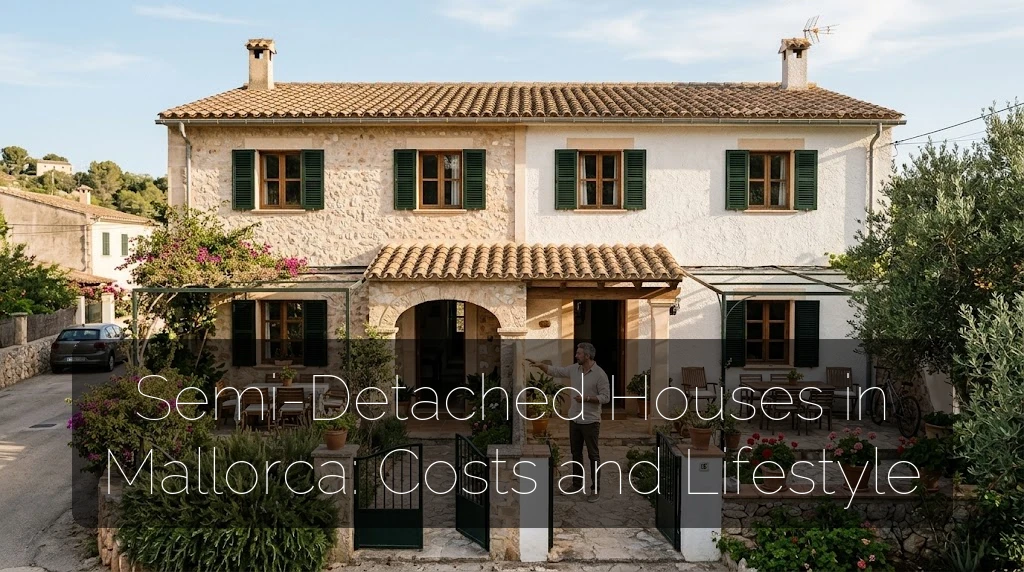
Choosing between a semi-detached house, a townhouse and a detached villa on Mallorca comes down to three things: how much privacy you need, how much upkeep you will put up with, and what the full bill looks like once taxes and community fees arrive. Semi-detached houses in Mallorca, known locally as casas pareadas, sit between the extremes, which is both their appeal and their trap. This guide covers what the shared wall means day to day, what asking prices looked like in November 2026, and which checks belong on your list before you shortlist one. I’m David, a Mancunian who has spent more than ten years helping English-speaking buyers in Spain, so expect plain talk and the odd grumble about paperwork.
Semi-detached houses in Mallorca (casas pareadas) share one party wall but usually offer private living space and often a terrace, garden or shared facilities, with a different maintenance and privacy balance from a detached villa. Price and annual costs depend on location, condition and community obligations. Budget for Balearic purchase taxes, community fees, insurance and upkeep.

What Is a Semi-Detached House in Mallorca?
A semi-detached house (casa pareada in Spanish) is a house that shares one party wall with one neighbouring house and has open elevations on its other sides. That single shared wall is the whole architectural definition. Everything else, including who owns the garden, the pool, the driveway and the roof, is a separate legal question that a listing headline cannot answer.
Semi-detached vs terraced vs detached
A casa adosada (townhouse) usually sits in a row. Middle units share walls on both sides, and only the end units share a single wall. A chalet independiente (detached villa) stands free on its plot with no shared structural wall. Mallorcan listings mix these labels freely: an end-of-terrace house is sometimes advertised as a pareado, and a pareado inside a development may be sold as an adosado. Ten years on the Costa del Sol have taught me that agents use the words loosely there too, so the label tells you very little.
| Type | Shared walls | Private outdoor space | Privacy | Upkeep | Legal points to check |
|---|---|---|---|---|---|
| Casa pareada (semi-detached) | One party wall | Often a garden or terrace on three sides, size varies | Moderate: one neighbour next door | Owner usually maintains own roof, facade and garden; party wall is shared | Own plot or part of a community; party wall ownership; exclusive-use areas |
| Casa adosada (terraced townhouse) | One wall (end unit) or two walls (middle unit) | Often a small patio, roof terrace or modest garden | Lower, particularly in middle units | Smaller footprint, often shared services or communal areas | Frequently within a community; statutes and fees matter |
| Chalet independiente (detached villa) | None | Usually the largest, all sides | Highest, subject to plot size and neighbours’ windows | Owner carries everything: pool, garden, boundary walls | Plot boundaries, licences for pool and extensions |
| Dúplex-style listing | Varies: may be a two-floor flat in a block | Terrace or balcony, sometimes a roof terrace | Depends on neighbours above, below and beside | Building elements are communal | Horizontal property; the building structure is community-owned |
Why a duplex is not necessarily a semi-detached house
A dúplex describes a layout over two floors, not a wall arrangement. A dúplex can be an upper-floor flat inside a block with neighbours above, below and beside, which is a very different proposition from a house with its own ground-level front door. Conversely, a genuine semi-detached house on three floors is not automatically a “duplex” in listing language. Ask whether the home has its own entrance from the street or plot, and whether anyone lives above or below it.
Architecture is not ownership
House configuration does not establish who owns the land or the facilities. Some pareados each stand on their own registered plot with an independent title. Others are units within a development under the Ley de Propiedad Horizontal, where the pool, access road and landscaped areas may belong to the comunidad de propietarios, while a garden may be private or an exclusive-use area of a common plot. Always ask for the nota simple before you commit, because it shows how the registry describes the property and what charges sit on it.
The Everyday Lifestyle: Space, Privacy and Neighbours
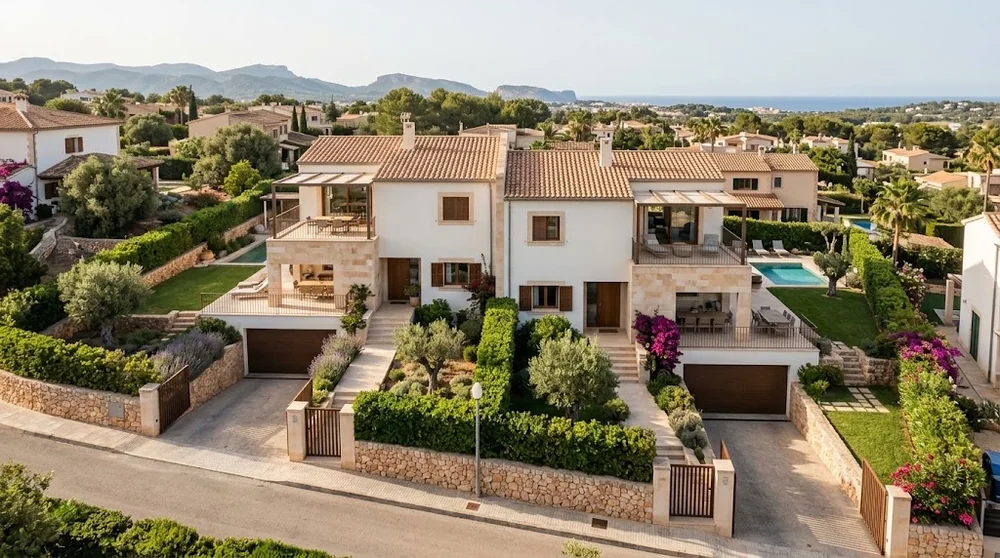
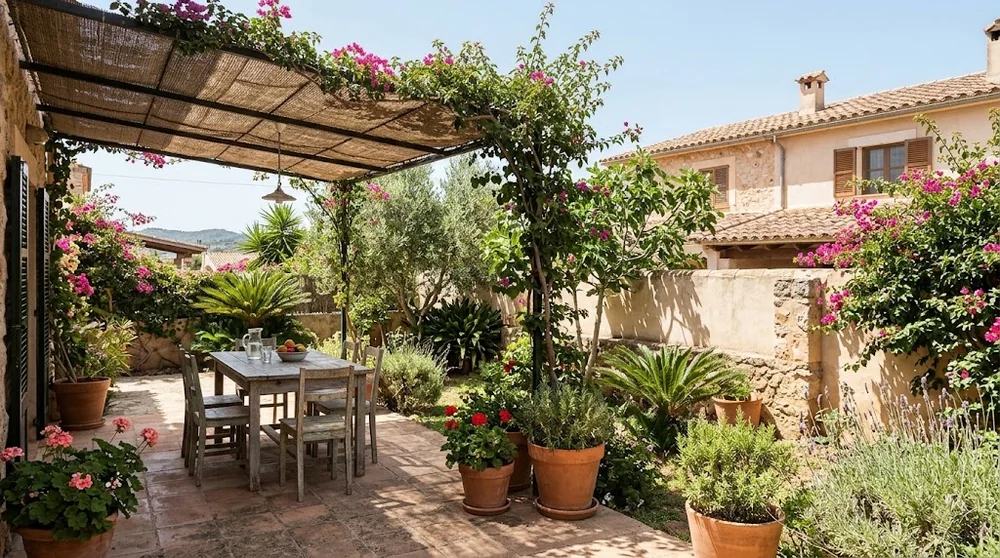
Living in a semi-detached house is mostly about the things you do not notice until you have moved in: the sound of a neighbour’s television through the party wall, where the bins go, and whether your terrace is in shade at five in the afternoon in August. The house is usually laid out over two floors, sometimes three, with living space at ground level and bedrooms upstairs. Gardens range from a paved courtyard to a generous plot with room for a private pool, so never assume a semi-detached house has a garden or shared facilities; confirm each one in the documents.
Shared-wall noise is the question I hear most. Modern developments generally have better acoustic separation than older village-edge houses, where a single brick or stone wall may carry voices and music. Visit at an evening hour and listen from the bedroom and the terrace. Parking deserves the same scrutiny: a private driveway, a garage, a communal space or on-street parking lead to very different daily lives, particularly in winter when you want to unload shopping in the rain.
Climate shapes comfort more than most buyers expect. Mallorca summers are hot, so shade, cross-ventilation and orientation matter. A west-facing terrace may be lovely in the evening and unusable in July. Winters are mild but can be damp, and homes with poor insulation, little sun and no heating can feel cold and develop condensation or mould. Check for reversible air conditioning, the type of heating, window quality, roof insulation and signs of damp on the party wall. Here’s where people usually come unstuck: they judge a house on a bright June viewing and never ask how it feels in January.
Why families choose semi-detached homes
Families tend to like the combination of a front door at street level, outdoor space for children and, in many developments, a pool or play area shared with neighbours. A semi-detached house often costs less than a comparable detached villa on a similar plot, although that depends on location, and I would not treat it as a rule. Staircases, a garden gate, access to schools and healthcare, and the layout of bedrooms matter more than the headline size. A communal pool also removes the chore of maintaining your own, though not the community fee that comes with it.
What retirees and second-home owners should consider
Retirees should examine stairs, the position of bedrooms and bathrooms, step-free access from the parking area, and the distance to a pharmacy and a medical centre. A hypothetical retired couple who love a three-floor house may find that, ten years on, the stairs decide the matter. Seasonal owners face different tests: security when the house stands empty, a reliable key-holder, water and electricity management, and whether the community is busy or deserted in winter. A realistic twelve-month evaluation walks through each season: summer heat and parking, autumn storms and roof drainage, winter damp and heating bills, spring garden growth and pool opening. If the house passes in all four, you have a home rather than a holiday impression.
My opinion, not a rule: when a buyer can only afford to inspect once, I would rather they see the house on a grey November afternoon than on a sunny day in May.
Where to Find Semi-Detached Homes in Mallorca
Semi-detached homes are not evenly spread across the island. A thinkSPAIN category page for Mallorca named Llucmajor, Calvià and Palma de Mallorca among the places with the most semi-detached villa listings in a November 2026 check, with Marratxí among the cheaper areas. That reflects one portal’s advertised stock and says nothing about every municipality, and some towns will offer only a handful of listings at any moment. Treat the table below as a shortlist aid, not a guarantee of choice.
| Area | Residential character | Everyday amenities | Potential trade-offs | Suitable buyer |
|---|---|---|---|---|
| Palma de Mallorca and outskirts | Urban and suburban, year-round life | Main hospitals, schools, shopping, transport, airport on the city edge | Higher prices, traffic, limited inventory of true pareados in central districts | Permanent residents and families wanting services |
| Marratxí | Suburban municipality next to Palma | Everyday shopping, schools, road links to the capital | Less sea access, busy commuter roads | Families and working residents seeking Palma access |
| Llucmajor | Large municipality with varied settings, from town to coastal and countryside urbanisations | Town services in the main centre; coastal areas vary | Distances within the municipality are significant; check winter activity | Buyers wanting more space and a range of price points |
| Calvià and southwest coast | Coastal urbanisations and resort districts with established communities | Marinas, golf, restaurants, international schools nearby | Seasonal quiet in resort zones; coastal premium | Second-home owners and residents wanting coastal access |
| Northern Mallorca | Quieter towns and coastal developments around Alcúdia, Pollença and the northeast | Local shops and services; seasonal hospitality | Further from Palma’s hospitals; strong seasonality | Quiet family or second-home buyers |
Palma and Marratxí for year-round convenience
Palma holds the island’s largest concentration of public and private hospitals and clinics, schools, shops and public transport, and the airport sits on the edge of the city. Marratxí lies immediately beside it and offers a suburban pattern of streets, schools and shops with road access to the capital. For a permanent resident this combination removes much of the winter isolation that worries some buyers. Check school catchments and the language of instruction, because teaching in Balearic state schools is largely in Catalan, and check bus routes and parking in the street rather than assuming them.
Llucmajor for space and varied residential settings
Llucmajor is a large municipality, so its character varies from a traditional town centre to coastal and countryside urbanisations. Its portal listings include four-bedroom semi-detached villas with pools at the upper end of mid-range prices, but quality varies, and distances between a particular urbanisation and the nearest supermarket or health centre should be checked on a map and then on the road. Winter activity can be limited in some urbanisations, which suits some owners and frustrates others.
Calvià and southwest Mallorca for coastal access
Calvià contains well-known coastal areas such as Santa Ponça and Palmanova, plus smaller developments inland. Its semi-detached villas sit at a markedly higher price point than the island-wide portal average, reflecting the coastal location, and some resort districts are quiet outside the main season. I compare it to parts of the Costa del Sol: lovely in June, and very different in February. Visit out of season before you decide.
Northern Mallorca for quieter family and second-home options
Around Alcúdia, Pollença and the northeast, semi-detached homes tend to appear in residential developments close to beaches, with a seasonal rhythm in shops and restaurants. Check healthcare access, local schools, the airport journey by road, and the winter opening patterns of the shops you would use weekly. I have not assumed any journey times here, and you should measure them for the specific property.
How Much Do Semi-Detached Houses Cost in Mallorca?
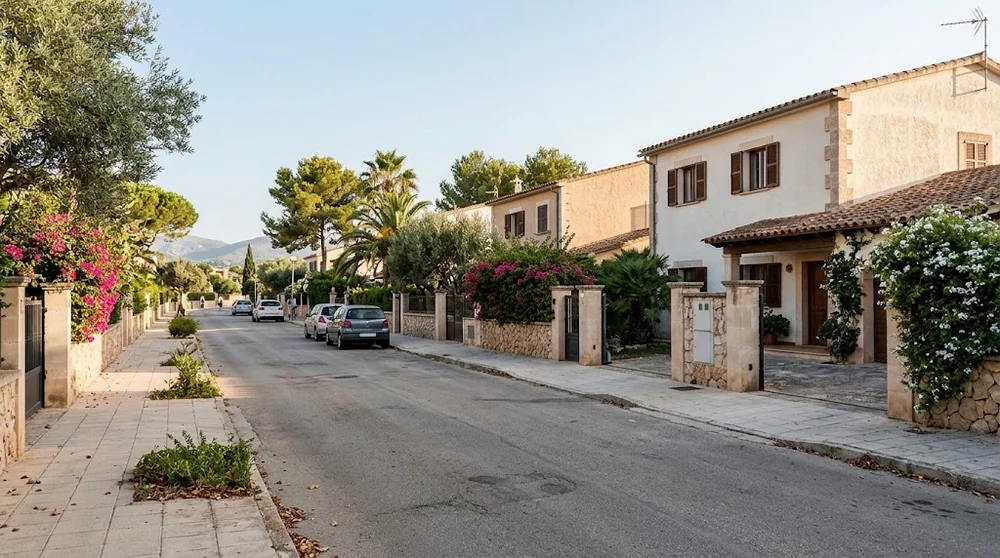
There is no single official price for semi-detached houses in Mallorca. The figures available are advertised asking prices from property portals, and those are different from completed sale prices, which appear later in registry and notarial statistics. Broad Mallorca house price averages and semi-detached-specific averages are also different datasets, and one should never be quoted as if it were the other.
Dated portal snapshot (November 2026)
A November 2026 check of thinkSPAIN category pages gave the following. Categories are labelled by the portal, sample sizes are small, and the figures are mean asking prices, not transaction prices. The Mallorca-wide listing count also moved between pages checked (127 on one, 117 on another), which shows how quickly portal stock changes.
| Portal category and area | Listings in sample | Average asking price | Average per m² |
|---|---|---|---|
| Semi-detached villas, Mallorca | 127 | €860,791 | €4,712 |
| Semi-detached villas, Calvià | 10 | €1,450,000 | €8,055 |
| Semi/terraced villas, Marratxí | 12 | €765,000 | €4,740 |
| Semi/terraced villas, Capdepera | 14 | €895,000 | €4,081 |
| Semi/terraced villas, Santanyí | 4 | €530,000 | €4,108 |
The rows are not like for like: “semi/terraced villas” is a broader portal category than “semi-detached villas”, and a sample of four properties tells you almost nothing. The Calvià figure of €8,055 per square metre against €4,712 island-wide shows why one average hides the variation between municipalities. Per-square-metre figures also depend on the area measured, so ask whether the quoted area is built area, usable interior area, or a total that includes terraces and garden. In Spain, terraces are usually valued at a lower rate than interior space, and garden land at lower again.
What drives the price
- Location: coastal Calvià or Palma neighbourhoods command a premium over inland Marratxí or Llucmajor.
- Built area and layout: usable interior space, number of floors and bedrooms.
- Outdoor space: private garden, terrace, roof terrace, and any private pool.
- Views and orientation: sea views and a sunny aspect add value; shaded plots reduce it.
- Parking: private garage or space versus street parking.
- Condition: new, reformed or needing work, plus insulation and energy rating.
- Community arrangements: shared pool and gardens affect both price and annual cost.
An illustrative €600,000 house
For the examples in this guide, I use a clearly hypothetical resale semi-detached house at €600,000: roughly 125 m² built at about €4,800 per m² (125 x 4,800 = €600,000), with a small garden and terrace. It is a calculation device, not a typical island-wide price and not a listing. Its per-square-metre figure is close to the island-wide portal average above, but a similar house in coastal Calvià could cost much more, and one in an inland village much less.
Buying Costs: Taxes, Fees and a Realistic Budget
The agreed price is not the full cost of buying. The purchase tax is the largest addition, and the rate depends on whether you buy a resale home or a new one. As of November 2026, a resale house in the Balearics is generally subject to ITP (Impuesto sobre Transmisiones Patrimoniales), administered by the Balearic tax agency ATIB and governed by the regional consolidated tax text, which is available through the BOE consolidated text of Decreto Legislativo 1/2014. ATIB publishes the current practical guidance on rates and forms, so confirm the figures with them or your adviser before you budget.
Resale purchase example
The general ITP scale is progressive, so each rate applies only to the slice of value within its band. As of November 2026, the general bands are as follows. Some portals show the 13% band starting at €3 million, but the consolidated legal text and most tax guides checked show it starting above €2 million, so confirm the current figure with ATIB or your adviser if your purchase is anywhere near those levels.
| Taxable base band | Rate on that band | Cumulative ITP at top of band |
|---|---|---|
| Up to €400,000 | 8% | €32,000 |
| €400,000.01 to €600,000 | 9% | €50,000 |
| €600,000.01 to €1,000,000 | 10% | €90,000 |
| €1,000,000.01 to €2,000,000 | 12% | €210,000 |
| Above €2,000,000 | 13% | Not capped |
For the hypothetical €600,000 resale house, assuming the taxable base equals the price and no relief applies, ITP is €32,000 (8% of €400,000) plus €18,000 (9% of €200,000), which gives €50,000. The taxable base is not always the agreed price: as of November 2026, the general rule is that the tax is calculated on the higher of the price declared and the administration’s reference value (valor de referencia), which is derived from cadastral data. A buyer who agrees a low price against a higher reference value may still pay tax on the higher figure, so check the reference value for the specific property before signing.
| Illustrative item | Assumption | Amount |
|---|---|---|
| Purchase price | Hypothetical resale house | €600,000 |
| ITP | Standard bands, base equals price, no relief | €50,000 |
| Independent solicitor | Placeholder of 1% of price, VAT excluded | €6,000 |
| Notary and land registry | Placeholder, varies by deed | €3,000 |
| Administration and gestoría | Placeholder | €600 |
| Technical survey | Placeholder for an architect or surveyor | €800 |
| Total extra costs | 50,000 + 6,000 + 3,000 + 600 + 800 | €60,400 |
| Total outlay | 600,000 + 60,400 | €660,400 |
Those professional fees are my illustrative assumptions, not quotations, and your own figures will differ. On these assumptions the extras are about 10% of the price. A deposit, such as 10% (€60,000) paid on signing a private contract, is not an extra cost: it counts towards the €600,000 price and is deducted from what you pay at completion.
New-build tax differences
A first sale of a new residential property by a developer is generally subject to IVA (VAT) at 10% as of November 2026, not to ITP. On a €600,000 new-build price that would be €60,000 before any other costs. Actos Jurídicos Documentados (AJD, stamp duty) is charged separately on the notarial deed, and published guides disagree on the exact Balearic rate and its thresholds, so I will not quote a universal figure here. Ask your solicitor to confirm the current AJD rate against the official regional text before you budget.
Reduced ITP rates and tax benefits exist in the Balearics for certain buyers purchasing a main home within value limits, such as younger buyers or large families. ATIB updated the relevant value thresholds through a regional order published in March 2026, and the figure identified for Mallorca and Menorca effective 14 June 2026 is €331,859.70. That is a threshold, not an entitlement: a British second-home buyer should not assume eligibility, and the specific conditions need checking with ATIB or an adviser.
Annual Running Costs and Community Responsibilities
Owning a semi-detached house adds a layer of recurring bills to the purchase price. These differ from property to property, so the worksheet below uses explicit placeholders that you should replace with real documents from the seller. It assumes the hypothetical €600,000 house, with a community fee and a non-resident owner, which makes it a fuller example than many buyers will actually face.
| Item | Illustrative annual assumption | How to replace it with real data |
|---|---|---|
| IBI (Impuesto sobre Bienes Inmuebles) | €900 | Latest receipt from the town hall |
| Refuse charge | €150 | Municipal bill |
| Buildings and contents insurance | €500 | Quote based on build size and contents |
| Utilities (electricity, water, internet, gas) | €2,400 (€200 a month) | Last 12 months of bills, including air conditioning |
| Community fee | €1,200 (€100 a month) | Approved annual budget and your participation share |
| Maintenance allowance | €3,000 (0.5% of €600,000) | Survey report and age of roof, windows, installations |
| Garden, pool and key-holding for an absent owner | €600 | Local quotes if not covered by the community |
| Non-resident income tax on imputed income | €1,200 | Assumes a €250,000 cadastral value, 2% imputed income (€5,000) at 24% |
| Total | €9,950 | 900 + 150 + 500 + 2,400 + 1,200 + 3,000 + 600 + 1,200 |
The last row applies only to non-resident owners who do not rent the property out, and the rate and method depend on residence status, so a tax adviser should confirm it. It is a Spanish tax on imputed income from owning a second home, not a tax on actual profit. As of November 2026, the Agencia Tributaria sets the rules, and its official website publishes the current non-resident forms. Mortgage payments are not included, and an owner who lives in the property permanently will have a different set of tax outcomes.
What do community fees actually cover?
Not every semi-detached house belongs to a comunidad de propietarios. Where there is one, the fee typically covers shared pools, gardens, lighting, roads, security, insurance on common areas and an administrator. Shared facilities may lower your personal workload, but they do not guarantee lower total spending: a development with a large pool and landscaped grounds can have a higher fee than a modest apartment block. Ask for the approved budget, the last two or three sets of meeting minutes (actas), the reserve fund balance, and details of any approved or proposed special assessments (derramas) for roof, facade, pool or road repairs.
The Ley de Propiedad Horizontal also matters when buying. As of November 2026, a buyer of a property within horizontal ownership can be affected by community debts attached to the property from the year of acquisition and the preceding three calendar years. A seller’s verbal assurance is not evidence, so request a signed certificate of community debt from the administrator.
What repairs remain the owner’s responsibility?
In a typical semi-detached house, the owner maintains the interior, their own roof, windows, facade and private garden. The party wall is usually shared with the neighbour, and the title or community statutes should say who pays for what. Elements such as drains, shared boundary walls, roofs that run across both houses, and exclusive-use terraces can be unclear. Here’s where people usually come unstuck: they assume the community pays for the roof, when the statutes assign it to the individual owner.
Professional observation: I have seen community budgets that looked modest until a major repair was approved. Always read the minutes as well as the budget.
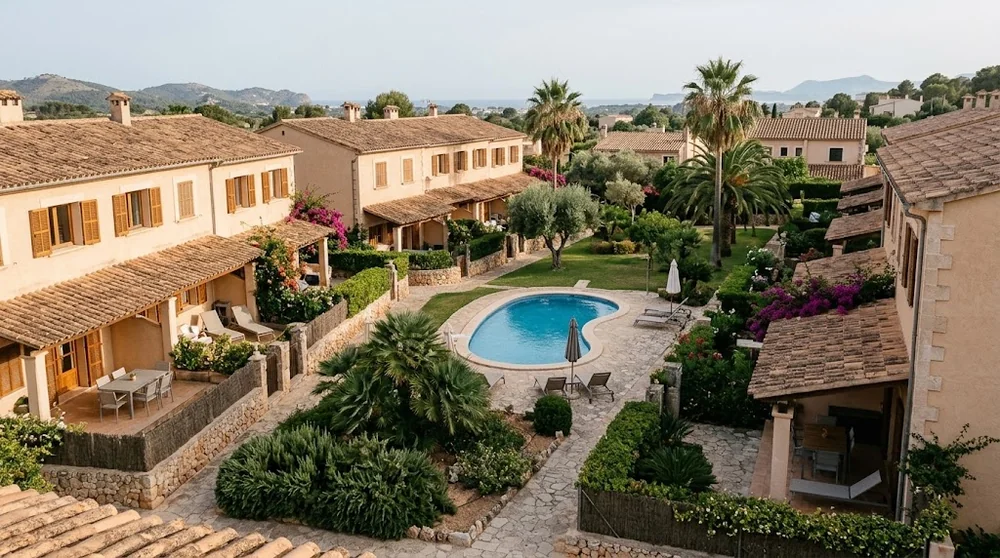
Semi-Detached vs Townhouse, Apartment and Detached Villa
The right property type depends on how you will use the home, not on which label sounds nicest. The matrix below uses conditional wording because outcomes depend on design, condition and community arrangements, so each cell describes a general tendency rather than a rule.
| Factor | Semi-detached | Townhouse | Apartment | Detached villa |
|---|---|---|---|---|
| Privacy | Moderate, one shared wall | Lower, especially in middle units | Depends on building and floor | Highest, subject to plot size |
| Outdoor space | Often a garden or terrace | Often a patio or roof terrace | Balcony or terrace, sometimes communal | Largest, all around |
| Maintenance control | Mostly yours, with shared wall questions | Often shared or managed | Mostly community | Entirely yours |
| Communal expenses | Only if in a community | Commonly in a community | Almost always | Often none |
| Accessibility | Often stairs; check bedrooms | Often several floors | Level access if a lift or ground floor | Single-level designs exist |
| Security when empty | Neighbour on one side helps | Neighbours on one or two sides | Building access control helps | Relies on alarm and key-holder |
| Price variability | Wide, depends on location | Wide | Wide | Widest |
| Parking and storage | Garage or space often included | Often limited | Often extra | Usually ample |
Here are four hypothetical buyers. None of them is a real client, and each is a thinking aid rather than advice.
- A relocating family wanting schools and a garden may find a semi-detached house in Palma’s suburbs or Marratxí balances space, price and services better than an apartment or an isolated villa.
- A retired couple may prefer a single-level apartment with a lift or a bungalow-style detached home, because stairs and upkeep matter more than garden size.
- A seasonal British owner may value the lock-up-and-leave quality of a semi-detached house in a managed community, provided the fees and key-holding arrangements are sensible.
- A garden-focused buyer who wants private outdoor space without full villa maintenance may find a semi-detached house with its own garden the sweet spot, though a detached villa will give greater privacy at a greater upkeep cost.
A detached villa may suit a buyer who needs sound separation, space for guests or a private pool without any community involvement. An accessible single-level apartment may suit someone with mobility concerns. A semi-detached house is not the default answer; it is simply the right answer for people who want a house, accept one neighbour on a shared wall and can live with some community rules.
Legal and Structural Checks Before Buying
Spanish property law and Mallorcan planning practice are not identical to the rules I know on the Costa del Sol, so please do not assume a checklist from Marbella transfers cleanly. My advice to every British buyer is to appoint an independent Spanish property solicitor, and an architect or surveyor where the building warrants it, before paying any deposit. The numbered list below is a prioritised starting point, not a replacement for professional advice.
- Nota simple from the Registro de la Propiedad. Confirms the registered owner, the description of the property, mortgages, embargoes and other charges.
- Catastro consistency. Compare the cadastral reference, built area and plot with the registry description; mismatches signal unregistered extensions.
- Legal plot boundaries. Check the title deed and plans for the exact boundary lines and what is private versus shared.
- Party wall status. Ask who owns and maintains the shared wall, and whether pipes, beams or roofs cross the boundary.
- Extensions, terraces, pools and garages. Confirm each exists in the registry and has planning permission; unlicensed work can create fines or limits on use.
- Planning status at the town hall. Ask about land classification, open planning files and any enforcement proceedings.
- Occupancy documentation. Request the habitability certificate or equivalent where applicable.
- Energy performance certificate. A valid certificate is generally required for a sale.
- Private versus common ownership. Verify which gardens, pools, driveways and roofs are private, shared or exclusive-use.
- Community statutes. Read the rules on rental, pets, works and who pays for which element.
- Approved budget and meeting minutes. Check the last two or three years for disputes, repairs and fee increases.
- Debt certificate. Obtain a signed certificate from the community administrator confirming no arrears.
- Planned works and special assessments. Ask what has been approved or discussed and who pays.
- Independent technical inspection. An architect or surveyor can check structure, damp, roof, electrics and plumbing.
Item 12 matters because, as of November 2026, Article 9 of the Ley de Propiedad Horizontal makes a buyer of a property in horizontal ownership answerable, through the property itself, for community debts from the year of acquisition and the three preceding calendar years. Never rely on a notary to catch every problem: the notary formalises the deed and checks identity and certain tax information, but is not hired to audit planning history, physical condition or community finances. That is the job of your solicitor and technical adviser.
Red flags specific to semi-detached homes
- A party wall that looks thinner, newer or different from the rest, which may signal an altered or illegally moved division.
- A terrace, garage, extra floor or pool that appears on the property but not in the registry or Catastro.
- Drains, pipes or roof timbers that cross into the neighbour’s house, without a written arrangement.
- A “private” garden that the title shows as a common area with exclusive use, and no document to support the exclusivity.
- A seller or administrator who delays providing the community debt certificate.
- Visible damp or condensation along the party wall or in north-facing rooms.
Personal view: if a seller will not show you the registry description, the community minutes and the planning status, treat that as information in its own right.
British Buyers: Residence and Rental Restrictions
British nationals can generally buy residential property in Spain, including Mallorca, but ownership does not create immigration rights. That is one of the biggest post-Brexit misunderstandings I deal with. As of November 2026, ordinary visa-free visits are generally limited to 90 days in any rolling 180-day period across the Schengen area. A British owner who wants to stay longer needs an appropriate immigration status, and the routes and conditions change, so check them with a specialist before assuming a plan will work.
To buy at all, you need an NIE (número de identidad de extranjero), the foreigner identification number used for tax and property transactions. Your independent solicitor can usually obtain it and will act for you, not for the seller or the agent. Some locations in the Balearics can also raise military-authorisation questions for certain non-EU acquisitions, under Spanish national-defence zone rules dating from 1975. Whether authorisation is needed depends on the specific property, its location and any exemptions, and I have not assumed that it applies to any particular semi-detached house. Ask your specialist to verify it before you sign a binding contract.
If you are unsure which documents, taxes or residence rules apply to your own situation, a short one-to-one conversation can save weeks of guesswork before you commit.
Those answers will also shape how you use the property. It helps to separate three uses: personal use, long-term letting, and tourist accommodation. Tourist rental is the one buyers most often take for granted. Eligibility depends on the applicable Balearic rules, the property’s classification, municipal restrictions and, in a community, the statutes and owners’ votes. The presence of a pool or a location in a tourist area does not grant permission. Never assume an individual semi-detached house can be let to holidaymakers; verify its licence status in writing before you rely on rental income in any budget. All the legal statements in this section reflect my understanding as of November 2026 and may change.
A Practical Semi-Detached Home Viewing Checklist
Take this list to every viewing, and use the decision matrix above to remember which factors matter most to you. It is built to turn the earlier points on ownership, comfort, costs and documents into questions you can actually ask on the day, and it is deliberately not a full conveyancing procedure.
- Layout: Count the floors and stairs, and check whether bedrooms and a bathroom are on the same level as the living area.
- Boundaries: Ask exactly where the plot ends and whether any fence, wall or hedge sits on the line.
- Private or shared: Ask which garden areas, driveways and terraces are private, shared or exclusive-use.
- Party wall noise: Stand in each room on the shared wall and listen; ask the neighbour’s usual hours if you can.
- Sun and shade: Note orientation and visit at the time of day you would use the terrace most.
- Damp and insulation: Look for stains, peeling paint, mould in corners, and check windows, roof insulation and heating.
- Roof and party wall condition: Look for cracks, patched areas, uneven tiles and signs of water entry.
- Cooling and heating: Ask which units exist, their age, and last year’s electricity bills.
- Parking: Confirm whether parking is private, communal or on the street, and how easily you can reverse out.
- Year-round surroundings: Walk to the nearest shop, pharmacy and bus stop, and check what is open in winter.
- Community management: Ask who the administrator is, what the monthly fee covers and whether any special assessment is planned.
- Cost documents: Request IBI, refuse tax, utility bills and insurance details for the past 12 months.
- Paperwork: Ask the agent for the nota simple, energy certificate, habitability documentation and licences for any extensions.
- Extensions and works: Ask what has been built or altered since the house was first registered.
Pass the answers and documents to your independent solicitor before you reserve or pay a deposit. If the agent cannot answer these questions, that tells you something about the property or the agency.
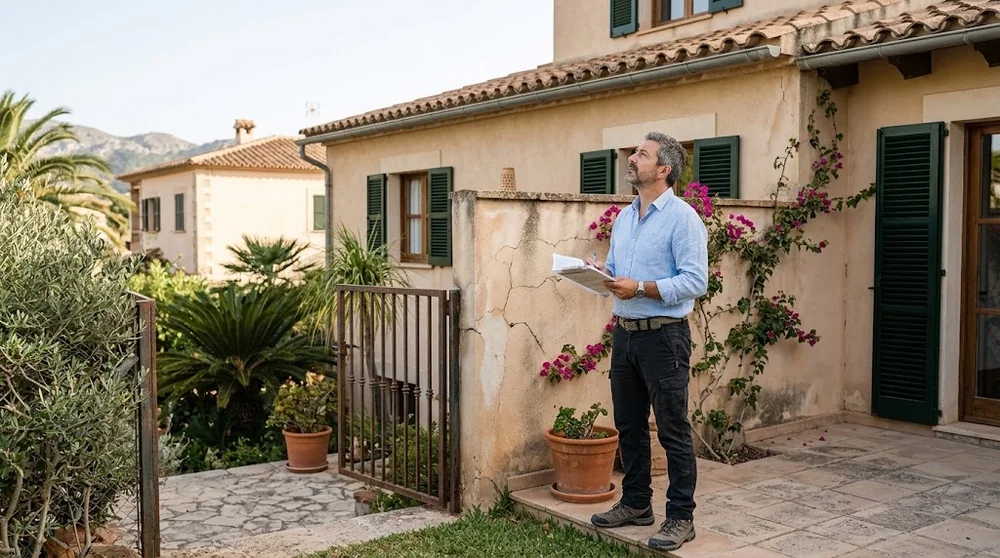
Frequently Asked Questions About Semi-Detached Living
How much does a semi-detached house cost in Mallorca?
Prices vary widely by municipality, size, condition and proximity to the coast. A thinkSPAIN category page for semi-detached villas in Mallorca showed an average asking price of roughly €861,000 in a November 2026 check, but that reflects advertised stock, not completed sales across the island. Compare individual properties and budget separately for purchase taxes and fees.
Is a semi-detached house the same as a townhouse in Mallorca?
Not necessarily. A semi-detached house, usually described as a casa pareada, typically shares one wall with another home. A terraced townhouse, or casa adosada, may form part of a longer row. Spanish property advertisements sometimes mix the terms, so check the building layout, plot boundaries, title and community arrangements rather than relying on the listing category.
Are semi-detached homes suitable for living in Mallorca all year?
Yes, many semi-detached homes are practical for permanent living, particularly in residential areas with schools, shops, healthcare and transport nearby. Check winter heating, insulation, humidity, parking and noise as carefully as summer outdoor space. For older buyers, stairs and access to bedrooms and bathrooms may matter more than the size of the garden.
What ongoing costs should I budget for a semi-detached home?
Annual ownership costs can include IBI property tax, refuse charges, insurance, utilities, repairs and, where applicable, community fees for shared gardens, pools or other services. Some owners also have non-resident tax obligations. Request recent bills, community budgets and details of planned works to produce a property-specific estimate rather than relying on an island-wide average.
Can a British citizen buy a semi-detached house in Mallorca and live there permanently?
British citizens can generally buy property in Mallorca, subject to applicable legal checks, but owning a home does not provide automatic residency. As of November 2026, visa-free visits are normally limited to 90 days within a rolling 180-day Schengen period. Longer stays require an appropriate immigration status. Buyers should also ask their solicitor whether any military-authorisation rules apply to the specific property.
Is a Semi-Detached Mallorca Home Right for You?
A semi-detached home suits buyers who want a house with its own front door, some private outdoor space and a more manageable upkeep than a detached villa, and who can accept one neighbour on the other side of a shared wall. It works well for families who value services and space, and for seasonal owners who want a lock-up-and-leave property in a well-run community. It is less suitable for anyone who needs complete acoustic privacy, a large private plot, or step-free living, where a detached villa or a single-level apartment may serve better.
The decision rests on four things: your daily lifestyle needs, your total budget including taxes and annual costs, how long you plan to stay each year, and how comfortable you are with community responsibilities. Let me put it plainly: a house that fits on all four is worth more to you than a bigger one that fails on a single point, such as damp, noise or an unclear title.
If you would like help narrowing down areas, budgets and property types that match your plans, a short guided questionnaire can turn this guide into a personal shortlist.
Whatever you do next, shortlist two or three areas, estimate the total cost for each using the worksheets above, and put the legal and technical checks in the hands of independent professionals before you commit any money.
Disclaimer: this article is general information as of November 2026 and is not personalised legal, financial or tax advice. Tax rates, thresholds, residence rules and local regulations change, and the cost examples are illustrative assumptions rather than quotations. Consult an independent Spanish property solicitor and, where appropriate, a tax adviser, architect or surveyor before making any purchase decision.