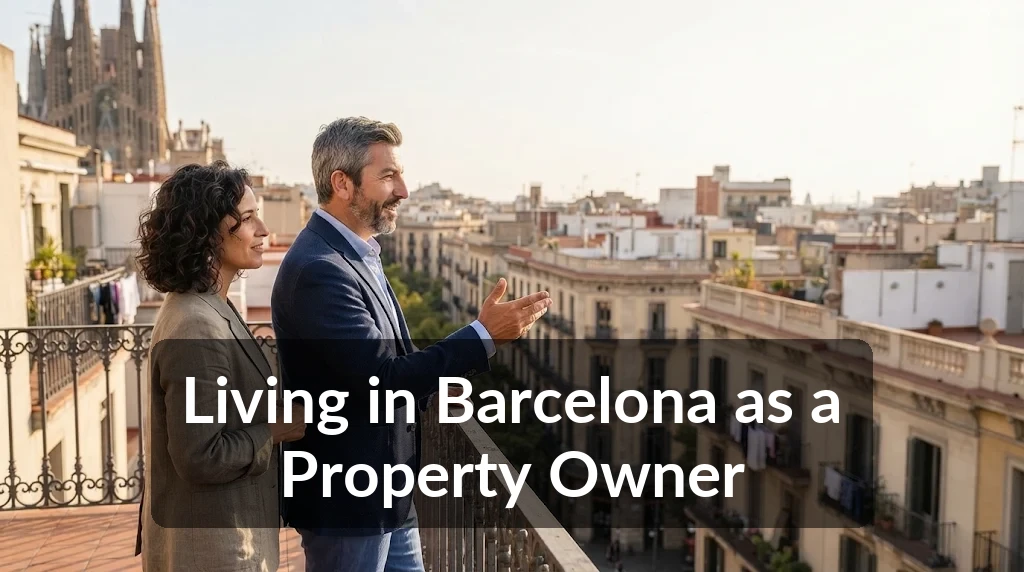
Barcelona sells itself in a long weekend: beach, tapas, Gaudí and a metro that actually turns up. Owning a flat there for the other 358 days of the year is a different proposition, with neighbours to deal with, a tax calendar and a lift that either exists or doesn’t. I’m David, a Mancunian who has helped British buyers across Spain from Marbella for over ten years, and this guide covers what changes once the keys are yours. The figures come from official sources and a dated Idealista report, and my own opinions are labelled as opinions.

Living in Barcelona as a property owner offers Mediterranean city life, excellent public transport and neighbourhoods ranging from historic Gràcia to family-friendly Sarrià. Owners avoid rent but still face property taxes, community fees, maintenance and utilities. The main trade-offs are high purchase prices, tourist pressure, older buildings and residency restrictions for non-EU citizens.
What Is Living in Barcelona Really Like?
Living in Barcelona as an owner means a dense, walkable Mediterranean city where most daily life happens within a few streets, combined with responsibility for a flat, a building and a calendar of bills. A week’s holiday shows you the first half. Ownership adds the second half, and renter-focused expat guides tend to skip it.
The benefits of living in Barcelona
- Walkability and transport. Many errands can be done on foot, and metro, bus, tram and suburban trains cover most of the city, so a car is optional for many central households.
- Beaches and green space. The city has public sand beaches along its seafront, and the Collserola hills give you woodland walking at the edge of town.
- Food and culture. Neighbourhood markets, long lunches and local festivals give each area its own rhythm. The August street festival in Gràcia is a well-known example.
- An established international community. English is widely heard in business and tourism, although day-to-day administration runs in Spanish and Catalan.
- No landlord. Nobody can raise your rent or end your tenancy, which is the biggest emotional difference between owning and renting.
The everyday trade-offs
- High purchase prices. Asking prices are high, as the October 2026 data later in this guide shows.
- Tourist pressure. Crowds concentrate in Ciutat Vella, around the Sagrada Família and along the seafront, and they affect shops, pavements and noise.
- Noise. Late dinners, terraces, scooters and night-time refuse collection can reach street-facing bedrooms.
- Summer humidity. After a Manchester upbringing I know damp, but Barcelona’s humid summer nights are another matter, and a flat without cross-ventilation can be stuffy.
- Responsibility. A leak from the flat above or a vote on roof repairs becomes your business, and a holiday landlord never has to think about that.
The prices, fares and rules in this guide are sourced and dated. The lifestyle judgements, such as how much noise is too much, are mine and will vary from person to person.
Best Barcelona Neighbourhoods for Property Owners
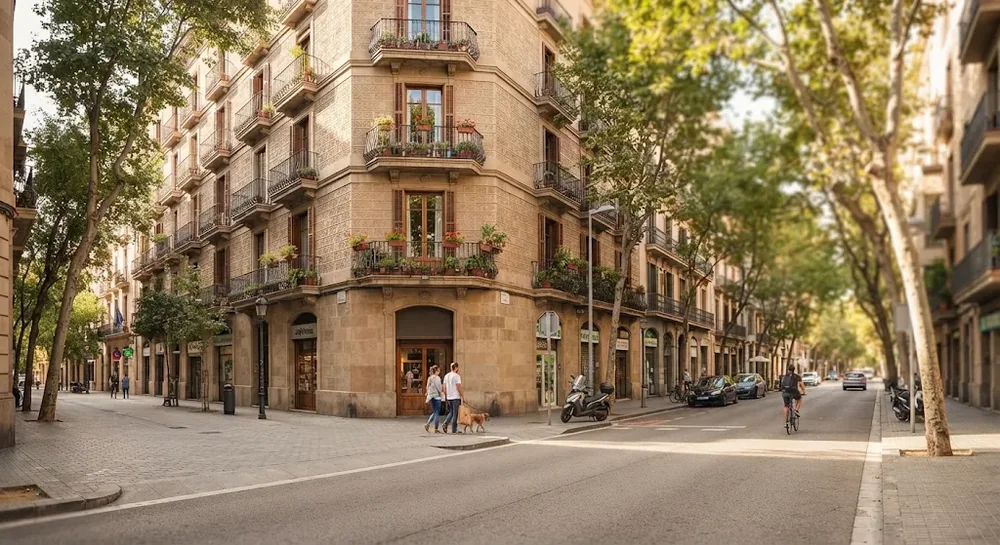
The best Barcelona neighbourhood for an owner depends less on the district name than on the building: its age, whether it has a lift, which way it faces and how noisy the street is. The table below compares the main districts on that basis.
| District | Atmosphere | Typical housing | Suitable owner | Main advantage | Main drawback |
|---|---|---|---|---|---|
| Eixample | Central, gridded, busy | Early 20th-century apartments; lifts vary by building | Owners wanting central convenience | Services and transport at the door | Traffic noise; older buildings can bring shared repair bills |
| Gràcia | Village feel, squares, independent shops | Smaller older flats, often in low-rise buildings | Couples and owners who value local identity | Strong neighbourhood character | Small flats, stairs, summer noise around squares |
| Poblenou (Sant Martí) | Seafront, creative, flat | Converted industrial lofts and newer blocks, often with lifts | Professionals and remote workers | Beach access and newer stock | Busier near the beach in summer |
| Sarrià-Sant Gervasi | Residential, leafy, calmer | Larger family flats and houses on higher ground | Families wanting space | Schools and green space | Highest asking prices in the dataset below; hills |
| Les Corts | Practical residential, university and business pockets | Mid-century and newer blocks, many with lifts | Families and professionals | Everyday services and transport | Less historic charm; event traffic near the stadium |
| Ciutat Vella | Historic core, intense street life | Very old buildings, small flats, narrow streets | Owners who prize character | Walkability and heritage | Tourist pressure, noise, dark flats, repair liabilities |
| Sants-Montjuïc | Working-neighbourhood feel, rail hub, park | Mid-century blocks with some newer stock | Commuters and budget-sensitive buyers | Rail connections and lower asking prices | Mixed street quality; some flats without lifts |
| Nou Barris | Residential, hillside, local community | Post-war blocks, many on slopes | Buyers prioritising space and budget | Lowest asking price in the dataset below | Further from the centre; steep streets |
District-wide statistics can conceal large differences between neighbourhoods and even between two streets, so no district name tells you what a particular flat is like.
Eixample: architecture and central convenience
Eixample is the gridded 19th- and early 20th-century extension of the city, with tall ceilings, balconies and a shop on nearly every block. The ownership catch is the building: many older blocks have no lift or a small one, and shared facade and stairwell repairs are paid by all owners. Interior flats may be quiet but darker, while street-facing flats get light and traffic noise.
Gràcia: neighbourhood character
Gràcia keeps a village atmosphere around its squares, which is exactly why owners love it. Flats are often smaller and in low-rise buildings, so check stairs, natural light and what happens on the square below at midnight in July.
Poblenou: beach access and newer housing
Poblenou in the Sant Martí district is flat, bike-friendly and close to the sand, with a mix of converted factories and newer blocks that more often have lifts and better insulation. Newer stock usually means fewer nasty surprises in the walls, though community fees can be higher where buildings share pools or concierges.
Sarrià-Sant Gervasi and Les Corts: family life
Sarrià-Sant Gervasi and Les Corts attract households wanting schools, parks and calmer streets, and both have many blocks with lifts. Parking is easier on some streets but not guaranteed. Sarrià-Sant Gervasi is also the most expensive district in the October 2026 Idealista data.
Ciutat Vella: character and compromises
Ciutat Vella covers the Gothic Quarter, El Born, El Raval and Barceloneta. Buildings can be centuries old, flats small, and heritage rules and tourist crowds shape daily life. Owners should budget for shared-building works and noise.
Sants and Nou Barris: practical alternatives
Sants-Montjuïc and Nou Barris offer lower asking prices and, in Sants, excellent rail links. In hillier parts, step-free access is the question that matters most, because a flat above steep streets and many stairs ages badly with you.
Barcelona Property Prices and What Your Budget Buys
The citywide advertised average in Barcelona was €5,463 per square metre in October 2026, according to the Idealista city report, but individual districts ranged from €3,282 to €7,236. These are asking prices from listings, not completed sale prices or valuations.
| Area | Asking price per m² | Illustrative 80 m² flat |
|---|---|---|
| Sarrià-Sant Gervasi | €7,236 | €578,880 |
| Eixample | €6,675 | €534,000 |
| Gràcia | €5,616 | €449,280 |
| Barcelona city (average) | €5,463 | €437,040 |
| Sant Martí | €5,350 | €428,000 |
| Ciutat Vella | €4,867 | €389,360 |
| Sants-Montjuïc | €4,601 | €368,080 |
| Nou Barris | €3,282 | €262,560 |
An 80 m² flat at the citywide asking average comes to roughly €437,040 before taxes, notary and registry fees and any renovation. A real flat can cost materially more or less because condition, floor, lift, light, terrace and street all move the price. Idealista does not publish a Les Corts figure in the data used here, so I have not quoted one.
Three methodology points stop readers comparing incompatible numbers. First, Barcelona city is not Barcelona province, and the province includes towns with very different markets. Second, district averages are not neighbourhood or street data. Third, Idealista changed its methodology in July 2026, so comparisons with earlier months should be treated carefully. That is also why October 2026 Idealista figures differ from the February 2026 prices in older articles and from Fotocasa’s September 2026 neighbourhood figures: the reporting dates and methods are different. Datasets based on completed transactions, such as those compiled from notary and registry records, measure something else again.
Let me put it plainly: an asking price is a seller’s hope, not a market verdict. Treat it as a starting point for a conversation and a reason to look at what comparable flats actually sold for. That is my opinion, not a rule.
Monthly Cost of Living in Barcelona as a Homeowner
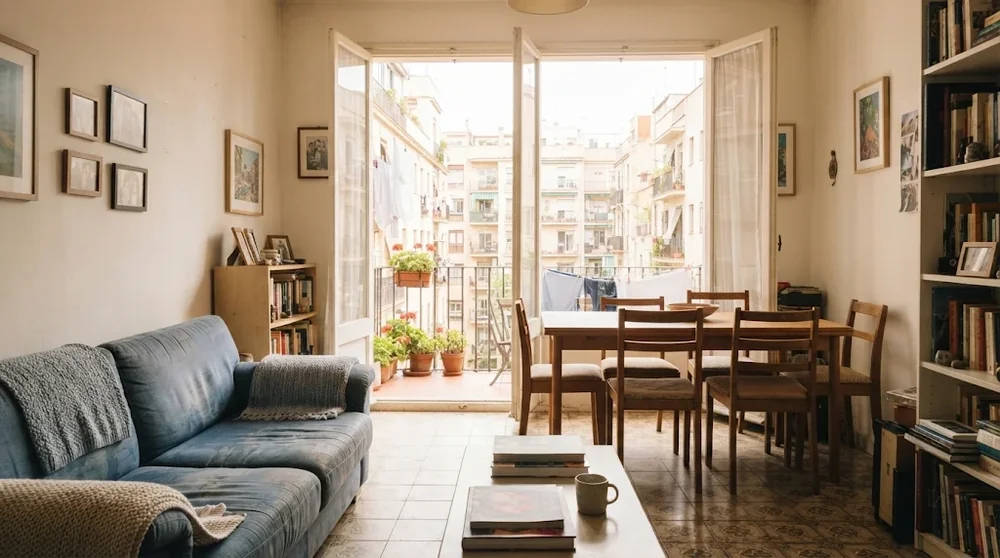
A mortgage-free owner in Barcelona avoids rent but still pays for food, utilities, transport, property tax, community fees, insurance and repairs, and the table below shows how those categories might look as an illustration. Only the transport fare is an official figure, the one-zone T-usual price for 2026. Every other amount is my own illustrative assumption, not an observed Barcelona average.
| Category | Single owner | Couple | Basis |
|---|---|---|---|
| Groceries and household | 250–350 | 450–600 | Illustrative assumption |
| Electricity and gas | 50–90 | 70–130 | Illustrative assumption |
| Water | 20–30 | 30–45 | Illustrative assumption |
| Internet and mobile | 40–60 | 60–90 | Illustrative assumption |
| Transport (one-zone T-usual) | 22.80 | 45.60 | Official 2026 fare per person |
| IBI property tax provision | 30–50 | 30–50 | Illustrative assumption; varies by property |
| Community fees | 60–120 | 60–120 | Illustrative assumption; varies by building |
| Home insurance | 15–30 | 15–30 | Illustrative assumption |
| Maintenance reserve | 80–150 | 80–150 | Illustrative assumption |
| Leisure and eating out | 200–350 | 350–600 | Illustrative assumption |
| Sum of the assumptions | about 770–1,250 | about 1,190–1,860 | Arithmetic only |
The calculation method is simple addition of the low and high assumptions in each column, so you can replace any line with your own quote. The property-related lines (IBI, community fees, insurance and the maintenance reserve) are the same for both households because they attach to the flat, not the people.
This example excludes mortgage repayments, one-off purchase taxes and fees, major renovation, private schooling, private health insurance, car costs and any exceptional building assessment. It matters because many expat cost-of-living estimates include rent, so they are not homeowner budgets. Subtracting a rent figure from them leaves out IBI, community fees and repairs, which are real costs of ownership.
Apartment age, household size, energy efficiency and location all move these numbers. A poorly insulated top-floor flat may cost far more to cool in summer than a newer block, and a building with a lift, concierge or communal pool will usually charge higher community fees.
Property Taxes, Community Fees and Owner Responsibilities
Owners in Barcelona pay a municipal property tax, contribute to their building’s running costs and may owe Spanish tax even when they are not resident, but not every owner has identical obligations. The main items are below, as of November 2026.
- IBI (Impuesto sobre Bienes Inmuebles). This annual municipal property tax is linked to the property’s cadastral value and the city’s applicable rate. Ask for the latest IBI receipt before buying, and check whether the cadastral record matches the flat.
- Comunidad de propietarios (community of owners). Each flat pays a share of the building’s ordinary costs, such as cleaning, lift maintenance, insurance and any reserve fund. Shares depend on the building’s rules and each flat’s quota.
- Derrama (extraordinary assessment). When owners vote for major works, such as a facade, roof or new lift, each owner pays a share on top of normal fees. Ask whether any derrama has been approved or discussed, and who pays it.
- Insurance and maintenance. Building insurance is normally arranged by the community, while contents and liability cover for your own flat is a sensible separate decision. Budget for repairs inside the flat.
- Non-resident income tax. The Spanish Tax Agency sets a general non-resident rate of 24% for non-qualifying non-EU taxpayers and 19% for qualifying EU/EEA cases, as of November 2026. The rate applies to the relevant tax base, which for a home you leave vacant or use yourself is generally calculated from the cadastral value, not from the purchase price. Rules and conditions differ for residents, so confirm your position with a tax adviser.
- Transfer tax on purchase. For resale homes, the Catalan general schedule starts at 10% on qualifying transfers up to €600,000, with higher marginal rates above that and separate exceptions, as of November 2026. New-build homes are generally taxed differently. The Agència Tributària de Catalunya, the Catalan tax authority, publishes the current rules, and your lawyer should confirm which applies to your purchase.
Ten years on the Costa del Sol have taught me that tax rates are the first thing British buyers compare, so for context: resale transfer tax in Andalusia is a flat 7%, while Catalonia starts at 10%. As a purely illustrative example, 10% of the €437,040 flat above would be €43,704, assuming a resale purchase and no special rate.
Before you buy, ask for the nota simple, the latest IBI receipt, the community’s most recent budget and accounts, the last three sets of meeting minutes, and a certificate that no community fees are outstanding. A Catalan or Spanish lawyer should read them with you.
Everyday Life: Transport, Food, Climate and Community
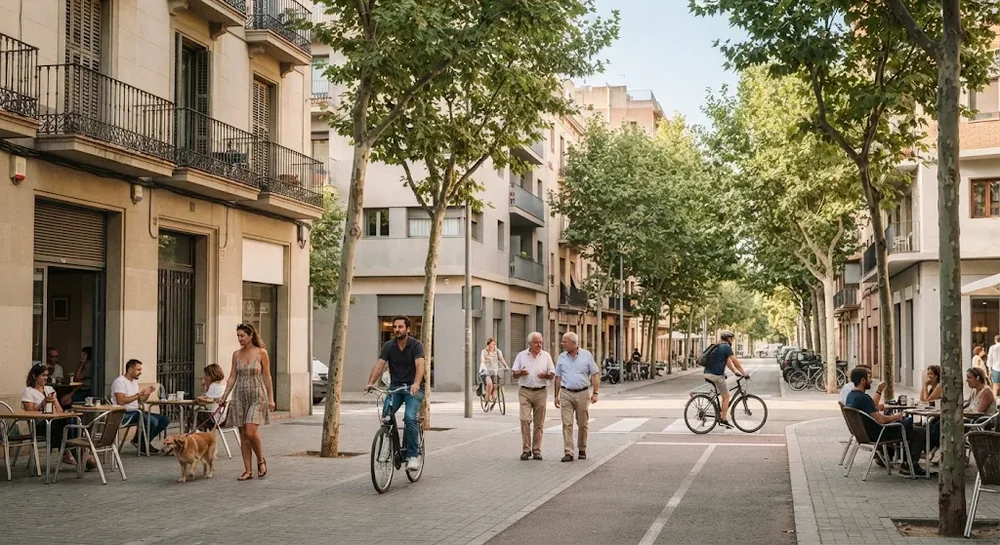
Daily life in Barcelona runs on foot, metro, bus, tram, bicycle and suburban rail, and the official one-zone T-usual pass costs €22.80 for 30 consecutive days of unlimited qualifying journeys, according to the 2026 fares valid from 15 January 2026. Fares change, so confirm the price with the transport operator (TMB) before relying on it. Cycling is easiest in flatter areas such as Poblenou and parts of Eixample, while hillier districts reward electric bikes and good legs.
Food shopping is local and routine. Municipal markets sell fresh produce, fish and meat in most neighbourhoods, and small shops often close for a lunch break or on Saturday afternoons, so ordinary errands need planning. Lunch is commonly later than in Britain and dinner later still, which is useful to know before you judge a quiet street at 8pm.
The climate is generous in spring and autumn. Summer is hot and humid, and an apartment without cross-ventilation or air conditioning can feel uncomfortable at night, particularly on a top floor. City beaches are public but get busy in summer, with the seafront and Barceloneta the most crowded. The Collserola hills and the city’s parks offer an escape that visitors often don’t see.
Language is practical, not decorative. Spanish gets you through most daily life, but Catalan is widely used in schools, local administration and building notices, and community minutes may be in either language. Learning some of both helps you take part in your own building.
Differences between adjacent streets can be large, and safety, noise and atmosphere vary by block and hour. As in any large tourist city, pickpocketing is a risk in crowded areas, so judge a specific street by visiting it, not by a district reputation.
Living in Barcelona with Children or in Retirement
Families, retirees and working professionals want different things from the same city, and the best neighbourhood for each depends on schools, healthcare, step-free access and green space. Quieter residential streets in Les Corts, Sarrià-Sant Gervasi or parts of Horta-Guinardó appeal to many households, though no whole district is uniformly quiet.
For families, three school types exist: public schools, concertada schools (privately run but publicly funded, usually with fees or contributions), and private or international schools. Admission to public and concertada places follows official criteria, including proximity to home, so buying a flat does not guarantee a particular place. Public schooling is delivered largely in Catalan, which matters for children arriving without it.
Healthcare access depends on your residence and insurance status. Registration with the Catalan public health system is not automatic for every owner, and a second-home owner on short visits would normally rely on travel or private cover. Check your own entitlement with the relevant authority before assuming anything.
Retirees should weigh accessibility more heavily than charm. Many older apartment buildings have no lift, narrow stairs or steps at the entrance, and a fourth-floor walk-up that is romantic at 45 is hard at 75. Ask whether the building has a lift, whether it reaches the street without steps, and whether the community has discussed installing one, because that could trigger a derrama. Metro step-free access, nearby clinics and flat pavements matter just as much.
Working professionals usually trade space for commute and nightlife. Poblenou, Eixample and Sants offer good connections, and a quiet bedroom away from the street is worth more than an extra room.
Can British Property Owners Live in Barcelona Full-Time?
No, property ownership does not by itself let a British citizen live in Spain full-time. As of November 2026, British nationals without relevant residence rights or exemptions are generally limited to 90 days in any rolling 180-day Schengen period, and buying a home does not extend that limit. The GOV.UK guidance on living in Spain is the place to check the current position.
- Ownership is not residence. The title deed records that you own the flat. It says nothing about your right to stay.
- The 90/180-day rule. Time spent in Spain counts towards the Schengen limit, so you must track your days across all Schengen countries, not just Spain.
- NIE. The NIE (Número de Identidad de Extranjero) is a tax and identification number you need to buy property. It does not by itself give you residency.
- TIE. The TIE (Tarjeta de Identidad de Extranjero) is the card that shows a foreign national holds a Spanish residence authorisation. You need an appropriate immigration route first, assessed individually. People who were lawfully resident in Spain before the end of 2020 may hold different Withdrawal Agreement status.
- Empadronamiento. This is registration on the municipal register at your town hall. It records where you live and helps with local services, but it does not create lawful immigration status.
- Tax residence. Spanish tax residence is a separate test, often linked to time spent in Spain and where your main interests lie, and it can apply even if your immigration paperwork is not settled. Get specialist advice.
Here’s where people usually come unstuck: they assume that buying means the right to stay, then find the rules do not work that way. The route that once granted residence for property investment was ended in 2025, so no current property purchase should be assumed to carry a visa. Speak to an immigration professional about your own case.
If you are unsure how your own circumstances fit these rules, a short one-to-one conversation before you sign anything is cheaper than fixing a mistake afterwards.
Once the residence question is clear, the next job is making sure the building itself will not surprise you.
Older Apartments, Building Checks and Hidden Problems
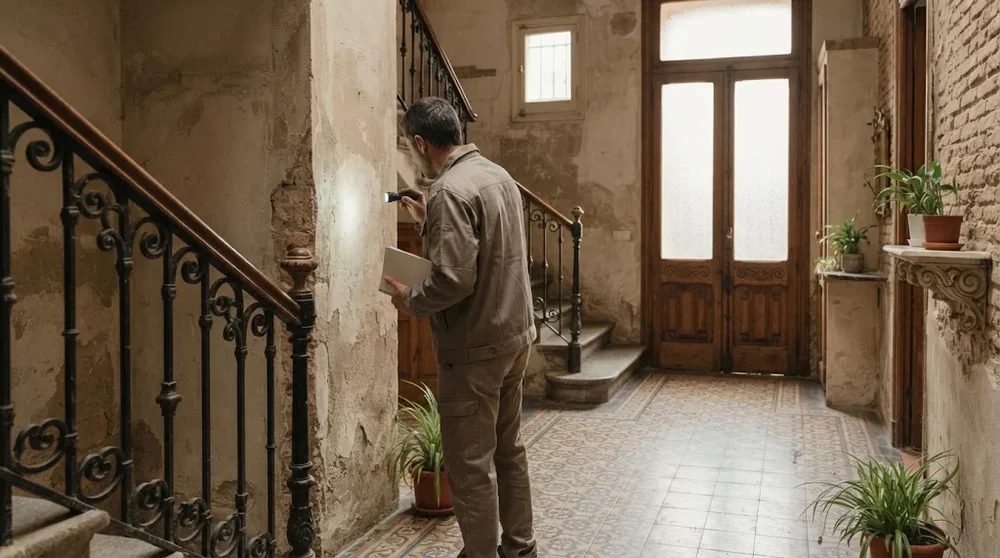
An attractive old Barcelona apartment can carry substantial shared-building costs, because the charm of high ceilings and original tiles often comes with limited natural light, interior courtyards, weak insulation, old plumbing, difficult access and a facade that needs repair. A clean title alone does not prove the building is sound. Always ask for the nota simple before you commit, then work through this checklist with independent professionals.
- Updated nota simple. This extract from the Registro de la Propiedad (the property registry) shows the registered owner, description, mortgages and charges. Request a recent one.
- Description and cadastre. Compare the registered description with the cadastral record and the actual flat, checking size, floor and layout.
- Cèdula d’habitabilitat. This Catalan certificate of habitability confirms the home meets minimum living conditions. Check that it exists and is in date, where applicable.
- Energy performance certificate. Read the rating and ask what it says about insulation, windows and heating or cooling costs.
- Community minutes. Review the last few years of meeting minutes for disputes, planned works and votes.
- Fee and debt documentation. Ask for a statement showing the flat has no unpaid community charges, since arrears can follow the property.
- Pending derramas. Ask what extraordinary works have been approved, discussed or recommended, and who pays.
- Building inspection. Older buildings may be subject to periodic technical inspection requirements, so ask for the latest report and any defects it lists.
- Independent technical survey. Commission your own surveyor to check damp, wiring, plumbing, structure and the stairwell, rather than relying on the seller’s or agent’s view.
- Use and alterations. Check the flat is permitted for residential use and that any extensions, merged rooms, terrace enclosures or interior reforms were properly authorised.
My opinion, after years of watching British buyers fall for a lovely stairwell: spend the survey fee before you spend the deposit. Hire a lawyer and a surveyor who work for you, not for the seller.
Tourist Rentals and Other Barcelona Ownership Restrictions
Owning a flat in Barcelona does not automatically give you the right to let it to tourists, because short-term tourist letting requires the applicable permissions and Barcelona has tightly restricted new licences. City Hall has announced that it will not renew roughly 10,101 existing tourist-flat licences when they expire in November 2028, a policy that Spain’s Constitutional Court supported in a March 2025 ruling on the Catalan decree behind it. I have not found a later decision that changes that position as of November 2026, but this area moves quickly, so verify the latest legal status with a Catalan lawyer before relying on any assumption.
Tourist letting is a different legal category from ordinary residential renting, which has its own contract types and rules, including rent regulation in areas declared stressed housing markets. A home let on a standard residential tenancy to a local tenant is not the same as a holiday let. I will not suggest likely earnings here, because rental income depends on permission, rules and demand, and none of those can be assumed. If a seller advertises a flat with holiday-let potential, ask for the licence number and have your lawyer confirm it is valid, transferable and still usable.
Barcelona or Nearby Towns: Where Should You Own?
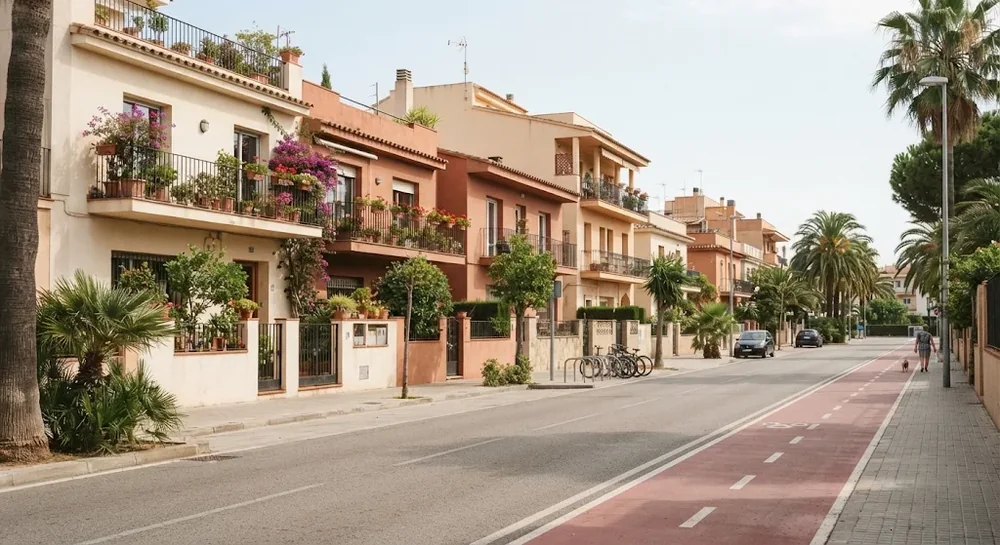
Barcelona suits owners who want a city on their doorstep, while Sant Cugat, Castelldefels and Sitges offer more space or a quieter pace at the cost of extra commuting. Nearby towns are not always cheaper, and some have similarly high or higher prices than comparable Barcelona districts, so compare current listings.
| Place | Residential atmosphere | Transport | Green space and family needs | Main trade-off |
|---|---|---|---|---|
| Barcelona | Dense, varied, city life | Metro, bus, tram and trains; car optional | City parks and the Collserola hills; schools vary by district | High prices, noise, smaller flats |
| Sant Cugat | Suburban, family-oriented, leafy | Commuter rail links to Barcelona; car common | Houses with gardens and international school options | Prices can match or exceed some city districts; more car use |
| Castelldefels | Coastal suburb with a long beach | Commuter rail and road links; airport nearby | Beach life and low-rise housing | Longer door-to-door journeys; quieter in winter |
| Sitges | Seaside town with strong tourism | Commuter rail link; car useful | Beach, old town and a lively international community | Seasonal crowds and tourist-driven housing demand |
Nominal train journey times are not door-to-door commuting times, since you must add walking, waiting, transfers and parking. I have not quoted travel times here, and you should check current timetables with the operators and test the journey at rush hour before buying.
How to Decide Whether Barcelona Suits Your Lifestyle
Barcelona suits you if you can picture a normal weekday there, not just a holiday weekend, and the five steps below turn that picture into a decision.
- Select neighbourhoods by lifestyle. Shortlist two or three areas based on how you actually live: schools, commute, quiet, beach, budget and lift access.
- Calculate realistic ownership expenses. Use the budget method above with your own quotes for IBI, community fees, insurance, utilities and a repair reserve, excluding the mortgage and purchase costs.
- Test the location at different times. Visit on a weekday morning, a Friday night and a Sunday, buy groceries, ride the metro at peak hour and sit in the street after dark.
- Check the building and administrative records. Review the nota simple, cadastral record, certificates, community minutes, fee statements and a survey before committing.
- Distinguish permanent residence from second-home use. Year-round living affects maintenance, tax and your immigration position, while occasional visits mean bills still arrive when you are away.
My advice to every British buyer is to rent for a month in your preferred area first, because a month of ordinary routine tells you more than any brochure.
If you would like a shortlist matched to your budget, region and reasons for buying, a few questions are enough to start.
Taking the time to match the flat to your routine will do more for your satisfaction than any single feature of the property.
Frequently Asked Questions About Living in Barcelona
Is Barcelona a good place to live?
Barcelona suits owners who value walkable neighbourhoods, reliable public transport, a mild climate and a strong cultural scene. Ownership adds responsibilities: IBI property tax, community fees, insurance and repairs. The practical limits are high purchase prices, tourist crowds, summer humidity and older buildings, so the street and building you choose matter as much as the city itself.
What is the best area to live in Barcelona?
There is no single best area; the right one depends on household and budget. Eixample offers central convenience, Gràcia a village atmosphere, Poblenou beach access and newer buildings, and Sarrià-Sant Gervasi quieter family streets. Sants-Montjuïc and Nou Barris had lower October 2026 asking prices on Idealista. Building condition, lift access and street noise matter as much as the district name.
How much does it cost to live in Barcelona if you own a property?
Without a mortgage, an owner still pays for groceries, utilities, transport, IBI property tax, community fees, home insurance and repairs. Totals vary with household size, apartment age, energy efficiency and lifestyle, so I give illustrative ranges rather than averages: roughly €770–€1,250 a month for a single person and €1,190–€1,860 for a couple, excluding mortgage, purchase taxes and major works.
Where do families live in Barcelona?
Families commonly look at Sarrià-Sant Gervasi, Les Corts and quieter parts of Eixample, while others prefer Poblenou or leave the city for Sant Cugat. The decision usually turns on school admission rules, commuting, space, lift access and budget. Public, concertada and private schools work differently, and no home purchase guarantees a place at a particular school.
Can British citizens live in Spain if they own property?
Owning a home in Spain does not give a British citizen the right to live there. Without an applicable residence status or exemption, stays are generally limited to 90 days in any rolling 180-day Schengen period, and longer stays need an appropriate immigration route. Property ownership, immigration residence and Spanish tax residence are three separate questions, as of November 2026.
What are the disadvantages of living in Barcelona?
The main disadvantages are expensive housing, crowded central streets, tourist pressure, late-night noise and humid summers. Bureaucracy can involve both Spanish and Catalan, and older buildings may carry poor insulation, no lift or costly shared repairs. These problems vary street by street, so viewing a property at several times of day tells you more than judging a whole district.
What Owning in Barcelona Comes Down To
Owning in Barcelona gives you a walkable, culturally rich Mediterranean city and the security of no landlord, but you take on the building, the bills and the paperwork that come with it. The neighbourhood sets the lifestyle, and the specific building sets the day-to-day experience, from lifts and light to noise and shared repair costs.
The October 2026 Idealista figures show asking prices from €3,282 to €7,236 per square metre across the districts quoted, and a mortgage-free owner still has to budget for IBI, community fees, insurance and maintenance. Ownership does not grant the right to live in Spain, and tourist letting cannot be assumed.
I came to Spain from Manchester more than ten years ago, and the lesson that has held up is to test the everyday before you fall for the view. Visit at odd hours, read the building’s paperwork, hire independent professionals and decide honestly whether you are buying a home or a holiday.
This article is general information, not legal, tax or immigration advice. Tax, property and immigration rules can change, and individual circumstances differ, so check your position with a qualified Spanish lawyer, tax adviser, technical surveyor or immigration professional before you commit. Figures and rules are stated as of November 2026.