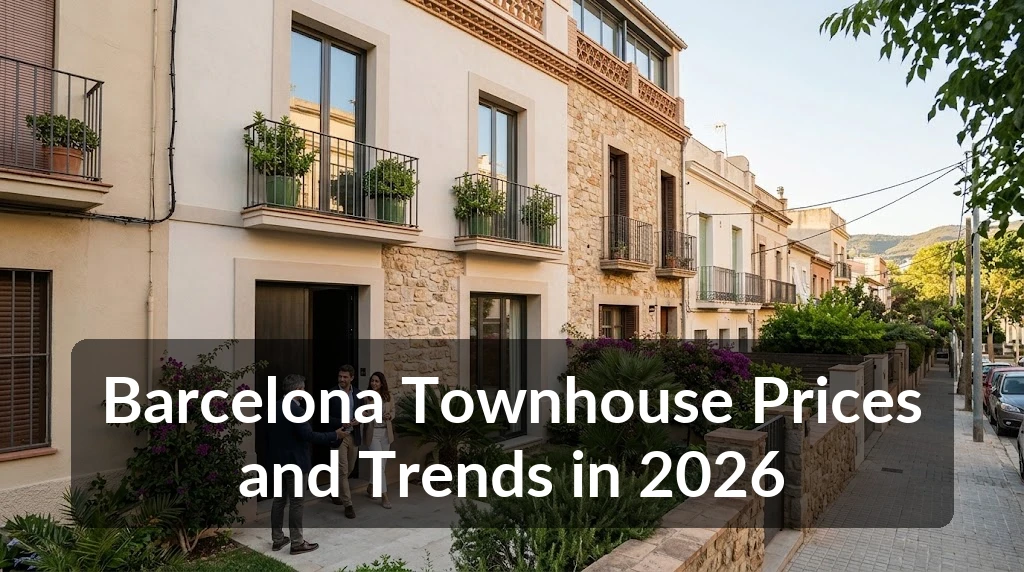
Barcelona townhouse prices in 2026 are hard to pin down, because the city is built of flats and a house here is the exception. Overall asking prices kept climbing through the year, with Idealista recording 5.8% growth in the twelve months to September 2026. Yet nobody publishes a clean price index for terraced houses alone. I’m David, a Mancunian who has spent a decade helping buyers from Marbella, so I’ll be upfront: Barcelona is not my home patch. Every Barcelona figure below comes from published statistics, not from my own deals.
Barcelona townhouse prices remain under upward pressure in 2026, although reliable townhouse-only price indices are scarce. Citywide asking prices reached €5,462/m² in September, up 5.8% year on year. Family houses are concentrated in selected residential neighbourhoods, where location, outdoor space, condition and limited supply matter more than citywide averages. Further gains are possible, not guaranteed.

Barcelona Townhouse Market Snapshot: November 2026
As of November 2026, no verified Barcelona townhouse-only price index exists in the public sources I reviewed. The available figures describe all housing, and they disagree because each one measures something different. Citywide asking prices run from about €4,938/m² to €5,462/m² depending on the portal, while registered sales in the second quarter of 2026 averaged about €5,200/m².
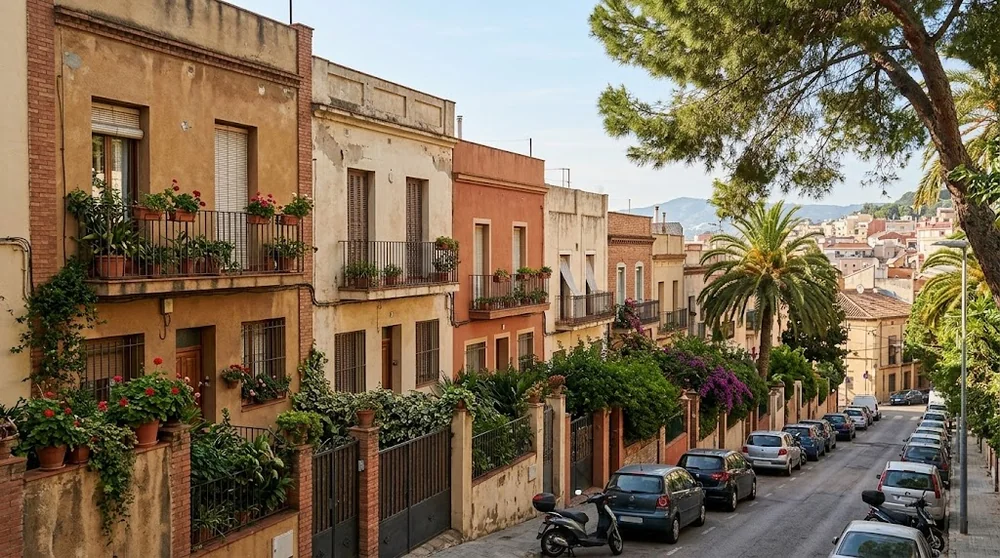
First, the vocabulary. A Barcelona townhouse (casa adosada) is a terraced house that shares one or both side walls with its neighbours. A casa pareada is semi-detached and shares one wall. A casa aislada is fully detached. Barcelona is overwhelmingly a city of apartments, and houses cluster on hillsides and in old village cores that the city absorbed over the last century. That scarcity is why a citywide average tells a house buyer so little.
If you are a family weighing budget, location and timing, or an investor looking at an uncommon property type, the table below shows what each number measures. Every figure is citywide and none is townhouse-specific.
| Source | Reference period | Geography and property category | Metric and observed value | Interpretation | Limitation |
|---|---|---|---|---|---|
| Idealista | September 2026 | Barcelona municipality, all residential | Asking price €5,462/m²; +5.8% year on year (€5,165/m² in September 2025) | Strong upward pressure on advertised prices | Listing prices, not completed sales; not townhouse-only |
| Fotocasa | October 2026 | Barcelona, all residential | Asking-price index €4,938/m²; +1.5% year on year | Much slower annual growth than the Idealista series | Different methodology; cannot be merged with Idealista |
| Indomio | September 2026 | Barcelona, citywide estimate | €5,114/m² | Falls between the two portal series above | Separate methodology; not townhouse-only |
| Barcelona City Council | Q2 2026 | Barcelona, all completed residential transactions | About €5,200/m²; average transaction value €413,400; transaction price per m² about +10.2% year on year | Registered sales grew faster than the portal asking series | All dwellings, mostly flats; not townhouse-only |
| Fotocasa terraced-house page | November 2025 | Barcelona terraced-house listings | Average asking price €873,310 | Shows the scale of house budgets, not a 2026 level | Historical, small and selective listing sample; not a sale price |
Why do the numbers disagree? Portals sample whatever is advertised on the day, using their own filters. The council counts deeds that were actually registered. One series was observed in September, one in October and one over a full quarter. Idealista’s September figure is €524/m² (about 10.6%) above Fotocasa’s October one, and that gap comes almost entirely from method.
The council’s two headline numbers are also revealing. Dividing the €413,400 average transaction value by roughly €5,200/m² implies a typical dwelling of about 80 m². That is a modest flat, not a family house. It is a rough ratio of averages, but it shows why these statistics cannot stand in for terraced-house values.
The Fotocasa figure of €873,310 is a November 2025 listing average. It is roughly double the council’s average transaction value, but the two measure different things, so I only use the comparison to show that house budgets are far above the city norm. My practical takeaway: treat citywide data as a compass for direction, and price a specific house from comparable houses. Ten years on the Costa del Sol have taught me that a headline average is the least useful number in a property file.
How Barcelona House Prices Changed in 2026
Barcelona’s overall prices rose across 2025–2026 on every series reviewed, but the pace depends on the measure. Asking prices rose between 1.5% and 5.8% a year, depending on the portal, and registered transaction prices per square metre rose roughly 10% in Q2 2026. None of these is a townhouse index.
Asking prices. Idealista’s Barcelona figure moved from €5,165/m² in September 2025 to €5,462/m² in September 2026, the published 5.8% increase. Fotocasa’s October 2026 index sits at €4,938/m², up 1.5% on its own methodology. Same city, same year, a four-point gap in growth. Asking prices are what sellers hope for, so they tend to move before, and sometimes away from, what buyers pay.
Completed sales. Barcelona City Council’s Q2 2026 housing statistics show an average transaction value of about €413,400, with transaction price per square metre up around 10.2% year on year. Second-hand sales averaged €415,910 across 3,525 registered sales, up 7.4% by average transaction value. Do not mix those two growth rates. A value average can rise because prices rose, or because bigger or better homes happened to change hands that quarter. A €/m² figure corrects for size but not for location or condition.
Catalonia and Spain. The INE House Price Index for Q2 2026, published on 7 September 2026 by the Instituto Nacional de Estadística, shows national annual growth of 12.2% (12.9% for resale homes) and 10.1% for Catalonia. Those are index movements for all dwellings. They are not Barcelona statistics and certainly not townhouse statistics.
My view, and it is only a view: the market is tight rather than frothy. Barcelona is squeezed between the sea, the Collserola hills and neighbouring municipalities, so new building land is scarce and families who want space compete for very few houses.
Mortgage conditions, household incomes and the supply of listings will decide how long the climb lasts. I have not quoted a mortgage rate here, because rates move between my research cut-off of 3 November 2026 and the day you read this. Check a current lender quote rather than relying on any article, including this one.
Here is the catch for house buyers. Few houses trade, so a district average can jump simply because one unusual property sold, or because several flats of a different type completed in the same quarter. A neighbourhood’s rise therefore cannot be assigned mechanically to an individual townhouse. An index movement describes a basket of homes. It says nothing about what your particular house will be worth when you sell. Nor can the Idealista, Fotocasa, Indomio and council numbers be stitched into one continuous series: they differ in what they count, when, and how.
Townhouse Prices by Barcelona Neighbourhood
The neighbourhoods most worth investigating for a townhouse are Sarrià, Sant Gervasi–La Bonanova, Vallcarca i els Penitents, El Coll, Horta, Font d’en Fargues and a few green pockets on the city’s hillside edge. No verified townhouse median exists for any of them. The only dated price indicators I can give are district-level asking-price benchmarks for all property types.
As of September 2026, Idealista’s district benchmarks were €7,211/m² for Sarrià-Sant Gervasi, €5,654/m² for Gràcia and €4,198/m² for Horta-Guinardó. They are dominated by flats, so they indicate the price tier of an area rather than the cost of a house. They sit above the neighbourhoods in the table because each district contains very different streets. Vallcarca and El Coll belong to the Gràcia district, while Horta and Font d’en Fargues belong to Horta-Guinardó.
| Neighbourhood | District and Idealista benchmark, September 2026 (all property, asking, €/m²) | Market character (my reading) | Townhouse suitability | Trade-offs | Availability caveat |
|---|---|---|---|---|---|
| Sarrià | Sarrià-Sant Gervasi, €7,211 | Old village core turned affluent; calm; schools nearby | Good starting point for a search | Premium prices; older stock often needs updating | Very few houses at any one time |
| Sant Gervasi–La Bonanova | Sarrià-Sant Gervasi, €7,211 | Leafy, residential, larger plots | Possible, but detached villas are common | Top-tier pricing; terraced houses are the minority | Check whether listings are truly terraced |
| Vallcarca i els Penitents | Gràcia, €5,654 | Hillside, mixed housing, long-running regeneration | Plausible for smaller terraced houses and patios | Steep streets; uneven renovation quality | District figure reflects Gràcia flats, not houses |
| El Coll | Gràcia, €5,654 | Quiet hillside, more modest character | Possible for small houses with terraces | Gradients, transport times, compact plots | Thin stock; verify each listing |
| Horta | Horta-Guinardó, €4,198 | Historic village feel, low-rise, close to the hills | Better odds of family houses at a lower benchmark | Older buildings; party-wall and damp checks matter | Availability varies street by street |
| Font d’en Fargues | Horta-Guinardó, €4,198 | Quiet northern hillside pocket | Possible for houses with terraces or gardens | Slopes, limited parking, bus reliance | Very few transactions; unreliable averages |
| Vallvidrera and Les Planes | Sarrià-Sant Gervasi, €7,211 | Green hill suburb inside the city limits | Houses with gardens are more common | Longer commutes; premium for space | Verify the type: many are detached |
Two cautions. First, the character descriptions are my reading of the areas, not statistics, and a district benchmark is not a house price. Second, city and province are different things: Barcelona municipality is one place, and the wider Barcelona province includes towns with very different prices. Check the listing’s actual municipality before comparing numbers. Never assume every district has a deep townhouse market; several of these have only a handful of houses for sale at any moment.
Townhouses Versus Apartments: What Costs More?
A Barcelona townhouse usually costs more in total than a flat in the same area, because you buy more floor area and private outdoor space. It does not follow that every townhouse costs more per square metre. The answer depends on how you count usable area and what condition the house is in.
| Factor | Townhouse (casa adosada) | Apartment, comparable location |
|---|---|---|
| Total acquisition budget | Usually higher; more area and land | Usually lower |
| Price per usable m² | Can be lower or higher; depends on area weighting | Often easier to compare |
| Garden, terrace, parking | Often private and included | Shared or priced separately |
| Structural maintenance | Owner responsible for roof, facade and party walls | Shared through the community of owners |
| Refurbishment exposure | Higher, especially in older houses | Often limited to the interior |
| Energy and running costs | More surface area to heat and cool | Lower, with shared walls on several sides |
| Resale liquidity | Fewer buyers, longer sales; condition matters | Deeper buyer pool |
Engel & Völkers displayed a house indicator of roughly €3,151/m² and an apartment indicator of roughly €4,343/m² in its series updated on 12 October 2026. I treat that as a qualified secondary example only. The house category is not townhouse-only, its geographic coverage differs from the municipal statistics, and it cannot be reconciled with the Idealista or council series. It does illustrate that house-labelled figures can look cheaper per metre than flats. My reading is that location and property mix are probably doing the work: larger, older houses in outer areas are being averaged with different stock.
Illustrative scenario, all numbers hypothetical. Imagine a 110 m² apartment at €6,000/m², which is €660,000. Nearby is a townhouse with 200 m² of usable area at €5,750/m², which is €1,150,000. The house is €250/m² cheaper but costs €490,000 more in total. Now count the 40 m² basement at half value: the weighted area becomes 180 m², and the same €1,150,000 equals about €6,389/m². The house now looks dearer per metre than the flat. Same property, two defensible answers, depending on the area rules.
My advice to every British buyer is to compare houses with houses, using usable area you have measured yourself, and to ask what is counted in each figure: the garage, the basement, the stairwell and the terrace all get treated differently.
The sensible method is a property-specific comparable-sales check: take three to five similar houses sold nearby in the last twelve months, adjust for area weighting, condition, outdoor space and parking, and compare completed prices rather than adverts. A local valuer (tasador) or Barcelona agent can usually help with this.
Barcelona Townhouse Price Forecast: Late 2026 and 2027
No published statistical forecast covers Barcelona townhouses, and a decline in 2027 is neither established nor ruled out by 2026 evidence. What can be said is that citywide asking prices and registered transaction prices were rising in 2026, and that the next move depends on mortgage costs, household affordability and the number of properties for sale.
Be careful with the prime-market evidence. Savills reported 1.5% capital-value growth for prime Barcelona residential property in the first half of 2026, as of its August 2026 analysis. That covers a different segment and only six months, so it cannot be doubled or substituted for a mainstream townhouse trend.
Below are three scenarios, built around a hypothetical €900,000 townhouse. Illustrative scenario: not a published forecast. The percentages are editorial assumptions I chose for illustration. The calculation is simply price × (1 + assumed change over 12 months). The base case loosely sits near the slower 1.5% Fotocasa and Savills readings, the upside case near the faster Idealista pace, and the downside case is an assumed reversal with no direct data behind it.
| Scenario (illustrative, not a published forecast) | Triggers | Counterargument | Assumed 12-month change | Hypothetical result on €900,000 |
|---|---|---|---|---|
| Upside | Easier mortgage conditions, strong family demand, very few houses listed | Affordability limits already bind; asking prices may outrun buyers | +5% | €900,000 × 1.05 = €945,000 |
| Base | Steady demand, stable financing costs, limited supply | Slow selling times could widen the gap between asking and sale prices | +2% | €900,000 × 1.02 = €918,000 |
| Downside | Weaker economy, tighter lending, more sellers cutting asking prices | Scarce houses may hold value even when flats soften | −5% | €900,000 × 0.95 = €855,000 |
The risk I’d flag is extrapolation. A year of rising citywide numbers does not guarantee another, and a quiet market can look strong in index data for months while individual houses sit unsold. Equally, a market-wide fall does not mean your target house gets cheaper, since a scarce, well-located house can behave differently from the average flat. The range between my upside and downside is wide for a reason. Nobody can honestly narrow it from the data available, and anyone who promises a precise 2027 number is guessing, however confident the chart.
Where Family Buyers Find Better Townhouse Value
Families sometimes find better townhouse value outside Barcelona municipality, in the Barcelona Metropolitan Area, but that is not a rule. Sant Cugat del Vallès and Sant Just Desvern are common alternatives, yet I have not verified current townhouse inventory or prices for either, so I won’t claim a saving.
The key point is the boundary. These towns are separate municipalities with their own councils, local taxes and school allocation. Barcelona’s district figures cannot be compared with theirs without matching property type, size and condition. Catalonia’s transfer tax brackets apply across the region, so ITP does not change when you cross the municipal line, but IBI and local rules do.
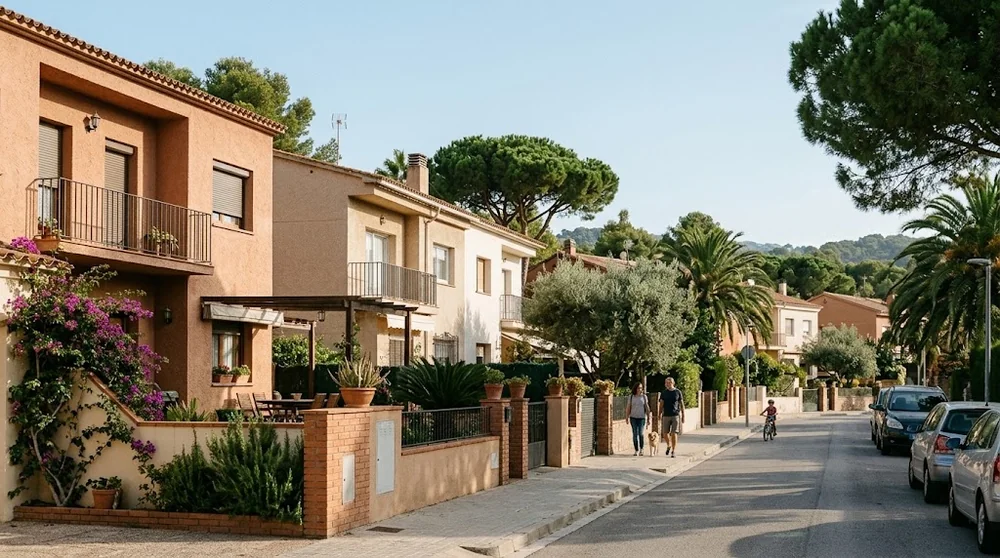
Sant Cugat del Vallès lies north-west of the city, is linked to central Barcelona by the FGC suburban rail network, and is known for houses with gardens. Sant Just Desvern borders the city’s western edge. Test both commutes at rush hour before you fall in love with a garden. Public schools in Catalonia teach mainly in Catalan, so check each school’s language of instruction and its admissions zone. A house can sit in the wrong catchment for the school you want.
Here’s where people usually come unstuck: they compare a €/m² figure for a suburban house against a city flat and declare victory, without counting commuting, a second car, school journeys and a bigger heating bill.
| Buyer profile | Main priority | Barcelona municipality | Metropolitan alternatives |
|---|---|---|---|
| Central-city lifestyle | Walkability, culture, short trips | Strong fit, with few houses and premium prices | Weaker fit; most daily life needs transport |
| Family space | Bedrooms, garden, schools | Possible in hillside neighbourhoods | Often more garden space; check catchments |
| Budget efficiency | Lower entry price per usable m² | Usually harder at the premium end | May suit some budgets; verify with current comparables |
Retirees often care most about step-free access and healthcare distance, which can rule out hillside houses with steep stairs. Investors face a thin resale market in either place. Whatever your profile, compare like with like: net usable area, outdoor space, condition and the true annual cost of ownership.
What Does Buying a Barcelona Townhouse Really Cost?
As of November 2026, a resale townhouse in Catalonia typically costs the purchase price plus roughly 12% to 13% in taxes and fees, before any renovation. The biggest item is ITP, which is progressive: a bracket rate applies to each slice of value, not to the whole price. That estimate uses the assumptions in the tables below.
Under the general Catalonia rules in force in November 2026 (see the consolidated legislation published in the Boletín Oficial del Estado), general resale ITP is 10% up to €600,000, 11% on the next €300,000, 12% on the next €600,000 and 13% above €1.5 million. Check exceptions and reduced-rate eligibility, because you should never assume you qualify.
| Taxable value band (€) | General resale ITP rate | Maximum tax in this band (€) | Cumulative tax at top of band (€) |
|---|---|---|---|
| 0 – 600,000 | 10% | 60,000 | 60,000 |
| 600,000 – 900,000 | 11% | 33,000 | 93,000 |
| 900,000 – 1,500,000 | 12% | 72,000 | 165,000 |
| Above 1,500,000 | 13% | 13% of the excess | 165,000 + 13% of the excess |
Worked examples: €600,000 gives €60,000. €900,000 gives €60,000 + (11% × €300,000 = €33,000) = €93,000. €1,200,000 gives €93,000 + (12% × €300,000 = €36,000) = €129,000. The taxable base is the higher of the price paid and the valor de referencia, the reference value set by the Spanish Cadastre. You can look up the cadastral data on the Cadastre’s online office (Sede Electrónica del Catastro). If your price is lower than that value, the tax is calculated on the higher one, so ask your lawyer to check it before you sign.
The other lines are my estimates, not statutory charges. I assume notary and Property Registry (Registro de la Propiedad) fees together at 1.0% of the price, an independent solicitor at 1.0% all-in, a survey at a flat fee, and a renovation allowance of 5% of the price. Illustrative scenario: replace each with real quotes.
| Item (€) | €600,000 purchase | €900,000 purchase | €1,200,000 purchase |
|---|---|---|---|
| General resale ITP (statutory, general brackets) | 60,000 | 93,000 | 129,000 |
| Notary and registry (estimate, 1.0%) | 6,000 | 9,000 | 12,000 |
| Solicitor (estimate, 1.0%) | 6,000 | 9,000 | 12,000 |
| Survey (estimate, flat) | 1,500 | 2,000 | 2,500 |
| Subtotal of taxes and fees | 73,500 (12.25%) | 113,000 (12.56%) | 155,500 (12.96%) |
| Renovation allowance (assumption, 5%) | 30,000 | 45,000 | 60,000 |
| Total outlay including purchase price | 703,500 | 1,058,000 | 1,415,500 |
Mortgage costs are excluded, and so are furniture, removals and currency charges. Annual costs then follow: IBI (the municipal property tax, which depends on cadastral value, so ask for the latest receipt), building insurance, utilities and maintenance. Older houses need more upkeep than flats.
A new house bought from a developer is taxed differently. A first delivery of qualifying residential property generally carries 10% VAT instead of resale ITP, plus stamp duty (AJD). On a €900,000 net price, 10% VAT is €90,000, but the AJD must be added and I have not verified the exact Catalonia rate here. Confirm it with the tax agency or your adviser before relying on any total.
Seven Checks Before Buying a Barcelona Townhouse
Seven checks matter before you pay a deposit: ownership and charges, floor area, permits for extensions, structure, damp and energy performance, terraces and shared elements, and debts. Hire an independent lawyer and a technical surveyor, and never rely on the seller’s agent for any of them.
- Nota simple and ownership. Always ask for the nota simple before you commit. This extract from the Property Registry shows the registered owner, the registered area and any mortgages or embargoes. Your lawyer verifies it. The warning signs are an owner who differs from the person selling, an unexplained mortgage or an embargo. If you see one, the sale should not proceed until it is cancelled.
- Registered versus cadastral area. Compare the area in the nota simple with the Cadastre record. Your lawyer checks, and a surveyor measures on site. A large gap suggests an unregistered extension or a loft that has been counted differently. Ask the seller to explain it and correct the records before completion.
- Permits and extensions. Ask for planning licences and completion certificates for every addition. Your lawyer does this, but urban-planning compliance must be confirmed with the relevant local authority. Here’s where people usually come unstuck: a glazed terrace or an extra floor built without permission can create legal exposure for the next owner.
- Structural inspection. A chartered architect or surveyor inspects foundations, beams, roof, staircases and party walls. Warning signs include diagonal cracks, sagging floors and visibly altered load-bearing walls. A serious finding should lead to a written repair estimate, which you use to renegotiate or walk away.
- Moisture and energy performance. The surveyor checks for damp on lower floors, roof leaks and party-wall dampness. Request the energy performance certificate. A poor rating is not a reason to walk away, but it tells you the likely heating bill and the insulation work to budget for.
- Terraces, gardens, garage and shared elements. Confirm in the registry documents that the garden, terrace and parking are included in the title, and whether any are shared. Check who owns the party walls and what rights neighbours have. A parking space described in an advert but absent from the title is a classic trap.
- Debts, community obligations and maintenance. Ask for the latest IBI receipt, utility bills and any community-of-owners certificate. Your lawyer verifies that taxes and community fees are paid, because some unpaid charges can follow the property rather than the seller. Request quotes for known repairs and estimated annual upkeep.
A composite example, not a real client: on the Costa del Sol I have seen a family fall for a terraced house with a lovely glassed-in terrace. The survey found it was never registered, and fixing the paperwork cost several months. Barcelona rules differ, which is exactly why you need a local lawyer rather than my say-so.
Buying a Barcelona Townhouse as a British Citizen
British citizens can buy a Barcelona townhouse freely, but owning it gives no right to live in Spain. You need an NIE (Número de Identidad de Extranjero), an independent solicitor, a bank account and a separate residence authorisation if you plan to stay beyond short visits. As of November 2026, that is the practical order of events.
The NIE is the Spanish foreigner’s tax identification number, and you need it to sign a deed, pay tax and open most accounts. It can be obtained through a consulate or in Spain, and I would allow several weeks. Appoint your own solicitor, not the seller’s, to check title, taxes and contracts. When you can, check documents in English and Spanish and get everything explained before signing.
Banks will ask for proof of identity, income and source of funds under anti-money-laundering rules. Non-resident mortgages exist, but lenders set their own terms and no loan-to-value percentage is guaranteed. Currency matters too. If your income is in sterling and the price is in euros, the exchange rate can move the cost by thousands between exchange and completion, so ask about fixing it.
If you want a second pair of eyes on your own documents, tax position or buying steps before you sign anything, a short one-to-one chat can save weeks of back-and-forth with agents and banks.
Now the immigration point, which causes most confusion. Since Brexit, ordinary visits are generally limited to 90 days in any 180-day period under the Schengen rule. Owning a house does not change that. Longer stays need a suitable visa or residence authorisation, and Spain’s golden-visa route for property investors ended in April 2025. Check current options with the Spanish Ministry of Foreign Affairs, your nearest consulate or the UK government’s travel advice for Spain.
Tax residence is a separate question again. As a general rule, spending more than 183 days a year in Spain can make you tax resident, while non-residents who own a home may owe annual non-resident income tax on imputed income and IBI. Confirm your position with a tax adviser. I swapped Manchester drizzle for Andalusian sun a decade ago, and I’m happy to say the paperwork there was no lighter than here. Allow enough time for it.
Should You Buy Now or Wait for Prices?
Whether to buy now or wait depends more on the individual house and your finances than on any citywide forecast. If the home meets your needs for years, the price is supported by comparable sales and you can afford the all-in cost, buying can be reasonable. If not, waiting or negotiating is sensible.
Waiting for a market-wide correction is a weak plan. Nobody can time it, and your target house may not follow the average anyway. A better question is whether this particular house, at this price, is worth it to you. Negotiation is reasonable when the asking price exceeds comparable completed sales, the survey finds defects, or the property has been listed for a long time.
The table compares two hypothetical houses with matching location and quality. Illustrative scenario: no predicted return. It assumes a €400,000 deposit for both and shows the all-in amount to fund, not a bank offer.
| Item (€) | House A: €900,000 asking, sound condition | House B: €840,000 asking, needs works |
|---|---|---|
| General resale ITP | 93,000 | 86,400 (60,000 + 11% × 240,000) |
| Notary, registry, solicitor, survey (estimates) | 20,000 | 19,300 |
| Repair budget (hypothetical) | 20,000 | 120,000 (damp, roof, rewiring) |
| Total outlay | 1,033,000 | 1,065,700 |
| Amount to fund beyond the €400,000 deposit | 633,000 | 665,700 |
The cheaper-looking house costs €32,700 more all-in. The asking price is only the start; renovation decides the real budget, so get a survey and a builder’s estimate before you negotiate.
If you would rather start from your budget, preferred area and plans for the house, a short quiz can turn those answers into a shortlist of properties worth viewing.
Whichever route you choose, write down your walk-away price before the first viewing. It stops a pleasant afternoon on a sunny terrace from rewriting your budget. Then work through this checklist.
- Define your holding period. Planning to stay five years or more suits a house better than a short-term plan, since transaction costs of about 12% to 13% take time to recover.
- Test the price against comparables. Compare completed sales of similar nearby houses, not adverts.
- Confirm financing. Get written lender terms and test your budget at a higher interest rate.
- Set a renovation contingency. Base it on a surveyor’s report, not on optimism.
- Compare at least two alternatives. Include a flat or a metropolitan-area house.
- Calculate the all-in affordability. Include tax, fees, repairs, IBI and maintenance.
- Test your downside tolerance. Ask whether you could hold the house if its value fell 5%, as in the downside scenario above.
Barcelona Townhouse Market FAQ
How much does a townhouse cost in Barcelona in 2026?
There is no sufficiently verified citywide townhouse-only transaction average in the reviewed sources. Fotocasa published an average asking price of €873,310 for Barcelona terraced-house listings in November 2025, but that is not a 2026 sales benchmark. Actual budgets depend on neighbourhood, size, condition and outdoor space. Compare current individual listings and completed local transactions.
Will Barcelona townhouse prices fall in 2027?
A decline is possible, but it is not established by the available 2026 evidence. Barcelona’s overall asking prices increased 5.8% year on year in September 2026 according to Idealista. Townhouse prices may behave differently because the stock is limited and heterogeneous. Mortgage conditions, household affordability and local supply will determine whether individual properties continue to appreciate.
Which areas of Barcelona are best for buying a family townhouse?
Sarrià, Sant Gervasi–La Bonanova, Vallcarca, El Coll and parts of Horta are sensible starting points for a townhouse search, depending on budget and lifestyle. Compare verified local listings rather than assuming uniform availability. Families should prioritise school journeys, outdoor space, parking, public transport, property condition and the legal status of any extensions or terraces.
Is it better to buy a Barcelona townhouse now or wait?
The decision depends more on the individual property than on a citywide forecast. Buying may make sense when the home meets long-term needs, financing is affordable and the price is supported by comparable evidence. Waiting may be preferable when the asking price is excessive, legal checks are incomplete or renovation costs remain uncertain. Neither approach guarantees savings.
Are townhouses more expensive than apartments in Barcelona?
Townhouses often require a higher total budget because they may offer more space, private outdoor areas and parking. However, that does not mean every townhouse has a higher price per square metre than every apartment. Location, condition and the treatment of garages, basements and terraces can materially change comparisons. Use comparable usable floor areas and local transactions.
What taxes do British buyers pay on a Barcelona townhouse?
British buyers pay the same transfer tax as anyone else: on a resale in Catalonia, general ITP runs at 10%, 11%, 12% and 13% on successive value bands under the rules in force in November 2026. A €900,000 taxable value produces €93,000 before exceptions. New builds generally attract 10% VAT plus stamp duty instead; check the taxable base and any reduced-rate eligibility with an adviser.
My Honest Verdict for Buyers
Barcelona prices were rising in 2026, but the evidence is about flats and the whole housing stock, not terraced houses. My reading is that scarce, well-located townhouses are likely to stay in demand. That is an opinion, not a forecast, and a house with an unregistered extension or a damp party wall can lose value whatever the index does.
Budget at least 12% to 13% on top of the price for tax and fees at the general resale rates, add a repair allowance from a real survey, and judge each house on comparable sales. If you want a shortlist filtered by budget, district and intended use, the quiz link earlier in this article is the simplest route; I do not claim exclusive access to properties or guaranteed prices. Always ask for the nota simple before you commit.
Disclaimer: This article is general information as of 3 November 2026 and is not legal, tax, financial or mortgage advice. Statistics are drawn from the named institutions and portals, which use different methods, and none of them is a townhouse-only index. Scenarios and budget examples are illustrative. Tax rules, exceptions and eligibility change, so consult an independent Spanish lawyer, tax adviser and chartered surveyor before buying.