
Buying an apartment in Barcelona is open to foreign buyers, but the city has its own Catalan tax scale, its own deposit rules and tight controls on tourist letting, with existing tourist-apartment licences due to end in 2028. I’m David, a Mancunian who swapped Manchester for Marbella more than ten years ago, and I’ve since helped hundreds of English-speaking buyers, many of them British families and retirees, buy safely in Spain. This guide covers the legal steps, the real acquisition costs, the checks that protect your deposit and the questions you should settle before you fall for a balcony on a chamfered corner.
Buying an apartment in Barcelona as a foreigner involves obtaining an NIE, documenting your funds, checking the apartment and building, agreeing a suitable deposit contract, and completing before a notary. Budget separately for Catalan purchase taxes and professional fees. Property ownership does not itself grant Spanish residence or permission for tourist letting.
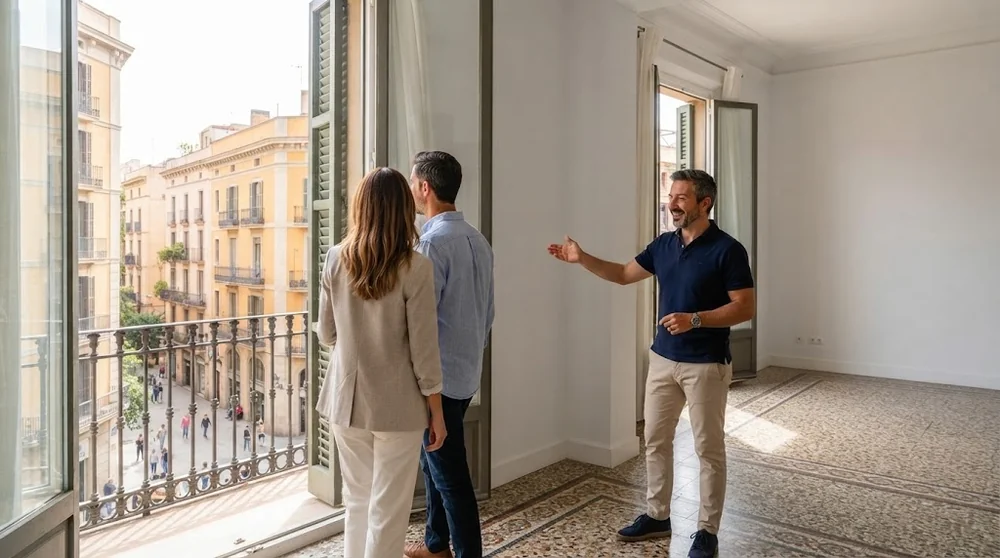
Can Foreigners Buy an Apartment in Barcelona?
Yes. As of October 2026, foreign nationals, including non-residents, can generally buy an ordinary residential apartment in Barcelona on the same ownership terms as Spanish buyers. Nationality does not stop you owning a flat. What it can affect is how long you may stay in Spain, and where you pay tax.
Keep three questions apart. Ownership is about the title deed. Immigration permission is about your right to enter, stay or live in Spain. Tax residence depends mainly on where you spend your time and where your economic interests lie. Buying an apartment answers the first question only.
Every foreign buyer needs an NIE (número de identidad de extranjero), the tax identification number Spain assigns to foreigners, before signing the purchase deed and filing taxes. A Spanish bank account is not a universal legal condition of buying, but in practice it makes paying taxes, community charges and utilities far simpler, and lenders normally require one. Your bank and notary will also ask where your money comes from, so gather source-of-funds evidence early.
British buyers after Brexit
Since Brexit, British citizens are treated as third-country nationals. Let me put it plainly: owning a Barcelona apartment does not let you stay longer. As a general rule, UK passport holders without a Spanish residence permit or visa may spend up to 90 days in any 180-day period across the Schengen area. Longer stays need a visa or residence route that suits your circumstances. The UK government keeps its current entry requirements for Spain up to date, so check them before each trip.
Spain’s property-linked “Golden Visa” has been abolished for new applications under Organic Law 1/2025, with the repeal taking effect on 3 April 2025 (position as of October 2026). If you hold or have applied for one, ask an immigration lawyer how the transitional rules affect renewals. Proposals to tax or restrict non-EU buyers have been publicly discussed; treat them as proposals unless and until they appear as enacted law in the Boletín Oficial del Estado (BOE).
Barcelona Apartment Prices and Neighbourhood Choices
Barcelona is divided into ten administrative districts, each containing several neighbourhoods (barris). Eixample, for example, is a district; Sant Antoni and Dreta de l’Eixample are neighbourhoods within it. Poblenou is a neighbourhood within the Sant Martí district. Listing portals blur these levels, so confirm which one any price figure refers to.
For an official benchmark, start with the Ministry of Housing and Urban Agenda’s appraisal-value statistic. For the first quarter of 2026, it put the average appraised value of free-market housing in Barcelona province at roughly €3,200 per square metre, about 12% higher than a year earlier. Understand what that figure is: a bank-appraisal value, not an asking or sale price, measured across the whole province rather than the city, and averaged over every kind of home. The city itself sits well above the provincial average, and central districts higher still. Portal asking prices for the city run materially higher than appraisal values, so never compare an asking figure with an appraisal one. For transaction prices, the notaries’ and Land Registry statistics are the most reliable next step; always check the date, the geography and whether the figure is per square metre of built or usable area.
| Area (administrative level) | Typical buyer fit | Common apartment stock | Viewing checks |
|---|---|---|---|
| Eixample (district) | Buyers wanting central living, transport and grid-plan streets | Late 19th and early 20th-century blocks, high ceilings, large flats often subdivided | Street-facing noise, interior-courtyard light, lift added later, condition of façade and roof |
| Gràcia (district; Vila de Gràcia neighbourhood) | Buyers who like village-style streets and squares | Smaller older buildings, narrow streets, some without lifts | Lift access, festival and terrace-bar noise, light at lower floors |
| Sarrià-Sant Gervasi (district) | Families and buyers wanting quieter upper-city areas | Mid- to late-20th-century blocks, larger flats, some with parking | Slope and walking routes, parking and storage rights, community charges for shared facilities |
| Les Corts (district) | Buyers wanting residential calm with good connections | Post-war and later blocks, some with gardens or communal pools | Match-day traffic near the stadium, building age and inspection status |
| Poblenou (neighbourhood in Sant Martí district) | Buyers drawn to newer stock and proximity to the beach | New developments, converted industrial buildings, older workers’ housing | Whether a loft is legally a dwelling, ongoing construction nearby, sea-air wear |
| Ciutat Vella (district) | Buyers prioritising historic character and the old town | Old buildings, small flats, many heritage-protected | Night noise, damp, heritage limits on works, lawful use history of the unit |
Resale apartments, new builds and penthouses
Most Barcelona purchases are resale flats in older buildings. Look at light at different times of day: a flat facing an interior courtyard (patio de manzana or patio de luces) may be quiet but dim. Walk the lift route, because some lifts stop between floors or are too small for a wheelchair or pram. Check cooling, as summer heat on upper floors is no joke.
Penthouses carry extra questions. A roof terrace may belong to the flat, or it may be a communal element the owner merely has exclusive use of, and that affects who pays for waterproofing and repairs. New builds simplify condition questions but bring their own: completion status, guarantees and the tax route explained below. In heritage-listed buildings, changes to windows, façades or interiors may need special permission.
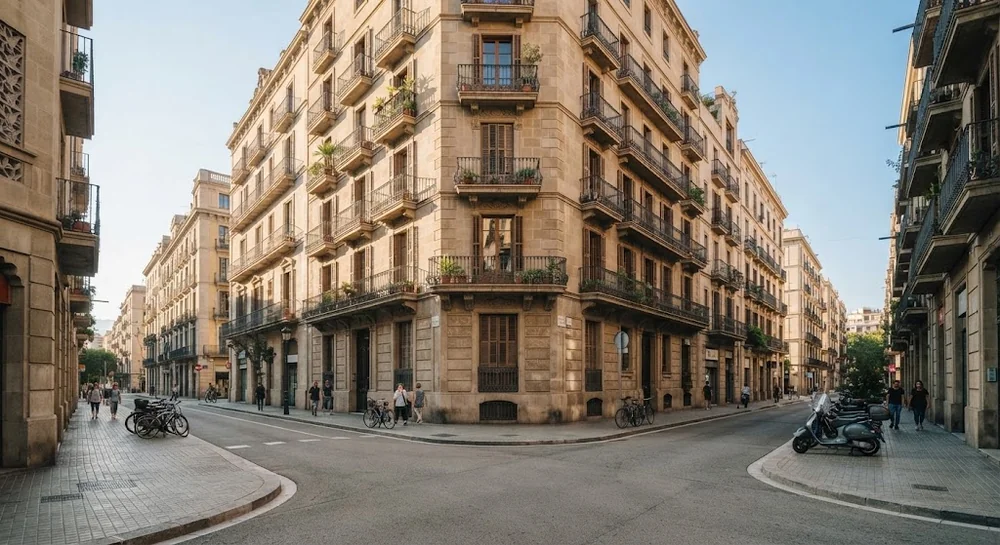
Barcelona Buying Costs: Catalan ITP, IVA and AJD
The tax you pay depends on whether the apartment is a resale or a qualifying first supply of a new home. Resale purchases pay Catalan ITP (impuesto sobre transmisiones patrimoniales), the regional transfer tax administered by the Agència Tributària de Catalunya (ATC). Qualifying new residential first supplies from a developer generally pay IVA, Spain’s VAT, plus AJD (actos jurídicos documentados), a stamp duty on the notarial deed.
| Portion of taxable base | Marginal rate |
|---|---|
| First €600,000 | 10% |
| Next €300,000 (€600,000.01 to €900,000) | 11% |
| Next €600,000 (€900,000.01 to €1,500,000) | 12% |
| Above €1,500,000 | 13% |
The bands are marginal: each rate applies only to the slice of value within that band. Assuming the taxable base equals the price and the ordinary general rates apply, a €400,000 resale apartment produces €40,000 of ITP, and a €750,000 apartment produces €76,500 (€60,000 on the first €600,000 plus €16,500 on the remaining €150,000). Special rates exist, including certain large-holder and whole-building cases, and conditional reduced rates or reliefs may apply to specific buyers. None applies automatically to foreign buyers.
Here’s where people usually come unstuck: the taxable base is not always the price you agreed. Spain’s Catastro, the cadastral register run by the Directorate-General for Cadastre, publishes a valor de referencia, a reference value for each property. Where that value applies and is higher than your declared price, it generally becomes the minimum taxable base. Ask your adviser to check it before you sign.
| Item | Resale apartment | Qualifying new residential first supply |
|---|---|---|
| Main purchase tax | Catalan ITP, marginal 10–13% under the general tariff | IVA, generally 10% for qualifying dwellings |
| Stamp duty | Not charged on the same transfer as ITP | AJD on the deed, ordinary rate 1.5% (ATC) |
| Illustration at €400,000 | €40,000 ITP | €40,000 IVA plus €6,000 AJD, if the sale qualifies at those rates |
| Who files | Buyer, through the Catalan self-assessment, generally within one month | IVA charged by the developer; buyer files AJD, generally within one month |
Not every developer sale follows the new-build route. A later sale, a sale after the developer has used the property, or a transaction where the VAT exemption is waived can be taxed differently; ATC applies a separate 3.5% AJD rate from 27 June 2025 where a VAT exemption has been waived. Your lawyer should confirm the classification in writing.
Professional and transaction costs are separate from tax. Budget individually for:
- Independent lawyer’s fee, usually quoted plus 21% Spanish VAT where applicable
- Notary fees for the sale deed, set under the official notarial tariff (the Consejo General del Notariado explains how notaries work in Spain)
- Land Registry (Registro de la Propiedad) fees for registering your title
- Technical survey of the apartment and building
- Bank valuation, if you are borrowing
- Sworn translations, NIE and power-of-attorney costs
- International transfer and currency exchange costs
- Any buyer’s agent fee you negotiate, plus VAT where charged
- Renovation budget, including permits
I won’t give you an all-in percentage. Those rules of thumb hide the tax band and the fees you actually face.
Non-Resident Mortgages and the Cash You Need
Spanish banks do lend to non-residents, but every approval is lender-specific. Underwriters look at your income, existing debts, credit history, the currency you earn in and the bank’s own valuation of the apartment. If you earn in pounds and borrow in euros, exchange-rate movements change your real repayments, and some lenders apply stricter affordability tests for that reason. Loan-to-value offers vary from bank to bank and applicant to applicant, so ask each lender for its terms in writing.
Consider a hypothetical example, assuming the taxable base equals the price and the general ITP rate applies. You buy a €400,000 resale apartment. Your total acquisition cost is €440,000 (price plus €40,000 ITP), plus your itemised legal, notarial, registry, valuation and mortgage-related costs and any works. If a lender offers 60% of the price, you borrow €240,000. Your own cash requirement is therefore €200,000 (€160,000 towards the price plus €40,000 ITP), plus those same fees and works. Your deposit under the private contract counts towards the price; it is not an extra cost. If you paid a €40,000 deposit at the arras stage, the price balance at completion is €360,000: €240,000 from the bank and €120,000 from you, with the tax and fees on top.
Separate three things. A bank valuation (tasación) protects the lender; it is not a structural survey. Pre-approval is an initial assessment, not a binding loan offer. Approval only becomes firm once the bank issues its binding offer documents. If the valuation comes in low, the loan may shrink and you fund the gap.
Not sure whether your budget, financing and timeline are ready for a Barcelona purchase? Take our short buyer-readiness quiz to see which steps to tackle first.
The Banco de España explains that, for covered mortgage contracts, the borrower generally pays the valuation while the lender pays most formalisation costs of the mortgage deed. Those are distinct from your sale-deed costs.
The disclosure period is a real completion dependency, so plan for it. Under national law, covered consumer mortgages require the lender to deliver the pre-contract documents at least 10 calendar days before signing, and you must attend the notary for free legal advice beforehand. In Catalonia, the regional consumer code ordinarily extends that period to 14 calendar days (as of October 2026). Receiving a binding offer does not mean every signing prerequisite has been met: the clock, the notary’s advice session and the record of it all have to be in place. Ask the notary to confirm which period applies to your loan and whether any exceptional treatment is relevant.
Buying an Apartment in Barcelona: Step by Step
The order of the steps matters more than their speed. These eight stages give a sensible sequence for a foreign buyer.
- Define use and total budget. Decide whether the flat is a home, a second home or a long-term let, and budget for price, tax, fees and works together.
- Appoint advisers and prepare identity and funds. Instruct an independent Spanish lawyer, apply for your NIE and assemble source-of-funds evidence your bank and notary will accept.
- Establish finance. Obtain an initial mortgage assessment from one or more lenders before making offers.
- Shortlist and inspect. View in person or through someone you trust, at different times of day, and test the lift route, light and noise.
- Complete essential checks before any binding commitment. Your lawyer reviews title, charges, debts and occupancy; your surveyor examines the flat and building.
- Negotiate lawyer-reviewed contracts. Agree price, deposit, conditions, inclusions and completion date in writing before paying anything binding.
- Coordinate mortgage and notary completion. Align the lender’s documents, the disclosure period, the notary appointment and the transfer of cleared funds.
- File taxes and confirm registration. Pay resale ITP generally within one month of the taxable act and obtain proof that your title is registered. Your lawyer should fix the accrual date: it is not always the notarial deed, as an earlier private agreement can trigger it.
If you cannot attend the signing, a representative can act under a notarial power of attorney. Have your lawyer approve the draft so its scope covers buying, borrowing, tax filings and utility changes. A power signed outside Spain may need an apostille and a sworn translation, depending on where it is signed, and the original usually has to reach Spain before completion. Your lawyer checks the draft; the Spanish notary who will use it decides whether it is acceptable, and a lender will review it too if you borrow. Remote signing does not replace a proper inspection of the apartment.
The planning ranges below are my own estimates for a typical purchase, not promises. The statutory periods in the last column are set by law and run on their own clock.
| Stage | Main responsibility | What usually drives the timing | Indicative planning range (estimate) | Statutory period |
|---|---|---|---|---|
| NIE and advisers | Buyer and lawyer | Appointment availability at the consulate or police office | 2–6 weeks | None |
| Finance assessment | Buyer and lender | Completeness of income and credit documents | 2–4 weeks | None |
| Legal and technical checks | Lawyer and surveyor | Seller’s speed in supplying community and building documents | 2–4 weeks | None |
| Contract to completion | Lawyer, lender, notary | Valuation, binding offer, disclosure period, funds clearance | 4–10 weeks | Mortgage disclosure: 10 days nationally, ordinarily 14 calendar days in Catalonia |
| Tax filing and registration | Lawyer or tax adviser | Accrual date and Registry processing | Registration often takes several weeks | ITP or AJD: generally one month; Modelo 211: one month |
Source-of-funds evidence should be ready before you make an offer, because your Spanish bank and the notary will both ask for it before money moves. Prepare:
- Passport and NIE, with proof of address
- Recent payslips, tax returns or company accounts showing your income
- Bank or investment statements showing savings built up over time
- Completion statement if the money comes from selling a property
- Signed gift letter and the donor’s own evidence if family is contributing
Your bank runs its anti-money-laundering checks when funds arrive; the notary checks the means of payment at signing and records them in the deed; your lawyer prepares the funds statement showing that cleared money is in place. My advice to every British buyer is to confirm bank details for every payment by phone with someone you already know, using a number you obtained independently. Email-based payment fraud targets property transactions precisely because the sums are large.
Apartment and Building Checks Before Your Deposit
Always ask for the nota simple before you commit. A nota simple is an extract from the Registro de la Propiedad showing the registered owner, the description of the property and any mortgages, seizures or other charges. It is only the start. A Barcelona apartment sits inside a building governed by a comunidad de propietarios, the owners’ association that manages shared parts and charges, so you are buying into its finances and its decisions too.
| Document or check | Who reviews it | Risk revealed | Action before commitment |
|---|---|---|---|
| Current nota simple | Lawyer | Wrong owner, mortgages, seizures, usufructs | Obtain a fresh extract; agree how charges are cancelled at completion |
| Seller identity and authority | Lawyer | Missing co-owners, heirs or company signatories | Confirm everyone needed can sign or has valid authority |
| Registro, Catastro and physical layout | Lawyer and surveyor | Area or layout differences, unregistered extensions | Resolve or price in differences before signing |
| Cédula de habitabilidad | Lawyer | Dwelling not certified as meeting habitability standards | Require a valid cédula from the seller for the transfer |
| Planning and lawful use status | Lawyer and surveyor | Unit is legally commercial premises or another non-residential use | Check the registered description and municipal use status as a dwelling |
| Energy performance certificate | Lawyer | Missing certificate or poor energy rating | Require a valid certificate; it shows energy efficiency only, not lawful residential use |
| ITE and certificado de aptitud, where applicable | Surveyor and lawyer | Structural or façade defects, required works | Review the inspection result and pending works |
| Community debt certificate, minutes and approved levies | Lawyer | Unpaid charges, special levies, major works approved | Agree who pays approved works in the contract |
| IBI receipts | Lawyer | Unpaid municipal property tax | Require proof of payment |
| Leases and occupancy | Lawyer | Tenants or occupants with continuing rights | Make vacant possession an express condition |
| Renovation permissions | Surveyor and lawyer | Unauthorised works, removed walls, added bathrooms | Request licences or communications for past works |
| Heritage protection | Surveyor | Limits on future works and alterations | Check the property’s protection level with the city |
| Terrace, storage and parking rights | Lawyer | Exclusive use mistaken for ownership | Confirm the legal basis in the title and community statutes |
The cédula de habitabilidad is the Catalan certificate confirming a dwelling meets habitability standards. As of October 2026, a valid cédula is normally required when a second-hand dwelling is transferred in Catalonia; the exemptions are narrow, such as certain purchases made for renovation under conditions set by the Catalan rules, so have your lawyer confirm whether any applies to your sale. The ITE (inspección técnica de edificios) is the technical inspection of older buildings; in Catalonia, the resulting certificado de aptitud records whether the building is fit for use or needs works.
Two limits are worth understanding. A satisfactory building inspection does not guarantee that you will face no future costs: roofs, pipes and façades age. A cédula de habitabilidad does not prove that every alteration inside the flat was lawfully permitted. Your lawyer reviews legal status and your surveyor reviews physical condition; neither replaces the other.
Be especially careful with ground-floor or loft units in converted commercial premises (locales) marketed as homes. If the unit lacks residential status, you may be unable to obtain a cédula de habitabilidad, occupy it lawfully as a home or let it lawfully as a dwelling. Keep a separate point clear: registering on the municipal population register (empadronamiento) records where you actually live, regardless of the dwelling’s physical or legal condition. Being registered there does not legalise residential use of the unit, and it does not give you any immigration permission.
Ten years on the Costa del Sol have taught me that the expensive surprises rarely hide in the flat itself. They sit in the community minutes: the approved façade repair, the lift replacement, the levy voted three weeks before you signed. Read the minutes.
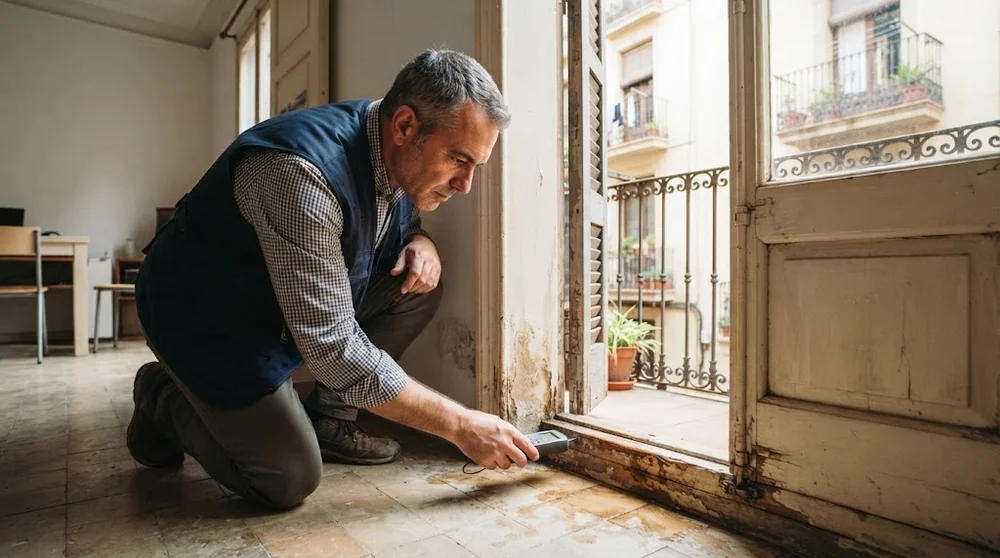
Arras Contracts and Protecting Your Deposit
Arras are deposits paid under a private contract before completion. In Catalonia, they are governed by the Catalan Civil Code rather than the general Spanish rules many buyers read about online, and the consequences depend on the contract’s actual wording.
Start with the reservation stage. A small reservation payment to take a property off the market is not necessarily the same as a binding deposit contract, but labels can mislead. What counts is what the document says about obligations, refunds and deadlines, so have your lawyer read it before you pay anything.
Under Article 621-8 of the Catalan Civil Code, a deposit is treated as confirmatory by default, meaning it confirms a binding sale and counts towards the price. A deposit allowing either party to withdraw by losing or returning it, known as a withdrawal deposit, applies only if the contract expressly agrees it. Do not assume the widely quoted “buyer loses the deposit, seller returns double” formula applies automatically in Barcelona.
Article 621-49 gives a consumer buyer a right to withdraw where financing falls through, but only if its conditions are met. The contract must contemplate that the price will be financed through a credit institution. The designated institution must refuse the loan, in writing, within the agreed period. The refusal must not be due to the buyer’s own negligence, and the parties must not have agreed otherwise. Where a valid withdrawal applies, the seller must return the sums the buyer has paid. A low bank valuation is not automatically the same as a protected refusal: if the lender simply offers less than you need, the outcome depends on what the contract says.
A 10% deposit is customary in some transactions, not a mandatory rule. Your contract should also deal with unresolved defects, vacant possession, included furniture and fittings, approved community works and the completion deadline.
Here is a hypothetical example. A buyer pays a 10% deposit on a flat, intending to borrow 60%. The valuation comes in lower than the price, and the bank offers a smaller loan. Whether the buyer can withdraw and recover the deposit depends on whether the contract made financing a condition, named the lending institution, defined refusal and set a deadline, and whether the written refusal was delivered on time. Independent legal review before signing is how you control that outcome.

Can You Rent Out a Barcelona Apartment?
Owning an apartment in Barcelona does not give you permission to rent it to tourists. Barcelona has three broadly separate letting categories: tourist use, genuine temporary lets for a specific non-tourist purpose such as work or study, and lets of a habitual residence. Each has its own rules, and one cannot be relabelled as another to avoid them.
The tourist-letting framework rests on Catalan Decree-law 3/2023, which made tourist use of dwellings subject to a time-limited five-year planning licence in pressured municipalities, Barcelona among them. In Judgment 64/2025 of 13 March 2025, Spain’s Constitutional Court rejected a challenge to that decree-law, holding that the licence requirement and the limits on number and duration delimit property rights rather than abolish them. That judgment addressed the decree-law’s constitutionality; it does not settle every individual licence, compensation claim or future court case. As of October 2026, Barcelona City Council’s published position is that existing tourist-apartment authorisations will end in November 2028 and will not be renewed. A tourist registration number, community consent or a seller’s past bookings does not by itself establish lawful tourist use for you.
Long-term letting is possible but regulated. Rent-control rules may apply depending on the area designation, the property’s rental history and whether you fall into a large-landlord category. Catalan Law 11/2025 has tightened temporary and room lets (position as of October 2026). A temporary lease must now meet a genuine temporary housing need, such as work, study or medical treatment, rather than leisure or tourism; the contract should state the purpose and be backed by supporting documents. A lease that fails that test is generally treated as a habitual-residence let, rent controls included. In stressed residential areas, letting by the room cannot be used to escape the limits: the combined room rents are capped by reference to what the whole dwelling could lawfully command.
Let me put it plainly: if letting income is part of your plan, treat it as a pre-purchase feasibility check, not an assumption. Start from the lawful rent the specific flat can achieve, then subtract community charges, IBI, insurance, maintenance, a realistic allowance for empty months, management fees and your Spanish non-resident tax. Ask your lawyer to confirm that your intended use is lawful for that apartment before you pay a binding deposit.
Completion, Registration and Annual Ownership Costs
Completion takes place at a notary’s office, where the seller and buyer, or their representatives, sign the public deed of sale (escritura). The notary checks identity, authority and payments, but does not act as your adviser. Before signing, your lawyer should give you a funds statement showing the price balance, taxes, fees and any amounts retained.
- Final inspection: visit the flat shortly before signing to confirm vacant possession, the agreed furniture and fittings and that no new damage has appeared.
- Deed and keys: you take possession as agreed, normally at signing, and the keys are handed over once payment is confirmed.
- Charges: any seller’s mortgage should be paid off at completion, with the cancellation arranged and later registered.
- Seller’s tax residence: ask for evidence of where the seller is tax resident, such as a tax-residence certificate, so your lawyer knows whether withholding applies.
- Non-resident seller: the Agencia Tributaria states that a buyer purchasing from a non-resident seller generally withholds 3% of the agreed price attributable to that seller and pays it through Modelo 211 within one month. This comes out of the seller’s proceeds; it is not an extra buyer tax. Where only some sellers are non-resident, it applies to their share. Keep your proof of payment and deliver a copy of the Modelo 211 to the seller.
- Municipal plusvalía: where the seller is a non-resident individual, the buyer becomes the substitute taxpayer for this municipal land-value tax. The rule does not apply in the same way to companies or resident sellers, so your lawyer should confirm the seller type and retain funds if needed.
- Purchase taxes: resale ITP and new-build AJD must generally be filed and paid within one month of the taxable act; your lawyer confirms the accrual date. IVA is charged by the developer and is not filed on the buyer’s Modelo 600.
- Handover: collect all keys and fobs, record meter readings, and obtain the community administrator’s details, appliance manuals and building certificates.
- Utilities and community: switch electricity, water and internet contracts, and notify the community administrator of the new owner.
- Registration: the deed is presented to the Registro de la Propiedad. Chase until you receive evidence that your title is registered, and check that any cancelled mortgage has been removed.
Ownership brings recurring costs. Expect annual IBI, community charges, home insurance, utilities and repairs. Non-resident owners generally have Spanish non-resident income tax obligations, either on imputed income or on actual rental income. Depending on your wealth and plans, take advice on Spanish wealth tax and succession tax too. Annual totals differ too widely between properties for a universal figure to be meaningful.
Final checklist before you sign:
- NIE obtained and funds documented
- Fresh nota simple and debt certificates reviewed
- Survey completed and community minutes read
- Contract conditions agreed in writing
- Binding mortgage offer received and disclosure period completed, if borrowing
- Payment details independently verified
- Tax and registration responsibilities assigned
If you would like a starting point, share your total budget, intended use, financing needs and preferred Barcelona areas, and we can put together a shortlist of apartments with an indicative breakdown of acquisition costs for you to review with your own advisers.
Barcelona Apartment Buying FAQs
Can I buy an apartment in Barcelona if I do not live in Spain?
Foreign buyers can generally purchase an ordinary residential apartment in Barcelona without living in Spain. You will need the appropriate Spanish identification and must satisfy transaction, funding and tax requirements. Ownership does not itself grant immigration permission or establish tax residence. British buyers should check their permitted stays separately from their right to own property.
How much tax will I pay when buying an apartment in Barcelona?
As of October 2026, Catalonia’s general resale ITP scale starts at 10% up to €600,000, with marginal bands of 11%, 12% and 13% above the relevant thresholds. Special rates and reliefs can apply. Qualifying new residential first supplies follow a different VAT and stamp-duty route. Confirm the taxable base and transaction classification before committing.
Can a non-resident get a mortgage in Barcelona?
Spanish lenders may offer mortgages to non-resident buyers, subject to income, existing debts, documentation, currency exposure and property valuation. Loan size and terms depend on the lender and applicant. Prepare cash for your price contribution, taxes and other acquisition expenses. An initial mortgage assessment or satisfactory valuation does not guarantee that the bank will lend.
What should I check before paying a deposit on a Barcelona apartment?
Have an independent lawyer review title, charges, occupancy, habitability documents, community debts and the proposed contract before paying a binding deposit. Commission appropriate technical checks on the apartment and building. Review approved works and terrace rights. In Catalonia, deposit consequences depend on the contract’s legal wording; mortgage refusal does not automatically make every deposit refundable.
Can I rent out my Barcelona apartment to tourists?
Do not assume that buying an apartment gives you permission for tourist letting. The Constitutional Court upheld Catalonia’s tourist-licence framework in Judgment 64/2025, and, as of October 2026, Barcelona’s published policy is that existing tourist-apartment authorisations end in November 2028. Check the specific property’s authorisation and community restrictions before buying. Long-term and temporary lets have separate rules and should not be treated as automatic workarounds.
Can I buy an apartment in Barcelona without travelling to Spain?
A representative may complete a purchase using a power of attorney accepted by the receiving notary and, where relevant, the lender. Have its scope checked before signing it abroad. Authentication and translation requirements depend on the document and jurisdiction. Remote signing still requires reliable property inspection, legal checks, cleared funds and independently verified payment instructions.
Final Thoughts
A good Barcelona purchase starts with the total figure, not the asking price. Work out the Catalan ITP on your actual taxable base, add every professional fee and your works budget, and if you are borrowing, know exactly how much of your own cash has to be in place at the deposit stage and at completion. Most buyers who come unstuck didn’t overpay for the flat; they underestimated the money around it.
Then protect yourself in the right order. Always ask for the nota simple before you commit, read the community minutes, separate habitability from lawful residential use, and make sure your arras contract spells out the financing condition, the lender, the deadline and what happens to your deposit if the bank says no. Build the mortgage disclosure period and the one-month tax deadlines into your timeline, rather than discovering them the week of signing.
Got a specific Barcelona flat in mind, or a question about costs, deposits or timing? Send me a message on WhatsApp and I’ll point you towards the checks that matter for your situation.
Finally, be honest with yourself about how you will use the apartment. A home, a second home and a rental investment carry different rules in Barcelona, and tourist letting in particular cannot be assumed. Settle the intended use with your lawyer before you pay anything binding, and the rest of the purchase becomes far easier to manage.
This guide provides general information only, as of October 2026, and is not personalised legal, tax, financial or immigration advice. Rules and rates can change. Before buying, take advice from an independent Spanish lawyer, a qualified tax adviser and, where relevant, a mortgage professional and technical surveyor.
Leave a Reply