
British buyers weighing up the best places to buy a second home in Spain usually end up comparing a beach apartment, a city flat and an island villa without a common yardstick. That is how people overspend, or buy a lovely place that is miserable to reach in February. This guide puts eight destinations side by side using the same questions: what it costs to buy, what it costs to keep, how you get there, and what the rules allow. All legal and tax points are stated as at November 2026.
The best places to buy a second home in Spain are Alicante for affordability, Málaga and Marbella for Costa del Sol living, Valencia for city-and-beach access, Barcelona and Madrid for urban amenities, Mallorca for premium island homes and Tenerife for winter sunshine. Compare asking prices, flight connections, annual costs and rental restrictions first.

8 Best Places to Buy a Second Home in Spain Compared
The eight locations below were chosen because they suit different second-home uses, not because they sit on a league table. Nobody can honestly rank Madrid against Tenerife, because a buyer wanting museums and high-speed rail is shopping for something entirely different from a buyer wanting winter sunshine. Treat the table as a map of trade-offs rather than a scoreboard, and note that no location comes with guaranteed returns or price growth.
The price column mixes different geographical units, because that is what the public data I could attribute gives us. The figures come from Idealista’s October 2026 asking-price index, which is a commercial listings index, not an official government statistical series. It showed a national asking price of €2,955 per square metre, up 11.2% year on year. Where I could attribute a figure to a specific unit it is shown with its label; where I could not, the table says so rather than guessing. Please re-check each Idealista figure against the original dated publication before relying on it. For recorded sales rather than adverts, use the official statistics: the INE (ine.es) publishes a housing price index based on transactions, and the Colegio de Registradores publishes registry-based sales data. Advertised prices and completed sales are different things and I keep them apart throughout.
| Location | Typical buyer scenario | Dated price benchmark (asking price, October 2026) | Travel access | Key advantage | Main compromise |
|---|---|---|---|---|---|
| Alicante (city and Costa Blanca) | Budget-conscious families and retirees | €2,744/m² for Alicante city municipality only; Costa Blanca towns are not covered by this figure | Alicante-Elche airport; UK routes vary by season | Lower entry prices than most of the other seven | Quality and prices vary widely between towns |
| Málaga (city) | Buyers wanting city amenities with beaches | Municipal figure not verified for this edition; unavailable here | Málaga-Costa del Sol airport; high-speed rail to Madrid | Year-round city life and culture | Smaller flats, older buildings and tighter tourist-let rules |
| Marbella (municipality) | Higher-budget lifestyle and villa buyers | Municipal figure not verified for this edition; unavailable here | Road transfer from Málaga airport | Gated communities, golf and international amenities | Higher entry price and heavier running costs |
| Valencia (city) | Families wanting city and beach together | €3,482/m² for Valencia city municipality only | Valencia airport; metro and tram to the beach | Large, liveable city with its own seafront | Building-specific rental rules; beach is urban, not resort-style |
| Barcelona (city) | Culture-led short-break owners | Municipal figure not verified for this edition; unavailable here | El Prat airport; extensive rail and metro | Culture, transport and year-round demand for city living | High costs and strict accommodation regulation |
| Madrid (city) | Family-visit and urban short-break owners | Municipal figure not verified for this edition; unavailable here | Madrid-Barajas airport; high-speed rail hub | Services, museums and connections all year | No coastal resort lifestyle |
| Mallorca | Premium Mediterranean island buyers | €5,619/m² for the Balearic Islands region as a whole, not Palma or Mallorca specifically | Palma airport; seasonal flight patterns | Strong island setting and premium coastal choice | High budgets, upkeep and tourism rules |
| Tenerife | Winter-sun buyers | Locality-level figure not verified for this edition; unavailable here | Tenerife South and Tenerife North airports | Mild winter conditions in the south | Microclimate differences; IGIC regime differs from mainland IVA |
Five of the eight rows carry no number, and I would rather show that gap than fill it with a guess. Because of it, this table is not a like-for-like price comparison, and you should not read the three figures that do appear as a ranking. Pull current listings for the exact neighbourhood and property type you want, and compare those.
Málaga and Marbella count separately because they are different municipalities with different housing stock, different buyers and different price levels. Treating the whole Costa del Sol as one uniform market is the commonest mistake I see in online comparisons. Picture a typical buyer scenario for each: a compact flat in a Málaga city block on one hand, a villa on a Marbella urbanisation on the other. Those two scenarios share a coastline and not much else. They are contrasting examples, not a full description of either place, because Málaga has villas and Marbella has perfectly ordinary urban flats. The destination sections below explain each place in turn.

How We Compare Spain’s Second-Home Locations
Every location in this guide is judged against the same seven criteria, so you can reproduce the exercise for any other town on your list. The first six are factual or can be checked against a source; the seventh, suitability for different buyers, is my professional judgement and is labelled as such wherever it appears.
- Purchase price: the dated asking-price benchmark for the stated geographical unit, where a reliable one exists.
- Annual ownership costs: property tax, community fees, insurance, utilities and non-resident tax.
- Flight connections: the airport, and how far the schedule thins out in winter.
- Ease of winter use: whether the place still works as a home between November and March.
- Amenities: healthcare, shops, transport and year-round services.
- Legal rental feasibility: whether occasional letting is realistic under regional, municipal and community rules.
- Buyer-profile suitability: my personal assessment of who the location suits and who it frustrates.
I have deliberately not combined these into a single score. A weighted ranking would pretend that a retiree’s priorities and a family’s priorities are identical, and they are not.
The comparison worksheet
Here is how each criterion is measured, so you can repeat it yourself. The factual criteria use a named source and a reference date. Criterion 7 is kept apart as opinion.
| Criterion | Measure used | Source type | Geographical unit | Reference date | Method |
|---|---|---|---|---|---|
| 1. Purchase price | Asking price per m² | Commercial index (Idealista); cross-check with INE and registry sales data | Municipality, or region where stated | October 2026 | Quote only where the unit is labelled; otherwise mark unavailable |
| 2. Annual ownership costs | Relative running-cost level | Municipal IBI rules, community accounts, insurer quotes | Property, not town | November 2026 | Low, medium or high band; the €250,000 worked example below gives actual euros |
| 3. Flight connections | Airport and seasonality | Airport and airline timetables (AENA publishes traffic data) | Airport | Check the season you will travel | Direct in all seasons, direct but seasonal, or connection likely |
| 4. Winter use | Services open and climate | AEMET climate data, local knowledge | Town or district | November to March | Easy, moderate or demanding |
| 5. Amenities | Hospital, rail, shops | Regional health service and transport operators | Municipality | November 2026 | Checklist of what is within a short drive or walk |
| 6. Rental feasibility | Regime outlook | BOE, regional gazettes, municipal rules, community statutes | Exact address | November 2026 | Open, restricted or likely unavailable, always confirmed by a lawyer |
| 7. Buyer suitability | Author’s judgement | Ten years of client experience | n/a | n/a | Opinion, kept separate from the factual rows |
Applying the worksheet’s consistent categories to all eight places gives the next table. Criteria 2, 4 and 6 are labelled assessments, not measurements, and every cell needs checking at the specific address.
| Location | Running-cost level (assessment) | Winter use (assessment) | Tourist-let outlook (as at November 2026; confirm per address) |
|---|---|---|---|
| Alicante and Costa Blanca | Low to medium | Moderate: city easy, resorts quiet | Restricted: regional registration and community approval |
| Málaga | Medium | Easy | Restricted: new licences curtailed in much of the city |
| Marbella | High | Moderate | Restricted: regional registration, community approval, local rules |
| Valencia | Medium | Easy | Restricted: building and municipal rules |
| Barcelona | High | Easy | Likely unavailable for new licences |
| Madrid | Medium to high | Easy, but cold | Restricted: tightening municipal rules |
| Mallorca | High | Demanding outside Palma | Restricted: island and municipal limits |
| Tenerife | Medium | Easy in the south | Restricted: Canary Islands holiday-let legislation |
Asking prices, transactions and appraisals
An asking price is what a seller or agent advertises. A transaction price is what was actually agreed and recorded in a deed, and an appraisal is a bank valuation prepared for a mortgage. The three measure different things and can diverge, especially where sellers start high. The Idealista figures used here are asking prices from a secondary, commercial source, not a registry transaction index. In practice, always test any average against recent comparable listings for the exact street.
Why geographical units matter
City, municipality, province, region and island statistics cannot be casually combined. A figure for Alicante city does not describe Jávea, and a Balearic regional figure does not describe a flat in Palma. Property type matters just as much: a new-build apartment, a resale flat and a detached villa will rarely sit at the same price per square metre. Every figure in this article is tied to its reference date, which is October 2026 for the Idealista asking-price data, and to its stated geographical unit.
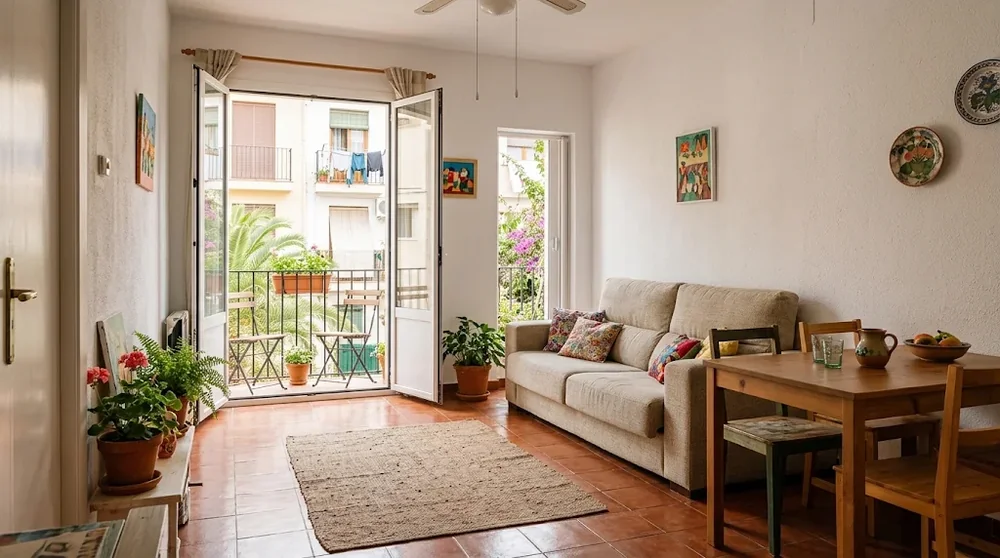
Alicante and Costa Blanca: Affordable Coastal Choice
Alicante’s strongest use case is a lower-cost coastal home close to a busy airport; the main trade-off is that the Costa Blanca is not one market, so a city average says little about premium northern towns.
Start with the labelling. Idealista’s October 2026 asking-price index gives €2,744 per square metre for Alicante city, which is the municipality, not the province. That compares with a national asking price of €2,955 per square metre in the same month. It is an advertised figure, not a recorded sale price. The province of Alicante contains Torrevieja, Guardamar del Segura, Jávea and Dénia, and Alicante city’s average should not be applied to any of them.
North versus south
Southern Costa Blanca, including Torrevieja and Guardamar, is generally associated with a large supply of apartments and villas at accessible entry points. Northern towns such as Jávea and Dénia are generally regarded as pricier and more residential in feel, with more hillside villas and a quieter off-season. I have no verified municipal figure for those four towns, so I will not invent one: look at current listings for the specific town and property type.
Airport, annual use and walkability
Alicante-Elche airport serves the whole coast, and AENA publishes its traffic data. British services exist all year, but the number of routes and frequencies changes between summer and winter schedules, so check the winter timetable before assuming a cheap Friday flight in January. Alicante city itself is walkable, with a seafront and a historic centre. Many coastal developments further south are easier with a car, so test the grocery run and the airport transfer, not just the pool.
- Best for: families and retirees wanting affordable coastal apartments and regular visits.
- Drawbacks: uneven neighbourhood quality, and development density in some resort areas.
- Buyer tip: compare the same property type in the same town on at least three listings before trusting any average.
Let me put it plainly: a cheap apartment with high community fees and no lift is not cheap. My advice to every British buyer is to price the first five years, not just the purchase.
Málaga: A Second Home With City Amenities
Málaga city’s strongest use case is a second home that works all year with beaches, restaurants and culture on the doorstep; the main trade-off is smaller, older flats and tightening rules on tourist letting.
Málaga is a proper working city, with urban beaches such as La Malagueta and Pedregalejo, a historic centre, theatres, museums and hospitals. Málaga-Costa del Sol airport has a large British route network, and the city has a high-speed rail link to Madrid. For a buyer who wants to pop over for a long weekend in March and still find restaurants open and neighbours around, this is hard to beat. Neighbourhoods vary considerably: the historic centre is lively and noisy, Malagueta and Pedregalejo are close to the sand, and inland districts such as Teatinos are quieter and more residential, with newer blocks and more lifts and garages.
Be realistic about the property. Central flats are often compact, in older buildings, and lifts and parking are not guaranteed. Newer blocks in districts like Teatinos are the better bet if you want a lift, a garage and lower maintenance surprises, at the price of a less atmospheric street. I do not have a verified October 2026 municipal asking-price figure for Málaga city, so check current listings for the specific neighbourhood.
On rentals, the city council has acted to curtail new tourist-flat licences across much of the city, and Andalusian regional registration also applies. As I understand the position at November 2026 this is an enacted restriction, not just an announced one, but its exact reach differs by street and building, so confirm it at the address in writing.
Málaga city versus Marbella municipality
Málaga city offers urban life: mostly flats, fewer gated developments, and a mixed community of residents. Marbella municipality offers resort living: many villas, golf, secure developments and a quieter, seasonal rhythm. These are typical patterns, not rules, since each place has the other’s kind of home as well. Their price levels differ, and neither figure should be borrowed for the other. If you want to walk to a market, a museum and a beach in one afternoon, Málaga suits better; if you want a garden, a pool and a gate, look at Marbella.
- Best for: year-round urban owners and couples wanting a walkable base.
- Disadvantage: compact apartments and rental restrictions that need checking before you buy.
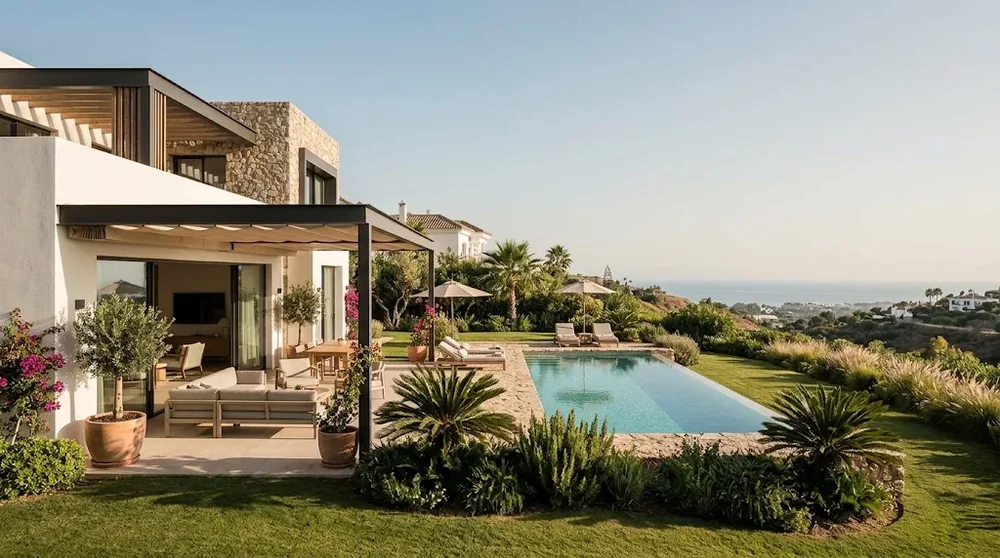
Marbella: Premium Costa del Sol Holiday Homes
Marbella’s strongest use case is a higher-budget villa or resort apartment with golf, security and international amenities; the main trade-off is a higher entry price and heavier running costs.
Ten years on the Costa del Sol have taught me that “Marbella” is not a single price zone. The Golden Mile, Puerto Banús, Nueva Andalucía with its golf valley, San Pedro de Alcántara and the old town are quite different markets. I swapped Manchester for Andalusia more than ten years ago, and I still tell buyers that the postcode on the brochure and the street outside the front door are two different things. I have no verified October 2026 municipal asking-price figure for Marbella, so use current listings for each area.
Apartments in complexes versus villas
Apartments in residential complexes usually come with communal pools, gardens and security, paid for through community fees. Those fees are a recurring cost, and in larger complexes a special assessment (a derrama) can arrive for roof, lift or facade works. Villas give privacy, but the owner pays for pool upkeep, gardening, repairs and often higher insurance. Here’s where people usually come unstuck: an extension built without a licence, or a pool never declared, which can turn into a legal problem at sale. Check planning legality before you commit.
Who suits Marbella over Málaga
Marbella suits buyers who want a resort environment with golf, beach clubs and a villa garden, and who can carry higher maintenance bills. Seasonal demand is strong in summer, but some services quieten off-season. Rental income is never guaranteed, and no one can promise returns: licence rules and occupancy vary by property, season and management quality. In my view, the owner who visits eight or more weeks a year gets more out of Marbella than the owner who visits for ten days.
Valencia: Urban Living Close to the Beach
Valencia’s strongest use case is a city-and-beach home for families who want daily life and sea air together; the main trade-off is that rental rules depend on each building and the beach is urban, not a resort strip.
Idealista’s October 2026 asking-price index gives €3,482 per square metre for Valencia city. That is the municipality only, and it is an advertised price, not a completed sale. It sits above Alicante city’s €2,744 per square metre in the same month, so Valencia is not the cheap option, but you get a large city with parks, schools, hospitals, markets and a metro and tram network.
Beach neighbourhoods and central districts
Malvarrosa and Cabanyal are the beach-facing districts, and Patacona sits just up the coast in the neighbouring municipality of Alboraya. Central areas such as Ruzafa and the Eixample offer cafés and walkability, but are further from the sand. Valencia airport handles European traffic, and high-speed rail links the city to Madrid, which helps family visits. Winter use is easy because the city never closes for the season. Older beachfront blocks often have lower prices and higher maintenance needs than newer buildings inland, so ask for the building’s inspection record before falling for the view.
Rental rules and who should choose Valencia
Tourist letting in Valencia depends on Valencian regional registration, municipal planning rules and, for flats, the building’s statutes and community approval following the April 2025 national reform described later. The city and region have tightened the regime in recent years, but the detail differs between building types and floors, and I have not verified the current implementation at every address. Never assume a flat can be let because the one next door is. Valencia suits buyers who want more city than Alicante offers and a gentler pace than Barcelona. If your dream is a resort with a golf course and a gate, look elsewhere on this list.
Barcelona: A Metropolitan Second Home
Barcelona’s strongest use case is a cultural, well-connected city base; the main trade-off is higher costs and strict accommodation regulation, so it should not be bought on the assumption of rental income.
Barcelona is an urban and cultural purchase, not a traditional beach-resort one. El Prat airport has extensive European connections, and the metro and rail network makes a car optional. Neighbourhoods differ sharply: the Eixample has grand, regular blocks, Gràcia feels like a village inside the city, Poblenou is near the sea, and Barceloneta is lively and compact. I have no verified municipal asking-price figure for Barcelona for October 2026, so check current listings by district.
Building condition and running costs
Many central apartments are in older buildings. Ask for the building’s technical inspection records, lift status and any planned facade or roof works, and read the minutes of recent community meetings. Purchase taxes in Catalonia are set regionally and differ from Andalusia, so budget with the regional authority’s current rates rather than a national rule of thumb.
Tourist-let restrictions
Do not buy in Barcelona expecting to obtain a tourist-rental licence. Catalan regional rules and the city’s own policy are among the strictest in Spain. The city council has announced a plan to phase out existing tourist-flat licences, and that is a stated policy that remains subject to legal developments, so do not treat it as settled either way. New licences should be treated as unavailable unless a lawyer proves otherwise in writing for that exact address. Barcelona suits those who will use the flat themselves and accept higher costs for convenience.
Madrid: A Second Home Beyond the Coast
Madrid’s strongest use case is a year-round city base for short breaks and family visits; the main trade-off is that there is no beach and no resort lifestyle.
Madrid belongs in a national comparison because many second-home buyers do not want the sea. The capital has major museums, restaurants, healthcare and the largest transport hub in Spain: Madrid-Barajas airport and a high-speed rail network. If your children study in Spain, or you want a base for regular theatre and gallery trips, a Madrid flat makes more sense than a beach apartment you would only use in August.
Be honest about the climate: AEMET data shows a continental pattern, with hot summers and cold winters, so this is not a winter-sun purchase. I have no verified October 2026 municipal asking-price figure for Madrid, so use current listings for your target neighbourhood. Central districts such as Salamanca, Chamberí and Retiro are polished and pricey, whereas areas further out offer more space and newer buildings for the money.
Madrid compared with Barcelona and Valencia
Madrid is more government-and-business oriented than Barcelona and has no sea. Barcelona gives more of a cultural and seaside-city feel at higher regulatory friction. Valencia gives a lower-key city with a beach. Choose Madrid if your use pattern is city-led, and note that the absence of seaside use changes what you should buy: a practical flat suitable for visits by friends and family, with a lift and good transport links, matters more than a pool.
Paid letting is a separate matter. The city has been tightening its rules on tourist flats, and I would check the municipal position and the building’s statutes for the exact address before relying on any income. Longer-term residential letting is a different legal framework again and should be discussed with a lawyer.
Mallorca: Premium Mediterranean Island Ownership
Mallorca’s strongest use case is a premium island home for owners with larger budgets and long stays; the main trade-off is high prices, flight dependence, upkeep and tourism rules.
The Balearic Islands’ regional asking-price benchmark was €5,619 per square metre in October 2026. That is a figure for the whole Balearic region, covering all the islands and all property types. It is not a Palma figure and not a Mallorca-specific figure, and it should not be quoted as such. The gap between this regional benchmark and the national €2,955 per square metre in the same month shows why island buyers need larger budgets.
Palma, coast and inland
Palma is a real city, with a cathedral, restaurants and year-round life, and it suits owners wanting a flat in a lived-in place. Coastal communities such as Port d’Andratx, Pollença, Alcúdia and Santanyí each have their own character and price level. Inland villages and rural properties offer space and quiet, but rural land carries tight planning rules and unlicensed extensions are a real legal risk. Water supply and storage, pool care and roof maintenance all matter, particularly in dry summers.
My assessment, not a fact: an island home is a beautiful way to turn a simple holiday into a part-time project. Budget for a caretaker.
Access, upkeep and rental rules
Palma airport carries most visitors, and winter flight schedules are thinner than summer ones, so verify the timetable for your preferred months. Holiday-let rules in the Balearic Islands have tightened, and Palma has moved to restrict new tourist lets in flats, but the detail differs between the island, the municipality and the type of dwelling. Check the regional and municipal position for the specific property before purchase. Homes left empty through winter in Mallorca also need regular checks for damp and leaks, which links to the unoccupied-home checks later in this guide.

Tenerife: A Second Home for Winter Sunshine
Tenerife’s strongest use case is a winter-sun home with mild conditions from autumn to spring; the main trade-off is that conditions vary by microclimate and that Canary Islands tax and rental rules differ from the mainland.
Southern coastal areas such as Costa Adeje, Los Cristianos and Los Gigantes are generally associated with drier, sunnier weather and resort infrastructure. Northern and urban Tenerife, including Puerto de la Cruz, La Laguna and Santa Cruz, is typically greener and cloudier, with a more local feel. AEMET publishes climate data for the islands, and the differences between north and south are real. I have no verified locality-level asking-price figure for Tenerife for October 2026, and I will not apply a Canary Islands average to a particular town.
Flights and winter use
Tenerife is served by two airports, Tenerife South and Tenerife North. UK services run throughout the year, but frequencies and routes change with airline schedules and the season. Flight times from the UK are noticeably longer than to the mainland, so a two-night trip is rarely sensible. Longer winter stays make a lot of sense, but note the 90-days-in-180 rule explained later.
IGIC, management and building rules
The Canary Islands do not apply mainland IVA. They use IGIC (Impuesto General Indirecto Canario), with its own rates set by the Canary government, so new-build purchase tax assumptions from the mainland do not transfer. Confirm the applicable rate and any resale transfer tax with the regional authority. Many resort developments have strict community rules and property managers. The Canary Islands have adopted their own holiday-let legislation, which I understand to be in force at November 2026, but eligibility turns on the property’s zoning and the building’s rules, so check it at the exact address before relying on any rental plan.
Getting There: A Short-Stay Accessibility Comparison
A second home you cannot reach easily becomes a home you do not use. To make the airport column more useful, the table below uses one defined starting point: a London departure, with a named representative area at each destination. The flight times and transfer ranges are approximate planning figures from my own experience, not verified against a November 2026 timetable. Check live schedules before you rely on any of them, and remember that direct-flight availability, frequency and seasonality are three separate questions.
| Destination (representative area) | Approx. flight from London | Approx. airport-to-home transfer | Two-night trip | Four-night trip | Extended stay |
|---|---|---|---|---|---|
| Alicante (city centre) | About 2.5 hours | About 20 to 30 minutes | Realistic | Good | Good |
| Málaga (central or Malagueta) | About 2.75 hours | About 20 to 30 minutes | Realistic | Good | Good |
| Marbella (Nueva Andalucía) | About 2.75 hours plus road transfer | About 45 to 60 minutes by road | Tiring | Good | Good |
| Valencia (Ruzafa or Cabanyal) | About 2.25 hours | About 25 to 40 minutes by metro or taxi | Realistic | Good | Good |
| Barcelona (Eixample) | About 2.25 hours | About 30 to 45 minutes | Realistic | Good | Good |
| Madrid (Chamberí) | About 2.5 hours | About 30 to 45 minutes | Realistic | Good | Good |
| Mallorca (Palma) | About 2.5 hours | About 20 to 30 minutes | Realistic in season | Good | Good |
| Tenerife (Costa Adeje) | About 4.25 hours | About 20 to 30 minutes | Poor | Workable | Good |
The columns for trip length are my assessment, not data. The pattern is simple: mainland airports with year-round British services support the shortest breaks, while the islands and anywhere that needs a long road transfer work better for longer stays. Flights that are direct in July may be indirect or less frequent in January, and I cannot tell you from here which winter routes will run, so check the exact months you will travel.
What Does a Second Home in Spain Really Cost?
A Spanish second home costs the purchase price plus acquisition costs, which for a resale on the mainland I would plan at roughly 9% to 12% in many regions, plus annual running costs that arrive whether or not you are in residence. That range is an illustrative planning assumption for resale property, not a general Spanish rule: new builds and higher-tax regions can need materially more, as the new-build example below shows. Everything here is a planning assumption to verify with an independent Spanish lawyer and tax adviser, not a quotation.
Purchase taxes: ITP, IVA, AJD and IGIC
Resale properties on the mainland generally pay regional transfer tax (ITP), at a rate set by each autonomous community. New builds generally pay IVA plus stamp duty (AJD), which is also set regionally. As at November 2026, the general IVA rate for qualifying new residential property on the mainland is 10%, per the Agencia Tributaria’s residential-property guidance (agenciatributaria.es). Reduced rates and exceptions can apply to particular property types, so ask your lawyer which applies. The Canary Islands apply IGIC instead of mainland IVA, at rates set by the Canary government.
Four values people confuse
Four different numbers get mixed up in Spanish property purchases, and they feed different calculations:
- Asking price: what the seller advertises. It is a marketing figure.
- Transaction price: the price declared in the deed. It is the usual starting point for ITP.
- Valor catastral (cadastral value): an administrative value on the Catastro and your IBI bill. It drives IBI and the non-resident imputed-income tax, and it is often well below market value.
- Valor de referencia (reference value): a separate value published by the Catastro, based on market data, and used for transfer taxation. Official Catastro guidance says it can determine the taxable base when it exceeds the declared price or consideration.
The practical point: for ITP, the tax authority compares the declared price, any declared value and the reference value, and the highest applicable amount can become the taxable base. Check the property’s reference value with the Catastro before signing, and ask the seller for the latest IBI receipt. Valor de referencia and valor catastral are not interchangeable.
Illustrative €250,000 resale in Andalusia
This is a hypothetical example, not a client case. It assumes a €250,000 resale apartment in Andalusia with a 7% ITP rate (as at November 2026, to be confirmed with the regional tax authority) and a cadastral value of €100,000. It also assumes the ITP taxable base is the €250,000 price, meaning the reference value does not exceed it; the next case shows what happens if it does. Lawyer, notary, registry and administrative amounts are planning assumptions.
| Cost item | When it applies | Basis or assumption | Illustrative amount (€250,000 resale, Andalusia) |
|---|---|---|---|
| ITP (regional transfer tax) | At completion | 7% of a €250,000 taxable base (assumption, verify) | €17,500 |
| Notary and registry (Registro de la Propiedad) | At completion | Planning assumption of 0.5% to 1% of price | €1,250 to €2,500 |
| Independent lawyer | At completion | Planning assumption of 1% plus 21% IVA | About €3,025 |
| Gestoría, NIE and admin | At completion | Planning assumption | €300 to €600 |
| Acquisition subtotal | About 8.8% to 9.5% of price | €22,075 to €23,625 | |
| IBI (property tax) | Following 12 months | General statutory urban range of 0.4% to 1.1% of cadastral value; the actual rate is set by each municipality | €400 to €1,100 |
| Community fees | Following 12 months | Varies hugely by complex | €600 to €2,400 |
| Insurance | Following 12 months | Planning assumption | €250 to €500 |
| Utilities and rubbish charge | Following 12 months | Standing charges even when empty | €600 to €1,500 |
| Non-resident imputed-income tax (Modelo 210) | Following 12 months (filed later) | 24% on 1.1% or 2% of €100,000 cadastral value; assumes a full tax year of sole ownership and no letting | €264 to €480 |
| Repairs and property management | Following 12 months | Planning assumption | €1,000 to €2,500 |
| Annual subtotal | Scenario only | About €3,114 to €8,480 |
Here is the arithmetic behind the headline. Purchase price €250,000 plus acquisition costs of €22,075 to €23,625 plus the first twelve months of annual costs of €3,114 to €8,480 gives a combined range of €275,189 to €282,105, or roughly €275,000 to €282,000 in round terms. Only the €250,000 and the acquisition costs are needed at completion. The annual costs are paid across the following twelve months, and the Modelo 210 is filed after the tax year ends. Furnishing, mortgage charges and renovation are extra, and non-resident lending terms are often less generous than those offered to residents.
Second case: the reference value is higher than the price
Now suppose the Catastro reference value for the same flat is €280,000, which is above the €250,000 price. If the reference value becomes the taxable base, 7% ITP is €19,600, not €17,500, which is an extra €2,100. Acquisition costs then become about €24,175 to €25,725, or roughly 9.7% to 10.3% of the €250,000 price, and the combined range moves up by the same amount. This is hypothetical and rates and rules should be confirmed, but it shows why checking the reference value before you sign matters.
New-build example: why 9% to 12% is not a universal rule
For a €250,000 new-build in Andalusia, assume 10% IVA (€25,000) and AJD at 1.2% (€3,000; assumption, verify), plus the same notary, lawyer and admin allowances. Acquisition costs would be about €32,575 to €34,125, or roughly 13% to 13.7% of the price, and that is above the 9% to 12% range. Regions with higher transfer tax rates push a resale above it too. Always ask your lawyer for a written breakdown for the exact property and region.
Modelo 210, cadastral value and the 19% or 24% rule
A non-resident owner who does not let the property still owes imputed-income tax on it, filed on Modelo 210 with the Agencia Tributaria; the tax is generally due in the year following the one it relates to, and the deadline is generally 31 December. The tax base is a percentage of the cadastral value (valor catastral), not market value. The percentage is commonly 1.1% where the cadastral value has been revised in the last ten years and 2% otherwise. The tax rate is 24% for most non-EU/EEA residents, including the UK, and 19% for EU/EEA residents. The Agencia Tributaria’s Modelo 210 page (Modelo 210 guidance) publishes the current form and rules; confirm the 2026 application before you file.
The table assumes a complete tax year of individual ownership with no letting. In your first year, liability depends on your acquisition date: it is calculated proportionally to the days you owned the property, so a purchase in September would attract roughly a third of a year’s figure. If you let the property for part of the year, the imputed-income calculation applies only to the days it was not let, and the rental income is taxed separately. Ask your adviser to run the numbers for your dates.
The statutory 0.4% to 1.1% IBI range is a general parameter for urban property, and municipalities set their own rates within it and have exceptions. Rather than estimating from the cadastral value alone, ask the seller for the latest IBI receipt. The seller, not you, normally pays the municipal capital-gains levy known as plusvalía, but ask your lawyer to confirm who pays in your contract, and never assume a Spanish property tax bill will arrive in English.
Can British Buyers Own and Use Spanish Holiday Homes?
Yes: as at November 2026, British citizens can generally buy residential property in Spain, but owning a home and having the right to live there are two different things. A purchase does not grant residence, a visa or longer stays. The practical position follows.
- Ownership: there is generally no nationality bar on a British citizen buying a Spanish home. The deed is registered in the Registro de la Propiedad.
- Visiting limit: ordinary British visitors may stay up to 90 days in any rolling 180-day period in the Schengen area, and Spanish days count towards that total alongside trips to other Schengen countries. UK government travel advice for Spain (gov.uk entry requirements) sets out the current position; check it before every trip.
- NIE: you generally need a Número de Identidad de Extranjero, a tax identification number, to buy, open utilities and file tax returns. It is not a residence permit.
- Longer stays: staying beyond 90 days needs separate immigration permission, and a property purchase does not itself provide it. Residence routes have their own eligibility rules, so take specialist immigration advice rather than relying on a property agent.
- Money and travel planning: arrange currency transfers early, keep records of days spent in the Schengen area, and verify entry procedures before each trip, since border systems are changing.
Let me put it plainly: a second home does not make you a Spanish resident, and the 90-day rule is not an annual allowance you can spend in one go. It is a rolling calculation: on any given day, look back 180 days and count the days you were in the Schengen area; that count must not exceed 90. A couple who fly in on 1 November and stay four consecutive months to the end of February will have spent about 120 days in the zone, well over the limit. They would normally need separate permission or a shorter stay, and a pause in March does not reset the clock. Work out your calendar before you work out your budget.
If you are unsure which documents and steps apply to your situation, a short one-to-one conversation can save you weeks of guesswork, and you can put your questions about NIE, taxes or the purchase process to us directly.
Whatever you decide, keep your independent lawyer in the loop, because an agent can help you choose and view, but the legal checks belong with a Spanish property lawyer acting for you alone.
Can You Rent Out a Second Home in Spain?
Potentially, but rental permission is decided property by property, not town by town. Private use, lawful short-term tourist letting and longer-term renting are three separate things with different rules. The steps below set out what to check, as at November 2026.
- Regional rules: each autonomous community sets its own tourist-let regime, including registration and requirements for the dwelling. Some regions have tightened sharply.
- Municipal restrictions: councils can limit tourist flats by zone, building type or number, and some have suspended new licences. Barcelona and Palma are examples of strict approaches, and Málaga, Valencia and Madrid have also moved to restrict new tourist flats. Distinguish rules already enacted from policies merely announced, and remember that final eligibility depends on the specific property and address.
- Community approval: a national reform of the Horizontal Property Law took effect on 3 April 2025 (consolidated Horizontal Property Law on boe.es). It generally requires express approval of the community of owners to start a new tourist let in a shared-ownership building, with a three-fifths majority of owners representing three-fifths of ownership quotas. Transitional provisions treat activities that were already operating lawfully before that date differently, so ask your lawyer how they apply to your flat. Read the building’s statutes and recent minutes.
- National registration: this is a point where the position has changed. Royal Decree 1312/2024 introduced a national single registration procedure for short-term lets in 2025, but the Supreme Court has since annulled substantial provisions of it. The judgments were published in the BOE in 2026 (BOE-A-2026-12300, BOE-A-2026-13893 and BOE-A-2026-15677). Do not treat the national registration procedure as an unconditional current requirement, and do not assume it has disappeared either. What remains operative, including any platform-registration or EU-level data obligations, should be confirmed by a specialist lawyer for your situation. Regional tourist-accommodation registration, municipal permissions and community approval are separate layers and are not removed by those judgments.
- Licence transferability: a seller’s existing holiday-let licence does not necessarily transfer to a buyer. Get written confirmation of the licence status and of the right to continue after sale.
- Tax: a UK-resident landlord is generally taxed at 24% on gross rent with no expense deductions, whereas EU/EEA residents can generally deduct certain expenses and pay 19% on the net. Confirm with a tax adviser.
Gross rent is never your result. As an arithmetic illustration only, and not a forecast: if a flat were let for 100 nights at €100, gross rent would be €10,000. A management fee of 20% would take €2,000, cleaning and laundry, utilities, platform fees, repairs and insurance would take more, and tax at 24% on the gross would be €2,400 for a UK-resident owner. Vacancies and low-season weeks then reduce the number further. Coastal resorts and city centres have different demand patterns, and nobody can assume that a licence is available in either.
If occasional letting is only a nice-to-have, buy a home you would be happy to keep empty. If rental income is essential to the sums, you are speculating, and you should speak to a lawyer before you pay a reservation deposit.
Choosing the Right Spanish Second Home for Your Lifestyle
Different buyers reach different conclusions from the same data, so the table below links each profile to the most suitable places, the deciding factor and the main compromise. These are my judgements, kept separate from the factual indicators above. Flight availability changes by airline and season, so confirm the schedule for the months you intend to travel.
| Buyer profile | Best matching places | Deciding factor | Main drawback |
|---|---|---|---|
| British families | Alicante, Valencia, Málaga | Good airport access, beaches and school-holiday practicality | School-holiday crowds and prices; winter schedules thinner |
| Retirees | Málaga, Alicante, Tenerife south | Healthcare, walkability and mild winters | 90-day limit on visits unless separate permission is obtained |
| Budget-conscious buyers | Southern Costa Blanca, Alicante | Lower entry prices than the premium locations | Variable quality; watch community fees and building condition |
| Premium villa buyers | Marbella, Mallorca | Gated developments, privacy and international services | Higher costs and maintenance; caretaker needed |
| Winter-sun buyers | Tenerife south, Málaga | Mild winters, with flights year-round | Microclimate differences; IGIC regime and island logistics |
| City-break buyers | Madrid, Barcelona, Valencia | Culture, rail links and services all year | No resort lifestyle; Barcelona rules are very strict |
| Owners considering occasional rentals | Only where the address has verified permission | Rental rights depend on the building and municipality | Licences may be unavailable; income is never guaranteed |
Practical access matters more than the airport name. Count the transfer at each end, the winter timetable, and what a missed connection costs. A direct flight to Málaga or Alicante makes a long weekend realistic, whereas an island home may need a longer journey and a rented car. Check hospitals, walkability and which restaurants and shops stay open in January, because many resort towns run on reduced hours between November and March. Healthcare for a UK visitor is a separate subject, so check current travel insurance and health cover arrangements.
Second-Home Risks and Checks Before Buying
Most problems with Spanish second homes are discoverable before you sign, which is why this checklist matters more than the swimming pool. Always ask for the nota simple before you commit, and have an independent Spanish lawyer and, where relevant, a surveyor review everything.
- Title: confirm the seller is the registered owner and has the right to sell.
- Nota simple: obtain a current extract from the Registro de la Propiedad showing owners, description and charges.
- Catastro: compare the cadastral record with the registry and the real property, including area and any extensions.
- Registered encumbrances: look for mortgages, embargoes and other charges, which should be cancelled at completion.
- Planning legality: check licences for the house, extensions, pools and terraces. Here’s where people usually come unstuck: an illegal extension may be impossible to regularise.
- Occupation or use documentation: the right document varies by autonomous community and by the property’s age and status. A new-build normally needs a certificate of completion and a first-occupation licence or equivalent, while a resale may rely on a different regional certificate or declaration, and older homes may have none in the modern form. Ask your lawyer to verify the correct licence, declaration or equivalent for your region, plus the energy certificate, planning legality and consistency between the registry and the Catastro.
- Community arrears: ask for a certificate showing the seller owes nothing to the community of owners.
- Special assessments: read the minutes for approved or planned works that will become your bill.
- Building condition: commission a technical survey, especially for older city buildings and coastal homes.
- Flood risk: check whether the property sits in a flood-prone area or near a dry riverbed.
- Rental permission: get written confirmation of any tourist-let status and community approval.
- Insurance: read occupancy conditions, which can restrict cover for empty homes.
- Maintenance: confirm who maintains roofs, facades, lifts, pools and gardens.
City flat, coastal apartment, new-build or villa
City flats put facade, roof and lift costs in the community’s hands, so read the minutes. Coastal apartments add salt air, humidity and often a large community with pools and security. New-builds come with a developer’s guarantees and fresh paperwork, but higher purchase taxes and sometimes snagging issues, while resales can reveal their problems only through a survey. Villas give freedom but make you personally responsible for the roof, pool, garden, boundary walls and any unlicensed building work. The cheaper the villa, the more carefully I would check the paperwork.
If the home will be empty for months
A vacant home deteriorates faster than most British buyers expect. Humidity, mould, burst pipes, failed water heaters, pests and break-ins are the usual risks, and standing charges, community fees, IBI and insurance continue to arrive. Arrange a local keyholder, ask the insurer whether an occupancy clause applies, consider turning off the main water supply when away, and budget for a gardener and pool maintenance. The Costa del Sol and Mallorca have plenty of owners who learned this expensively.
My advice to every British buyer is: pay for the independent survey and the lawyer before you pay the deposit, not after.
How to Shortlist and View Second Homes in Spain
A good shortlist starts with how you will actually use the property, not with a listing portal. These six steps are the sequence I would follow.
- Define intended use: count the weeks you expect to spend there each year, who will come, and whether letting is essential or optional.
- Set an all-in budget: add acquisition costs (roughly 9% to 12% for a resale, more for a new-build) and the first-year running costs to the price.
- Shortlist three areas: choose from the destinations above and compare like with like.
- Check airport and seasonal access: look at the winter timetable and the real transfer, not just the airport name.
- Inspect in person: view outside the summer peak where possible, since a street that is lively in August can be silent in February. Visit at different times of day.
- Carry out independent due diligence: instruct your own Spanish lawyer, order the nota simple, and commission a technical survey before any non-refundable commitment.
Here is a hypothetical example, clearly illustrative and not a client case, with the maths shown. A British family has €250,000 as its total available budget, not a price ceiling. On a resale with roughly 9.5% acquisition costs, that leaves about €228,000 for the price itself (€228,000 plus about €21,700 of costs, on the planning assumptions above). They compare a two-bedroom resale apartment of about 70 square metres in each area. At Alicante city’s October 2026 asking figure of €2,744 per square metre, 70 square metres is about €192,000, which would leave room for a lift building or a garage. For Málaga I have no verified municipal figure, so I cannot calculate it, and I would not trust one I could not source: the family should price three comparable listings in the neighbourhoods they like. The likely outcome, as my expectation and not a fact, is that Málaga buys a smaller or older flat for the same money while offering more year-round city life. If the family will visit mostly in school holidays, Alicante’s apartment complex with a pool might win; if they want long weekends all year, Málaga’s walkable neighbourhood might suit better. The shortlist exercise forces the choice onto their calendar rather than onto a brochure.
If you would like help narrowing down two or three areas that fit your budget, property type and plans, you can answer a few short questions and receive a tailored selection of properties.
Tell us your budget, preferred region, property type and the number of weeks you expect to use the home, and I can suggest where to look and how to arrange sensible viewings, with no pressure to commit. An agent does not replace an independent lawyer, and you should appoint one before paying any deposit.
Frequently Asked Questions About Spanish Second Homes
Where is the best place to buy a holiday home in Spain?
There is no single best place; the right choice depends on how you will use the home. As at November 2026, my rough matching is: a lower budget points towards Alicante and the Costa Blanca, city life by the sea towards Málaga, a villa and golf towards Marbella, island living towards Mallorca and winter sun towards southern Tenerife. Compare purchase taxes, annual costs, flight access and rental rules before choosing.
Where is the cheapest coastal area in Spain to buy property?
Southern Costa Blanca towns such as Torrevieja and Orihuela Costa are generally regarded as more affordable than Marbella or Mallorca, though prices vary by street and property type. The cheapest advertised apartment is not always the cheapest to own, so compare current asking prices, regional transfer tax, community fees, building condition and airport access, and check figures against recent listings in the month you buy.
Can British citizens buy a second home in Spain after Brexit?
Yes. As at November 2026, British citizens can generally buy residential property in Spain, but ownership does not by itself give residence rights or extended stays. Ordinary visa-free visits are limited to 90 days in any rolling 180-day period under Schengen rules, counted back from each day rather than per calendar year. Buyers normally need an NIE tax identification number and should use an independent Spanish lawyer before committing to a purchase.
How much tax do you pay when buying a second home in Spain?
Tax depends on the region and the type of home. As at November 2026, resale properties generally pay regional transfer tax (ITP), calculated on the highest applicable value, which can be the Catastro reference value if it exceeds the price. New builds generally pay IVA (10% for qualifying residential property on the mainland) plus stamp duty (AJD), while the Canary Islands apply IGIC instead of IVA. Notary, registry and legal fees add further costs, and ownership brings annual IBI and, for non-residents, imputed-income tax.
Can you rent out your second home in Spain to holidaymakers?
Potentially, but the specific property must meet regional, municipal and building-community requirements, and the status of the national registration procedure has changed following Supreme Court judgments in 2026, so take specialist confirmation of what still applies. Since 3 April 2025, many newly established tourist lets in shared-ownership buildings need express community approval under the Horizontal Property Law, generally by a three-fifths majority. An existing licence does not automatically transfer to a buyer, so obtain written confirmation of current eligibility before relying on any rental income.
Is Costa del Sol or Costa Blanca better for a holiday home?
Costa Blanca generally offers lower entry prices, particularly around Torrevieja and Orihuela Costa, while Costa del Sol offers established international amenities and wider choice, with premium areas such as Marbella costing considerably more. Prices overlap by property type and street, so the better choice depends on your budget, preferred airport, the months you will visit and the type of home you want.
My Verdict: Match the Place to How You Will Actually Use It
After more than ten years working on the Costa del Sol, my view is that the right second home is the one you will use often enough to justify its costs. If you count the visits you will really make, the shortlist usually shrinks to two or three places on its own. Mainland airports with year-round British flights suit short, frequent trips; the islands and resort developments suit longer stays and a bigger maintenance budget. That is my professional opinion, not a ranking and not a guarantee of returns or price growth.
Three checks matter wherever you buy. Budget for the full acquisition and first-year cost, which on a €250,000 resale in Andalusia comes to roughly €275,000 to €282,000 on my illustrative assumptions, and more if the Catastro reference value is higher than the price or the home is a new-build. Remember that the rolling 90-days-in-180 rule limits how long you can stay, and confirm any rental permission at the exact address before it features in your sums. Instruct an independent Spanish lawyer and read the nota simple before you commit.
Disclaimer: This article provides general information as at November 2026 and is not legal, tax, immigration or financial advice. Tax rates, immigration rules, tourist-let licensing and property regulations vary by region and municipality, can change, and require property-specific verification by a suitably qualified Spanish lawyer, tax adviser or other specialist. Price figures are commercial asking-price benchmarks, not guaranteed values or recorded sale prices, and nothing here promises rental income or price appreciation.
Leave a Reply