
Buying property in Spain for retirement is a different decision from buying a holiday home. A holiday flat only has to work for a fortnight in July, whereas a retirement home has to work in February, when the lift, the pharmacy and the bus stop matter more than the sea view. Ten years on the Costa del Sol have taught me that the mistakes fall into seven groups, and in my experience many of them can be caught before any money changes hands. Law, tax and immigration points below are stated as of November 2026.
The biggest mistakes when buying property in Spain for retirement are choosing the wrong location, overlooking accessibility, underestimating costs, skipping legal checks, misunderstanding residency rights, neglecting healthcare and tax planning, and rushing into a purchase. Rent locally first, calculate long-term expenses and use an independent Spanish lawyer before signing or paying a deposit.

The 7 Biggest Retirement Property Mistakes
A retirement purchase has to pass four separate tests: the home must suit you, the title must be legal, the long-term budget must hold, and you must have permission to live in Spain. Passing one test says nothing about the other three, which is why a beautiful flat at an attractive price can still be the wrong purchase. The table below is the overview, and the sections that follow take the seven mistakes in the same order.
| Mistake | Warning sign | What to do before committing |
|---|---|---|
| 1. Wrong location | You have only visited in summer | Rent for a winter and compare neighbourhoods, not just cities |
| 2. Home that won’t age well | Steps, no lift, steep street or remote plot | Run a ten-point inspection and commission an independent technical survey |
| 3. Underestimated costs | Your budget stops at the purchase price | Build acquisition, annual and reserve budgets with a written tax estimate |
| 4. Skipped legal checks | Pressure to pay a deposit before documents arrive | Instruct an independent lawyer; obtain a fresh nota simple and community-debt certificate |
| 5. Residency assumption | You plan to stay beyond 90 days without a permit | Agree a residence route with an immigration specialist before buying |
| 6. Healthcare gap | No S1 or insurance plan; remote home | Confirm eligibility, read policy exclusions and map hospital access |
| 7. Tax and inheritance blind spot | No adviser has seen your pension and residence plans | Take Spain–UK tax advice and Spanish succession advice early |
Rushing sits behind almost all seven. Let me put it plainly: a good retirement property will still be there after a winter of renting and a fortnight of paperwork, and a seller who cannot wait for your lawyer is telling you something. Each section below gives the full procedure for one mistake.
Mistake 1: Choosing the Wrong Retirement Location
Choosing a location from a holiday memory, a sunny week in August or an online ranking is the most common first mistake. No Spanish location is the best for every retiree. A couple who drive and play golf, a single owner who wants to walk to everything and someone needing regular specialist appointments will each reach a different answer.

Neighbourhood differences often outweigh city-wide differences. A flat near the centre of Málaga and a hillside development further out share a postcode area on paper but offer very different daily lives. The comparisons below are my general observations, not rankings, and they cover year-round services, transport, healthcare access, winter activity, climate and walkability.
Coastal, City or Island: How the Lifestyles Differ
Marbella and Málaga (Costa del Sol) offer a large international community, wide private healthcare and an airport that works all year. Málaga city is a genuine year-round city, while many Marbella-area developments sit on hillsides where a car is close to essential.
Alicante and the Costa Blanca have long-established international communities and a major airport. Some coastal urbanizations are lively in summer and very quiet in January, so visit in winter to see which kind you are considering.
Valencia is a large, mostly flat city with metro, trams and cycle paths, and it functions normally in every season. Mallorca and Tenerife bring mild winters and island living, but regular travel depends on flights or ferries, and some specialist treatment may involve leaving the island. Barcelona and Madrid are useful urban reference points: they offer the widest hospital networks and transport but higher density and, in Madrid’s case, a continental climate with cold winters and hot summers.
| Area | Lifestyle it tends to suit | What to test before buying |
|---|---|---|
| Marbella and Málaga | Established international community, private healthcare, city or resort living | Hills, parking, winter opening hours, seasonal traffic |
| Alicante and Costa Blanca | Residential communities, flatter coastal towns, airport access | Winter population, bus frequency, distance to hospital |
| Valencia | Walkable city life, public transport, cultural calendar | Noise, building age and lifts, summer heat |
| Mallorca | Island lifestyle with Palma as the main service hub | Services outside Palma in winter, travel logistics |
| Tenerife | Mild climate across the year, island pace | North versus south differences, specialist care access |
| Barcelona and Madrid | Retirees prioritising hospitals, transport and culture | Purchase price, building access, climate extremes |
What to Check During an Off-Season Visit
- Which shops, clinics, bars and bus routes still operate in January and February.
- How the home feels in winter, including heating, damp and the temperature indoors.
- Noise at night and at weekends, particularly near bars and main roads.
- The walk from the front door to a pharmacy, supermarket and bus stop, including gradients.
- Whether English, Spanish or another language dominates daily life and how you feel about it.
- Social life: clubs, classes, neighbours and how many homes around you are occupied year-round.
Renting locally for three to six months before buying is the cheapest insurance in this whole process. The rent is a known, modest cost, while a wrong purchase can mean taxes, fees and fall-back selling costs that run to tens of thousands of euros. The real risk is committing after a summer holiday, when everything is open and the sun is out.
My opinion, not a rule: my advice to every British buyer is to rent for one winter in the exact neighbourhood you like. Many buyers I meet change either the street or the town after doing so, and many have told me the trial rental was money well spent.
Mistake 2: Buying a Home That Won’t Age Well
A home that works at 60 may be harder to live in at 75 or 85, but suitability depends on the individual. Many people in their eighties climb stairs daily without difficulty, and others need step-free access at 65. The aim is to keep your options open, not to assume a particular future.

Here’s where people usually come unstuck: they fall for a hillside villa with a terrace, a large garden and a pool, then discover that every errand involves a steep road and a car. Upper-floor flats in older Spanish buildings without a lift, remote properties and villas with large gardens can all become inconvenient, and some cost more to maintain than owners expect.
Accessibility Checks Before Making an Offer
- Lift: is there one, does it work reliably, and is the cabin and door wide enough for your needs?
- Steps: count the steps from street to front door and from the front door to the living area.
- Bathroom: check for a walk-in shower, space to move and a layout that could be adapted.
- Doorways and corridors: measure widths if mobility aids may be needed later.
- Floors: look for slippery tiles, loose rugs and level changes between rooms.
- Parking: note the distance from parking to the door and whether the space suits your car.
- Street gradient: walk it, uphill and downhill, in both directions.
- Services: measure the distance to a pharmacy, health centre, shops and public transport.
- Heating and cooling: check insulation, damp and whether the home is liveable in both winter and summer.
- Utilities: confirm reliable water pressure, electrical capacity and internet connection.
Do not rely on your own impressions alone. Commission an independent technical inspection from a qualified surveyor or an arquitecto técnico (a Spanish technical architect) to assess structure, damp, wiring, plumbing and roof. A good-looking interior is not proof of structural soundness, and a visible convenience such as a terrace is not proof of lawful construction. Ask for written quotes for any adaptation you might need, because costs depend on the structure and on whether works touch common areas that need community approval.
Hidden Maintenance Obligations in Apartments and Villas
In an apartment, the comunidad de propietarios (the owners’ community that runs the building) charges regular fees and can vote a derrama, a special assessment for major works such as a new roof, façade or lift. Ask for the last three years of community meeting minutes, any pending works or disputes, and whether the building has passed its mandatory technical inspection where the municipality requires one.
In a villa, you are your own community. Pools, gardens, roofs, septic tanks, private roads and boundary walls all need money and attention. Where the property sits in an urbanización with shared facilities, check how much those facilities cost each year and who decides on improvements, because a leisure complex that is a pleasure at 62 can be an expensive burden at 82.
Mistake 3: Underestimating Purchase and Living Costs
The price on the listing is the smallest part of the planning. A sound retirement budget has three layers: initial acquisition costs, recurring annual ownership expenses and an emergency reserve. Skipping any one of them is how a purchase that looked affordable becomes a source of worry.

The Impuesto sobre Transmisiones Patrimoniales (ITP) is the transfer tax paid by the buyer on most resale homes, and each autonomous community sets its own rate, bands and reductions. The same price can therefore produce a different bill in different regions. Ask your lawyer for the current rate where you are buying and obtain it in writing, as of November 2026.
For a qualifying new home on the mainland or in the Balearic Islands, the buyer pays IVA (Spanish VAT) at the general 10% rate as of November 2026, instead of ITP, plus Actos Jurídicos Documentados (AJD), a stamp duty set regionally on the deed. Tenerife falls under the Canary Islands indirect-tax framework, which uses its own tax, IGIC, instead of mainland IVA, so mainland assumptions should never be applied to a Canary Islands purchase.
Other acquisition costs may include notary and registry fees, a gestoría (administrative agent), the independent lawyer, a technical survey, translations, currency conversion and, if you borrow, mortgage valuation and bank charges. Many guides suggest allowing roughly 10–15% above the price as a broad planning estimate. Competing guides give different ranges, so treat any percentage as an estimate and ask for an itemised written quote.
Worked Retirement Purchase Budget
The table below is a hypothetical illustration for a mainland resale property. It is not a quote, a market average or advice.
| Item | Assumption | Amount (€) |
|---|---|---|
| Purchase price | Hypothetical resale home | 250,000 |
| ITP | Assumed 8% for modelling only; not a nationwide rate | 20,000 |
| Other acquisition expenses | Assumed total for legal, notary, registry, gestoría and survey | 4,000 |
| Acquisition expenditure | Before moving, furniture or renovation | 274,000 |
In this example the extra costs are €24,000, or 9.6% of the price. A different region, a new-build with IVA and AJD, or a mortgage would give a different figure.
Ongoing Costs After Completion
IBI (Impuesto sobre Bienes Inmuebles) is the annual local property tax, set by the town hall and linked to the cadastral value. The other running costs below use deliberately round, hypothetical assumptions so you can replace them with real quotes.
| Cost | Illustrative assumption | Annual amount (€) |
|---|---|---|
| IBI | Assumed figure; check the latest receipt | 500 |
| Community charges | Assumed monthly fee of €100 | 1,200 |
| Home insurance | Assumed figure | 350 |
| Utilities | Assumed €200 a month | 2,400 |
| Maintenance | Assumed 1% of purchase price | 2,500 |
| Contingency | Assumed further 1% of purchase price | 2,500 |
| Total | Excludes health insurance, income tax, car, food and travel | 9,450 |
The 1% maintenance line and the 1% contingency line are two separate, illustrative budgeting assumptions. They are not recommended industry percentages, and your own figures could be higher or lower depending on the age and type of the property. Maintenance is the money you expect to spend every year on painting, servicing boilers and air conditioning, and routine repairs. Contingency is money set aside for the repairs you do not expect, such as a burst pipe or a failed roof membrane, and in a bad year it may not be enough.
Special assessments for building works come on top of this, as does any annual filing owed as a non-resident owner, which is typically calculated from the cadastral value. Ask your tax adviser what applies to you.
Turning the Costs into a Retirement Cash-Flow Check
Currency is the quiet risk. If your pension arrives in sterling and your bills are in euros, a 10% fall in the pound against the euro reduces your euro income from a fixed sterling pension by roughly 10%. Keep part of your reserve in euros, use a regulated currency provider and avoid assuming today’s exchange rate will hold.
Here is a hypothetical sterling pension of £2,400 a month, translated at two invented exchange rates. These are not forecasts. At €1.15 to the pound it comes to €2,760 a month, or €33,120 a year. If the rate fell by 10% to €1.035, the same pension comes to €2,484 a month, or €29,808 a year. That is €276 a month, or €3,312 a year, less to spend, with no change in the pension itself.
Now set that income against the €9,450 ownership model above. Every figure below is invented for illustration, and income tax is excluded.
| Annual item (hypothetical) | Base rate (€1.15) | Stress rate (€1.035) |
|---|---|---|
| Pension income (£2,400 a month) | 33,120 | 29,808 |
| Ownership costs (model above) | 9,450 | 9,450 |
| Ordinary living costs (€900 a month) | 10,800 | 10,800 |
| Healthcare and insurance (€200 a month) | 2,400 | 2,400 |
| Transport (€150 a month) | 1,800 | 1,800 |
| Travel and family visits | 1,500 | 1,500 |
| Total outgoings | 25,950 | 25,950 |
| Surplus | 7,170 | 3,858 |
In this example the surplus shrinks by almost half under the stress rate, and a single special assessment could absorb most of what is left. Run the same exercise with your own numbers, and see whether the budget still holds when the exchange rate moves against you.
My opinion: the emergency reserve is the line that gets cut first and regretted most. Keep it accessible and separate from the money you earmarked for the house.
Mistake 4: Skipping Spanish Property Legal Checks
Every retirement buyer needs an independent Spanish lawyer who works for them, not for the seller or the agent. A notary is a public official who verifies identity, capacity and the formalities of the deed; the notary does not replace your own legal review of the property or negotiate on your behalf. Always ask for the nota simple before you commit.

A nota simple is an information extract from the Registro de la Propiedad, the Spanish land registry, showing the registered owner, the property description and registered charges such as mortgages or embargoes. It should be recent, because ownership and charges can change. A nota simple cannot establish full planning legality, so a clean registry extract does not prove that every extension, pool or terrace was lawfully built.
The Catastro is the separate cadastral record, a tax and descriptive register run by the Spanish state, and each property has a referencia catastral (cadastral reference), a 20-character identifier that your lawyer can use to pull the official cadastral certificate. Differences between the registry and the cadastre in size or description are a warning sign. Neither record on its own proves that the building complies with planning rules.
Community debts deserve their own check. Under Article 9.1.e of the Ley de Propiedad Horizontal (the Horizontal Property Law), a property is exposed to qualifying unpaid community charges for the current year and the three previous calendar years, as of November 2026. Some older guides quote a shorter period, which describes an earlier version of the rule. Ask for a certificate of community debts signed by the community administrator before completion.
Documents to Check Before Paying a Deposit
| Document | Authority or provider | What it helps verify | Who should review it |
|---|---|---|---|
| Nota simple | Registro de la Propiedad | Registered owner, charges, registered description | Independent lawyer |
| Cadastral certificate and reference | Catastro | Cadastral description, surface and use | Lawyer, with the technical surveyor |
| Community debt certificate | Community administrator | Outstanding community charges and payment status | Lawyer |
| Owners’ meeting minutes, approved budgets, planned major works and derramas | Community administrator | Approved or proposed works, special assessments, disputes and future expenditure | Independent lawyer |
| Latest IBI receipt and municipal certificates | Seller and town hall | Local tax status and municipal liabilities | Lawyer |
| Planning and licence documents | Town hall and seller | Lawful residential use, permits, alterations | Lawyer and technical surveyor |
| Occupancy and habitability documents | Seller and relevant authority | That the home may lawfully be occupied | Lawyer |
| Technical inspection report | Independent surveyor | Structure, damp, installations, defects | Buyer and lawyer |
| Reservation or arras contract | Seller or agent | Deposit, deadlines, withdrawal consequences | Lawyer, before signing |
The contrato de arras is the preliminary contract under which a deposit is paid. Its consequences depend on its wording. In the common penitential form, a buyer who withdraws loses the deposit and a seller who withdraws returns it doubled, but a different clause can change this. Deposits in the region of 10% are common in my experience, though they are negotiable. Make sure conditions such as mortgage approval or confirmation of title are written into the contract.
Several property types need extra caution:
- Rural land: building and extension rights on non-urban land are tightly restricted, and an informal farmhouse conversion may be unlawful.
- Coastal properties: coastal-protection rules can restrict works and use within protected zones, and some areas have flood risk.
- Off-plan homes: check that payments made before completion are covered by a guarantee, and ask about the developer’s construction licence and structural insurance.
When to Walk Away
- The seller will not provide a recent nota simple or the documents your lawyer requests.
- The registered owner differs from the person selling, with no valid power of attorney.
- The registry, cadastre and actual building do not match, and nobody can explain why.
- The community certificate shows unexplained debts or the seller resists producing it.
- You are told to pay a deposit immediately and look at the paperwork later.
- The lawyer recommended by the agent has not met you and works for the agent.
Mistake 5: Assuming Ownership Gives You Residency
Let me put it plainly: buying a property in Spain does not give a British or other non-EU buyer a right to live there permanently. Four separate things are often confused: property ownership, permission to reside, short-stay travel rights under the Schengen rules, and tax residence. A single purchase decision affects all four but settles none of them.
Can British Retirees Live in Spain All Year?
Most British visitors without a residence status are subject to the Schengen 90/180-day rule, which limits short stays to 90 days in any rolling 180-day period, as of November 2026. Property ownership does not exempt a visitor from this limit. Spending four months a year in your own flat can breach it.
Three groups are treated differently. British citizens who were lawfully resident in Spain before the end of the transition period on 31 December 2020 and obtained the Withdrawal Agreement residence document have protected rights. New British arrivals need appropriate residence permission. EU citizens can generally use freedom of movement but must register with the Spanish authorities for stays over three months and show sufficient resources and health cover. Details vary, so check the latest GOV.UK guidance on living in Spain.
What Does a Non-Lucrative Visa Require?
The non-lucrative residence visa is for people who plan to live in Spain without working there. Its financial requirement is expressed through IPREM (Indicador Público de Renta de Efectos Múltiples), a Spanish public benchmark index. Official consular guidance from the Spanish Ministry of Foreign Affairs for 2026 uses 400% of IPREM for the main applicant and 100% for each dependent, which the official examples show as €28,800 and €7,200 a year, as of November 2026.
These are eligibility thresholds, not guarantees of approval. The application usually involves other documents, such as proof of health insurance valid in Spain, a criminal record certificate and a medical certificate, but individual consulates differ on format and detail. Check your own consulate’s requirements before spending money on a property.
The sequencing matters. In my experience the sensible order is to confirm your income against the threshold, check with your consulate which documents it wants and in what format, line up qualifying health insurance, and only then commit to a purchase. Some consulates expect certificates to be recent and apostilled or translated, which can take weeks, so build that time into your plan. If you apply from the UK, the visa is generally issued first and the residence card is dealt with after arrival, but processes differ, so ask an immigration specialist what your consulate currently requires.
Spain’s investor residence route, often called the golden visa, closed to new applicants on 3 April 2025, following a change in Spanish law published in the BOE (the official state gazette). Transitional cases may need separate legal review, but a purchase today should not be justified by the hope of that route.
An NIE (número de identidad de extranjero) is a foreigner’s identification number that is commonly required for property purchases and tax filings, and an NIE is not a residence permit. A TIE (tarjeta de identidad de extranjero) is the physical identity card that documents an applicable foreigner status, so holding one shows you have residence authorisation, while having only an NIE does not. Neither a property deed nor an NIE creates residence rights. Banks also differ in what they ask of new customers, so do not assume every bank’s onboarding rules are the same, and ask yours what it needs.
Mistake 6: Overlooking Healthcare and Future Care
Healthcare matters more in retirement for two reasons: whether you are entitled to state care, and how easily you can physically reach it. Owning a property or reaching retirement age does not by itself create a right to Spanish state healthcare. Entitlement depends on your status and registration.
Healthcare for British Pensioners
An S1 certificate is a UK-issued document that, for eligible UK State Pension recipients, can allow access to state healthcare in another country at the UK’s expense. It has to be registered with the Spanish social security authorities, after which you can obtain a health card from the regional health service. Eligibility and rules differ for people who moved after 31 December 2020, so check the position on GOV.UK and with the Spanish authorities before relying on it.
The GHIC or EHIC is a different arrangement. It covers necessary state healthcare during temporary visits, not people who live in Spain, and it is not a substitute for travel insurance with repatriation cover.
Healthcare Before Reaching State Pension Age
Early retirees often rely on private health insurance, and the non-lucrative visa requires qualifying cover. Read the policy closely: exclusions for pre-existing conditions, waiting periods, age limits on new policies and premium increases with age all vary between insurers. Check whether the medication you take is available in Spain, whether it needs a prescription, and how regular specialist appointments would work in your area.
A Practical Healthcare Pathway
Which route applies to you depends on your situation. S1 healthcare is not free or automatic for everyone, so work through the one that matches yours:
- You receive, or will soon receive, a UK State Pension: confirm with the relevant UK authority whether you are entitled to an S1, apply for it before you move, then register it with the Spanish social security authorities and ask the regional health service for your health card.
- You retire early: verify that your private insurance meets the requirements of your visa, read the exclusions, and ask an immigration specialist or the relevant Spanish authority whether any public healthcare route is open to you. Do not assume one is.
- You need regular specialist treatment: establish continuity of care before you relocate. Ask your current clinician for a treatment summary, check the medication is available, and confirm which hospital would take over your care and how you would get an appointment.
Consider two hypothetical buyers. One buys a flat in an urban neighbourhood close to a hospital and a health centre, with frequent buses. The other buys a remote inland home on a narrow road. I am not quoting journey times, because they depend on the road, the weather and the time of day, but you should work out your own for both an ordinary appointment and an emergency. Check how an ambulance would reach the address and that the home appears accurately on mapping systems.
Language support is a practical issue too. Many private clinics and some public services have English-speaking staff, but this is not guaranteed everywhere. Learning enough Spanish to explain symptoms is worth the effort.
Future care deserves honest planning, not fear. Needs change, and options range from home help and adapted housing to residential care. Public support for dependency is assessed by the region and typically linked to legal residence, so no one should assume entitlement. Think about whether the home would still suit you with some support and how difficult a later sale would be if you needed to move closer to family.
My opinion: choose the neighbourhood as if you will need the pharmacy every week, even if today you do not.
Mistake 7: Ignoring Tax, Pensions and Inheritance
Owning a seasonal second home and moving permanently are different tax positions. A visitor who owns a holiday flat is generally a non-resident with limited Spanish obligations, including IBI and an annual non-resident filing linked to the property. Someone who moves permanently may become a Spanish tax resident, taxed on worldwide income.
Will My UK Pension Be Taxed in Spain?
Under Spanish domestic rules, you are generally tax resident if you spend more than 183 days in Spain in a calendar year, or if your centre of core economic activities or interests is in Spain. There is also a presumption linked to a spouse and dependent minor children. Immigration residence and tax residence are separate questions, and owning a property does not decide either. Day-count slogans are too simple, because a person can be tax resident with fewer than 183 days. The Agencia Tributaria is the Spanish tax authority.
The Spain–UK double-taxation treaty allocates taxing rights between the two countries by type of income. UK State Pension, workplace and personal pensions, annuities, lump sums and public-service pensions can each be treated differently, so there is no single answer for all UK pensions. Treaty treatment depends on how a pension is classified, and distinct provisions may apply to pensions paid for government service compared with ordinary private pensions or the State Pension. I am not giving a universal outcome here. Ask a qualified cross-border adviser to read the relevant treaty provisions against your own pension documents. Spanish tax residents may also have to report certain foreign assets above set thresholds.
If you would like to talk through your own purchase, legal steps and tax questions one-to-one before committing, a short conversation can save a lot of guesswork.
Whoever you speak to, take your pension statements and a rough timeline of days in Spain, so the advice reflects your actual facts rather than generalities.
What Happens to a Spanish Home When the Owner Dies?
A Spanish property forms part of a cross-border succession that may involve Spanish inheritance tax, registration procedures and succession rules. Under Regulation (EU) No 650/2012, which Spain applies, the law governing the succession is generally the law of the deceased’s habitual residence at death, unless a valid election of the law of nationality or another exception applies. Succession law and inheritance-tax liability are separate questions, and getting one right does not settle the other.
Some Spanish regions have forced-heirship rules that protect close relatives. Spanish inheritance tax is paid by heirs and varies widely by autonomous community in rates and reductions.
UK inheritance tax may also apply depending on the deceased person’s long-term UK residence status and the applicable transitional rules. Since 6 April 2025, the UK has generally used a long-term residence framework rather than the former domicile-based system to determine the inheritance-tax exposure of overseas assets. The standard test generally looks at UK tax residence during at least 10 of the previous 20 tax years, subject to transitional and departure rules, as of November 2026. HMRC explains the rules in its guidance on inheritance tax for long-term UK residents.
Spanish co-ownership works differently from English joint tenancy, so ask a Spanish succession specialist how title should be held before you sign the deed. A Spanish will for Spanish assets, coordinated with any UK will, is usually part of the plan. Because the Spanish and UK rules interact, I recommend coordinated advice from a Spanish succession specialist and a UK inheritance-tax specialist.
I do not recommend tax avoidance schemes and nothing here is a tax calculation for your circumstances.
Sample Timeline of Professional Consultations
- Before shortlisting: speak to a Spain–UK tax adviser about residence, pensions and the likely tax position.
- Before reserving a property: consult an immigration specialist about your visa route and health cover.
- Before paying any deposit: instruct an independent lawyer and commission a technical inspection.
- Before completion: have a succession specialist advise on how title should be held and on your wills, have your lawyer confirm debts and certificates, and have your tax adviser confirm the taxes due.
- After completion: finalise coordinated Spanish and UK wills, update your records and review your inheritance-tax planning and annual tax calendar.
Retirement Home Checklist Before You Commit
This checklist turns the seven mistakes into an order of work. It separates lifestyle, property, legal, financial and residency checks so that no single enthusiasm carries the others.
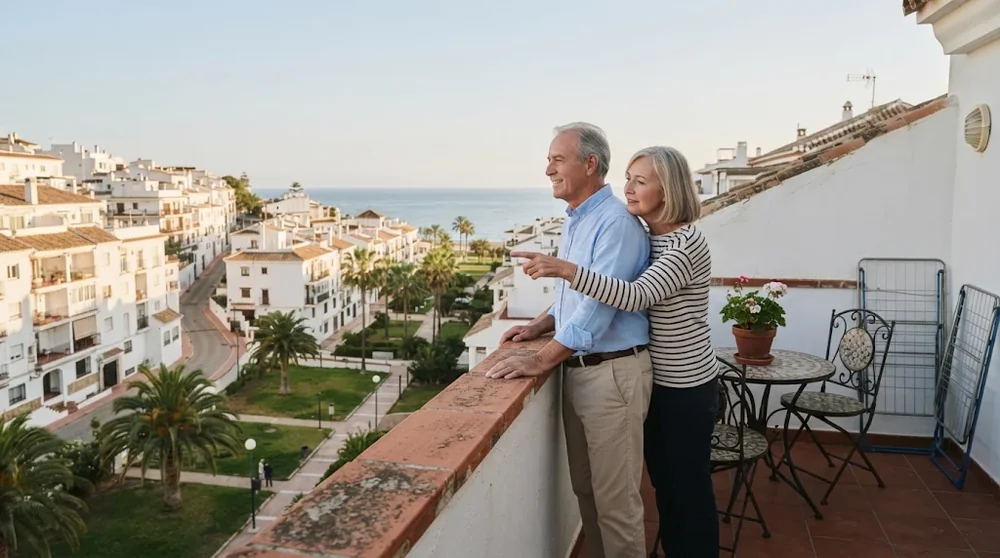
- Shortlist neighbourhoods that suit your daily routine, not just cities.
- Visit outside peak season and test transport, shops and healthcare access.
- Rent locally for three to six months where possible.
- Build an annual budget covering running costs, a reserve and currency movement.
- Confirm residence, healthcare and succession routes with the relevant specialists.
- Appoint an independent lawyer and surveyor.
- Inspect the property with the ten-point accessibility checklist.
- Verify title, planning and community debts through the nota simple, Catastro and certificates.
- Have the lawyer review the reservation or arras contract and complete only after documented concerns have been resolved.
Renting First Versus Buying Immediately
| Factor | Rent for three to six months first | Buy immediately |
|---|---|---|
| Cost | Known rent, with no transfer tax or purchase fees | Taxes and fees paid up front; resale costs if you change your mind |
| Information gained | Real winter, services and neighbours | Based on viewings and short visits |
| Flexibility | Easy to change area | Harder and costlier to reverse |
| Risk | Market may move while you wait | Wrong location or building locked in |
Rent is a real cost, and prices could rise during the trial. That is the opportunity cost; set it against the cost of a mistaken purchase, which includes transfer taxes, legal fees and selling costs on top of any loss of value.
A Decision Matrix You Can Adapt
The matrix below has no scores filled in because the weights and scores are yours. Here is a simple method:
- Choose your criteria and give each a weight, with all weights totalling 100%.
- After visiting, score each property from 1 (poor) to 5 (excellent) on every criterion.
- Multiply each score by its weight, add up the results for each property, and compare the totals.
- Enter each property’s comparable annual running cost in the last row, using the same cost model for every property, so a cheap-looking flat with high community fees is not flattered.
| Criterion | Weight (your choice, total 100%) | Property A score (1–5) | Property B score (1–5) |
|---|---|---|---|
| Accessibility and lift | |||
| Healthcare and pharmacy access | |||
| Year-round services and transport | |||
| Community and social life | |||
| Weighted total | 100% | ||
| Comparable annual running cost (€) | Compare alongside, not scored | ||
| Legal clarity of title and planning | Veto: pass or fail | ||
| Affordable lifetime cost | Veto: pass or fail |
Legal defects and unaffordable lifetime costs are veto conditions, not weighted preferences. A property that fails either one is out, however high it scores elsewhere. A beautiful view cannot compensate for an unresolved planning issue, and a lovely home that only works financially if nothing goes wrong is not a safe retirement home.
It also helps to decide in advance who answers which question. Take title, contracts and planning to the lawyer, and visas to an immigration specialist. Take pension and residence tax to the tax adviser, building defects to the surveyor, and medical questions to a suitable healthcare professional or insurer.
If you are still deciding which region, budget and type of property fit your plans, a short questionnaire can help you compare options before you start viewing.
Use any shortlist as a starting point for the checks above, not a substitute for them.
Red Flags That Justify Delaying a Deposit
- Unresolved discrepancies between the registry, cadastre and the actual building.
- Missing licences or permissions for extensions, pools or conversions.
- Unexplained community debts or large planned building works.
- A long-term budget that only works if nothing goes wrong.
- No clear route for residence or healthcare for your circumstances.
Frequently Asked Questions About Retiring in Spain
What are the biggest mistakes to avoid when buying property in Spain?
The costliest mistakes are choosing an unsuitable location, ignoring future accessibility, underestimating ownership costs, and failing to check title, planning permissions or community debts. Retirement buyers should also verify residency rights, healthcare arrangements and tax consequences. An independent Spanish lawyer, a technical inspection and an off-season trial stay help identify problems before any non-refundable commitment.
Can I buy a house in Spain and retire there permanently?
No. Buying a house in Spain does not give a right to retire there permanently. British citizens without existing residence rights are generally limited to 90 days in any 180-day Schengen period as of November 2026. Longer stays normally need residence permission, such as a non-lucrative visa for those who qualify. EU citizens and people protected by the Withdrawal Agreement follow different rules.
How much extra should I budget when buying a retirement home in Spain?
Many buyers allow roughly 10–15% above the purchase price as a broad planning estimate, but actual costs vary by region, property type and circumstances. There is no universal fixed percentage. Resale homes usually attract a regional transfer tax, while qualifying new mainland homes attract 10% VAT as of November 2026, plus possible stamp duty. Budget separately for legal fees, inspections, moving, insurance, community charges, maintenance and emergencies.
Can British pensioners get free healthcare in Spain?
Not automatically. Eligible British State Pension recipients may obtain an S1 certificate that supports access to Spanish state healthcare once it is registered with the Spanish authorities. Owning property or reaching retirement age does not create an entitlement on its own. Early retirees may need qualifying private insurance or another recognised route. Check eligibility and registration before moving, particularly if you need ongoing treatment.
Where is the best place to buy property in Spain for retirement?
The best retirement location depends on budget, mobility, healthcare needs and lifestyle. Alicante and the Costa Blanca suit buyers seeking established international communities, Málaga and Marbella offer Costa del Sol options, Valencia provides city living, and Mallorca or Tenerife suit island preferences. Compare specific neighbourhoods and visit outside the holiday season instead of relying on any single ranking.
Do I have to pay Spanish tax on my UK pension if I retire in Spain?
As of November 2026, Spanish tax residents may be taxed on worldwide income, but UK pension treatment depends on the pension type and the Spain–UK double-taxation treaty. Spanish tax residence can arise through more than the 183-day test alone. A qualified cross-border tax adviser should review your pension sources, residence status and reporting obligations before you relocate.
Final Thoughts: Slow Down Before You Sign
Almost every retirement mistake in this guide comes from the same place: deciding on the home before testing the life around it. The seven problems of location, ageing, costs, legal checks, residency, healthcare and tax are all easier and cheaper to solve before a deposit than after completion.
I swapped Manchester for Andalusia for the light and the pace of life, and after a decade I still think Spain is a wonderful place to retire. What I have seen in that time is that buyers who rent first, budget honestly and use independent professionals tend to enjoy it, while buyers who rush tend to spend their first years fixing problems.
My advice to every British buyer is to treat the purchase as the last step, not the first. Rent for a winter, work out your lifetime budget, confirm your right to live in Spain and your healthcare, and let a lawyer check the property thoroughly. If a deal cannot survive that, it was not the right deal.
Disclaimer: This article is general information as of November 2026. It is not personalised legal, tax, immigration, healthcare or financial advice, and laws, rates and thresholds may change. Consult a qualified Spanish lawyer, immigration specialist, tax adviser, surveyor and healthcare professional about your own circumstances before making any commitment.
Leave a Reply