A penthouse viewing in Mallorca is easy to enjoy and hard to judge. The sea glints, the terrace looks enormous, and the agent is already talking about summer dinners. I have spent over ten years helping English-speaking buyers in Spain from my base in Marbella, and the penthouses that cause grief are rarely the ones that look rough. They are the ones where nobody asked who owns the roof, so this checklist keeps you on the questions that matter before you commit any money.
A Mallorca penthouse viewing checklist should cover terrace ownership, roof waterproofing, drainage, heat, wind exposure, lift access and community liabilities. Compare the advertised layout with title documents and approved plans, request repair records and community minutes, and arrange independent legal and technical checks before signing or paying a reservation deposit.
The Mallorca penthouse viewing checklist
In Spanish listings, ático describes a top-floor flat, usually one with a terrace. It is a marketing and property description. It does not prove that the terrace, the roof above it or the airspace belongs to the flat’s owner. That distinction drives most of the checks below. Work through these eight points at the viewing and again with your advisers afterwards:
- Terrace rights: establish whether the terrace is privately owned or a common element reserved for your exclusive use, and which documents say so.
- Waterproofing and drainage: look for stains, patched ceilings, lifted tiles and signs of pooling, and ask for the leak and repair history.
- Authorised layout: compare what you see with the approved plans, because enclosed terraces and moved walls are common.
- Heat and wind: note shade, orientation, glazing and how exposed the terrace feels, ideally at more than one time of day.
- Lift and access: walk the route from the street, check for a final flight of stairs, and ask how technicians reach rooftop equipment.
- Noise and privacy: listen for plant, lift and neighbours, and look at who can see into the terrace.
- Community liabilities: ask for accounts, minutes, debts, approved levies and any roof disputes.
- Independent checks before commitment: have your own lawyer review the documents and a qualified building professional assess the roof and terrace.
The workflow is simple. Record what you observe at the viewing, request the matching documents, send both to your lawyer and technical adviser, and decide only when the evidence answers each point. Anything unanswered goes onto a written list, not into your memory of a nice afternoon.

Request the penthouse documents before viewing
Ask for paperwork before you travel, not after you have fallen for the flat. Sellers and agents who answer quickly tell you something useful, and slow answers tell you something too. Always ask for the nota simple before you commit. It is the summary extract from the Registro de la Propiedad showing the registered description, owner, charges and mortgages. Your lawyer should obtain a current one, because an older copy may miss a recent charge.
Here is the core set of documents and what each one can and cannot tell you:
| Document | Question it answers | Reviewer |
|---|---|---|
| Nota simple from the Registro de la Propiedad | Who is the registered owner, how is the property described, and are there mortgages, embargoes or other charges? | Independent lawyer |
| Escritura (title deed) | What did the seller acquire, including any stated terrace, roof rights, parking or storage? | Independent lawyer |
| Horizontal-division documents and community statutes | Is the terrace private or a common element with exclusive use, and what rules apply to alterations and use? | Independent lawyer |
| Catastro information | What areas and use does the cadastral record show, and do they match the deed and listing? | Lawyer, with technical adviser for areas |
| Approved plans and alteration permissions | Does the layout, including any enclosure or extension, match what was authorised? | Architect or qualified building professional, with lawyer |
| Cédula de habitabilidad | Is there a habitability certificate, and does it correspond to the current layout? | Lawyer, with technical adviser |
| Energy certificate | What energy rating is recorded, and is the certificate in date? | Technical adviser |
| Parking and storage records | Are the garage space and storeroom registered with the flat, or documented separately? | Independent lawyer |
No single document proves that a property is fully legal. Cadastral registration is not proof of planning legality, and a registry entry does not confirm that building works were authorised. Here’s where people usually come unstuck: they treat one tidy document as the whole answer. Request everything early, and let your lawyer verify the set before you are bound to anything. Where papers are missing, that is a question for the seller to answer, not a gap for you to fill with optimism.
One extra point if you are not an EU citizen, which now includes British buyers. Ask your lawyer to determine whether a Balearic military authorisation applies to the exact property you are considering, and whether an exemption covers it. It will not be relevant to every Mallorca penthouse, but it is far better to have the answer before you reserve than after.
Who owns the terrace and roof?
This is the question I would put at the top of any penthouse list. Spanish apartment buildings sit under the Ley de Propiedad Horizontal (Law 49/1960), which splits a building into private parts and common elements. The consolidated text is published on the official state gazette site: Ley de Propiedad Horizontal on boe.es. Where co-ownership rules fall outside that law, the general co-ownership provisions of the Civil Code, including Article 396 on buildings divided by floors, are also on the state gazette site: Código Civil on boe.es. A penthouse terrace can fall on either side of the private and common line, and the roof above or beneath it may be treated differently again. Your lawyer reconciles the registered title, the deed, the division documents and the statutes of the comunidad de propietarios. Nobody should do that from the sales brochure.
Private ownership of the terrace
Sometimes the terrace is part of the flat itself, described in the title with its own area. In that case the deed and registry description should say so clearly. Do not rely on a marketing figure for the terrace. A privately owned terrace surface can still sit on a structural slab and roof system that the community owns, so ownership of the surface does not settle every question.
Common property with exclusive use
Many penthouses have an exclusive-use roof terrace. The roof remains a common element, but the documents give one owner the right to use it. Exclusive use is not ownership. It may come with conditions on alterations, maintenance and access, and those conditions normally sit in the statutes or the division documents.
Access for communal maintenance
Roofs carry aerials, water tanks, extraction outlets, solar panels and sometimes air-conditioning plant. Ask whether neighbours, the building administrator or technicians have a right to cross the terrace, and how that is arranged. A locked door does not establish title, and a private key proves only that somebody has used the space. Roofs are not one single thing. Railings, waterproof membranes, the structural slab and the surface finish can each require a separate legal analysis, and responsibility for repairs depends on the element affected and the cause of the damage. I will not give you a blanket rule here, because there is not one.
Inspect waterproofing, drainage and terrace alterations
Terraces on top floors take the full weight of sun, rain and foot traffic, so waterproofing failure is one of the most expensive faults a penthouse can have. A viewing is not a survey. Your job is to notice and record, then pass the evidence to a specialist. The table translates what you might see into evidence to request and the professional who should follow up.
| Check | Visible warning | Evidence to request | Specialist |
|---|---|---|---|
| Ceilings below the roof | Staining, fresh paint patches, flaking or bubbling plaster | Dated leak history, repair invoices, insurance correspondence | Architect or qualified building professional |
| Terrace surface | Visibly lifted, cracked or displaced tiles; loose edges | Records of resurfacing, contractor details, any warranty | Building professional |
| Drainage outlets | Blocked or debris-filled outlets; water marks suggesting pooling | Maintenance records, seller’s account of heavy-rain behaviour | Building professional |
| Door and window thresholds | Damp marks, swollen frames, little height between terrace and interior floor | Photographs over time, any complaint to the community | Building professional |
| Flashing and perimeter edges | Cracked sealant, gaps where the membrane meets walls or railings | Waterproofing works records and warranties | Waterproofing contractor via your adviser |
| Reported pooling | Seller or neighbour mentions standing water after rain | Community minutes recording the issue and any diagnosis | Building professional, with lawyer for liability |
Ask the seller for a written leak history, repair invoices, warranties and any insurance correspondence. A clear record is reassuring. A vague answer such as “it was sorted years ago” is not evidence.
Keep your own inspection safe and passive. Do not run flood tests, load the terrace, climb onto roofs or lean over unprotected edges. Those tests can cause damage, create liability and put you at physical risk. A building professional can arrange proper testing with the owner’s permission.
Alterations need separate scrutiny. Pergolas, glazed enclosures, outdoor kitchens and hot tubs each raise three distinct questions: planning permission from the municipality, approval or rules from the community, and a structural and waterproofing assessment. A yes to one does not answer the others. A previous owner’s enclosure may have been built without any of them, and you would inherit the problem. Repair responsibility after a leak also turns on the cause. A defect in the building’s waterproofing is analysed differently from damage linked to a private alteration, so keep the evidence trail intact.

Test heat, wind, noise and lift access
A penthouse can look perfect on a calm spring morning and be a different place in August. Visit at least twice, at contrasting times of day, and ideally in different conditions. Even then, treat your observations as clues. Two visits do not prove how the flat performs across a whole year.
Outdoor comfort
- Shade and orientation: note where the sun falls and how much of the terrace has permanent shade or a usable awning.
- Wind exposure: check how furniture, plants and awnings would cope on an open top floor.
- Coastal corrosion: look at railings, door tracks and metalwork for rust or salt damage if the building is near the sea.
- Overlooking: stand where you would sit and see which windows and balconies can see you.
Indoor services
- Glazing and heat: check how much sun enters, what blinds or shutters exist, and how hot the rooms feel.
- Cooling maintenance: ask for service records for air conditioning, and where the outdoor units sit.
- Water pressure: with the seller’s permission, run taps and showers at the same time on the top floor.
- Noise: listen for rooftop plant, extraction fans and the lift shaft, particularly from the bedrooms.
Everyday access
- The full route: walk from the street and the parking space to the front door, carrying something heavy if you can.
- Final stairs: check whether the lift stops one floor short, which matters for older buyers and anyone with mobility concerns.
- Private lift security: if the lift opens straight into the flat, ask how access is controlled and who maintains it.
- Maintenance routes: ask how technicians reach shared equipment on the roof, and whether that route crosses your terrace or flat.
A word of personal opinion rather than a rule, because access needs change faster than most buyers expect:
Judge the stairs and the lift for the person you will be in ten years, not the one standing on the terrace today. A last flight that feels like exercise now can become a daily obstacle as your needs change.

Compare internal space, terrace area and views
Listings often quote one large figure that blends several different measurements. Ask for each area separately: usable internal area, constructed area (which can include a share of walls and structure), any allocated communal area, and the terrace area stated on its own. These are not interchangeable, and a figure that mixes them can make a flat look cheaper per square metre than it is.
Reconcile the listing, the approved plans, the title and the cadastral record. Where they disagree, ask why. A larger terrace in the marketing may reflect an enclosed or extended area, an included common element or simple rounding. Neither the registry nor the cadastre alone proves planning legality, so your lawyer and technical adviser should explain any gap. There is no universal terrace multiplier, and no single percentage discrepancy should be treated as proof that this property’s measurements and legal position are acceptable; ask your advisers to explain each difference. Avoid calculating a price per square metre from blended indoor and outdoor figures.
Views deserve the same scepticism. A penthouse in central Palma and a top-floor flat in a coastal community elsewhere on Mallorca face different questions about neighbouring plots, height limits and future building. Check what the municipality’s planning information says about nearby land and any permitted development. Nobody can guarantee a view for ever, and a seller’s confident reassurance is not a planning document.
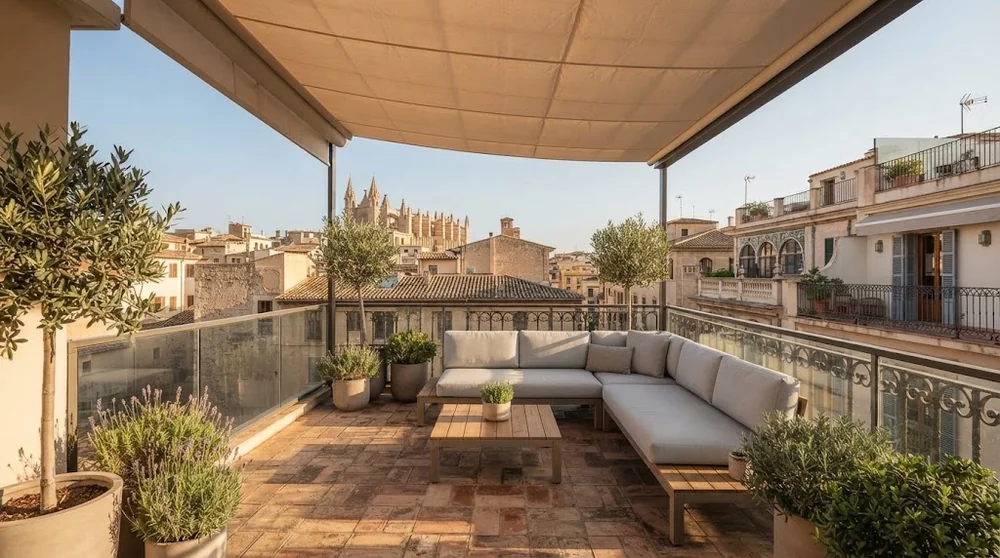
Check community debts, roof works and derramas
A penthouse is only as sound as the building around it. The comunidad de propietarios shares costs for the roof, lift, façade and common areas, and a derrama is a special levy raised for works not covered by the regular budget. Ask the seller, through the administrator, for:
- the latest annual accounts and current budget;
- the community statutes and any internal rules;
- minutes of recent meetings, with two to three years being a practical request rather than a universal legal obligation;
- a certificate confirming whether the seller owes anything to the community;
- details of approved special levies, including amounts, dates and who pays them;
- lift maintenance and inspection records, plus any quotes for replacement;
- any dispute, claim or insurance matter linked to the roof or terraces.
The debt point matters because it can follow the flat, not just the seller. As of October 2026, Article 9.1.e of the Ley de Propiedad Horizontal (Law 49/1960) makes the acquired property answerable for qualifying community debts attributable to the part of the year in which the purchase takes place and the three preceding calendar years. The same article ordinarily requires the seller to declare the state of community debts and to provide the matching community certificate for the public conveyance deed, unless the buyer expressly waives it. Do not agree to a waiver until your lawyer has reviewed the position. Your lawyer should also confirm the current consolidated wording on the day you buy, and settle how debts and levies are handled in the contract.
Approved but unbilled levies need the same attention. As of October 2026, Article 17.11 of the same law assigns improvement levies to the owner of the flat when payment becomes due. That is your liability to the community. It is separate from any reimbursement the buyer and seller negotiate between themselves, so a deal on who bears a voted-but-unbilled levy must be written into the contract, not left to goodwill.
For roof problems, the community minutes may show whether an earlier leak was diagnosed, whose responsibility it was held to be, and whether it was fixed. Technical specialists diagnose the defect and its cause. Lawyers assess legal responsibility, and where liability is disputed it may need agreement between the parties or a decision by a court. Keep those two questions separate, and use independent advisers rather than relying on the seller’s agent for either.
Finally, look at the running costs of the flat itself. Ask for the community fee, and for recent utility and insurance bills. Community fees on a penthouse can differ from those of lower flats because the building may allocate costs by share, so confirm the figure and what it covers.
If you would like a second pair of eyes on a specific listing before you travel, send me the details and the documents you have so far, and I will tell you which of the points above look thinnest.
Questions about a penthouse you are considering in Mallorca? Message David on WhatsApp for a plain-English first look at your documents and the points to raise with your lawyer.
Confirm your intended use before committing
Decide how you will use the penthouse and test that plan against the rules. Own use, residential letting and tourist accommodation are three different things, and permission for one does not give you the others. Tourist letting is the one that catches buyers out.
As of October 2026, the Balearic tourist-accommodation rules are in Decreto-ley 4/2025 as amended by Ley 4/2026. In summary, new activity declarations for ordinary flats under horizontal ownership are prohibited, subject to statutory exceptions. Existing authorisations and the letting of a principal home are treated separately, and your lawyer should check each of those categories for this exact property. Do not assume anything is transferable to you.
The community adds a second layer. As of October 2026, Article 7.3 of the Ley de Propiedad Horizontal requires express prior community approval for new qualifying tourist activity, and Article 17.12 requires a three-fifths majority of both owners and ownership quotas to adopt it. The absence of a prohibition in the statutes is not enough. Ask your lawyer to check Balearic law, Consell de Mallorca records, the municipal position, the statutes and the minutes for this exact property, and to look separately at transitional treatment and any existing activity. An advertised licence is not enough on its own. Ask what is actually registered, in whose name, and whether it survives the sale.
One point for British buyers. After Brexit, owning a property in Spain does not itself give you a right to reside or to stay without limit. Immigration status is a separate matter from ownership and from holiday-letting permission, and I will not turn this checklist into a visa or tax guide. The UK government publishes current entry requirements for Spain here: entry requirements for Spain on gov.uk. If your plans depend on living in Mallorca beyond visa-free stays, take specialist advice before you pay a deposit. As a non-EU buyer, also ask your lawyer to confirm whether the Balearic military authorisation mentioned earlier applies to your purchase. Let me put it plainly: ownership, letting permission and immigration status are three separate questions, and each needs its own answer.
If you want to test how ready you are before you book flights, a short quiz can show you which parts of the checklist you have covered and which still need work.
Not sure which checks you have missed? Take the short Mallorca penthouse quiz and see which documents and questions to chase before you pay a deposit.
Decide what needs resolving before a deposit
There is no pass mark for a penthouse. An arbitrary score could let a strong view outweigh a serious legal defect, which is exactly the trap you are trying to avoid. Sort each finding into one of three groups instead.
| Status | What it looks like | Example findings |
|---|---|---|
| Documented and acceptable | Evidence supports the point and your advisers see no concern | Terrace rights confirmed in title and statutes; clean debt certificate |
| Unresolved pending specialist review | Evidence is missing or unclear and needs a lawyer or technical adviser | Unclear roof status; old leak with no repair invoice; enclosure without plans |
| Unacceptable to you | The issue conflicts with your plans, budget or comfort whatever the advisers say | Missing terrace-rights evidence you cannot resolve; recurring leaks; unapproved enclosure; unaffordable levies; unsuitable access |
Your independent lawyer advises on title, statutes, debts, contract terms and permitted use. An architect or other appropriately qualified building professional advises on the roof, waterproofing, structure and approved layout. Choose advisers who work for you, not for the seller or the selling agent, and ask each to confirm in writing what they have and have not checked.
Reservation and arras terms vary, and refunds cannot be assumed. Have your lawyer read the paperwork before you sign or pay, and ask for any outstanding checks to be reflected in writing. If an important point stays unresolved and the seller will not give you time, the honest answer may be to walk away.
Mallorca penthouse viewing questions
How do I know whether the penthouse terrace belongs to me?
Ask your independent lawyer to check the registered title, deed, horizontal-division documents and community statutes. A terrace may be privately owned or a common element allocated for exclusive use. Exclusive access does not establish ownership, and the underlying roof structure may have a different legal status from the terrace surface.
Who pays if a penthouse roof terrace leaks?
Responsibility depends on the legal status of the affected element, the cause of the leak and the applicable documents and law. Structural or waterproofing defects need a different analysis from damage caused by private alterations or neglected maintenance. Obtain a technical diagnosis and legal review before accepting the seller’s allocation of responsibility, and bear in mind that a disputed liability may need agreement or adjudication.
Should I arrange a survey before paying a reservation deposit?
Arrange an independent technical inspection before any binding commitment where possible, especially if there are leaks, alterations or uncertain roof condition. Have your lawyer review the reservation terms before you sign or pay. If checks remain outstanding, ask the lawyer to negotiate written protections rather than assuming the deposit is refundable.
Can I add a hot tub or enclose the terrace?
Do not assume that private use allows structural changes. A hot tub needs assessment of loads, waterproofing and services by an appropriate professional. Enclosures and other alterations may require municipal permission and community approval. Ask your lawyer and technical adviser to establish the requirements for the specific building before proceeding.
Can I use a Mallorca penthouse for holiday lets?
Do not assume so. As of October 2026, Decreto-ley 4/2025 as amended by Ley 4/2026 prohibits new activity declarations for ordinary flats under horizontal ownership, subject to statutory exceptions, and existing authorisations and principal-home letting are treated separately. New qualifying activity also needs express prior community approval under Article 7.3 of the Ley de Propiedad Horizontal, adopted by a three-fifths majority of owners and quotas under Article 17.12. Ask a local lawyer to verify the property’s exact position, including transitional treatment, and remember that an advertised licence is insufficient evidence on its own.
What I would settle before paying a deposit
My advice to every British buyer is to treat the penthouse viewing as the start of an evidence-gathering exercise, not the moment of decision. The terrace, the roof and the lift matter more than the view, because they decide what you can use, what you must repair and what you will be asked to pay. Ask for the nota simple, deed, statutes, plans and community records early, and put each finding into one of the three groups above.
Ten years on the Costa del Sol have taught me that most expensive surprises were visible beforehand, usually in a document nobody requested. Use your lawyer for title, levies and permitted use, and a qualified building professional for waterproofing, structure and layout. Everything here reflects my general experience as a Marbella-based adviser to English-speaking buyers, not a view on any particular Mallorca building. The legal references are Law 49/1960 and the Balearic tourist-accommodation rules as of October 2026, and both need confirming on the day you buy.
General information only: this article is not legal, tax or technical advice and does not guarantee any outcome. Laws, local rules and practice change, and every property is different, so take independent, property-specific legal and technical advice before reserving, paying or signing anything.
Leave a Reply