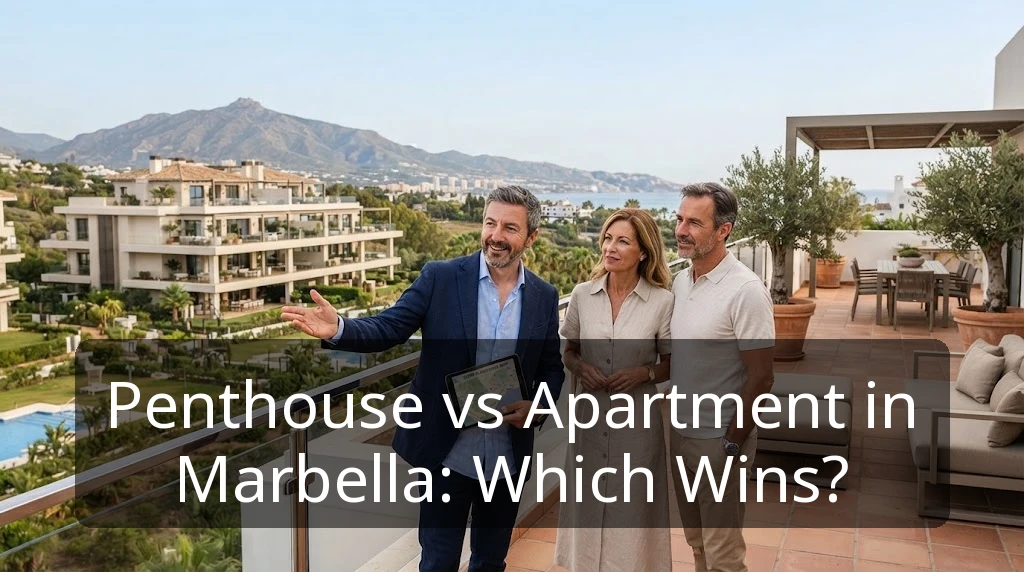
The penthouse vs apartment in Marbella decision usually comes down to one blunt question: will you actually live on the terrace? Ten years on the Costa del Sol have taught me that the honest answer separates a happy purchase from an expensive disappointment. This guide compares both property types at the same budget, covering taxes, running costs, terrace rights and holiday-rental rules as at November 2026. The aim is to tell you which type deserves your precious viewing days.
A penthouse in Marbella usually offers more outdoor space, privacy and open views, but costs more to buy and can bring higher maintenance expenses. A luxury apartment often provides better value, easier upkeep and similar communal amenities. Choose a penthouse for terrace-led living; choose an apartment when practical space, accessibility and running costs matter more.

Penthouse vs Apartment in Marbella: Key Differences
The table below compares typical tendencies for a penthouse (ático) and a mid-floor luxury apartment of similar quality. Individual buildings break these rules constantly, so treat each row as a question to ask at the viewing rather than a verdict.
| Criterion | Penthouse (ático) | Luxury apartment (typical mid-floor) |
|---|---|---|
| Location within building | Uppermost residential floor, often set back from the facade | Any floor from ground to just below the top |
| Layout | Often larger terraces than interior; some are duplex with internal stairs | Usually a single level with a regular floor plan |
| Terrace | Large terrace or solarium, sometimes with exclusive roof access | Covered balcony or modest terrace; garden terrace on the ground floor |
| Privacy | No neighbours above; may be overlooked by taller neighbouring blocks | Neighbours above and below; terraces may face other balconies |
| Sunlight and views | Strong light and open outlook, with more exposure to sun and wind | Varies by floor and orientation; more shelter, sometimes less view |
| Accessibility | Lift-dependent; stairs inside duplex units | Lift-dependent above the ground floor; easy step-free access on lower levels |
| Maintenance | Roof, waterproofing and terrace surfaces are more exposed | Less weather exposure; fewer outdoor surfaces to keep up |
| Costs | Higher purchase price; running costs often higher in my experience | Lower price per home of similar interior size; simpler running costs |
| Buyer suitability | Terrace-led living, entertaining, buyers who want open views | Retirees, practical households, lock-up-and-leave owners |
One point often lost in glossy brochures: a luxury specification does not define the floor of the dwelling. Marble bathrooms, smart-home systems, concierge service and a spa can all appear in a first-floor apartment, while a top-floor flat in a tired block can carry the word “penthouse” in its advert with little else to justify it.
What counts as a penthouse in Spain?
Spanish law does not give “penthouse” a tidy statutory definition. The word is a market description of a home’s position and configuration, so the label tells you very little until you see the registered documents. These are the terms you will meet in Marbella listings:
- Ático (penthouse): a dwelling on the top residential floor, usually with terraces larger than a standard balcony.
- Dúplex ático (duplex penthouse): a top-floor home spread over two levels joined by internal stairs, often with a solarium (roof terrace) upstairs.
- Top-floor flat: a home on the highest floor that may have no setback terrace at all, yet is sometimes marketed as a penthouse.
- Luxury apartment: a quality category covering finishes, services and amenities, which can sit on any floor.
Let me put it plainly: luxury describes how a home is specified, while penthouse describes where it sits and how it is arranged. The two overlap often, but one does not guarantee the other.
Which is better for which buyer?
A simple decision rule works well here. If you expect to spend most evenings outdoors for at least eight months of the year, and you can live with the extra upkeep, a penthouse deserves viewings first. If you value shelter, step-free daily life and predictable bills, start with luxury apartments and add a penthouse viewing only if the terrace is genuinely usable.
The Real Advantages and Drawbacks of Marbella Penthouses
A good Marbella penthouse is a wonderful thing. A poorly chosen one is a roof-shaped repair bill with a view. These are the points I walk buyers through before they fall in love with a photograph.
What penthouses do well
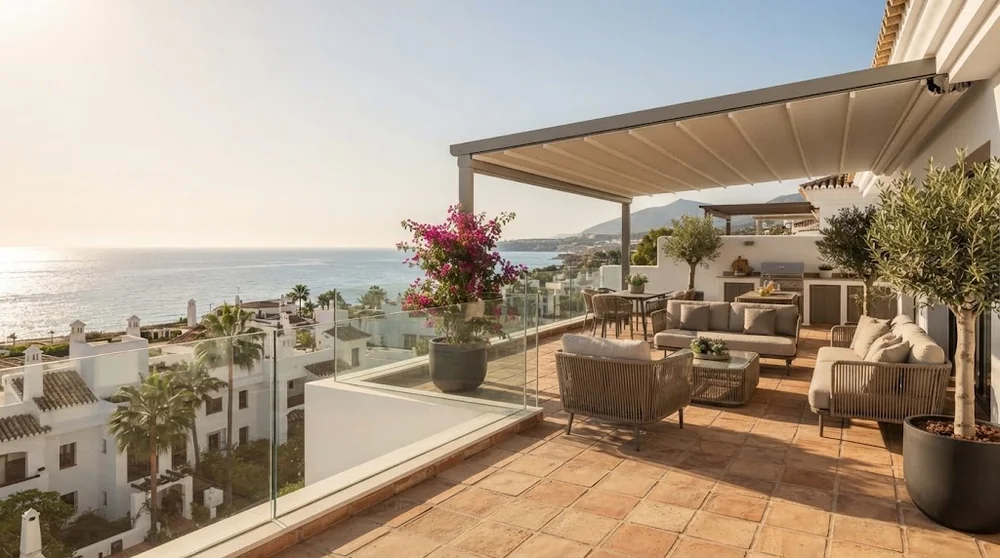
- Private outdoor living: a large terrace works as a second living room for lunches, evenings and guests, and it is the main reason people pay the premium.
- No upstairs neighbours: no footsteps, furniture dragging or terrace parties overhead, which matters more than most buyers expect.
- Views and light: height often brings sea, mountain or golf outlooks and bright interiors for much of the day.
- Resale appeal: well-documented penthouses with usable terraces are easy to describe and photograph, which helps marketing. I would not treat that as a promise of price growth.
What brochures tend to skip
- Summer heat: a top floor sits directly under a sun-baked roof. In July and August, an unshaded terrace can be uncomfortable from late morning until early evening, and the apartment’s air conditioning works harder.
- Coastal wind: higher floors catch the levante and poniente winds. Furniture needs weighting or storing, glass screens may be needed, and some terraces are too breezy for comfortable dining.
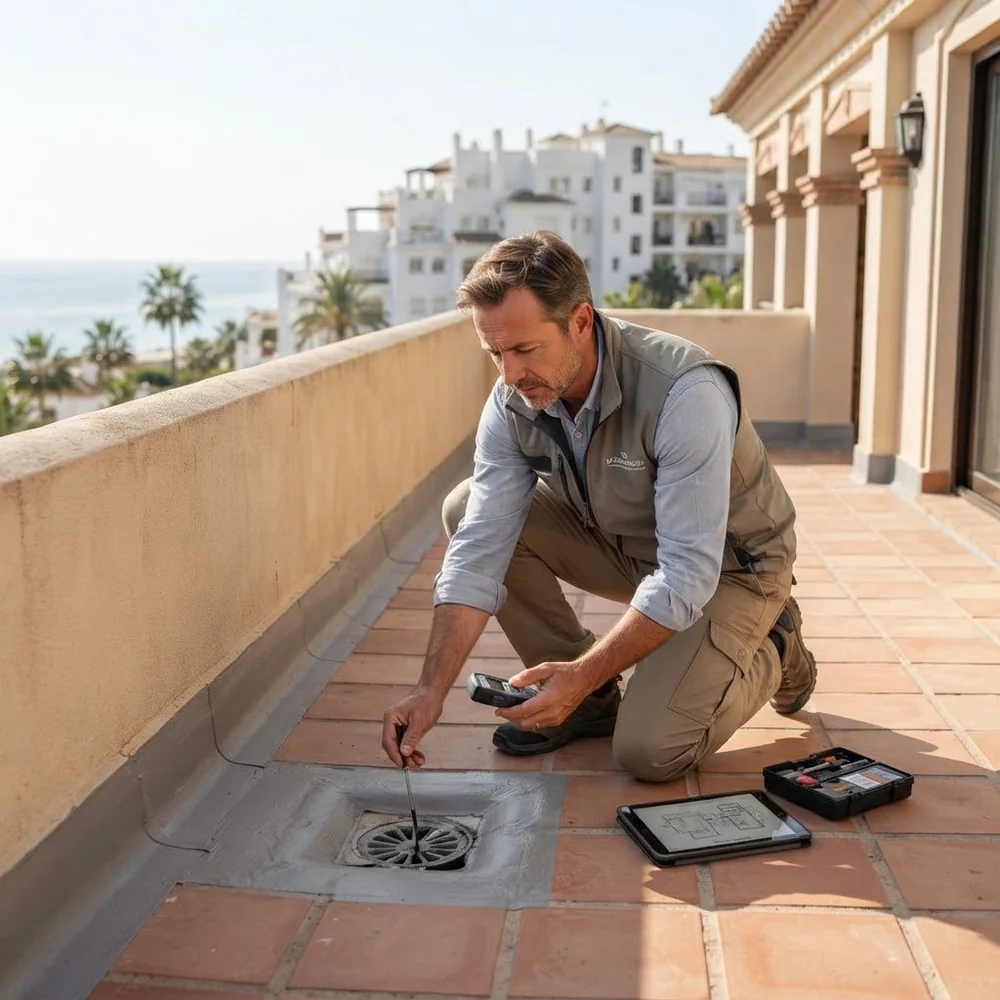
- Weather exposure: a penthouse takes the rain, sun and salt air first. Waterproofing membranes, drainage outlets and terrace surfaces age faster than interior finishes.
- Leaks: a roof or terrace waterproofing failure shows up in the top home first. Always ask who pays and who is responsible.
- Lift reliance: if the lift fails, a top-floor owner is the most inconvenienced, particularly with shopping, luggage, a pushchair or reduced mobility.
- Duplex stairs: internal stairs are lovely until knees, small children or a mobility aid enter the picture.
- Outdoor furnishing upkeep: teak, cushions, awnings and planters age quickly in sun and salt, and replacing them is not free.
A summer-versus-winter usability test
Visit the property twice, if you can, or ask for photographs and a written description of conditions at different times of year. In winter, check whether the terrace has sun between about noon and 4 pm, whether it is sheltered enough for a coffee outside, and how much of the day it is in shade. In summer, check when the sun leaves the terrace, how much natural shade exists, and what a pergola, awning or screen would cost and require in permissions.
A terrace is too exposed to be useful when it faces west with no shade at 5 pm in August, when wind funnels between two blocks, or when a neighbouring tower looks straight onto it. In those cases a smaller, sheltered balcony on a lower floor can give far more real outdoor hours.
Why “penthouse” does not mean complete privacy
Having nobody above you is not the same as being unobserved. Taller buildings nearby, shared roof access for maintenance engineers and common-area terraces can all create overlooking. In some developments the community has a right to enter roof areas for lift machinery, aerials or solar panels. Check where the access is, and how often it is used.
Here’s where people usually come unstuck: they judge a penthouse on a sunny viewing at 11 am in April. Go back at 5 pm on a windy day in November, then think about August, and you will learn more in an hour than any brochure will tell you.
Why a Luxury Apartment May Be the Better Buy
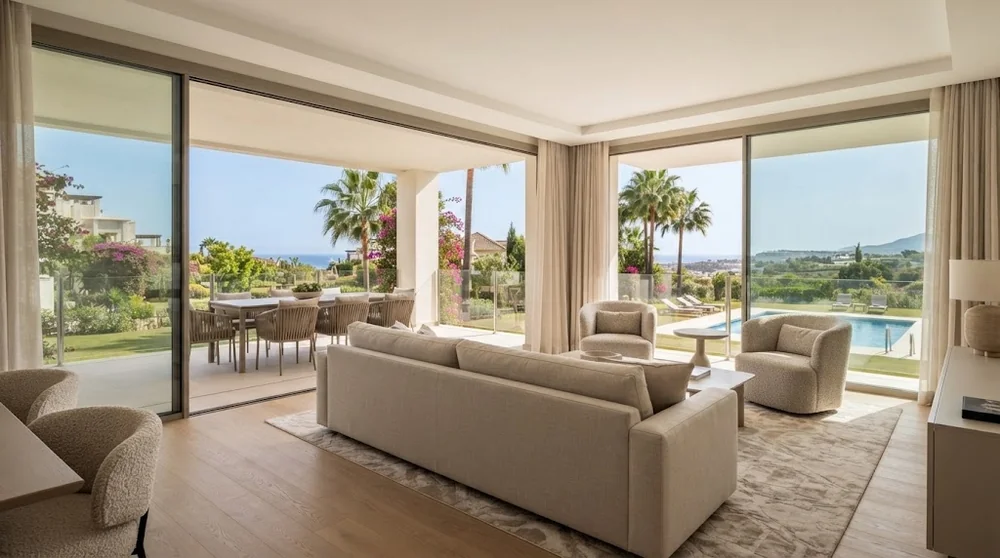
An apartment on a mid-floor often delivers more everyday comfort per euro than a penthouse, and it does so with less drama. A well-designed apartment with a deep, covered balcony can feel like a proper outdoor room, usable in April and October, with shade built in rather than added later at your cost.
The single-level floor plan is the second big advantage. Everything sits on one floor: bedrooms, kitchen, living area and terrace, with no internal stairs. For retirees and for households with young children or guests of mixed ages, that simplicity is worth real money. A penthouse with a small interior and a vast terrace can leave you paying for outdoor space while the indoor rooms feel cramped. A buyer comparing two homes at the same price will often find the apartment offers more usable interior area.
Communal amenities also tend to be equal. In a gated complex, the pools, gardens, gym, padel courts, security and concierge normally serve every resident, whichever floor they live on. A penthouse owner may pay a larger community contribution for the same access, depending on the building’s participation coefficients.
Weather exposure matters too. A mid-floor apartment is shielded by the floors above and below from a lot of heat and rain, so cooling bills are often lower and roof leaks are somebody else’s problem. For owners who leave the property empty for several months, that lower exposure is a quiet benefit.
Two cases where a mid-floor apartment beats an ático
First, a hypothetical retired couple who plan to live in Marbella year-round and want to keep the home easy to manage. A third-floor apartment in a building with two lifts, a covered balcony and a pool downstairs suits them better than a duplex penthouse with a steep internal staircase and a roof terrace they would use for two hours a day. Second, a hypothetical working family that wants to lock up for the summer months and travel. A mid-floor home has no roof to inspect and fewer exposed surfaces to deteriorate in their absence.
When the apartment is the wrong choice
Lower floors have their own traps. Ground-floor homes can suffer from damp, limited privacy and noise from paths, pools or car parks. A terrace overlooked by other balconies can feel like a stage. A home on a busy road or beside a restaurant can be noisy late into the evening. Poor orientation, such as a north-facing living room in a shaded complex, can leave a luxury finish feeling dim. Visit at different times of day, and pay particular attention to street noise, bin stores, ventilation and where the sun actually falls.
Penthouse and Apartment Prices in Marbella in 2026
Price evidence for Marbella penthouses is patchy, and the headline numbers you see online come from very different samples. I use them as dated market examples, not as authoritative statistics. Always separate three things: asking prices (what sellers want), actual sale prices (what buyers paid) and broad market indices (averages across all property types).
Current price evidence
| Source and date | What it measured | Figure | What it does not tell you |
|---|---|---|---|
| Marbella Wire, 5 September 2026 | 87 penthouses advertised at €3 million or more across Marbella and Benahavís | Median asking price of €4,299,500 | Excludes everything under €3 million; asking prices, not sales; includes Benahavís |
| Inmolux, 1 November 2026 | 23 penthouses listed by one agency in Marbella | Median asking price of €1,475,000 | One agency’s inventory, not the whole market; asking prices, not sales |
| Muse Selection, 30 October 2026 | Zone medians for the Golden Mile, Nueva Andalucía and Puerto Banús | Covers all residence types | Not penthouse-only; cannot be read as a penthouse price |
The first two samples are not interchangeable. One is a premium segment above €3 million, the other is a single agency’s mixed inventory, and neither is a completed-sale median for Marbella as a whole. Reading the €1,475,000 and €4,299,500 figures as a range for “a Marbella penthouse” would be a mistake. The Muse Selection zone medians are useful for sensing how the Golden Mile, Nueva Andalucía and Puerto Banús differ from each other, but they blend apartments, villas and penthouses together.
You will also see third-party claims that quote luxury running costs of €15,000 to €40,000 per year, or a penthouse premium of 30% to 50%. Those are segment-specific claims from individual publishers, built on particular buildings and definitions. Treat them as prompts for your own calculation, not as market laws. Community-fee estimates vary just as widely, because they describe different buildings, sizes and service levels.
How to calculate a genuine penthouse premium
The only reliable premium is a matched one. Compare two homes in the same development with the same bedroom count, similar internal usable area, similar condition, the same orientation and the same parking and storage rights. Then look at what the penthouse adds: terrace rights, height, view and privacy.
Be careful with price per square metre. Calculate interior €/m² and outdoor areas separately, because terrace square metres are not valued like interior square metres. A hypothetical illustration shows why. Suppose an apartment has 150 m² of interior space and sells for €1,000,000, which is €6,667 per interior m². A penthouse has 150 m² of interior plus an 80 m² terrace and is priced at €1,150,000. Divided by interior space alone it is €7,667 per m², roughly €1,000 more per interior m². Divide it by interior plus terrace (230 m²) and it looks cheaper at €5,000 per m². Neither figure is the “true” premium; the useful question is what the extra €150,000 buys that you will actually use.
Never assume a fixed percentage premium for penthouses. Prices reflect the specific building, location, finish and demand at the time of sale, and no source I trust can promise future appreciation.
Best Marbella Areas for Penthouses and Apartments
The right micro-location matters at least as much as the property type. A mid-floor apartment two minutes from the sea and shops can deliver a stronger daily experience than an exposed penthouse that needs a car for every errand. Compare the actual street, development and walking route, not the prestige of an area name.
| Area | Everyday feel | Strengths | Watch-points | Often suits |
|---|---|---|---|---|
| Golden Mile | Prestigious belt between Marbella centre and Puerto Banús | Close to beaches and Marbella centre; many gated complexes with sea views | Heavy traffic on the main road at peak times; some stretches are not walkable | Holiday buyers, second-home owners, those wanting central luxury |
| Puerto Banús | Marina, yachts, restaurants and a lively nightlife scene | Walkable services, marina atmosphere, rental demand in summer | Noise and crowds in summer; parking pressure | Holiday and rental-focused buyers; less suited to a quiet retirement |
| Nueva Andalucía | Residential valley with golf courses and a village feel in places | Golf, green spaces, family-friendly layout, near Puerto Banús | Slopes and car dependency; check walking routes to shops | Families, golfers, permanent residents |
| Marbella Centre | Old Town, promenade and everyday amenities | Walkable shops, restaurants, services and beaches; strong year-round life | Limited parking; older buildings; some noisy streets | Retirees, permanent residents, those who dislike driving |
| Marbella East | Quieter coastal residential areas east of the centre | Beach access, more space for the money in many cases, relaxed daily life | Variable walkability; check each development individually | Families, permanent residents, buyers seeking a calmer setting |
Beach and resort lifestyle
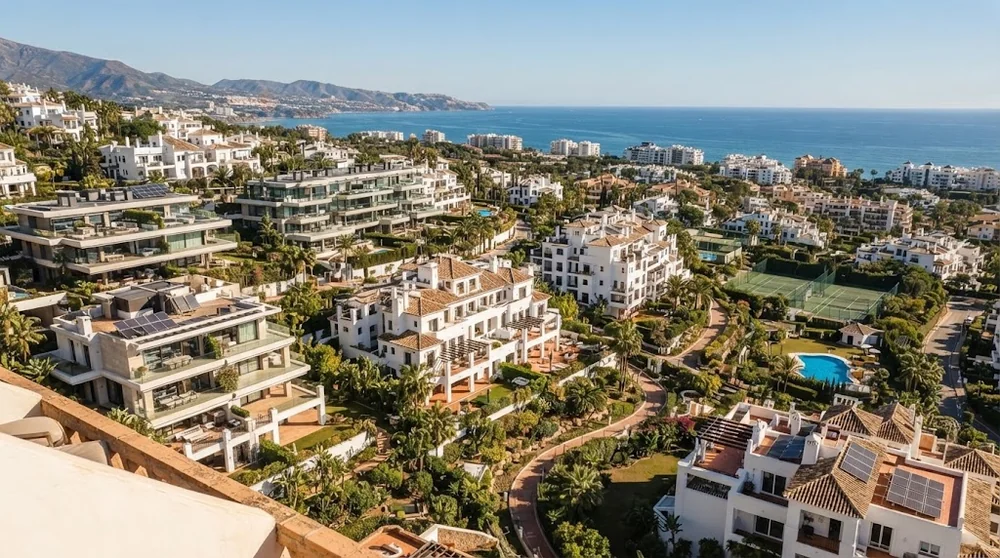
For beach days and a resort feel, the Golden Mile, Puerto Banús and parts of Marbella East stand out. A beachside apartment with a short walk to the sand can beat a more expensive hillside penthouse for daily use. In Puerto Banús, check noise levels at night before falling for a terrace overlooking the marina, because that same view usually comes with the soundtrack. Summer traffic on the Golden Mile can turn a five-minute trip into a half-hour one, so test the route at the hour you would actually travel.
Golf and family living
Nueva Andalucía is the classic choice for golf and relaxed family routines, with gated communities, green spaces and fairways. Slopes and distances can be tiring on foot, and many daily trips need a car. Several international schools sit within a short drive of Nueva Andalucía and Marbella East, but admissions and fees vary, so check the school first and the home second. In family-oriented areas, a lower-floor apartment with a garden terrace can be more practical than a penthouse for small children, with direct access to the pool and no stairs.
Everyday convenience and retirement
For retirees and permanent residents, convenience tends to win. Marbella Centre offers walkable pharmacies, supermarkets, medical services and restaurants, and many Old Town and nearby apartments are close to the promenade. Flat walking routes, lift reliability and nearby parking matter more than a rooftop view. In my professional view, a well-located mid-floor apartment usually suits this group best, with a penthouse worth considering only if the building has dependable lifts and the terrace is genuinely sheltered.
Buying Costs: Penthouse vs Apartment in Andalucía
The label on the brochure has no effect on the tax. Spanish transfer taxes depend on the characteristics of the transaction, not on whether the home is a penthouse or an apartment. What matters is whether you are buying a resale home from a private seller or a qualifying new home from a developer.
| Item | Resale home | Qualifying new-build (first delivery) |
|---|---|---|
| Main purchase tax (as at November 2026) | ITP (Impuesto sobre Transmisiones Patrimoniales): general Andalusian rate of 7% | IVA (Impuesto sobre el Valor Añadido, VAT): general rate of 10% for qualifying new dwellings |
| Stamp duty | Not charged on top of ITP | AJD (Actos Jurídicos Documentados): general Andalusian rate of 1.2% where applicable |
| Illustrative tax on a €1,000,000 base | €70,000 | €100,000 IVA plus €12,000 AJD = €112,000 |
| Illustrative tax as a share of price | 7.0% | 11.2% |
This calculation is illustrative. It assumes a €1,000,000 taxable base for both cases and ignores legal, notary, registry and other charges. Case-specific rules, exemptions and reduced rates may apply, and the tax base can differ from the price you negotiated. For ITP and AJD, the authorities can use a reference value for the property, so the taxable base may be higher than the declared price. The Spanish tax authority, the Agencia Tributaria, and the regional tax authorities of Andalucía publish the current rules, and your lawyer should confirm which apply to your purchase.
Other purchase costs to budget for
- Notary fees: charged for the public deed (escritura) under a regulated scale.
- Land registry fees: for registering the property in your name.
- Legal fees: an independent lawyer should check title, debts, planning and community documents.
- Technical survey: optional but wise for a penthouse with a large terrace or an older building.
- Mortgage costs: valuation, arrangement and related charges if you borrow.
Deadlines matter. As at November 2026, the general ITP and AJD declaration period in Andalucía runs for two months, starting the day after the taxable event. Your lawyer or gestor normally handles filing, but you should confirm who is responsible and when. Seller-side taxes, such as the municipal capital gains tax (plusvalía municipal), are a separate matter and are usually negotiated or allocated under the contract.
Annual Costs and a Five-Year Ownership Comparison
Running costs are where penthouses and apartments quietly diverge. The table below uses two hypothetical homes bought at the same €1,000,000 price, to isolate recurring costs. Every figure is an assumption for illustration, not an official market average, and your own numbers depend on the building, size and services.
| Annual cost (hypothetical) | Apartment | Penthouse | Assumption |
|---|---|---|---|
| Community fees | €4,200 | €5,400 | Penthouse carries a larger participation coefficient |
| IBI (property tax) | €1,500 | €1,700 | IBI is the Impuesto sobre Bienes Inmuebles, set by cadastral value |
| Insurance | €900 | €1,200 | Higher rebuild and contents cover for the penthouse |
| Utilities, including air conditioning | €4,800 | €6,000 | Larger glazing and top-floor heat gain |
| Terrace care | €300 | €1,800 | Deck, planting, irrigation, waterproofing checks |
| Repair provision | €3,000 | €5,000 | Set-aside for unplanned repairs |
| Total per year | €14,700 | €21,100 | Sum of the rows above |
| Five-year running costs | €73,500 | €105,500 | Annual total × 5, with no inflation applied |
Now add the purchase. Both homes cost €1,000,000, the general resale ITP of 7% adds €70,000, and I have assumed €20,000 for notary, registry, legal and survey costs on each. This hypothetical excludes financing and resale proceeds.
| Five-year cash outlay (hypothetical) | Apartment | Penthouse |
|---|---|---|
| Purchase price | €1,000,000 | €1,000,000 |
| Resale ITP at 7% | €70,000 | €70,000 |
| Other purchase costs (assumed) | €20,000 | €20,000 |
| Five years of running costs | €73,500 | €105,500 |
| Total cash outlay | €1,163,500 | €1,195,500 |
Sensitivity: what if the penthouse costs more upfront?
In real life, a penthouse rarely sells for the same price as a comparable apartment. The next table keeps the running-cost gap of €32,000 over five years and adds a penthouse price premium of 0%, 10% or 20%. I hold other purchase costs at €20,000 for simplicity, though legal fees can rise slightly with price.
| Penthouse premium | Extra purchase price | Extra ITP at 7% | Extra running costs (5 years) | Extra outlay vs apartment | Per year |
|---|---|---|---|---|---|
| 0% | €0 | €0 | €32,000 | €32,000 | €6,400 |
| 10% | €100,000 | €7,000 | €32,000 | €139,000 | €27,800 |
| 20% | €200,000 | €14,000 | €32,000 | €246,000 | €49,200 |
The extra purchase price is not simply “lost”, because you may recover part of it on resale. I have not modelled resale value, and I will not assume appreciation, because nobody can promise it. The table shows the cash you commit, and you decide whether the terrace is worth it.
Community coefficients and special levies
Community costs in Spain follow the participation coefficient (coeficiente de participación) fixed in the title documents of each property. A larger home with a larger coefficient pays a larger share of the approved budget, but amenities, services and the building’s age also matter. Always ask for the latest accounts, the budget, and any approved or planned special levies (derramas) for roofs, facades, lifts or pool works. A fee that looks modest can hide a large levy waiting for the next meeting. Under the Ley de Propiedad Horizontal, communities must also hold a reserve fund, and the figure to check is the current balance.
Terrace Ownership, Roof Rights and Planning Permission
Terrace rights are the part of penthouse buying that buyers most often misunderstand. The advert says “private roof terrace of 90 m²” and the buyer assumes the terrace is theirs to rebuild as they please. In Spain, that assumption can be wrong, and finding out after completion is expensive.
Does the penthouse terrace legally belong to you?
Three situations look similar on a viewing but are legally different:
- Registered private terrace: the terrace is part of your registered property, described in the title deed (escritura) and land registry entry with its own surface area.
- Exclusive use of a common element: the terrace or solarium is a common area of the building, but you have the exclusive right to use it, often under the community statutes or constitutive title (título constitutivo).
- Shared structural roof obligations: even when you own or use the terrace, the roof structure and waterproofing may be a community responsibility, or may be split between you and the community under the statutes.
The working documents are the nota simple from the property registry, the title deed, the community statutes and the building plans. Always ask for the nota simple before you commit, and compare it with what the advert claims. Your lawyer can request one from the property registry, or you can apply for it directly. The consolidated Ley de Propiedad Horizontal (Horizontal Property Law, Ley 49/1960) sets the general rules for communities; as at November 2026 the consolidated text includes updates published in October 2026, so your lawyer should confirm the version that applies to your purchase.
If a particular terrace, enclosure or title deed leaves you unsure, a short one-to-one conversation before you sign can save a great deal of grief.
Terrace disputes tend to follow the same pattern: someone enclosed a terrace years ago, nobody registered it, and the buyer inherits the problem. A good lawyer will compare the registered surface area, the cadastral record and the advertised size, and will flag any mismatch before you pay a deposit that is hard to recover.
Can you enclose a terrace or install a pool?
Do not take blanket permission for granted. Glazing a terrace, adding a pergola, fitting a jacuzzi or building a rooftop pool can change the structure, the facade or the load on the building. Depending on the work, you may need community approval under the Ley de Propiedad Horizontal, a municipal licence from Marbella’s town hall and a technical project signed by an architect or engineer. Structural load capacity, waterproofing and fire or safety rules all come into play, and coastal and building restrictions can limit what is allowed on a roof.
Here’s where people usually come unstuck: a hypothetical listing shows an attractive glazed terrace, yet the nota simple describes a much smaller dwelling. If the enclosure is not registered and was built without permission, the new owner may face planning issues, community objections and difficulties with mortgages and insurance. Ask your lawyer and an independent architect whether the enclosure is legal, whether it can be regularised, and who would bear the cost.
What to Check Before Viewing or Reserving a Property
The cheapest moment to find a problem is before you pay a non-refundable deposit or agree to binding terms. Use the checklist below in order, and ask the agent or seller for each document at the start, not the end.
- Obtain a nota simple from the property registry to confirm the owner, any mortgages, embargoes or other charges, and the registered description.
- Compare registered, cadastral and advertised areas. A large gap between the title surface and the marketing figure is a warning sign.
- Verify the terrace. Is it a registered part of the property, or exclusive use of a common element? Check the title deed, statutes and plans.
- Confirm parking and storage rights. Are the garage space and storage room registered with the property or only informally allocated?
- Request a community debt certificate confirming the owner has no unpaid community fees, since the buyer can be liable for arrears from the current and previous year.
- Read the community meeting minutes for at least the last three years, looking for disputes, planned works and complaints.
- Check the community budget and reserve fund and ask whether special levies are approved or being discussed.
- Inspect the roof and waterproofing. Ask for dates of the last repairs and any guarantees.
- Look at drainage and terrace surfaces for pooling water, cracks, damp stains on ceilings and failing sealants.
- Test the lift and access. How many lifts serve the building, how often do they break down, and what is the maintenance contract?
- Check the air conditioning and ventilation units, including age, capacity and any roof-mounted equipment.
- Search for illegal alterations such as enclosed terraces, extra rooms or changed layouts that differ from the registered plans.
- Ask about noise at different times: neighbours, pool areas, restaurants, traffic and building services, in both summer and winter.
- Commission an independent survey from a technical architect or surveyor where the terrace is large, the building is older or you see damp.
- Have an independent lawyer review everything before you sign a reservation agreement or private purchase contract.
Professional roles matter. A lawyer should review registry title, debts, contracts and tax. An architect or technical surveyor should assess structure, waterproofing, damp and the legality of any alterations. The agent can help gather documents but should not be your only adviser, since the agent is paid on completion.
[CTA: Request a curated Marbella property shortlist]
Rental Income, Resale and Long-Term Value
Rental and resale arguments deserve the same scepticism as price claims. Three distinctions keep expectations honest. Asking prices are what sellers hope for, sale prices are what buyers paid, and the two can differ. Gross rental yield is annual rent divided by price, while net cash flow is what remains after management, voids, running costs, insurance and tax. Seasonal demand also cuts both ways: summer weeks can be busy while winter can be quiet.
Penthouses with terraces and views can attract higher nightly rates, and families like the extra outdoor space. Maintenance exposure and a narrower pool of buyers can make resale slower in some cases. Apartments often have broader appeal and lower running costs, though rates are usually lower. I cannot give you a market-wide yield benchmark, because none I trust exists for like-for-like Marbella properties.
A hypothetical rental illustration
The table below is a labelled hypothetical, not a forecast. Both homes are assumed to cost €1,000,000, be let for 150 nights a year, and carry the running costs from the five-year example. The assumed average nightly rates are €350 for the apartment and €420 for the penthouse. Management and platform fees are 20% of gross rent and cleaning and linen are 8%. The tax line assumes a non-EU/EEA non-resident owner taxed at 24% on gross rental income without deductions, which is how I understand the general rule as at November 2026. Your own position may differ, so confirm it with a tax adviser.
| Annual line (hypothetical) | Apartment | Penthouse |
|---|---|---|
| Gross rent (150 nights) | €52,500 | €63,000 |
| Management and platform fees (20%) | €10,500 | €12,600 |
| Cleaning and linen (8%) | €4,200 | €5,040 |
| Owner running costs | €14,700 | €21,100 |
| Net before income tax | €23,100 | €24,260 |
| Income tax at 24% of gross | €12,600 | €15,120 |
| Net after tax | €10,500 | €9,140 |
| Gross yield on €1,000,000 | 5.25% | 6.30% |
| Net yield after tax | 1.05% | 0.91% |
The lesson is the gap between the gross and net lines. A higher nightly rate does not guarantee a better outcome once costs and tax are deducted, and the penthouse’s higher revenue may not compensate for its higher running costs. A sober approach is to model several occupancy levels and treat any single figure from an agent with caution.
VUT registration, community consent and municipal limits
Holiday letting in Andalucía normally requires registration as a vivienda de uso turístico (VUT), meaning a tourist-use dwelling. Marbella’s town hall can also apply its own planning and urban rules, so check the current municipal position for the specific building. The owners’ community must also be considered. Under the Spanish reform whose revised community approval framework took effect on 3 April 2025, new holiday-rental activity in a divided building faces a stricter community approval requirement under the Ley de Propiedad Horizontal, which as I read it involves a qualified majority of owners. Existing lawful activity may be treated differently under transitional rules.
Never assume a holiday-let licence transfers to you or remains valid after purchase. Ask your lawyer to verify the registration number, the community statutes, any vote or ban, and the municipal rules before you rely on rental income in your budget.
What British Buyers Need to Know After Brexit
Brexit changed residence and travel rules, not the basic right to own Spanish property. This is where my own move from Manchester helps: I have been through the paperwork myself, and the same questions come up constantly.
- Ownership versus residence: British nationals can generally buy residential property in Spain without being resident, but ownership does not create any right to live in Spain.
- The 90-in-180 rule: as at November 2026, British visitors without a residence permit are usually limited to 90 days in any 180-day period across the Schengen area, subject to relevant residence rights and exceptions. Owning a penthouse does not extend that limit.
- No immigration advantage: the property-linked investor visa route was withdrawn in 2025, so I would treat any sales pitch that links a purchase to residency with suspicion. Speak to an immigration specialist about your own situation.
- NIE: you need a Número de Identidad de Extranjero (foreigner identification number) to buy property, pay taxes and sign at the notary.
- Mortgages: Spanish banks assess non-resident borrowers more cautiously. In my experience, loan-to-value ratios for non-residents are often lower than for residents, so confirm affordability early.
- Non-resident taxes: owning a second home can bring annual tax obligations, including IBI and, for non-rented homes, a non-resident imputed-income charge. Rental income is taxed separately, and the rate depends on your residence.
- Independent legal representation: use your own lawyer, not the seller’s or the developer’s.
My advice to every British buyer is to settle the residence and tax questions before choosing between property types. An Atlantic-facing penthouse you can use for 90 days a year has a very different cost per night of enjoyment than the same property lived in year-round.
Which Marbella Property Fits Your Lifestyle?
No property category wins automatically. The matrix below summarises how the two types tend to fit different households, using a simple scale where more ticks suggest a stronger general fit. It reflects my professional judgement, not a formula.
| Buyer profile | Penthouse | Luxury apartment | Deciding factors |
|---|---|---|---|
| Retirees | Fair, if lifts are reliable and stairs are avoided | Strong | Single-level layout, step-free access, predictable costs |
| Families with young children | Fair; duplex stairs and exposed terraces need care | Strong, especially with a garden terrace | Safety, pool access, school distance |
| Remote workers | Strong if the interior has a quiet office space | Strong | Internet quality, quiet, a terrace for breaks |
| Permanent residents | Good with a sheltered terrace | Strong | Year-round comfort, walkable services, running costs |
| Holiday-home users | Strong for terrace-led summers | Strong for lock-up-and-leave | Months of use, maintenance exposure, security |
| Rental-focused buyers | Possible, subject to licence and community rules | Possible, subject to licence and community rules | VUT status, net cash flow, management |
Hypothetical buyer case A: the terrace-led second-home owner
Imagine a buyer with a budget of around €1.5 million who plans to spend about four months a year in Marbella, mostly from May to September. They entertain often and want a place for long evenings outside. A penthouse with a sheltered, west-facing terrace and a registered solarium could justify the premium, provided the nota simple confirms the terrace rights and the community has no major levies pending.
Hypothetical buyer case B: the year-round downsizer
Now imagine a retired couple with a budget of about €900,000 who plan to live in Marbella all year and want easy daily life. They need step-free access, a covered balcony and shops within walking distance. A mid-floor apartment in or near Marbella Centre will probably serve them better than a duplex penthouse, and the saving in running costs may fund travel home to see family.
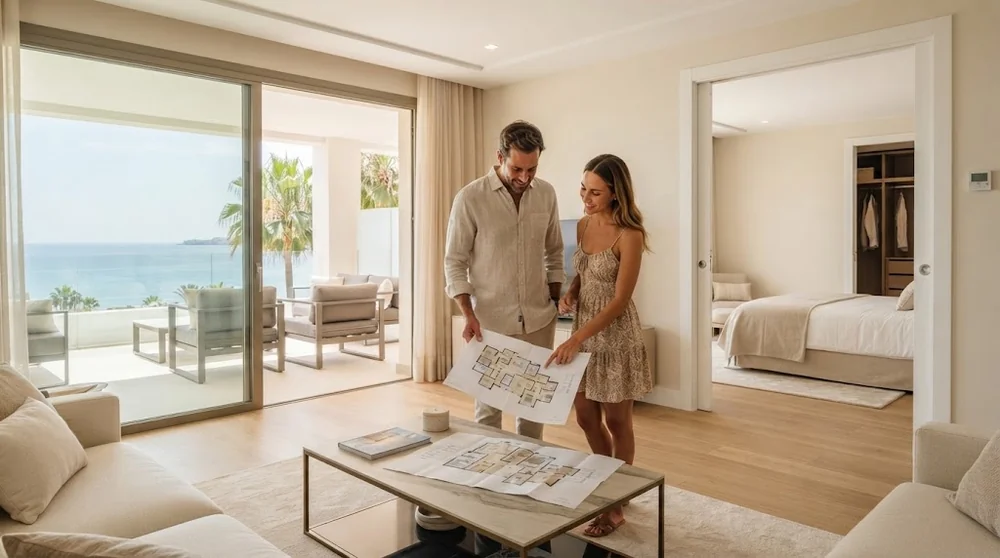
If you would like a shortlist of Marbella apartments and penthouses matched to your budget, preferred area and plans, the short property quiz is the quickest route.
My conditional recommendation is simple. Choose a penthouse if you will use the terrace for most of the year, the legal rights are clear and you accept the higher running costs. Choose a luxury apartment if indoor space, accessibility, shelter and cost control matter more than outdoor drama.
[CTA: Compare Marbella apartments and penthouses matched to your budget]
Frequently Asked Questions
What is the difference between a penthouse and a luxury apartment in Marbella?
A penthouse (ático) sits on the uppermost residential floor and usually comes with a substantial terrace, open views or a duplex layout. A luxury apartment describes quality, not position, so it can be on any floor with equally fine finishes and communal facilities. The real differences are the floor plan, legally documented outdoor space, access, privacy and price.
Is a penthouse worth paying more for in Marbella?
A Marbella penthouse can justify a higher price if you will use the terrace regularly, value open views and like having no neighbours above. It is much less compelling when the terrace is windy, overheated or costly to maintain. Compare two similar homes in the same development, then add the purchase premium to five years of expected running costs.
How much does a luxury penthouse cost in Marbella?
Luxury penthouse prices in Marbella vary widely by address, size, condition and facilities. One agency’s 23 listed Marbella penthouses had a median asking price of €1,475,000 on 1 November 2026, while a separate sample of 87 penthouses advertised above €3 million in Marbella and Benahavís had a €4.30 million median in September 2026. Both are asking-price samples, not completed-sale averages.
Do penthouses have higher community fees than apartments?
Penthouses do not automatically have higher community fees. Community charges depend on a property’s participation coefficient (cuota de participación), the approved community budget, shared amenities and any special levies. A large penthouse may pay more than a smaller flat in the same building, but the calculation is property-specific. Ask for the coefficient, recent accounts, meeting minutes and written confirmation of outstanding fees.
Can I build on or enclose a penthouse terrace in Spain?
You cannot automatically build on or enclose a Spanish penthouse terrace. Exclusive use of a terrace does not necessarily include ownership of the structural roof or permission to alter the building. Glazing, pergolas, jacuzzis and pools can require community approval, municipal authorisation and technical assessments. Before buying, ask an independent lawyer and architect to check the registered title, community rules, planning requirements and structural capacity.
Can a British buyer purchase and holiday-let a penthouse in Marbella?
British nationals can generally buy residential property in Marbella, but ownership does not confer Spanish residency. Holiday letting is separate: it depends on Andalusian tourist registration, municipal limits and the owners’ community. New tourist-rental activity faces community approval rules introduced in April 2025, with transitional treatment for existing lawful activity. Verify permissions before projecting rental income.
Final Verdict: Penthouse or Luxury Apartment?
A penthouse is worth the extra money when the outdoor living and the views are things you will use for most of the year, the terrace rights are clearly documented and the building is well managed. A luxury apartment is the smarter buy when practical interior space, easy access and tighter cost control matter more than a large roof terrace. On my illustrative €1 million example, the penthouse added roughly €32,000 in running costs over five years before any purchase premium, which is a useful yardstick for what the terrace must be worth to you.
Ten years of helping buyers has convinced me of one rule above all others: compare two actual properties, not two labels. Put the nota simple, community accounts, terrace documents and survey findings for a specific penthouse next to those of a specific apartment, and let the figures and your own habits decide. If the numbers and the lifestyle point the same way, you have your answer.
[CTA: Get a personalised Marbella property shortlist]
Disclaimer: This article is general information as at November 2026 and does not constitute legal, tax or financial advice. Tax rates, community-law rules, holiday-rental regulations and market data change, and every purchase has individual circumstances. All calculations marked as hypothetical or illustrative are assumptions, not forecasts or market averages, and no profit or price growth is promised. Consult an independent Spanish lawyer, tax adviser and technical surveyor before committing to any purchase.
Leave a Reply