Category: Buying Property in Spain

  • Reservation Deposit vs Arras Deposit in Spain: Guide

    Reservation Deposit vs Arras Deposit in Spain: Guide


    Reservation Deposit vs Arras Deposit in Spain: Guide

    You have found the apartment in Marbella, the agent says two other couples viewed it this week, and you are being asked to transfer €5,000 today to “take it off the market” before your solicitor has even seen the paperwork. That moment is exactly where the reservation deposit vs arras deposit Spain question stops being theory and starts being your money. The two payments look similar on a bank statement, yet they can carry very different obligations, refund rights and risks. Here is how I explain the difference to buyers before they press “send”.

    A reservation deposit in Spain normally holds a property temporarily while checks are completed, with refund rights depending on the agreement. An arras deposit usually accompanies a more detailed purchase commitment. Under expressly agreed arras penitenciales, a withdrawing buyer forfeits the deposit and a withdrawing seller returns double. Neither outcome applies automatically to every contract.

    Property agent discussing purchase paperwork with buyers at a villa in southern Spain

    Reservation Deposit vs Arras Deposit: Key Differences

    Reservation deposit vs arras deposit in Spain: typical features (illustrative, not universal rules)
    FeatureReservation deposit (contrato de reserva)Arras deposit (contrato de arras)
    Main purposeHolds the property for a short period while checks proceedRecords a fuller purchase bargain and the consequences of withdrawal or breach
    Typical stageShortly after an offer is acceptedAfter initial legal checks, before the notarial deed
    Usual amount (market practice)Often around 1–5% or a fixed sumOften 5–15%, with 10% a common convention
    Usual recipientSeller or estate agent, depending on the agreementUsually the seller, sometimes a nominated stakeholder
    Contractual commitmentVaries from a simple hold to binding obligationsUsually detailed: price, deadline, conditions, deposit consequences
    Refund conditionsOnly those written into the agreement or arising from applicable lawDepend on the type of arras and any conditions agreed
    Withdrawal rightsNo standard statutory withdrawal regimeAgreed withdrawal applies mainly to arras penitenciales
    Legal basisGeneral contract law in the Civil CodeSpanish Civil Code Article 1454; Catalan Civil Code Article 621-8 in Catalonia
    Next stepArras or private purchase agreementEscritura pública de compraventa before a notary

    A reservation deposit and an arras deposit are defined by what the signed clauses say, not by the title printed at the top of the page. As of October 2026, Spanish law does not contain a separately standardised statutory “reservation contract” with its own automatic refund rules. A reservation agreement is assessed under general contract principles in the Spanish Civil Code (or Catalan civil law where it applies), which means its effect depends on its wording, the parties’ intentions and the circumstances.

    The same caution applies to arras. Spanish Civil Code Article 1454 is not triggered automatically by every payment described as “arras”. Spanish courts generally look at whether the parties clearly agreed a right to withdraw in exchange for losing or doubling the deposit. A document called “arras contract” that never mentions withdrawal might be treated as a confirmatory deposit towards a binding sale, with very different consequences.

    Here’s where people usually come unstuck: they assume the reservation is “the soft one” and the arras is “the serious one”. Sometimes that is true. But I have seen reservation forms drafted so tightly that they read like a full purchase commitment, and arras documents so loose that nobody could say with confidence what would happen if either side walked away.

    The typical sequence runs from accepted offer to reservation, then arras or a private purchase contract, then completion at the notary. These stages are illustrative rather than compulsory. Some transactions skip the reservation and go straight to arras; others combine reservation and arras in a single document; some buyers sign a full private purchase contract instead of arras. What matters is that each payment is backed by clear written terms you understand before money leaves your account.

    What Is a Reservation Deposit in Spain?

    A reservation deposit in Spain is a payment made under a contrato de reserva (reservation agreement) to hold a specific property for an agreed period, usually while the buyer arranges legal checks and finance. You may also see it described as a depósito de reserva, señal or reservation fee. Estate agents and sellers typically request it to show that the buyer is serious and to justify taking the property off the market.

    What a reservation actually secures

    In practice, a reservation is meant to buy you time and exclusivity. A well-drafted reservation should state that the seller (or the agent with the seller’s authority) will stop marketing the property and will not accept other offers during the hold period. If that commitment is not written down, you may simply have paid money to someone who is still showing the villa to the next viewer on Saturday.

    Hold periods are commonly somewhere between one and four weeks, depending on the property, the seller and how quickly checks can be done. A one-to-four-week reservation period is a market habit, not a legally required deadline. The period that applies to you is whatever the agreement states, so it needs a specific end date rather than vague wording such as “until the arras is signed”.

    The reservation usually leads to a fuller purchase agreement, typically a contrato de arras or a private purchase contract. The reservation should explain how the money paid will be treated at that next stage, normally as part of the later deposit and ultimately the purchase price.

    Is a reservation contract legally binding?

    A reservation contract can be legally binding in Spain, depending on its wording and the applicable law. Spanish contract law does not require special formalities for most private agreements, so a signed document recording agreement on the property, price and key terms can create enforceable obligations even if it calls itself a “reservation”.

    It helps to distinguish three things that often get mixed up:

    • An accepted offer, often an email or a signed offer form confirming that the seller agrees to your price in principle.
    • A reservation receipt, which may do little more than confirm that money was received for a property.
    • A binding contractual promise, which sets out obligations, conditions and consequences, regardless of what it is called.

    Who signs matters too. If the estate agent signs and receives your money, you need to know whether the agent is acting with the seller’s written authority to accept a reservation and whether the agent is responsible for returning it in any refund scenario. If the seller signs, confirm that the person signing is the registered owner, or properly represents all of them. Let me put it plainly: a reservation signed by someone without authority can leave you chasing the wrong person for your money.

    What Is an Arras Deposit and How Does It Work?

    An arras deposit is a sum paid under a contrato de arras, a preliminary purchase agreement that normally records the price, parties, property, deposit amount, completion deadline and the consequences if either party withdraws or fails to perform. It is usually signed after initial legal checks and before completion at the notary.

    The commercial heart of an arras agreement is usually straightforward: the agreed price, how much has already been paid, the balance due on completion, the long-stop date for signing the escritura pública de compraventa (the public deed of sale signed before a Spanish notary), who pays which costs, and what is included in the sale, from furniture to parking spaces and storage rooms.

    When Article 1454 applies

    As of October 2026, Spanish Civil Code Article 1454 provides that where arras or a deposit have been given in a sale, the contract may be terminated by the buyer agreeing to lose them or by the seller returning them doubled. This loss-or-double mechanism is associated with arras penitenciales, meaning a deposit that the parties have clearly agreed will operate as the price of a permitted withdrawal. You can read the consolidated text of the Spanish Civil Code on the official BOE website.

    “Returning double” means the seller’s total repayment is twice the deposit received, not the original deposit plus a further double amount. If the buyer paid €30,000, a withdrawing seller under applicable penitential arras would repay €60,000 in total: the buyer’s €30,000 back plus €30,000 on top.

    There is an important distinction between withdrawal and breach. Under penitential arras, withdrawal is a contractual right: either side can step away, at the agreed price of losing or doubling the deposit, usually within the agreed period. A breach is different: it means one party fails to perform a binding obligation, for example by not turning up to sign or not paying the balance, in an agreement that does not give a withdrawal right. A breach can lead to claims for performance, termination or damages, depending on the contract and the law.

    Why the agreement’s wording matters

    Spanish courts have long treated penitential arras as the exception that should be clearly agreed, rather than the default interpretation of any deposit. In Catalonia, Catalan Civil Code Article 621-8 states expressly that penitential arras must be agreed expressly. The safest practical approach anywhere in Spain is to make sure the agreement states in plain terms whether it creates a withdrawal right and what happens to the deposit.

    Finally, paying arras does not make you the owner. Legal ownership of Spanish property normally passes on completion, typically when the escritura pública de compraventa is signed and possession is delivered, not when a deposit is paid. Registration at the Registro de la Propiedad then protects your title against third parties.

    Arras Penitenciales, Confirmatorias and Penales Explained

    Spanish law and case law recognise three broad types of arras: penitenciales, confirmatorias and penales, and each produces different consequences if the purchase does not complete. The type of arras matters far more than the heading on the document.

    The three types of arras in Spanish property purchases (general overview as of October 2026)
    TypePurposeAgreed withdrawal?If the buyer does not performIf the seller does not performPossible remedies
    Arras penitencialesPrice of a permitted withdrawalYes, if expressly agreedBuyer who withdraws generally loses the depositSeller who withdraws generally returns doubleMainly the loss-or-double mechanism of Article 1454
    Arras confirmatoriasEvidence of a binding sale and payment on account of the priceNo unilateral withdrawal rightSeller may seek performance or termination with damagesBuyer may seek performance or termination with damagesGeneral contract remedies under the Civil Code
    Arras penalesAgreed penalty for non-performanceNo unilateral withdrawal rightDeposit may be kept as a penalty, depending on the clauseAgreed penalty may apply, depending on the clausePenalty plus, in some cases, performance or damages

    The loss-or-double-return mechanism in Spanish Civil Code Article 1454 is characteristic of arras penitenciales, not a universal remedy for every property deposit. This is the single most common misunderstanding I hear from buyers who have read a quick guide online.

    Arras confirmatorias are a deposit that confirms a binding purchase and counts towards the price, without giving either party a right to walk away. If the seller refuses to complete under confirmatory arras, the buyer may be able to ask a court to enforce the sale or to terminate it and claim damages; the buyer is not simply limited to a double refund. The same logic applies in reverse if the buyer defaults.

    Arras penales are a deposit that operates as an agreed penalty if a party fails to perform. Whether the innocent party can also demand performance or extra damages depends on the precise wording of the penalty clause and how Spanish law treats penalty clauses, which is a question for your lawyer, not for a general guide.

    Classification depends on substance and on the express intention of the parties. A clause that says “the parties expressly agree that these are arras penitenciales under Article 1454 of the Civil Code, and either party may withdraw on the terms of that article until the completion date” leaves little room for doubt. A clause that just says “€20,000 is paid as arras” may leave a great deal.

    Catalonia deserves separate mention. As of October 2026, Catalan Civil Code Article 621-8 provides that sums delivered as arras are, as a general rule, treated as paid on account of the price, while penitential arras must be expressly agreed. It also links the buyer’s forfeiture to an exception for justified withdrawal under Article 621-49 on third-party financing. Buyers in Barcelona, Girona or elsewhere in Catalonia should therefore never assume that the national Civil Code rules apply without adjustment.

    Three sets of blank property contract papers arranged on a solicitor's desk

    How Much Is a Reservation or Arras Deposit?

    There is no legally mandated universal percentage for a reservation or arras deposit in Spain; amounts are negotiated. The figures you hear from agents are market conventions, and they vary between areas, agencies and developers.

    Commonly reported deposit amounts in Spain (market practice, not statutory tariffs)
    PaymentCommonly reported rangeNotes
    Reservation depositAround 1–5% of the price, or a fixed sumFixed sums such as €3,000, €6,000 or €10,000 are common, especially with agencies and developers
    Arras depositAround 5–15% of the priceAbout 10% is the most frequently quoted convention
    Balance at completionThe remainder of the pricePaid at the notary, often by banker’s draft or bank transfer as agreed

    To make the arithmetic concrete, here is a hypothetical €300,000 resale purchase, excluding taxes, notary fees, registry fees, legal fees and any other adjustments:

    1. The buyer pays a €3,000 reservation deposit after the offer is accepted.
    2. The parties agree that the total deposit at the arras stage will be 10%, which is €30,000.
    3. The €3,000 already paid is credited towards that €30,000, so the buyer transfers an additional €27,000 when signing arras.
    4. The remaining €270,000 is paid at completion before the notary.

    This is an example, not a required payment structure. Some sellers ask for less than 10%, some developers ask for more, and some transactions use staged payments.

    Making sure the first payment is credited, not counted twice

    The reservation agreement and the arras agreement should both state, in figures and words, whether money already paid forms part of the next deposit. A well-drafted arras agreement should state the total deposit, the amount already received, the amount now being paid and the balance due at completion. Without that, you can end up with an awkward debate about whether you owe €30,000 or €27,000, and a seller’s agent might later argue that the reservation was a separate, non-refundable “fee”.

    The same reconciliation matters if the deal fails. If the arras are penitential and the seller withdraws, is the double calculated on €30,000 or on €27,000? It should be €30,000 if the reservation was credited as part of the arras, but you want that written down, not argued about later. My advice to every British buyer is to keep a simple table of every payment, date, recipient and reference, and to check it against each new document before signing.

    Buyers reviewing property payment paperwork and a calculator

    Can You Get Your Reservation Deposit Back?

    A reservation deposit in Spain is not automatically refundable or automatically lost; whether you get it back depends on the signed agreement, the reason the purchase is not proceeding and the applicable law. The useful question is not “is it refundable?” but “refundable in which circumstances, and who decides whether those circumstances have occurred?”

    Reservation and deposit refund scenarios in Spain: likely issues to check (outcomes depend on the contract and law)
    ScenarioWhat usually decides the outcomePractical risk for the buyer
    Buyer simply changes their mindWhether the agreement allows withdrawal and at what costOften high: the deposit may be lost, and a binding agreement could support other claims
    Seller changes their mindRefund, penalty or double-return wording, and whether the reservation was binding on the sellerBuyer may have a claim, but recovery may need negotiation or legal action
    Survey finds a serious defectWhether a survey condition with a deadline was agreedLow if a clear condition exists; uncertain if not
    Title review reveals an undisclosed mortgage or legal issueWhether refund is linked to adverse legal checks, and how “adverse” is definedUsually better protected with a specific clause; otherwise contested
    Agreed condition not satisfiedWording of the condition, evidence required and deadlineDepends on proving the condition failed in time
    Mortgage refusedMortgage contingency clause, or Catalan Article 621-49 where applicableHigh if no financing protection applies
    Reservation period expiresWhat the agreement says happens at expiryUnclear wording can trap the deposit
    Seller fails an essential commitmentSeller obligations in the agreement and general breach rulesBuyer may terminate and claim, subject to evidence and notice

    If you change your mind

    A buyer who simply changes their mind, without relying on a written condition or a seller breach, should assume the deposit is at risk. Discretionary withdrawal by the buyer is different from termination based on a documented contractual condition or the seller’s breach. If the agreement is binding and gives no withdrawal right, the seller might in theory argue for more than keeping the deposit, although in practice most disputes over small reservations end with the payment being retained.

    If the seller pulls out

    If the seller pulls out of a reservation, your position depends on what the seller promised. A reservation that obliges the seller to sell at an agreed price, and that sets out a refund or penalty for seller withdrawal, gives you something concrete to rely on. A reservation that only obliges you leaves you arguing from general principles, which is slower and less certain.

    If legal checks reveal a problem

    Adverse legal findings are where a carefully drafted refund clause earns its keep. A clause that refunds the reservation “if the buyer’s lawyer identifies charges, planning irregularities or registry discrepancies not disclosed before signing, notified in writing before the expiry date” is far stronger than a vague “subject to checks”.

    Whatever the scenario, the practical steps are the same:

    1. Read the refund and termination wording carefully, ideally with your solicitor.
    2. Record the factual trigger: the lender’s written refusal, the registry extract, the surveyor’s report.
    3. Send written notice by the method and within the deadline the agreement specifies, such as burofax or email to a named address.
    4. Preserve evidence of payment: bank confirmation, transfer reference and receipt.
    5. Seek independent legal review before accepting any settlement or making counterclaims.

    What Happens If the Seller Withdraws After Arras?

    Under expressly agreed arras penitenciales, a seller who withdraws within the agreed terms generally has to repay twice the deposit received. If the arras are confirmatory or penal, the seller’s refusal to complete is usually treated as a breach, and the buyer’s remedies are different.

    Let us return to the hypothetical €300,000 purchase with a total deposit of €30,000, assuming the €3,000 reservation was credited as part of the arras:

    Hypothetical €30,000 deposit: outcomes depend on the type of arras agreed
    SituationArras penitencialesArras confirmatorias or penales
    Buyer withdrawsBuyer generally forfeits the €30,000 depositTreated as buyer breach: seller may claim performance, termination, damages or an agreed penalty
    Seller withdrawsSeller generally repays €60,000 in totalTreated as seller breach: buyer may claim performance, termination, damages or an agreed penalty
    Both complete€30,000 credited to the price; €270,000 due at completionSame: deposit credited to the price

    A buyer is not automatically entitled to double repayment unless the agreement supports that remedy. Under confirmatory arras, for example, the buyer might prefer to force the sale through the courts rather than accept money, which may be the better option if you have sold your UK home and are emotionally committed to the property. Under penal arras, the penalty clause wording controls a great deal.

    Contractually permitted withdrawal and breach should not be confused. A seller who exercises an agreed penitential withdrawal is using a right; a seller who simply fails to turn up at the notary under confirmatory arras is breaking a promise. The difference shapes what you can claim and how.

    Real-world recovery also depends on procedure. If the agreement requires the seller to notify withdrawal in writing before a certain date, or the buyer to give notice to complete, those steps matter. A seller who refuses to repay double does not hand over the money just because Article 1454 exists; you may need to negotiate, send formal demands or bring proceedings, with cost and time attached. That is why an independent lawyer should check the notice and deadline clauses before you pay, not after the seller goes quiet.

    What If Your Spanish Mortgage Is Refused?

    Mortgage refusal does not automatically excuse a buyer under every Spanish property contract. Outside the specific Catalan regime described below, a buyer usually needs a negotiated financing condition, often called a mortgage contingency clause, to recover a deposit if the loan falls through.

    A useful mortgage contingency clause should specify the essentials:

    • The loan sought: the approximate amount or loan-to-value requested, and ideally the lender or type of lender.
    • The lender decision: what counts as refusal, including an offer on materially worse terms than those specified.
    • Evidence: a written refusal from the lender, or from a specified number of lenders.
    • Deadline: the date by which the buyer must prove refusal.
    • Consequence: full refund of the deposit within a stated number of days.
    • Buyer conduct: an obligation to apply promptly and supply documents, which sellers will reasonably expect.

    Lenders typically ask for identification, proof of income, tax returns, bank statements, details of existing debts, credit reports and the valuation of the property. Delays commonly come from translations, missing documents and valuation queues. A two-week financing deadline in a summer reservation can be unrealistic for an overseas buyer, so negotiate a period that reflects how long your chosen lender actually takes.

    Catalonia: Articles 621-8 and 621-49 of the Catalan Civil Code

    Catalonia is different, and the difference matters. As of October 2026, Catalan Civil Code Article 621-49 provides that where a purchase contract contemplates financing of all or part of the price by a credit institution, the buyer may, unless otherwise agreed, withdraw from the contract if they prove in writing, within the agreed period, that the designated institution refused the financing or refused subrogation of an existing mortgage, unless the refusal resulted from the buyer’s negligence.

    The Catalan mortgage-refusal protection in Article 621-49 applies only when its conditions are met. In summary:

    • the contract must contemplate third-party financing of the price;
    • the parties must not have excluded the protection by contrary agreement;
    • the buyer must provide documentary proof of the refusal within the agreed period;
    • the refusal must not stem from the buyer’s own negligence.

    Catalan Civil Code Article 621-8 connects to this rule: a buyer who withdraws under penitential arras generally loses them, unless the withdrawal is justified under Article 621-49. Catalan courts and commentators have debated how these requirements apply in practice, including what counts as negligence and what happens if no deadline was fixed, so a buyer in Barcelona should still negotiate clear financing wording rather than relying on the statute alone.

    The Catalan Article 621-49 rule should not be assumed to apply to purchases in Malaga, Madrid, Valencia, Alicante, Mallorca or Tenerife. Purchases governed by the general Spanish Civil Code depend on the contract’s own financing terms.

    Concerns for British non-resident buyers

    Since Brexit, British buyers who are not resident in Spain are generally assessed as non-EU non-residents by Spanish lenders. In my experience, that often means more documentation, more conservative loan-to-value limits and longer underwriting, but criteria vary by lender and change over time, so there is no fixed legal percentage you can rely on. Income in sterling raises currency questions: a lender may stress-test your income against exchange-rate movements, and the euro amount you need at completion can shift if the pound moves between reservation and notary. Brexit does not change Spanish deposit law, but it can change how long finance takes, which is precisely why your financing deadline needs breathing room.

    What to Check Before Paying Any Deposit

    Before paying any deposit in Spain, a buyer should verify ownership, charges, planning status, documentation and the exact payment and refund terms, preferably through an independent Spanish property lawyer. Always ask for the nota simple before you commit. It is quick to obtain and tells you a lot, but it is only the starting point.

    Property and seller checks

    1. Obtain a current nota simple. A nota simple is an informational extract from the Registro de la Propiedad showing the registered description, owner and recorded charges of a property. It has informational value only, while a formal registry certificate (certificación registral) is the document with full evidential value. You can request a nota simple online through the Spanish Land Registry’s official electronic service, or simply ask your lawyer to obtain it for you, usually within a day or two.
    2. Confirm the registered owner and authority to sell. The seller named in your agreement should match the registered owner. If there are several owners, a company owner, an inheritance in progress or a representative acting under power of attorney, check that the person signing has authority for all of them.
    3. Verify identification and legal capacity of signatories. Check passports or Spanish identity documents, NIE numbers and, for companies, the appointment of the director or attorney.
    4. Review charges and mortgages. Existing mortgages, embargoes and other encumbrances should be identified, with a clear plan for cancellation at or before completion.
    5. Compare the registry, the Catastro and the physical property. Built area, plot size and boundaries should broadly correspond between the registry description, the cadastral record and what is actually on site.
    6. Check planning status and any legalisation. Your lawyer may need to check municipal records for planning infractions, especially where there are extensions, enclosed terraces, pools or outbuildings that do not appear in the registry.
    7. Request first occupation or equivalent documentation where applicable. Depending on the property and region, this may be a licencia de primera ocupación or a newer declaration-based equivalent, which can affect utility connections and future resale.
    8. Check community charges and local taxes. Ask for a certificate of being up to date with community fees and recent IBI (local property tax) receipts, and ask whether any special levies have been approved.

    Contract and payment checks

    1. Confirm the price and inclusions. The agreement should state the exact price, how existing payments are credited and what is included, such as furniture, parking and storage.
    2. Read the payment, refund and expiry wording. Identify who receives the money, on whose authority, by when the next step must occur and exactly when you get the money back.

    Not every risk appears in the property register. A nota simple does not prove that every building element is legal, that planning permission was obtained for every extension, that there are no unpaid community fees or that the property has no hidden defects. On the Costa del Sol, I regularly see properties where a pool, a converted garage or an extra bedroom on the terrace never made it into the registry description. That does not automatically mean a problem, but it does mean your lawyer needs to look at municipal records and, sometimes, an architect’s report.

    Legal adviser checking property documents with a homebuyer

    Who Should Hold Your Property Deposit?

    The party legally entitled to receive your deposit and the actual holder of the bank account are not always the same, and both should be identified in writing before you pay. No recipient or account is automatically protected just because it belongs to an agency or a lawyer, so the safeguards need to come from the contract and from your own checks.

    1. Seller. Paying the seller directly is common at arras stage. Confirm that the account belongs to the registered owner, or to someone with documented authority to receive funds on their behalf.
    2. Estate agency. Agencies often take reservation deposits. Ask whether the agent holds the money for the seller, under what written authority and who is responsible for any refund. If the agency is not a party to the sale contract, ask what happens to your money if the seller and agency disagree.
    3. Developer. For new-build purchases, ask whether payments go into a designated special account and what guarantee documentation will be issued (see the next section).
    4. Nominated stakeholder. Some deals use a lawyer’s client account or a notarial deposit to hold funds pending conditions. This can help, but the holding terms, release conditions and responsibilities must be written down.

    Whoever receives your money, insist on a signed receipt that names the payer, the recipient, the property, the amount, the date and the purpose of the payment. The remittance reference on your transfer should match the agreement, for example “Reservation – [property address] – [buyer name]”.

    Fraud precautions are not optional. Payment diversion scams, where criminals send fake “updated bank details” by email, target property buyers in Spain just as they do in the UK. Confirm bank details by phone using a number you already know, treat any last-minute change of account with suspicion and send a small test payment before the main transfer if time allows. If you use a currency specialist for a transfer from a British account, make sure the beneficiary name matches the agreement exactly.

    If you are weighing up a specific reservation form or an agent’s request for money and want a second pair of eyes on the practical steps before you transfer anything, a short conversation can help you decide what to ask your solicitor.

    Being asked for a deposit and not sure who should hold it or what the receipt should say? Send me your question and I will explain the practical steps for your situation.

    Ask David a question on WhatsApp

    Whatever route you choose, the principle stays the same: know who has your money, why they have it and who must give it back if the purchase does not go ahead.

    Reservation Deposits on New-Build Spanish Property

    A new-build reservation payment to a developer is not automatically the same as a qualifying advance payment protected under the Ley de Ordenación de la Edificación. Off-plan purchases often involve a marketing reservation, then a private purchase contract, then staged payments during construction, and each payment can sit under different rules.

    As of October 2026, the first additional provision of Ley 38/1999, the Ley de Ordenación de la Edificación, as amended by Ley 20/2015, requires developers of housing who receive amounts on account of the price, from the point at which the building licence is obtained, to guarantee the return of those amounts plus legal interest through insurance or a bank guarantee, and to receive them through a special account at a credit institution. The guarantee is designed to protect buyers if construction does not start or is not completed within the agreed time, or if the required occupation documentation is not obtained.

    The statutory advance-payment protection depends on its conditions being met; it does not mean every reservation fee taken by a developer is automatically covered by a bank guarantee. Payments taken before the building licence, payments labelled purely as reservation fees and payments made to an account that is not the special account can raise questions that need a lawyer’s assessment rather than assumptions in either direction.

    Documents to request before paying a developer include:

    • the building licence, or confirmation of its status;
    • details of the special account into which payments must be made;
    • the individual bank guarantee or insurance certificate covering your payments, issued in your name;
    • the contract clauses on delivery dates, delay, cancellation and refunds;
    • the building specifications and plans forming part of the contract.

    Here is a hypothetical example. A couple from Leeds reserve an off-plan two-bedroom apartment near Malaga with a €6,000 reservation, then sign a private contract requiring 30% of a €280,000 price in stages during construction. Their lawyer checks that the building licence has been granted, confirms that each stage payment goes into the developer’s special account and requests an individual guarantee for each payment. The reservation itself is refundable only on the terms of the reservation form, so the lawyer also negotiates wording that refunds it if the guarantee is not issued. The protection they end up with comes from combining statutory rules with careful contract drafting, not from either alone.

    Delivery failure, long delays and changes to specifications are the classic off-plan risks. Make sure the contract states a delivery date, any permitted extension and what you can do if the date is missed.

    A Safe Deposit Timeline for British Buyers

    A safe Spanish property deposit timeline puts legal review and payment verification before money moves, and every payment after it is tied to written conditions and deadlines. The sequence below is illustrative, not mandatory; some steps run in parallel and some transactions combine stages.

    1. Agree the offer terms in writing. Price, inclusions, target completion date and any conditions, such as finance or survey.
    2. Appoint an independent Spanish property lawyer. Independent means not recommended by, or paid through, the seller’s side. Your lawyer can obtain your NIE, the foreigner’s identification number required to buy property, if you do not already have one.
    3. Obtain and review the nota simple. Check owner, description and charges before committing.
    4. Assess planning, charges and ownership. Municipal checks, community certificates and IBI receipts.
    5. Seek a mortgage pre-assessment if you need finance. Ask the lender how long a full approval realistically takes for a non-resident.
    6. Negotiate the reservation agreement and written contingencies. Hold period, marketing suspension, refund triggers and crediting of the payment.
    7. Verify the recipient account. Confirm ownership and authority, by phone, using a known number.
    8. Pay a traceable amount. Bank transfer with a clear reference; never cash.
    9. Track due diligence and financing deadlines. Put every date in a calendar with a reminder a week before.
    10. Negotiate and sign the appropriate arras or private purchase agreement. Decide expressly whether the arras are penitential, confirmatory or penal.
    11. Credit previous payments. Confirm the reservation is deducted from the arras amount and the balance.
    12. Complete by escritura pública before a Spanish notary. Pay the balance, receive the keys and register the deed at the Registro de la Propiedad.

    British buyers often expect the English pattern where nothing is binding until exchange of contracts. Spain does not work that way. In Spain, a private agreement signed early in the process can already create binding obligations, long before the notary appointment. When I moved from Manchester to Andalusia, that was one of the first cultural shifts I had to get my head around: the signature on a short private document can matter as much as the grand moment at the notary.

    Identity checks will come up repeatedly. Under Spanish anti-money-laundering law, Ley 10/2010, notaries, estate agents and banks must identify their clients and may ask about the source of funds. Have your passport, NIE, proof of address and evidence of where the purchase money came from ready, including a UK house sale completion statement or savings records.

    If you cannot be in Spain to sign, a power of attorney can allow your lawyer or another trusted person to sign for you. It can be granted before a Spanish notary, at a Spanish consulate or before a UK notary with an apostille, and it should be limited to what is needed for the purchase. Ask for translations of anything you sign, and never sign a Spanish document you do not understand because the translation “will follow”.

    Overseas transfers take time: allow for bank compliance checks on large payments and for currency conversion. Brexit does not dictate your refund rights; those come from Spanish law and your contract. But being a non-resident non-EU buyer can slow the paperwork, so build that into every deadline.

    Homebuyers and a legal professional meeting to complete a property purchase

    Deposit Contract Clauses Buyers Should Negotiate

    The most protective deposit agreements in Spain specify the parties, the property, the conditions, the deadlines and exactly when the deposit is refunded, rather than relying on general labels. What follows is a set of discussion points to raise with your solicitor, not ready-to-sign legal clauses. Your lawyer should draft the actual wording for your property and the applicable law.

    • Parties and authority: Are all registered owners named, and does anyone signing for them have documented authority? Is the agency a party, and if so, in what capacity?
    • Property identification: Does the agreement cite the registry details, cadastral reference, parking space and storage room, and any furniture included?
    • Reservation period and marketing: Is there a fixed end date, and does the seller expressly agree to suspend marketing and refuse other offers during that period?
    • Treatment of existing payments: Does each document state how earlier payments are credited towards the deposit and the price?
    • Refund triggers for legal checks: Is there a conditional refund following an adverse legal review, for example where undisclosed charges, planning irregularities or registry discrepancies are found and notified before a stated date?
    • Financing conditions: If you need a mortgage, does the mortgage contingency clause name the loan sought, the evidence required, the deadline and the refund? In Catalonia, has Article 621-49 been preserved or excluded?
    • Type of arras and withdrawal consequences: Does the agreement say expressly whether the arras are penitenciales, confirmatorias or penales, and what each party can do if the other does not complete?
    • Notices, extensions, governing law and disputes: How must notices be sent, can deadlines be extended in writing, which law applies and which courts or procedure will resolve disputes?

    Be wary of two common drafting traps. The first is the vaguely worded non-refundable deposit: “the reservation is non-refundable” with no exceptions, even where the seller cannot deliver clean title. The second is the one-sided penalty: the buyer loses everything if they withdraw, but the seller’s withdrawal triggers nothing more than a simple refund. Balanced agreements treat both sides consistently, or at least explain why they do not.

    Questions worth sending to your solicitor before you sign include: “If the nota simple shows a mortgage not mentioned by the agent, do I get the reservation back?”, “What happens if my lender’s valuation comes in low?” and “If the seller refuses to complete, can I insist on the sale, or am I limited to a refund?”

    Common Deposit Mistakes in Marbella and Beyond

    Local deposit customs never replace the legal regime that applies to your contract. The examples below are hypothetical, built from patterns I see often, and are not descriptions of real clients.

    1. Hypothetical: the Marbella villa with the unregistered pool house. A British buyer pays a €10,000 reservation to an agent on a “standard” form with no refund conditions. The lawyer then finds that the pool house and an enclosed terrace are not in the registry or the Catastro. Possible outcome: the seller refuses to refund, arguing the buyer withdrew voluntarily. Better approach: make the reservation refundable if legal checks reveal unregistered or unlicensed construction, notified before a fixed date.
    2. Hypothetical: the Alicante retirees and the community debt. A retired couple sign arras on a townhouse without asking for a community fees certificate. Shortly before completion, they learn of unpaid fees and an approved special levy for roof works. Possible outcome: a dispute over who pays, delaying completion. Better approach: require a community certificate before arras and a clause allocating approved levies.
    3. Hypothetical: the Barcelona buyer and the lapsed finance deadline. A buyer in Barcelona signs penitential arras with a 30-day financing period, but the lender’s valuation takes longer and no written refusal is obtained in time. Possible outcome: the buyer may struggle to rely on Article 621-49 because the documentary proof was not produced within the agreed period. Better approach: a realistic deadline, a named lender and a right to extend in writing.
    4. Hypothetical: the overseas buyer in Valencia and the changed bank details. An overseas buyer receives an email, apparently from the agency, with “new” bank details for the arras payment. Possible outcome: funds sent to a fraudster’s account and difficult to recover. Better approach: verify bank details by phone and treat any change as a red flag.
    5. Hypothetical: the Malaga new-build without a guarantee. A buyer pays stage payments to a developer without obtaining individual guarantees or checking the special account. Possible outcome: weaker practical protection if the project stalls. Better approach: request the guarantee documentation before each payment.

    Warning signs that merit immediate independent advice include pressure to pay before you have seen any documents, a reluctance to provide the nota simple, a seller who is not the registered owner, a request for cash, a non-refundable clause with no exceptions and any last-minute change of bank account.

    Which Deposit Agreement Should You Sign?

    Neither a reservation agreement nor an arras agreement is categorically safer in every case; the right choice depends on how ready you are, how certain your finance is and what checks are still outstanding. A narrowly drafted, conditional reservation may be sensible when preliminary checks are still underway, while a fuller arras or private purchase agreement makes more sense once you know what you are buying.

    Choosing between a reservation, an arras agreement or waiting: a practical decision guide
    Your situationConditional reservationArras or private purchase agreementWait before signing or paying
    Buyer readinessCommitted, checks just startingChecks largely completeStill comparing properties
    Financing certaintyPre-assessment in hand, approval pendingApproval obtained or cash buyer, or clear finance condition agreedNo lender contact yet and no finance condition offered
    Seller commitmentSeller agrees to suspend marketingSeller ready to commit to price and dateSeller unwilling to commit in writing
    Outstanding documentationNota simple obtained; other checks underwayPlanning, charges and community checks reviewedNo nota simple or ownership unclear
    Deposit at riskSmall, with clear refund triggersLarger, with agreed type of arras and conditionsNon-refundable with no exceptions

    If you are still deciding which property, budget and area actually suit you, it can be wiser to settle those questions first than to rush into a deposit on the first place that looks right. Clarity about what you want makes every later contract negotiation simpler.

    Still weighing up regions, budgets and property types before committing to any deposit? A short questionnaire can narrow the options to properties that genuinely fit your plans.

    Get a personalised shortlist of properties in Spain

    Once you have the right property in your sights, the deciding factor is the written review. My advice to every British buyer is simple: get an independent lawyer to read the deposit agreement and confirm the refund triggers before you transfer a single euro.

    Reservation and Arras Deposits: Frequently Asked Questions

    What is the difference between a reservation contract and an arras contract in Spain?

    A reservation contract generally holds a Spanish property for an agreed period while the buyer completes preliminary checks. An arras agreement usually records a fuller purchase commitment and specifies deposit consequences. The critical distinction is the actual contractual wording. Only qualifying penitential arras give the agreed withdrawal mechanism associated with Spanish Civil Code Article 1454; other agreements can create different obligations.

    Can I get my reservation deposit back if I change my mind?

    A reservation deposit in Spain is not automatically refundable. The outcome depends on the signed agreement, applicable law and why the purchase is not proceeding. A buyer who simply changes their mind may lose the payment or face another contractual claim. Before paying, request explicit written refund conditions for adverse legal checks, financing issues and seller non-performance.

    How much deposit do you pay when buying property in Spain?

    Spanish property reservation deposits are often quoted at around 1–5% of the agreed price, while an arras deposit is commonly around 10%, although amounts vary. These are commercial conventions rather than compulsory national percentages. On a €300,000 purchase, a €3,000 reservation might be credited towards a later €30,000 deposit, leaving €27,000 to pay at that stage.

    What happens if the seller pulls out after signing an arras contract?

    Under expressly agreed arras penitenciales, a seller who exercises the contractual withdrawal right generally returns twice the deposit received. A €20,000 deposit would therefore result in €40,000 total repayment. However, confirmatory or penal arras may involve different contractual remedies, including performance or damages. The exact agreement and applicable law must be reviewed before assuming double repayment.

    Do I lose my deposit if my Spanish mortgage is refused?

    Mortgage refusal does not produce one universal result throughout Spain. Buyers should negotiate clear financing conditions and evidence requirements before signing. Catalonia has specific rules under Civil Code Article 621-49 where the agreement contemplates third-party finance, subject to stated conditions and possible contrary agreement. Elsewhere, a buyer may risk losing their deposit if the contract provides no applicable protection.

    Should I pay a reservation deposit before my solicitor checks the property?

    Ideally, an independent Spanish property solicitor should review the reservation terms and basic ownership information before you transfer money. At minimum, establish the payment recipient’s authority, the reservation deadline, the refund conditions and the precise property being reserved. Obtain a current nota simple and avoid signing an unconditional non-refundable commitment before essential legal checks have been arranged.

    Final Thoughts

    The real difference between a reservation deposit and an arras deposit in Spain lies in the clauses, not the labels. A reservation usually holds a property while checks proceed, and an arras agreement usually records a fuller commitment, but either can be binding, and only expressly agreed arras penitenciales carry the familiar rule of losing the deposit or repaying double. Catalonia has its own rules on arras and mortgage refusal, new-build advance payments have statutory protections with conditions attached, and the percentages you hear from agents are conventions rather than law.

    Ten years on the Costa del Sol have taught me that the buyers who sleep well are rarely the ones who found the cheapest property; they are the ones who knew exactly what they had signed. Get the nota simple, put refund triggers and deadlines in writing, verify who is holding your money and keep a running record of every payment so nothing is counted twice.

    Above all, let an independent Spanish property lawyer review the agreement before you pay, and bring in a mortgage adviser or tax specialist where your situation needs it. A few days of checks costs far less than a deposit you cannot recover.

    Legal information disclaimer: this article provides general information on Spanish property deposits as of October 2026. It does not constitute legal, financial or tax advice and does not replace advice from a qualified professional based on your individual contract, property and circumstances.

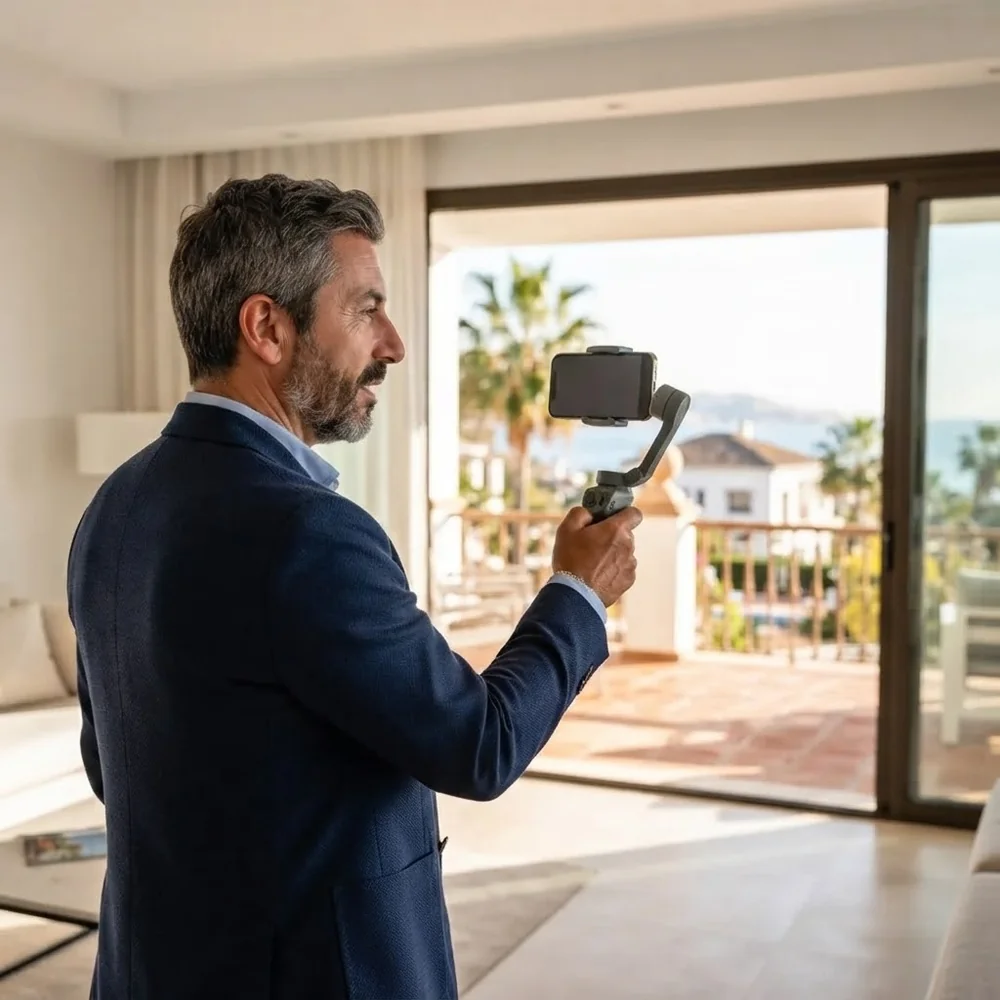
  • Virtual Property Viewings in Spain: Buying Safely

    Virtual Property Viewings in Spain: Buying Safely

    You have spotted a flat in Estepona online, the agent has offered a video call, and you are sitting in Leeds or Boston wondering whether that is enough to start sending money. A screen can tell you whether a property deserves your attention, but it cannot tell you whether it deserves your deposit. This guide separates what video can show from what only documents, independent professionals and, occasionally, your own two feet can confirm.

    Virtual property viewings in Spain can help you shortlist homes and buy remotely, but video alone cannot establish ownership, planning legality or structural condition. Before committing money, arrange independent legal checks and an on-site technical inspection. A properly drafted power of attorney can let your representative complete the purchase while you remain abroad.

    What Virtual Property Viewings in Spain Can Establish

    I swapped Manchester drizzle for Marbella sunshine more than a decade ago, and ten years on the Costa del Sol have taught me that even a perfectly honest video has limits. The agent can film every room in good faith and still show you nothing about the title, the planning history or what is going on behind the plaster. Trouble starts when a buyer asks a video to prove things it never could. A remote purchase has three decision stages: shortlist (is this worth investigating?), investigate (is it legally and physically sound?) and commit (am I prepared to pay and sign?). Each stage needs a different kind of evidence.

    MethodPurposeWhat it can showWhat it cannot establish
    Prerecorded tourEarly shortlistingLayout, finish, light and general styleCurrent condition, editing choices, rooms left out, the surroundings off camera
    Buyer-directed live video viewingTesting the shortlistA continuous route, visible defects you request, real-time answersOwnership, legality, hidden damp, structural movement or true noise levels
    Independent technical inspectionPhysical investigationProfessional assessment of structure, installations and visible or detectable defectsTitle, debts or planning status, unless specifically instructed and documented
    Legal due diligenceLegal investigationRegistered owner, charges, planning and tax position, community debtsThe physical condition of the building

    Let me put it plainly: a video cannot prove ownership, lawful construction or structural soundness. A live video viewing is an excellent filter, but the second and third stages belong to a Spanish lawyer acting for you and an independent arquitecto técnico (a qualified building surveyor) who physically visits the property.

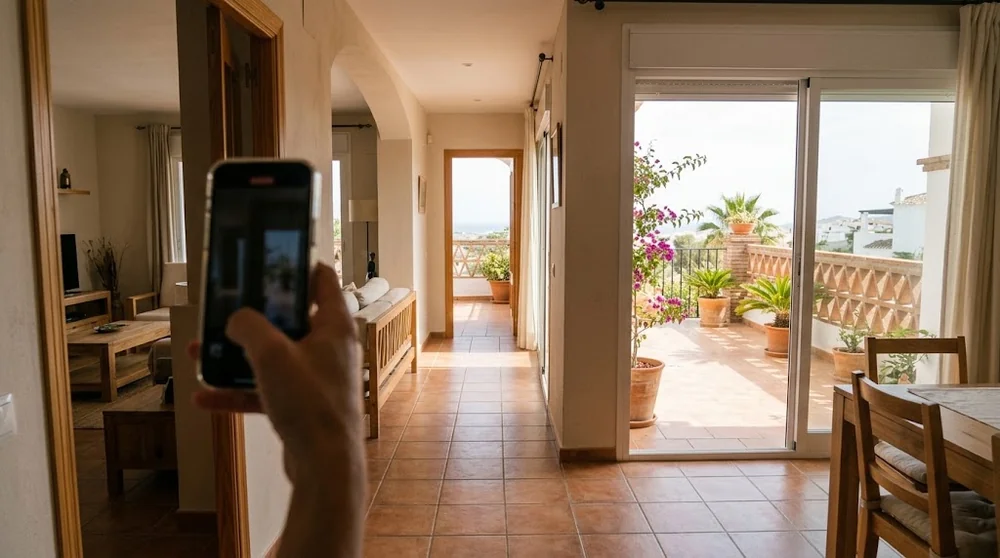
    Property agent conducting a live video viewing inside a Marbella apartment

    Your Live Video Viewing Checklist

    A good live viewing is directed by you, not choreographed by whoever holds the phone. Send your requests in writing before the call, so nothing gets “forgotten” and you have a record of what you asked to see.

    Preparation before the call

    • Ask for a continuous route from the street or building entrance to the front door, then through every room without cuts. Gaps in footage are where inconvenient things live.
    • Confirm the property’s identity privately: the agent can show the door number, the floor and the building entrance so you can match them against the listing and, later, the registry description. Ask them not to film the seller’s letters, ID or other personal documents.
    • Agree before the call whether it may be recorded. Ask for consent from the agent and any occupant, and keep the recording for your own reference.
    • Request a tape measure or laser measure, and list the spaces you need measured: bedrooms, the kitchen run, the terrace, the parking space and the storage room.
    • Schedule the call in good daylight and ask for a stable connection; a frozen screen in the bathroom tells you nothing. If damp, the roof or drainage are a concern, ask for extra photos or a short video during or just after rain as well, because a sunny afternoon is when leaks hide best.

    Room-by-room checks

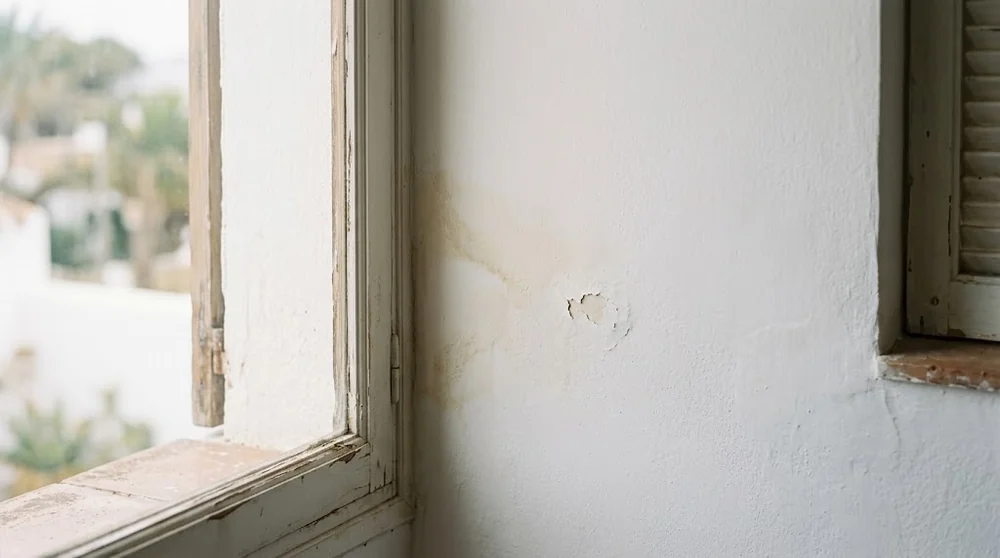
    • Slow, close views of ceilings, corners, skirting boards and window frames, looking for staining, bubbling paint, fresh patches of paint or cracks.
    • With the owner’s permission, run taps, flush the toilet, operate shutters (persianas), open windows and switch on air conditioning so you can see whether things actually work.
    • Look inside wardrobes and under sinks, where damp and leaks tend to show first.
    • Check the electrical panel and boiler or water heater visually, without asking anyone to open covers or handle installations.
    • Note accessibility: steps to the entrance, lift size, stair width and whether furniture will realistically get in.

    Exterior, neighbourhood and the second visit

    Ask the agent to show the parking space and storage room actually included in the sale, the stairs, the lift, the pool and gardens, and any communal areas run by the community of owners. Then ask them to step outside and pan slowly around the street: neighbouring bars, building sites, main roads, steep hills. Here’s where people usually come unstuck: they view a Fuengirola flat at eleven on a Tuesday morning and buy above a terrace bar that only wakes up at midnight. Arrange a second viewing at a relevant time, such as a weekend evening, the school run or, for summer lets, high season.

    Be honest about technology’s limits. Phone microphones suppress background noise, wide-angle lenses make rooms look bigger, and screens flatten colour, so damp stains and fresh paint can look identical. Rain can reveal leaks that sunshine hides, and vice versa. If the footage contradicts the floor plan or the photos, or a room is suddenly “not available to show”, treat it as a question for your lawyer and surveyor rather than a detail to wave away.

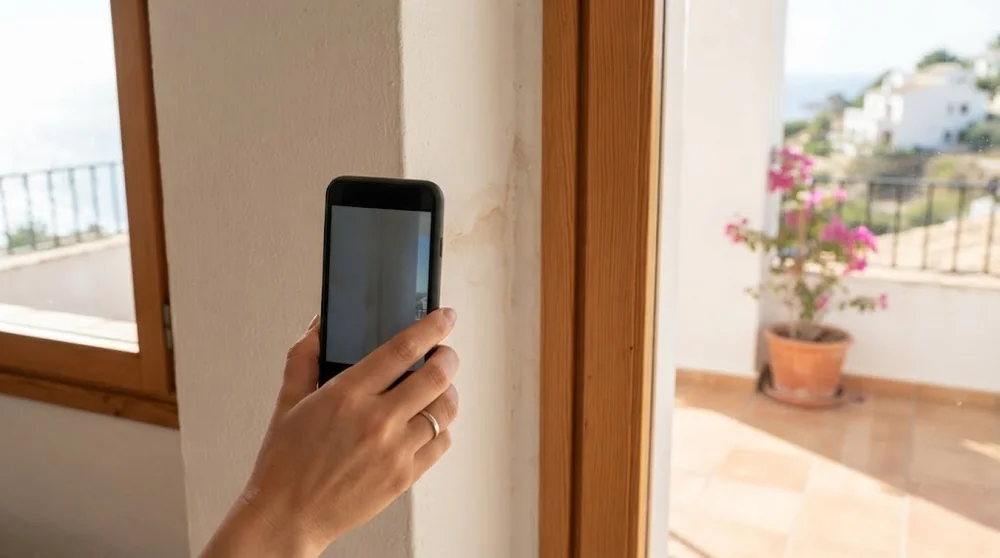
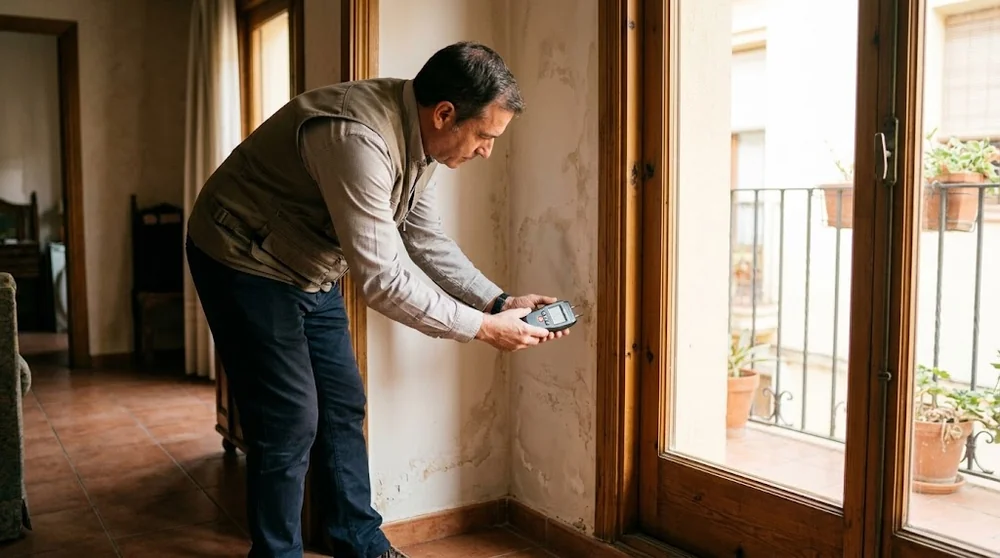
    Smartphone camera showing water staining beside an apartment window

    Verify the Nota Simple and the Physical Property

    The nota simple is an extract from the Registro de la Propiedad (the Land Registry) showing the registered owner, the registered description and the charges recorded against the property. A nota simple has informative value only: it is not a survey, not a certified registry certificate and not complete planning clearance. The Catastro is a separate cadastral register used mainly for tax purposes, recording location, surface area and use; it does not prove ownership. Problems often sit in the gaps between the registry, the Catastro and what is physically on the plot. Always ask for the nota simple before you commit.

    The table below links each risk to the evidence you need, who issues that evidence, who checks it for you and what happens if it fails. Documents should come from the issuing body through your lawyer, not as a forwarded PDF from the seller’s side.

    RiskEvidenceIssuer / authoritative channelVerifierEscalation
    Seller lacks authoritySeller ID, nota simple, any power of attorney, probate or company documentsRegistro de la Propiedad; authorising notary; Registro Mercantil for companiesBuyer’s lawyer; notary at signingHold payments until every owner or heir signs or is validly represented
    Mortgages, embargoes or other chargesRecent nota simple; lender payoff statementRegistro de la Propiedad; the lending bankBuyer’s lawyerWritten cancellation arrangement at completion, with funds retained if needed
    Registry, Catastro and reality disagreeNota simple, cadastral certificate, survey measurementsRegistro de la Propiedad; Catastro; commissioned technical reportLawyer and arquitecto técnicoWritten legal and technical assessment, then regularisation before completion. A discount does not cure unlawful construction, missing title or an unregistrable alteration, so accept any unresolved discrepancy only after that written assessment
    Illegal extensions or alterationsLicences and planning recordsAyuntamiento urbanismo departmentLawyer; technical professionalFormal urbanismo enquiry; specialist planning advice
    Missing occupancy documentationFirst occupation licence, declaración responsable or cédula, depending on regionAyuntamiento or regional housing authorityLawyerClarify utility and resale consequences before signing
    Unpaid IBI (municipal property tax)Latest receipts plus a municipal debt enquiry or certificateMunicipal tax office or provincial collection agencyLawyerDocument settlement before completion or a retention from the price
    Community debts and future leviesDebt certificate, recent minutes, approved worksCommunity secretary-administrator, with the president’s approvalLawyerAgree who pays approved levies in the contract
    Tenants or occupantsLeases, possession confirmationSeller; landlord’s records; lease registration where applicableLawyerMake vacant possession a condition of completion
    Hidden physical defectsCommissioned technical report with photos, scope and exclusionsYour independent arquitecto técnicoSurveyor; lawyer for contractual consequencesFurther specialist investigation, renegotiation or withdrawal within agreed conditions
    Coastal boundary or easementDeslinde records, registry entry, plan of the plotState coastal authority (Demarcación de Costas); Registro de la PropiedadLawyer; technical professional for plot positionWritten assessment of restrictions before signing; withdraw if the use you need is not permitted
    Military authorisation in restricted zonesAuthorisation or documented exemption for the exact propertyMinistry of DefenceLawyer; notary and registry at completionObtain authorisation or a confirmed exemption before completion; make it a contractual condition
    Off-plan stage paymentsBuilding licence, bank guarantee or insurance policy per payment, special account detailsAyuntamiento; issuing bank or insurerLawyer, checking directly with the bank or insurerNo stage payment until each guarantee is confirmed by its issuer
    Rental or tourist-letting permissionRegional register entry, municipal confirmation, community statutes and minutesRegional tourism authority; Ayuntamiento; community of ownersLawyerTreat rental income as unproven until permission for your own future use is confirmed in writing

    Community debts deserve special attention. Under the national Horizontal Property Act (Ley de Propiedad Horizontal), where applicable, article 9.1.e makes the purchased home itself answerable for unpaid general community charges attributable to the elapsed part of the year of purchase and the three preceding calendar years (as of October 2026). The same provision requires the seller to provide a community debt certificate before the deed is authorised, unless the buyer expressly waives it. Some regions have their own civil-law rules on communities, so ask your lawyer to check which regime applies, particularly in Catalonia, where the Catalan Civil Code governs. My advice to every British buyer is never to waive the certificate, and to read the minutes too: an approved but not-yet-billed levy for a new roof will not necessarily appear as a debt.

    Three different professionals answer three different questions. Your lawyer acts for you and investigates title, debts, planning and the contract. The notary is impartial: they authorise the escritura pública (the public deed of sale), check identities and legal formalities and advise both parties, but they do not act for you or inspect the building. The independent technical professional reports on physical condition within an agreed scope.

    In my view, the most expensive words in a remote purchase are “the agent said it’s all legal”. An agent can gather documents and arrange access; independent clearance has to come from your own lawyer and surveyor.

    Building professional examining a ceiling crack in a Spanish apartment

    Buying Remotely from the UK or US

    Buying property in Spain remotely usually means appointing someone, often your lawyer, to sign on your behalf under a poder notarial (a notarial power of attorney). Start early with the NIE, the foreigner identification number you will need for the purchase, taxes and utilities; your lawyer can advise whether it can be obtained through a Spanish consulate or a representative in Spain. The power of attorney itself should be transaction-specific, drafted in Spanish or bilingual form, and approved by the completing Spanish notary before you sign it.

    RouteHow it worksExtra stepsWatch for
    Spanish consulateSigned before the consul acting as notaryNormally no apostille, as it is a Spanish instrumentAppointment availability
    Local notary plus Hague ApostilleSigned before a UK notary public or a US notaryTranslation of the instrument, notarial certification and apostille as required by the receiving Spanish notary; bilingual wording alone does not settle acceptanceSpanish notary’s prior approval of wording and format
    Video before a Spanish notaryPower for specific acts authorised by videoconferenceElectronic identification and signatureNot available for general powers; the notary decides suitability

    As of October 2026, article 17 ter of Spain’s Notaries Act (Ley del Notariado), added by Law 11/2023, allows certain instruments, including powers of attorney for specific acts, to be authorised by videoconference, while general and preventive powers are excluded. That is not the same as personally signing your property deed over video: remote representation is the established route for completion, and whether any particular act can be done online is for the notary to confirm.

    Buying from the UK

    Post-Brexit, British buyers are non-EU nationals in Spanish law. A power signed before a UK notary public normally needs an apostille from the FCDO Legalisation Office, plus translation where required. Brexit also brings two practical consequences: possible military authorisation in restricted zones (covered below) and the fact that time in Spain counts against short-stay limits. Owning a Spanish home does not, by itself, give you the right to live in Spain. As of October 2026, the property investment residence route ended on 3 April 2025 under Organic Law 1/2025, so residence needs a separate visa route.

    Buying from the US

    American buyers usually sign before a local notary, but apostille authentication depends on the issuing jurisdiction, typically the competent authority of the state where the document was notarised; federal documents follow a different route through the US Department of State. The US State Department’s apostille guidance explains which office handles which document. Do not assume one office covers the whole country. Ask your Spanish lawyer to confirm in writing the exact chain the receiving Spanish notary will accept, and get that notary’s approval of the wording before you sign or pay for anything.

    Whichever route you choose, limit the authority: identify the property, set a maximum price, list the permitted acts (signing, paying taxes, registering, connecting utilities), decide whether sub-delegation is allowed, consider an expiry date where appropriate, and remember that a power can be revoked through a notary.

    Before Paying a Reservation Fee or Arras

    The pressure to “secure it today” peaks exactly when you know least. Use these gates before any money leaves your account:

    1. Verify the professionals. Confirm your lawyer is a practising member of a Spanish bar association and that your surveyor is suitably qualified, using sources you found yourself.
    2. Obtain essential evidence. At minimum a recent nota simple, seller identity, and confirmation of charges and community debts.
    3. Have the exact contract reviewed. Your lawyer should read the reservation document or contrato de arras that you will actually sign, not a template.
    4. Define outstanding conditions. List the checks still pending, the survey access you need, deadlines, and any negotiated refund conditions.
    5. Confirm the payee independently. Check who receives the money, their authority to receive it, and the bank details through a trusted channel.
    6. Document your approval. Give written payment instructions only after your lawyer confirms the gates are met.

    Reservation fees and arras are contract-specific, and no reservation payment is automatically refundable. As of October 2026, article 1454 of the Spanish Civil Code recognises penitential arras, under which the buyer may withdraw by forfeiting the deposit and the seller by returning double. That mechanism applies only where the contract clearly agrees it; confirmatory or penalty arras work differently, and courts look at the actual wording. A reservation fee paid to an agent may follow different terms again.

    Bank-detail fraud is the quiet threat to remote buyers. Criminals intercept email chains and send convincing “updated” account details at the last minute. Treat any change of payment instructions as suspect until confirmed by phone, using a number you already held. Prepare source-of-funds evidence early, because banks and notaries apply anti-money-laundering checks, and ask for written fee quotations from every professional.

    If you are facing a reservation contract or a power of attorney and want help organising the evidence and preparing the right questions, a short one-to-one conversation can get you ready for your lawyer. Interpreting the contract and approving the power of attorney remain the job of your independent Spanish lawyer and the receiving notary.

    Ask David a question on WhatsApp

    Currency exposure matters too: a few weeks of sterling or dollar movement between reservation and completion can change your real cost, so discuss timing and transfer options with a regulated provider before you commit to dates.

    When Location or Property Type Requires More Checks

    Spain has national laws, regional laws and municipal planning, so the same checklist is a starting point rather than a finish line. Each local legal question should go to your lawyer and, where needed, the Ayuntamiento urbanismo department (the town hall planning office).

    Regional documents

    Occupancy documentation varies by region. A resale flat in Barcelona will usually involve a cédula de habitabilidad under Catalan rules, while a home in Marbella or Malaga sits within the Andalusian system, and properties in Alicante or Valencia follow the Valencian regime. Madrid has its own arrangements again. Your lawyer should confirm which document applies and whether it is current.

    Rural, coastal and island homes

    Rural villas inland from Marbella or in the Alicante countryside call for planning history, legal road access, water supply and drainage checks; a lovely video of a pool says nothing about whether the pool was licensed. Seafront property may be affected by coastal law restrictions: ask your lawyer to establish where the official boundary of the maritime-terrestrial public domain (the deslinde) runs and whether the plot falls within a protection or access easement, checking the registry entry and the coastal authority’s records rather than relying on the listing.

    On the islands, Mallorca and Tenerife buyers should ask early about restricted zones: as of October 2026, Law 8/1975 on zones of interest for national defence can require military authorisation from the Ministry of Defence for non-EU buyers, now including British nationals, in designated areas. Whether the land is legally documented as urbanised can affect whether authorisation is needed at all, a point addressed in the registry resolution of 27 November 2025, published in the BOE on 9 March 2026 (BOE-A-2026-5490). Exemptions and practical treatment depend on the specific property and location, so your lawyer should establish which exemption, if any, applies to the exact property and what supporting evidence the notary and registry will require.

    Occupied homes, off-plan and rental claims

    An occupied home needs lease review and a clear vacant-possession condition. Off-plan purchases need confirmation of the building licence from the Ayuntamiento, plus the bank guarantee or insurance policy covering each stage payment and the details of the special account those payments go into; your lawyer should check these documents with the issuing bank or insurer before you pay a penny. A rendering or show-home video is not evidence about the exact unit you are buying.

    Rental income claims deserve scepticism. Ask to see the actual tourist-letting registration for the property in the regional register, confirm with the Ayuntamiento whether local restrictions or moratoriums apply, and have your lawyer read the community statutes and minutes. As of October 2026, where the national Horizontal Property Act applies, articles 7.3 and 17.12 require a new tourist-letting activity to have the community’s prior express approval, by three-fifths of the owners representing three-fifths of the participation quotas. Lets already operating before that rule took effect may fall under a transitional exception, but that needs separate legal analysis for the specific flat. And do not assume an existing registration automatically passes its operating rights to you as the buyer: that depends on regional and municipal rules. Barcelona is notably restrictive, and buying, residence and letting permission are three separate questions.

    Before you even reach these checks, it helps to narrow your search to areas and property types that suit your budget, intended use and tolerance for paperwork.

    If you are still deciding between the Costa del Sol, the Costa Blanca or the islands, a short questionnaire on budget, region and buying goals can turn a vague wish list into a focused shortlist.

    Get a tailored selection of Spanish properties

    A tighter shortlist also means fewer live viewings, fewer surveys and less money spent investigating homes that were never right for you in the first place.

    From Remote Shortlist to Completion and Handover

    Here is the workflow I recommend, with the caveat that timings are case-dependent estimates and can stretch with mortgages, inheritance issues or regularisation.

    1. Shortlist using prerecorded tours, then hold buyer-directed live viewings at two relevant times.
    2. Instruct an independent lawyer and obtain the nota simple and core documents.
    3. Commission an on-site technical inspection with an agreed written scope.
    4. Pass the pre-payment gates, then sign the reviewed reservation or arras contract.
    5. Arrange the NIE, the approved power of attorney, funds and source-of-funds evidence.
    6. Arrange a final on-site condition check shortly before completion, by your surveyor, lawyer or a trusted representative, with photos and an agreed inventory if furniture is included.
    7. Complete before the notary, with charges cancelled and debts settled as agreed.
    8. Take possession: collect all keys, fobs and remotes, record meter readings and transfer utilities.
    9. Follow up registration in the Registro de la Propiedad and the delivery of your deed and tax receipts.

    Stop and reassess if survey access is refused, documents and reality do not match without explanation, refund terms are unclear, someone pressures you to pay before checks, or bank details change without verification. A personal visit is worth arranging for rural plots, major renovations, high-value homes, contradictory footage or a neighbourhood you genuinely do not know.

    As a general observation, the buyers who sleep best are not the ones who saw the most video. They are the ones who said “not yet” when the evidence was incomplete.

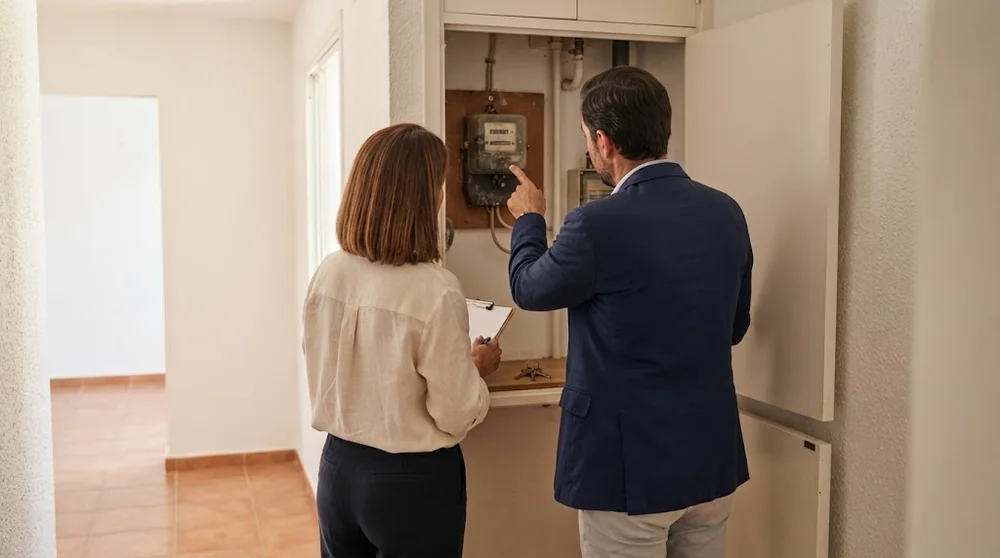
    Two people checking a utility cupboard during an apartment handover

    Frequently Asked Questions

    Can I buy a property in Spain without travelling there?

    You can arrange a Spanish property purchase through a representative holding an accepted notarial power of attorney. That does not remove the need for independent legal checks, identification requirements or a physical inspection of the home. Not every bank or administrative task is guaranteed to be available remotely, so your lawyer and the completing notary should confirm the documents needed for your transaction.

    Is a virtual viewing enough to buy a property safely?

    A virtual viewing helps you assess layout, visible condition and surroundings, but it cannot establish legal title, planning compliance or hidden defects. Combine a buyer-directed live visit with documentary checks and an independent on-site technical inspection. If significant questions remain unresolved, postpone commitment or arrange a personal visit before accepting the risk.

    What should I ask the agent to show during a live viewing?

    Ask for a continuous walk from the entrance through every room, followed by terraces, parking, storage and communal areas included in the sale. Request close views of visible cracks, staining and repairs, plus measurements of important spaces. Check surrounding streets at another time, remembering that video and microphones can distort space, light and noise.

    How do I arrange a Spanish power of attorney from the UK or US?

    Start with wording approved by your Spanish lawyer and the notary handling completion. Depending on the available route, you may execute it at a Spanish consulate or before an appropriate local notary, with apostille and translation where required. US apostille procedures depend on the issuing jurisdiction. Confirm acceptance before signing or paying for the foreign document.

    Should I pay a reservation deposit before the legal checks?

    Have your independent lawyer review the proposed agreement and essential property evidence before you pay. A reservation payment is not automatically refundable, and arras agreements can have different consequences. Clarify outstanding checks, deadlines and any negotiated refund conditions in writing. Verify the recipient and bank details independently, especially after any request to change payment instructions.

    Do I need an independent survey if the video looks fine?

    A clear video does not rule out concealed damp, roof problems, unsafe installations or structural movement. Commission a suitably qualified independent professional to inspect on site and agree the report’s scope and exclusions. Older homes, alterations and visible defects may require specialist investigation. The survey and your lawyer’s documentary checks answer different questions.

    Conclusion

    Virtual property viewings in Spain are a genuinely useful tool: they save flights, sharpen shortlists and let you test a property before spending serious money. Video supports selection; independent legal and technical evidence supports commitment. Keep those two jobs separate and buying from the UK or US becomes a manageable process rather than a leap of faith. My own rule of thumb comes down to three signals. Go when your lawyer has a clean nota simple, confirmed charges and community debts, and the reviewed contract; your surveyor has inspected on site with no unexplained defects; and the payee and bank details are verified through a channel you trust. Pause when a document is still on its way, the survey scope is unclear, refund terms are vague, or footage and paperwork disagree in a way that might have an innocent explanation. Stop when survey access is refused, the seller cannot show authority to sell, an unlawful extension or missing permission surfaces, or bank details change without independent confirmation.

    If you would like a buyer-directed live viewing and a written evidence checklist for a specific property, send a note with your intended use, preferred location, travel constraints and financing needs. I can arrange access and help you organise the paperwork, but independent legal clearance must come from your own Spanish lawyer and the physical assessment from your own surveyor.

    This article provides general information as of October 2026 and is not legal, tax, financial or technical advice. Rules vary by region, municipality and individual circumstances. Before committing to any purchase, consult a suitably qualified Spanish property lawyer and an independent qualified technical professional.

  • 10 Property Viewing Red Flags in Spain | Buyer Checks

    10 Property Viewing Red Flags in Spain | Buyer Checks

    A viewing is your best chance to look properly before money and paperwork take over, yet most buyers spend it admiring the terrace and the light. I’m David, and I work with English-speaking buyers, many of them British families and retirees, who are purchasing property in Spain. Many of the problems that cause real trouble later were visible, or at least hinted at, on the first visit. This guide sets out ten warning signs, the question to ask about each one, the evidence that answers it, the independent specialist who should check it and the point at which you should proceed, renegotiate or stop.

    Property viewing red flags in Spain include damp, suspicious cracks, unverified alterations, failing utilities, missing documents, unclear ownership, community debts, unresolved occupation, environmental risks and pressure to pay immediately. Record what you see, request supporting evidence and arrange independent legal or technical checks before signing or paying a deposit.

    Property viewing red flags in Spain: the checklist

    Most viewing checklists stop at “look for damp” or “check the paperwork”. That advice is fine as far as it goes, but it leaves you with an uneasy feeling and no plan. A warning sign during a viewing is a reason to investigate, not proof of a defect. The table below links each of the ten red flags to a specific question, the evidence that should answer it, the professional who should verify it, the next step to take and the threshold that should be met before you commit.

    Warning signEvidence or questionWho verifies itImmediate next stepProceed only when
    1. Damp, staining or patchy repaintingRepair history, invoices, previous reportsIndependent technical professionalPhotograph with permission; request a moisture assessmentCause, remedy and cost are documented; renegotiate if repairs are needed, stop if the cause cannot be identified
    2. Cracks, distortion, tired shared structuresWhen did cracks appear? Any monitoring or reports?Arquitecto técnico or structural engineerCommission a condition survey with an agreed scopeA written survey explains the movement and the repair cost is known; stop if active structural movement is unresolved
    3. Extensions not matching recordsMunicipal permissions, nota simple, Catastro dataProperty lawyer plus technical professionalCompare physical layout with every recordLegality is confirmed or regularisation is a written contract condition; stop if enforcement risk remains open
    4. Utilities failing or untestableRecent bills, supply contracts, maintenance recordsSurveyor, licensed installer, lawyer for rural supplyAsk for supplies to be connected for a second visitServices have been demonstrated or inspected and any lawful rural supply is confirmed in writing
    5. Missing occupancy or energy papersWhich occupation document applies locally?Lawyer, town hall or regional authorityObtain written confirmation of local requirementsThe applicable document exists or obtaining it is a written condition of the contract
    6. Unclear ownership or chargesCurrent nota simple, seller identity and authorityIndependent property lawyerRequest registry extract before any paymentEvery owner signs or is validly represented and charges have an agreed cancellation plan
    7. Community debts or derramasDebt certificate, minutes, budget, approved worksLawyer, community administratorAgree written allocation of special assessmentsA formal debt certificate is received and every approved instalment has an agreed payer
    8. Restricted access or unclear occupationWho lives there, on what legal basis?Independent property lawyerMake vacant possession a written contract conditionYou have seen every room and lawful occupation and handover are confirmed; pause until then
    9. Hidden location risksFlood mapping, insurer questions, local enquiriesLawyer, insurer, technical professionalCheck official maps and revisit at different timesInsurance is available on acceptable terms and the site-specific risk is understood
    10. Pressure to pay immediatelyWritten terms, payment recipient, refund conditionsIndependent property lawyerPause until the agreement has been reviewedYour lawyer has reviewed the written terms and the recipient of the money; walk away if checks are refused

    An estate agent and buyers inspect a window during a property viewing in Spain

    1. Damp smells, staining or suspicious repainting

    Your nose is a surprisingly good surveyor. A musty smell in a bedroom, a wardrobe or a ground-floor storeroom suggests that moisture is present somewhere. Look at window reveals, skirting boards, ceiling corners and the backs of built-in cupboards for staining, black mould spots or white powdery salt deposits on plaster. Furniture pushed hard against a wall, or a single patch of fresh paint in an otherwise tired room, is worth a polite question.

    Let me put it plainly: fresh paint does not prove concealment, and a stain does not tell you its cause. Condensation from poor ventilation, a leaking roof or terrace above, a plumbing fault and moisture rising from the ground all look broadly similar on a wall, yet each needs a different remedy. Coastal apartments that sit closed up for months often show condensation marks, but ventilation and dehumidification are the right response only once an assessment has confirmed condensation and ruled out water ingress or other causes. A terrace membrane failure, for instance, is a different matter entirely.

    Ask the seller or agent when the marks appeared, what caused them, what repairs were carried out and whether invoices or reports exist. Ask permission before photographing affected areas. If the answers are vague or the problem looks active, refer it to an independent technical professional for a moisture assessment before you go any further. My threshold is simple: proceed only when the cause, the remedy and the likely cost are documented in writing.

    Damp staining and peeling paint beside an apartment window

    2. Cracks, distortion and neglected shared structures

    Cracks are common in buildings of many ages, and fine hairline cracks in plaster or render can simply reflect finishes expanding and contracting in the summer heat. That is an observation, not a diagnosis. The ones that deserve attention are cracks that run diagonally from the corners of doors and windows, cracks that have been filled and have reopened, and gaps where walls meet ceilings or floors. Doors that stick or swing open on their own, floors that visibly slope and tiles that have lifted or cracked in a line are further clues.

    Look up and around as well as inside. Balconies with rusting exposed steel, spalling concrete or loose railings, bulging garden retaining walls on hillside plots and shared roofs with obvious missing tiles or ponding water all affect what you would be buying, even when the defect sits in a communal area. I would not give you a crack-width rule, because no visual threshold can replace an engineering assessment of a specific building.

    Keep your own checks visual and safe: look from the ground, from windows and from accessible terraces only. Never climb onto roofs or into unsafe spaces. Ask when cracks appeared and whether they have been monitored, then commission an arquitecto técnico, a building technical specialist who commonly carries out condition surveys in Spain, or another appropriately qualified professional. A mortgage valuation will not answer this question for you. If the survey cannot explain the movement, or finds it is still active, that is a reason to stop rather than to hope.

    3. Extensions that do not match the records

    Here’s where people usually come unstuck: the property looks wonderful because of features that may never have been authorised. Glazed-in terraces, swimming pools added years after construction, garages converted into bedrooms and roof rooms or solariums built on top of villas are all common on the Costa del Sol and beyond. Some have the necessary permissions. Others do not, and the difference matters for future works, resale, insurance and potentially enforcement.

    Three sets of records answer different questions. The Registro de la Propiedad records ownership and registered rights; the Catastro records the property for tax and mapping purposes; the town hall holds planning permissions. Your lawyer should compare the physical property with the registry description in the nota simple, the cadastral description and municipal licences, while a technical professional compares layouts and areas.

    Be fair about differences. Built area, which includes walls and sometimes a share of communal parts, and usable area, which measures the floor you can actually walk on, legitimately produce different figures. A discrepancy is a question, not automatically an illegality. Equally, a feature appearing in a cadastral entry or registry description does not by itself establish that it complied with planning law. Age is not a magic eraser either: whether an older unauthorised structure can still face action or be regularised depends on the type of land, the applicable regional and municipal rules and the facts. Only an independent lawyer, working with a technical professional, should reach that conclusion.

    Enclosed and open terraces on a Spanish apartment building

    4. Utilities that fail or cannot be tested

    Services are dull until they fail in August. With the owner’s or agent’s permission, you can carry out a few ordinary user checks during a viewing without touching anything technical:

    • Water: run the kitchen and bathroom taps and note whether the flow is reasonable and the water runs clear after a moment.
    • Drainage: watch whether basins, showers and sinks drain freely, and notice any sewage smell indoors or near outside manholes.
    • Leaks: look under sinks and around the water heater for staining, drips or corrosion.
    • Hot water: ask for the hot tap to be run and see how long warm water takes to arrive.
    • Heating and cooling: ask for air-conditioning units or heating to be switched on briefly using their normal controls.

    Do not open electrical panels, remove covers or attempt to diagnose wiring; leave that to a qualified installer. Disconnected supplies are common in empty homes, but a property where nothing can be demonstrated needs a second visit with services connected, plus recent bills and maintenance records. For rural homes, ask how water is lawfully supplied, whether a well or borehole has the relevant authorisation and how wastewater is handled, whether by mains connection or a septic system. Your lawyer should check the legal side and a technical professional the condition.

    5. Missing occupancy or energy documentation

    Spain does not have one nationwide occupancy certificate issued under a single procedure, which confuses many buyers. Occupancy and habitability requirements vary by region, by municipality and by property. A licencia de primera ocupación is a municipal document confirming that a newly built or substantially altered property matches its building licence and can be occupied. A cédula de habitabilidad is a certificate of habitability used in regions such as Catalonia and the Balearic Islands. Some regions, Andalusia among them, now accept a responsible declaration for certain occupation procedures, and terminology and accepted documents differ from place to place.

    Three separate questions are often blurred together. Residential occupation evidence is one thing. Authorisation to let the property to tourists is a different regional and often municipal matter, and a buyer should never assume that an existing tourist registration can simply be taken over. Energy performance is a third matter: as of October 2026, Real Decreto 390/2021 governs the certificado de eficiencia energética, the energy performance certificate. The decree applies to the sale of buildings and homes within its scope, subject to listed exemptions, such as certain buildings bought for demolition or major renovation. For an ordinary covered sale of an existing home, the seller must provide the registered certificate, and the certificate and energy label accompany the sale contract.

    An energy certificate rates expected energy consumption and emissions. A certificado de eficiencia energética does not certify structural safety, legality or general condition. If occupation or habitability evidence is missing, ask your lawyer to obtain written confirmation from the town hall or regional authority of what actually applies to that property, and treat the answer as a condition of proceeding.

    6. Unclear ownership or unexplained registered charges

    Always ask for the nota simple before you commit. A nota simple is an information extract from the Registro de la Propiedad showing the registered owner, the property description and recorded charges such as mortgages, seizures or rights of way. It should be current, which means obtained recently by your own lawyer rather than a copy that has been sitting in an agent’s folder.

    Your independent lawyer should check that the person selling is the registered owner or has proven authority to sell, for example through a valid power of attorney. Co-ownership matters: if a property is registered to a couple, to several siblings or to an estate, every owner with rights must take part or be properly represented. Probate situations need particular care.

    A registered mortgage is common and is not automatically a reason to walk away. An existing mortgage can normally be dealt with through a properly arranged cancellation at or before completion, with the outstanding amount settled from the purchase price under terms your lawyer controls. What matters is that the arrangement is agreed in writing and verified.

    Equally, a clean nota simple is incomplete reassurance. The extract does not tell you about damp, unauthorised extensions, unpaid community fees, local tax status or who is living in the property. It is one important piece of evidence among several.

    7. Community debts and unexplained derramas

    Most apartments and many villas on urbanisations belong to a comunidad de propietarios, the owners’ community responsible for shared areas such as gardens, pools, lifts and roofs. Ordinary community fees fund routine running costs. A derrama is a special assessment, an extra payment approved by the community for specific works or costs, such as a new lift or façade repairs. Peeling communal paint, a scaffolded neighbour’s block or a noticeboard announcing a general meeting are all reasons to ask questions.

    Request four things: a certificate confirming the seller’s payment status, minutes from recent general meetings, the current budget and details of any approved or proposed works. Under the national regime, as of October 2026, the debt certificate is issued by the person acting as secretary of the community, with the president’s approval (visto bueno). The law allows a buyer to expressly waive the certificate, but I would not do so casually; without it, you are relying on the seller’s word. In Catalonia, the certificate should also identify approved ordinary and extraordinary expenses not yet due and contributions to the reserve fund. Community arrears, approved special assessments and likely future works are three separate issues, and each needs its own answer.

    For arrears, the legal exposure is tied to the property rather than being an unlimited transfer of every seller debt. The applicable regime depends on where the property is:

    Regime (as of October 2026)Legal provisionArrears the property answers forPractical check
    National rule, most of SpainLey 49/1960 de Propiedad Horizontal, Article 9.1(e)Qualifying community debts for the elapsed part of the year of acquisition and the three preceding calendar yearsDebt certificate signed by the secretary with the president’s approval before signing
    CataloniaCódigo Civil de Cataluña, Book Five, Article 553-5Qualifying common-expense debts for the elapsed part of the current year and the four preceding yearsLawyer confirms latest consolidated wording and obtains a certificate that also covers pending approved expenses and reserve-fund contributions

    A derrama approved before completion but payable afterwards is a separate question from arrears. Under the national regime, as of October 2026, Article 17.11 of the Ley de Propiedad Horizontal places assessments for improvements on whoever owns the property when the amounts become payable. In practice, the community may look to you for an instalment that falls due after completion, even if the works were approved while the seller owned the flat. A clause in which the seller agrees to cover those instalments does not change whom the community can pursue; it gives you a right to reimbursement from the seller. Works that are not classed as improvements, and regional rules such as Catalonia’s, can be treated differently, so your lawyer should check the applicable regime and the exact wording of the meeting resolution.

    My advice to every British buyer is to have your lawyer agree that allocation in writing, with a retention from the price where appropriate, before any deposit changes hands.

    Ask the lawyer to verify the status of IBI, the annual municipal property tax, separately; IBI debts can also affect a property, and the lawyer should check receipts and the position with the local tax office rather than rely on a rule of thumb.

    8. Restricted access or unclear occupation

    Every so often a viewing comes with a locked door. “The owner keeps personal things in there” may be completely innocent, but you are being asked to buy a room you have not seen. Ask for full access, at a second visit if necessary, before you make an offer that relies on its condition.

    Pay attention to signs that someone else lives in the property: clothes, food, toiletries or belongings that do not fit the seller’s description, or a viewing arranged around an occupant’s schedule. None of this is sinister in itself. A lawful tenant has rights under a tenancy agreement that may continue after a sale, depending on the contract and the applicable law. Unauthorised occupation is a different and more difficult situation. Treat neither as a reason for alarm, but treat both as reasons for clarity.

    Ask directly who occupies the property, on what legal basis and until when. Request any tenancy agreement, notices given and the seller’s written plan for handover. Pause until lawful occupation and the handover date are confirmed in writing.

    A verbal promise that the property will be empty on completion is not a substitute for a contractual vacant-possession condition. Your independent lawyer must examine occupation rights and draft delivery conditions so that you are not paying the full price for a home you cannot move into.

    9. Location risks hidden by viewing conditions

    A viewing on a sunny Tuesday morning in May shows you a property at its best. Look for clues the weather cannot hide: drainage channels running towards the house, tide marks or staining in basement garages, sandbags or flood barriers stored in a utility room, dry riverbeds nearby and steep access roads with visible erosion. The October 2024 floods in Valencia province were a painful reminder that water follows the landscape, not estate agents’ descriptions.

    Check the Sistema Nacional de Cartografía de Zonas Inundables, the national flood-zone mapping system published by MITECO, the Ministry for the Ecological Transition, together with any regional or municipal risk maps. Ask the town hall and neighbours about past flooding. A location without mapped flood coverage is not proof that the location is safe, because maps model particular scenarios and do not cover every small watercourse or drainage problem. Ask insurers whether cover is available, at what terms and with which exclusions.

    I am not suggesting that whole towns are unsafe. Parts of Alicante province, Marbella hillsides with seasonal streams and areas of Mallorca crossed by torrents simply call for site-specific questions rather than generalisations. Revisit at different times: a weekday evening for traffic and bar noise, a Saturday night in August for holiday-let activity, and a winter afternoon, if you can, to see how much sun reaches the living room once the sun drops behind the block opposite. Ten years on the Costa del Sol have taught me that a suspiciously quiet viewing slot sometimes tells you more than the brochure.

    Drainage channels beside a sloping street and basement garage entrance

    10. Pressure to pay before independent checks

    “Another couple is viewing this afternoon, so if you transfer a reservation fee now we can take it off the market.” Sometimes that is true. Sometimes it is a sales technique. Either way, urgency is never a reason to skip independent checks.

    A reservation agreement and a contrato de arras, the private deposit contract commonly signed before completion in Spain, create obligations whose precise effect depends on their written terms. Under one common form of arras, associated with Article 1454 of the Código Civil, a buyer who withdraws may lose the deposit and a seller who withdraws may have to return it doubled, but the wording of the specific contract decides the position. No automatic refund or universal cooling-off period applies to Spanish resale purchases, and there is no fixed deposit percentage you should simply accept. Before paying anything, have your lawyer review who receives the money, whether it is held by a third party, which checks remain outstanding and the exact refund conditions.

    Be wary of sellers or agents who resist written answers or refuse an independent inspection. Roles differ: an agent markets the property and is usually paid on completion; your lawyer represents you; a lender’s valuer assesses value for the bank; a notary formalises the deed and checks certain legal requirements. Neither a mortgage valuation nor a notarial signing replaces your own legal investigation and condition survey. If you are unsure what a particular reservation document commits you to, get a one-to-one answer before transferring a single euro. A short delay costs far less than an unrecoverable deposit.

    What to do before making a commitment

    Spotting a red flag is the start of a process, not the end of a purchase. The workflow I suggest is deliberately simple:

    1. Record the sign. Note what you saw, where and when, and take photographs only with permission.
    2. Ask a specific question. “When did this stain appear and what was done about it?” is better than “Is there damp?”
    3. Request the evidence. Invoices, reports, licences, certificates, minutes or contracts, in writing.
    4. Refer it to the correct professional. Technical issues go to a surveyor or arquitecto técnico; legal and documentary issues go to your independent lawyer.
    5. Obtain findings and cost implications. Ask for written conclusions and, where relevant, repair quotations from contractors.
    6. Decide. Proceed, renegotiate the price or terms, or stop.

    The following situations are illustrative examples of decision-making, not real client cases or legal conclusions.

    Illustrative situation: moisture. A buyer notices a musty bedroom and a freshly painted wall. The surveyor finds condensation linked to poor ventilation rather than a leak. The buyer obtains a quotation for ventilation improvements and decides whether to proceed at the agreed price or renegotiate.

    Illustrative situation: record mismatch. A villa’s pool and enclosed terrace do not appear in the registry description. The lawyer requests municipal records and a technical report. Depending on the findings, the buyer might proceed with regularisation as a contract condition, renegotiate, or withdraw.

    Illustrative situation: community works. Minutes show an approved façade repair payable over two years. The buyer’s lawyer negotiates a written clause stating which instalments the seller pays, and the buyer reflects the remainder in the overall budget.

    Once the technical and legal picture is clear, the remaining question is whether this particular home still fits your budget, preferred area and reasons for moving. If the evidence makes you doubt the property, it is far easier to compare it calmly with alternatives than to argue yourself into a purchase.

    Spain property viewing FAQs

    Should I get a building survey before buying in Spain?

    An independent condition survey can help you understand defects, likely repairs and issues requiring specialist investigation before you commit. A mortgage valuation serves a different purpose and should not be treated as a building survey. Agree the inspection scope with a suitably qualified professional, such as an arquitecto técnico, particularly for older homes, altered buildings or properties showing damp or cracking.

    How can I check whether an extension is legal?

    Ask an independent lawyer and an appropriate technical professional to compare the extension with municipal planning permissions, relevant completion or occupancy evidence, the Land Registry description and cadastral information. A registered or cadastral entry alone does not establish planning legality. Differences need investigation, and the possibility of regularisation depends on the property and applicable local rules.

    Can I inherit unpaid community fees when I buy?

    As of October 2026, Article 9.1(e) of the national Horizontal Property Law attaches qualifying community arrears to the property for the elapsed acquisition year and three preceding calendar years. Catalonia’s Article 553-5 covers the elapsed year and four preceding years. Ask your lawyer to confirm the applicable regime, review the debt certificate and check special assessments separately.

    Does a clean nota simple mean the property is safe to buy?

    A nota simple provides information about registered ownership, the property description and recorded rights or charges. It does not replace a condition survey, municipal planning checks, occupation checks or verification of community and tax matters. A reassuring extract is one part of the evidence your independent lawyer and technical adviser need to assess before you commit.

    Should I pay a reservation deposit during the viewing?

    Have an independent lawyer review the proposed agreement, payment recipient, checks still outstanding and written refund conditions before paying. A verbal assurance that a deposit is refundable may not reflect the contract. Pressure to transfer money immediately, missing documents or resistance to independent checks are reasons to pause and investigate before any money leaves your account.

    Conclusion

    A red flag at a viewing is a reason to gather evidence, not a verdict on the property. Damp, cracks, a glazed-in terrace or a locked spare room may turn out to be minor, or they may change the price, the contract terms or your decision altogether. The difference only becomes clear once a specific question has been answered with documents and an independent professional has looked at the evidence.

    Unresolved material risks should be checked before you sign anything or pay a deposit. Instruct an independent Spanish property lawyer for ownership, debts, planning, occupation and contracts, and a suitable technical professional for condition. Use the thresholds in the checklist: proceed when the cause, remedy and cost are known, renegotiate when they change the value, and stop when a key question cannot be answered.

    Then decide on facts rather than hope. A home that survives a proper investigation is one you can buy with confidence, and one that does not has probably saved you a great deal of money and stress.

    Disclaimer: this article is general information, reflects legal research up to October 2026 and is not legal, tax, financial or technical advice. Rules vary by region and municipality and can change. Obtain advice on your specific property from qualified independent professionals.

  • Property Inspection in Spain: Checks Before Signing

    Property Inspection in Spain: Checks Before Signing

    Most of the expensive surprises I see in Spanish property purchases were visible, or at least discoverable, before anyone signed anything. The trouble is that the building and the paperwork are usually checked by different people, at different times, and sometimes not at all. The real decision is not whether to inspect, but what to inspect, whom to hire and how to time those checks so you still have choices when the findings arrive.

    A property inspection in Spain should combine an independent assessment of the building’s condition with legal checks on ownership, debts, planning permissions and permitted use. Arrange these checks before signing a binding agreement or paying an unprotected deposit. A mortgage valuation, energy certificate or notarial appointment does not replace a buyer’s inspection.

    Property adviser and building inspector examining a villa with buyers in Spain

    Your Property Inspection Checklist Before Signing

    A sensible property inspection in Spain follows a sequence, because each check depends on the one before it. This is the order I recommend, with who normally does what and the evidence you should be holding at the end of each step.

    1. Appoint independent advisers. You instruct an independent lawyer and, where the property justifies it, a technical inspector who is not paid by the seller, the agent or the developer. Evidence: signed engagement letters stating each adviser’s scope and fees.
    2. Identify the property and the seller. Your lawyer confirms the exact registered property, its cadastral reference and that the person selling has authority to sell, including every co-owner, heir or company signatory. Evidence: current registry information, identity documents and any powers of attorney.
    3. Collect the documents. The seller or agent supplies the deed, plans, permits, energy certificate, IBI receipts and, for apartments, community records. Evidence: a dated list showing what has arrived and what is still missing.
    4. Inspect the home and the shared building. Your technical professional examines the accessible parts of the property and, for apartments, the common elements the community lets them see. Evidence: a written report with photographs and a severity rating for each finding.
    5. Reconcile records with reality. Your lawyer and inspector compare what was actually built with what the registry, the Catastro and the town hall describe. Evidence: a written note of every discrepancy and the enquiry it needs.
    6. Assess costs and intended use. You and your lawyer check running costs, repair exposure and whether your plans, such as letting or extending, are permitted. Evidence: actual bills, community figures, repair quotations and written planning or licensing answers.
    7. Resolve findings and contract conditions. Your lawyer negotiates repairs, price changes or conditions before you sign the binding contract. Evidence: agreed clauses, deadlines and written repair commitments.
    8. Recheck before completion. Your inspector revisits agreed repairs and your lawyer refreshes registry, debt and tax checks shortly before the notary appointment. Evidence: a reinspection note and updated searches dated close to completion.

    Timing matters as much as content. An offer is usually a proposal, but a reservation agreement can create genuine obligations in Spain, depending on its wording, so never assume it is a harmless formality. The contrato de arras is the private deposit contract most buyers sign next; it normally fixes the price, the completion date and the consequences if either side pulls out. Completion happens when the escritura, the public deed of sale, is signed before a notary and the price is paid. Let me put it plainly: by the time you reach the notary, the inspection should be ancient history, not a job for the morning of the signing.

    Survey, Valuation and Legal Checks: The Differences

    Buyers often assume that because somebody has looked at the property, it has been inspected. Here’s where people usually come unstuck: each of the checks below answers a different question, and none of them answers all of them.

    What each pre-purchase check does and does not cover
    CheckPurposeProfessionalEvidence producedLimitations
    ViewingJudge layout, light, location and obvious problemsYou, often accompanied by the agentYour own notes and photographsNot a technical assessment; in most sales the agent acts for the seller
    Technical inspection (survey)Assess the visible condition of the building and its installationsArquitecto técnico (aparejador) or architectWritten report with photographs and prioritiesUsually non-invasive; hidden areas and concealed services are excluded unless agreed
    Specialist structural assessmentInvestigate suspected movement, cracking or structural alterationsStructural engineer or suitably experienced architectSpecialist report, sometimes with monitoring or testsCommissioned separately; opening-up needs the owner’s consent
    Tasación hipotecaria (mortgage valuation)Estimate value as security for the lenderValuer from a valuation company approved by the Bank of SpainValuation certificate for the bankPrepared for the lender’s purposes; not a defect survey
    ITE / IEEPeriodic statutory assessment of a building, where local rules require itCompetent technician appointed by the owner or communityInspection report, sometimes with required worksAddresses the building’s regulatory condition, not your purchase questions; may be out of date
    Certificado de Eficiencia EnergéticaRate energy performance for sale or lettingQualified certifying technicianRegistered certificate and energy labelNot a condition survey; validity limits apply
    Legal reviewCheck title, charges, debts, planning, licences and contract termsIndependent lawyer (abogado)Due diligence report and contract adviceDoes not assess physical condition

    An independent pre-purchase survey is generally optional in Spain: no national rule obliges a buyer to commission one before buying a home. Separate statutory duties can still apply to the building itself, such as a regional or municipal requirement for an Inspección Técnica de Edificios (ITE) or an Informe de Evaluación del Edificio (IEE), or the seller’s obligation to provide an energy certificate. The notary checks identities, the legality of the deed and the registry and tax formalities, but the notary does not inspect the building. The bank’s tasación protects the lender’s loan, and a house can value perfectly comfortably while needing a new roof. A lender-ordered valuation cannot replace the buyer’s own technical assessment, because it was never designed to find defects for you.

    Choosing an Independent Inspection Professional

    The usual first choice for a pre-purchase inspection is an arquitecto técnico, also called an aparejador: a building professional trained in construction, materials and building pathology. An architect (arquitecto) may suit questions about design, extensions or planning drawings, while a structural engineer is the right person when movement or load-bearing alterations are suspected. These qualifications overlap, but they are not interchangeable for every task, so match the professional to the property’s likely problems. Before you instruct anyone, check the following points.

    • Membership of the relevant professional association (colegio profesional), which you can confirm with the colegio directly.
    • Current professional indemnity insurance that covers pre-purchase reports.
    • Independence: no commission, family or business link with the seller, the agent or the developer.
    • Relevant experience with your property type, whether a 1970s block in Benidorm, a rural finca in Mallorca or a hillside villa above Estepona.
    • A written scope listing rooms, roof, terraces, plot, pool, outbuildings, equipment and any shared areas to be inspected.
    • Stated exclusions, including areas that cannot be safely or lawfully reached on the day.
    • The equipment to be used, such as moisture meters or thermal imaging, and what those readings can and cannot show.
    • A report in English, or with an agreed translation, containing dated photographs, defect severity, likely further tests and recommended specialist follow-up.
    • A section in the final report recording what actually happened on the day: rooms or roof areas that were locked or unsafe to reach, utilities that were switched off, equipment such as the boiler, pool pump or air conditioning that could not be tested, how those gaps reduce confidence in the findings and whether a return visit is needed.

    That last point matters more than buyers expect. A report that simply says “no defects observed” is far less reassuring once you discover the water was disconnected and the loft was padlocked. Most pre-purchase inspections are non-invasive: the inspector looks, measures and uses portable equipment but does not lift floors, drill walls or dismantle installations, because the property still belongs to the seller. An inspector can flag that wiring looks dated or that a boiler seems poorly vented, but a general inspection is not a certification of electrical, gas or pool installations, and it does not automatically include structural calculations. If those matters concern you, ask for the specialist checks to be quoted separately and in writing.

    What to Check During a Spanish Property Viewing

    A viewing is your chance to collect questions for the professionals, not to reach conclusions. Go more than once, photograph anything that bothers you and, if you can, return at a different time of day and after rain. A sunny August viewing in Marbella tells you remarkably little about how a north-facing bedroom feels in February, and as a Mancunian I can confirm that Spain has damp too; it is simply better at hiding it under fresh paint.

    Structure and envelope

    • Cracks in walls and ceilings, around door and window openings and where an older section meets a newer one; note their location and pattern rather than trying to judge them.
    • Freshly painted patches on a single wall or ceiling, which may be cosmetic or may cover damp or cracking.
    • The roof as seen from the ground or a safe window: slipped tiles, sagging lines and stained eaves.
    • Terraces and flat roofs showing standing water, lifted tiles, blocked outlets or staining on the ceiling below.
    • Doors and windows that stick, which can follow movement, poor fitting or simple swelling.

    Water and drainage

    Use your nose as well as your eyes. Musty smells, tide marks, white salt deposits and mould behind wardrobes all deserve a note, whether the cause turns out to be condensation, a leak or water rising from the ground; telling those apart is the inspector’s job. Run two taps at once to get a feel for water pressure, ask how long hot water takes to arrive and find out the age and type of the water heater. On rural plots, ask whether the house is connected to mains drainage or relies on a septic tank, and look at whether the garden slopes towards the walls.

    Electrical installations and climate control

    Ask how old the electrical installation is and whether an installation certificate exists. Check that air-conditioning and heat-pump units actually run, and for apartments ask whether external units on the façade were authorised by the community. Note any flickering lights or tripping you notice, but do not open the distribution board, remove socket covers or test the installation yourself; that work belongs to a qualified installer.

    Daily comfort and included fixtures

    • Noise from roads, bars, pool pumps, lifts and neighbours at different times of day and week.
    • Ventilation in bathrooms and the kitchen, and signs of condensation on windows.
    • Persianas (roller shutters) and mosquito screens that open, close and lock.
    • Which furniture, appliances and air-conditioning units are included, recorded in writing in the contract.
    • Orientation, sun and shade in summer and winter.

    A word on safety. Do not climb onto pitched or fragile roofs, step onto unguarded terraces, open electrical equipment or tap walls to decide whether they are load-bearing. Tapping tells you nothing reliable about structural safety, and an ill-judged ladder can turn a pleasant viewing into an afternoon in urgencias. Your role is to observe and record; the qualified professional diagnoses.

    Inspector checking moisture beside a terrace door in a Spanish apartment

    Nota Simple, Catastro and Planning Documents

    The physical property and the paperwork have to tell the same story. In Spain that story is spread across offices that do not always talk to each other. The Registro de la Propiedad (Land Registry) records ownership and charges. The Catastro is a tax database describing location, physical features and cadastral value, identified by a referencia catastral. The Ayuntamiento (town hall), through its urbanismo (planning) department, holds licences and planning status.

    Key purchase documents, who issues them and what they cannot prove
    DocumentIssuerQuestion answeredLimitationReviewer
    Nota simple (current registry information)Registro de la PropiedadWho is the registered owner, and are there mortgages, embargoes or other charges?Informative only; a registry certification is the evidential version, and neither is a technical or planning clearanceYour lawyer
    Title deed (escritura)Notary, then registeredHow did the seller acquire the property, and how was it described?The description may be old or incompleteYour lawyer
    Seller authorityNotarial records, registry, Mercantile Registry for companiesCan this person or company lawfully sign the sale?Powers can be limited or revoked; every co-owner must consentYour lawyer
    Catastro record and referencia catastralDirección General del CatastroWhat does the tax record show for location, built area and use?Cadastral inclusion does not prove lawful authorisationLawyer and inspector
    Plans and building permitsAyuntamiento (urbanismo)Were the house, extensions, pool and outbuildings authorised?Archives can be incomplete; works may exceed what was permittedLawyer, with an architect where needed
    Occupation or habitation evidenceAyuntamiento or regional authorityHas the building been authorised for occupation as a dwelling?Names, requirements and formats vary by region and periodYour lawyer
    Certificado de Eficiencia EnergéticaCertifying technician, registered with the regional bodyWhat is the energy rating?Says nothing about defectsYou and your inspector
    IBI receiptsAyuntamiento or its tax collection agencyIs the municipal property tax paid, and what does it cost each year?An IBI bill does not establish planning legalityYour lawyer

    Occupation evidence deserves particular care. Depending on the region and the age of the building, it may be a licencia de primera ocupación (first occupation licence), a declaración responsable submitted to the town hall, or a cédula de habitabilidad (habitation certificate), so ask your lawyer which document applies locally rather than hunting for one specific piece of paper. On energy certification, as of October 2026, the current consolidated national rules in Royal Decree 390/2021 on the BOE, including an amendment effective in July 2026, set a maximum validity of ten years, reduced to five years for properties rated G.

    Then reconcile everything with what you saw: plot size, built and usable areas, boundaries, the number of bedrooms and bathrooms, parking spaces, trasteros (storage rooms), terraces, pools and extensions. A discrepancy between the property and its records requires investigation, not an automatic verdict of illegality. Cadastral areas are often measured differently, and old deeds can be vague. But a terrace enclosed as a living room, or a casita that appears on no record at all, needs checking with planning. Equally, registration, cadastral inclusion or an IBI bill does not prove planning legality. Always ask for the nota simple before you commit, make sure it is current rather than the faded copy in the agent’s folder, and have your lawyer refresh the relevant searches shortly before completion.

    Apartments: Community Debts, ITE and Derramas

    When you buy an apartment, you buy a share of a building as well as the flat itself. Every owner belongs to the Comunidad de Propietarios (owners’ community), which maintains roofs, façades, lifts, garages, pools and gardens and divides the costs among owners. Ask your inspector to look at whatever common elements are accessible, because a pristine kitchen does not help much if the building’s roof membrane has given up.

    From the community’s administrator or secretary, request a certificate of debts for the flat, the most recent approved accounts and budget, the reserve-fund position, the building insurance policy and the minutes (actas) of recent general meetings. Ask too for any ITE or IEE report and any remedial orders from the town hall. Minutes are where the truth tends to live: arguments about leaks, quotes for façade repairs and plans to install a lift all leave a paper trail.

    Separate three things clearly. Existing arrears are sums the seller already owes. An approved derrama is an extraordinary levy the community has agreed, often payable in instalments over months or years. Proposed works are discussed but not yet approved. Your contract should state who pays each instalment of an approved derrama, including those falling due after completion, because without that clause you and the seller have nothing agreed between yourselves.

    Here’s where people usually come unstuck, though: that clause binds you and the seller, not necessarily the community. As of October 2026, Article 17.11 of the national Horizontal Property Law says that levies for improvement works are payable by whoever owns the flat when each amount becomes due. So if an instalment falls due after completion, the community can normally ask you, the new owner, for it, even if the seller agreed to pay. Your lawyer should therefore turn the private clause into something enforceable: a reimbursement obligation, a sum retained from the price at the notary, or simply a price reduction. Regional civil law can change the picture, so that check needs to be done for the specific building.

    As of October 2026, Article 9.1(e) of the national Horizontal Property Law (Ley 49/1960) on the BOE makes the flat answerable for community arrears attributable to the year of acquisition and the three previous calendar years, and requires the debt certificate to be issued within seven calendar days of the request. That national rule does not apply everywhere: Catalonia regulates horizontal property in its own Civil Code, so purchases in Barcelona and elsewhere in Catalonia need the Catalan regime verified separately. Inspection rules for buildings also vary, and there is no single nationwide age or interval at which every Spanish building must pass an ITE; your lawyer or inspector should confirm what the region and municipality actually require.

    My view: on resale apartments, I would rather read three years of meeting minutes than look at thirty photographs of the living room. The photographs show you the flat; the minutes show you the building’s future bills.

    Inspector observing the façade and communal entrance of an apartment building

    Regional Rules, Coastal Risks and Intended Use

    Spain has national laws, seventeen autonomous communities and thousands of municipalities, and property rules sit across all three levels. A checklist that works perfectly in one town can miss the point entirely in another, so treat the examples below as prompts for local enquiry rather than as the law of each place.

    Regional documents and planning status

    In Barcelona, the cédula de habitabilidad and the Catalan civil-law framework need checking alongside the city’s own building inspection requirements. In Madrid, municipal rules on building evaluation and the city’s licensing records are the starting point. In Valencia and Alicante, Valencian regional law governs occupation documents and land classification, which matters on inland rural plots. On the Costa del Sol, Andalusian rules apply in Malaga and Marbella, and Marbella’s planning history, including the court annulment of its 2010 general plan, means local planning status deserves particular care. Mallorca brings Balearic rules on rustic land and habitation certificates, while Tenerife falls under Canary Islands planning and tourism legislation. In every case, ask your lawyer to confirm the occupation-document terminology, the planning status and the applicable ITE or IEE rules locally.

    Andalusia also uses a status called asimilado a fuera de ordenación (AFO). It applies to qualifying completed buildings that were built irregularly but for which the period the authorities had to take planning-restoration action has expired. AFO is not a legalisation certificate, and it is not blanket immunity either: it does not override other proceedings, such as criminal cases, and it does not stop the courts issuing or enforcing judgments, including demolition orders. AFO status can also restrict the works you may carry out and may affect utilities, finance, insurance and resale, so its practical consequences need explaining property by property.

    Coastal and environmental checks

    The Sistema Nacional de Cartografía de Zonas Inundables (SNCZI), Spain’s national flood-zone mapping system published by the Ministry for the Ecological Transition (MITECO), is a useful starting point. MITECO itself cautions that the mapping is incomplete, so the absence of a mapped flood zone does not establish that a property is safe from flooding. Ask your inspector about surface drainage, nearby dry riverbeds, retaining walls on sloping plots and signs of past water damage. Near the sea, the Ley de Costas (Coastal Law) can place land within the public maritime-terrestrial domain or its protection easements, which restricts works; your lawyer should check the official coastal demarcation. Rural properties also need verified legal access, not just a track everyone has always used. Before committing, ask an insurer about flood and storm cover; Spain’s Consorcio de Compensación de Seguros covers certain extraordinary events through ordinary policies, but terms and exclusions still matter.

    Foreign-buyer and rental-use checks

    If you plan to let the property, check rental permissions independently with the regional register and the town hall. A holiday-let registration or licence does not transfer automatically with the property, and some areas restrict new registrations. In buildings governed by the national Horizontal Property Law, a change that took effect on 3 April 2025 means that, as of October 2026, a new tourist let in an apartment needs the community’s express prior approval, voted by three-fifths of the owners who also represent three-fifths of the participation quotas. Lets already operating lawfully before that date may fall under transitional provisions, and Catalonia applies its own regime, so your lawyer should confirm how the rules apply to your building. Since Brexit, British buyers are non-EU nationals: owning a Spanish property does not in itself give you any right to live in Spain, and residence needs separate specialist advice. Finally, as of October 2026, Law 8/1975 restricts acquisitions by foreign nationals in designated defence-interest areas, so affected British and other non-EU buyers need a plot-level check for any required military authorisation.

    Retaining wall and drainage channel beside a hillside villa in Spain

    Inspection Costs, Timelines and Repair Exposure

    Inspection fees depend on scope, so ask for a written quotation rather than a figure over the phone. The main price drivers are the property’s size and type, the plot, any pool or outbuildings, shared areas to be inspected, travel time, report depth and specialist tests such as thermal imaging or drainage surveys. There is no official national tariff, and any range you see quoted online describes one firm’s scope, not a market standard. Get two or three written quotations for the same scope and compare like with like. As of October 2026, VAT on professional services is generally charged at 21% on the mainland and in the Balearics, while the Canary Islands apply IGIC instead, so check how tax is shown on any quote.

    Keep separate budget lines for each type of cost: the inspection, the bank’s valuation if you take a mortgage, legal fees, purchase taxes, repairs and running costs. Purchase taxes depend on the region and on whether the property is new or resale, so get a written estimate from your lawyer or tax adviser rather than relying on a headline percentage. For running costs, ask for actual records instead of the agent’s estimate: recent IBI receipts, the community fee and any approved derrama, and twelve months of electricity and water bills where available. A villa with a large garden and pool can surprise you in July.

    Once inspection, legal fees, taxes and realistic running costs are on the table, it often becomes clearer which areas and property types genuinely fit your budget and buying goals.

    Get a property shortlist matched to your budget and region

    Bear the completion-day mechanics in mind as well. As of October 2026, Spanish Tax Agency (AEAT) guidance requires the purchaser to withhold 3% of the price when the seller is not tax resident in Spain and to pay it using Modelo 211 within one month of the transfer. That withholding is part of the price, not an extra tax for the buyer, and it turns on tax residence rather than nationality, so a British seller living in Spain may not be affected. There is no nationwide deadline for receiving a survey report: agree the access date, report delivery date and a window for follow-up questions in writing, and make sure they fit inside any contract deadline.

    Inspection Findings and Your Arras Contract

    A report is only useful if it changes what you do next. The table below maps common findings to the evidence, specialist and contractual action they usually call for.

    Turning inspection findings into contract decisions
    FindingAdditional evidenceResponsible specialistProposed action
    Damp of unknown originMoisture mapping, drainage or plumbing checks, repair historyArquitecto técnico, plumber or waterproofing specialistDiagnose the cause, obtain repair quotations, then negotiate repairs or price
    Suspected structural movementStructural assessment, monitoring, any previous reportsStructural engineerPostpone binding commitment until the specialist reports
    Undocumented extension or poolTown hall licence search, planning status, historic imageryLawyer, with an architectSeek explanation, regularisation evidence or a price and risk decision
    Approved or proposed community worksMeeting minutes, quotes, derrama schedule, ITE/IEE ordersLawyer and community administratorAllocate payments in the contract, secure reimbursement or retention, or adjust the price
    Uncertain permitted useLicence status, regional register, community statutesLawyerObtain written confirmation or decide whether to proceed on that basis

    The contract is where findings become protection. If you must sign something before the inspection, ask your lawyer to negotiate access for the inspector, a reporting deadline, objective criteria for what counts as an adverse finding, and clear refund consequences if those criteria are met. Add a finance condition if you need a mortgage, written repair commitments with a specification, and a reinspection before completion. No buyer has an automatic right to withdraw and recover a deposit simply because an inspection found problems; refunds and withdrawal depend on what the agreement says and the applicable law. Article 1454 of the Spanish Civil Code on the BOE, for example, lets a buyer withdraw by forfeiting the deposit, and a seller by returning double, only where the parties have agreed that penitential framework.

    Hypothetical scenario: a coastal villa. Imagine buyers viewing a resale villa near Mijas. The survey records high moisture readings in a lower-ground bedroom, and the glazed porch and a garden casita appear in neither the Catastro record nor the licence file. The sensible response would be a drainage and waterproofing investigation, a planning search by the lawyer and a written decision on price, repairs or withdrawal under agreed terms before any unconditional deposit changes hands.

    Hypothetical scenario: an apartment facing building works. Now imagine an older apartment in Alicante where the minutes show the community discussing façade repairs required by an inspection report. Before signing arras, the buyer’s lawyer would request the report, quotations and any derrama schedule, then draft a clause allocating approved and future instalments, backed by a retention or price adjustment in case the community bills the new owner.

    If you have a reservation or arras draft in front of you and want to talk through how inspection deadlines and conditions might work for your particular purchase, a short one-to-one conversation can help you prepare the right questions for your lawyer.

    Ask a question on WhatsApp

    Whatever is agreed, put it in writing with dates, and do not accept an informal promise that the seller will sort out a problem after completion. Spoken assurances have a habit of evaporating once the keys change hands.

    New Builds, Snagging and Hidden Defects

    New-build inspection is different from inspecting an older home. Snagging means checking a newly completed property for defects and unfinished work, such as cracked tiles, poorly sealed windows, faulty drainage falls or air conditioning that never quite cools. Ask for the completion documents, including the occupation evidence applicable in that region, the final works certificate, the building’s user and maintenance documentation and details of guarantees and insurance. Test systems where safe, inspect shared areas such as garages and pools, and record follow-up evidence with dated photographs and written acknowledgements from the developer.

    As of October 2026, Articles 17 and 18 of the Ley de Ordenación de la Edificación (LOE) on the BOE, Spain’s Building Act, distinguish liability periods of one year for finishing defects, three years for habitability defects and ten years for structural defects. Those periods run from acceptance of the works without reservations or, where reservations were recorded, from the date those reservations were corrected. Under Article 6, acceptance can also happen tacitly if the developer does not formally accept or object within the legal period. So ask the developer for the acceptance record (acta de recepción) and any record showing when reservations were corrected; without them, nobody can tell you when your clock started. A separate two-year period applies for bringing the relevant claims after the damage appears. The LOE clock does not restart when a later buyer purchases the property. Insurance cover also varies with the type of project and its exceptions, so verify what actually exists rather than assuming a policy covers everything.

    Where the national Civil Code regime applies, the hidden-defect actions in Article 1490 must be brought within six months of delivery, although that deadline applies to those specific actions rather than every possible claim. Regional civil law can provide different rules and periods; Catalonia, for example, has its own conformity remedies for sales. Ask your lawyer to identify which regime governs your purchase before anyone calculates a deadline. Post-purchase remedies are slow, uncertain and dependent on evidence, which is exactly why they are no substitute for inspection. If you discover a defect, take prompt legal and technical advice.

    My view: a new build’s guarantees are a safety net, not a reason to skip snagging. It is far easier to get a developer to fix something before completion than to argue about it a year later.

    Property Inspection in Spain: Frequently Asked Questions

    Do I need a survey to buy property in Spain?

    An independent pre-purchase building survey is generally optional in Spain, but it can be valuable for any buyer and particularly for older, altered, rural or complex properties. Mandatory building inspections may apply separately. A mortgage valuation, energy certificate or recent refurbishment does not establish that the home is free from defects.

    Who can carry out a property inspection in Spain?

    Buyers commonly commission a suitably qualified arquitecto técnico, also known as an aparejador, or an architect with relevant inspection experience. Suspected structural problems may require a specialist engineer. Confirm professional credentials, insurance, independence and the written scope. Your lawyer handles title, contractual and planning-law questions alongside the technical professional.

    What documents should I check before buying property in Spain?

    Request current registry information, the seller’s deed and authority to sell, cadastral details, relevant plans and permits, applicable occupation or habitation evidence, the energy certificate and IBI records. For apartments, add community debt evidence, accounts, meeting minutes and building inspection reports. Have specialists compare those records with the actual property and intended use, as requirements vary locally.

    How much does a property survey in Spain cost?

    There is no single nationwide survey tariff. The quotation depends on the property’s size, location, age, complexity and the agreed inspection depth, including pools, land or specialist testing. Ask for a written price stating VAT, travel, report contents and exclusions. Compare equivalent scopes rather than choosing solely by the lowest headline fee.

    Should I get a survey before signing an arras contract?

    Arrange the survey and legal review before making an unconditional contractual commitment whenever possible. If the seller requires an earlier reservation or deposit, ask your lawyer to negotiate inspection access, deadlines and clear consequences for adverse findings. A survey condition or refund right is not automatic merely because you intend to inspect later.

    What happens if an inspection finds defects?

    Ask the inspector to explain the defect’s seriousness, investigation needs and repair implications. Your lawyer should assess any related planning or contractual issue. Depending on the evidence and agreed terms, you may seek repairs, renegotiate, postpone or withdraw. Obtain written remedies and verify completion; do not rely on an informal promise or assume a deposit is refundable.

    Conclusion

    Before you sign anything binding, you should be able to say yes to six points: the property and seller are clearly identified; the technical inspection has been completed within an agreed written scope; legal and planning findings have been answered in writing; inspection, legal, tax, repair and running costs are understood; your intended use, including any letting, has been checked; and the contract protects you with clear deadlines and conditions.

    Any unresolved material issue justifies pausing for specialist advice, however keen the agent is to fix a date. Ten years on the Costa del Sol have taught me that the buyers who wait a fortnight for a proper answer rarely regret it, while the ones who sign first and ask later often do. My advice to every British buyer is simple: send the property’s documents and your inspector’s report to your independent lawyer and ask for a written list of outstanding points before you sign.

    This article is general information as of October 2026 and does not replace property-specific legal, tax or technical advice from qualified professionals.

  • Barcelona vs Valencia vs Malaga: Which City to Shortlist?

    Barcelona vs Valencia vs Malaga: Which City to Shortlist?

    Choosing between Barcelona, Valencia and Malaga is rarely about which city is “best”. It is about which city fits your total budget, your household and the way you will actually use the home in February as well as in August. I’m David, a Mancunian who moved to Marbella over 10 years ago, and this guide compares the three municipalities on asking prices, purchase taxes, neighbourhoods, rental rules, residency and building risks. The aim is simple: to help you pick one or two cities worth booking viewings in, and to spot the deal-breakers before they cost you a deposit.

    Barcelona suits buyers prioritising metropolitan careers and culture; Valencia merits a shortlist for urban amenities and a lower citywide asking-price benchmark; Malaga appeals to buyers seeking milder winters and Costa del Sol access. Compare neighbourhoods, total buying costs, year-round services and rental permissions before choosing a city or paying a deposit.

    Property adviser and buyers looking across residential rooftops from a terrace in Malaga

    Barcelona vs Valencia vs Malaga at a Glance

    This guide compares three municipalities: the city of Barcelona in Catalonia, the city of Valencia in the Comunitat Valenciana and the city of Malaga in Andalucía. A city, its province, its metropolitan area and a nearby resort coast are four different property markets. Malaga province includes Marbella, but Marbella is a separate municipality with its own prices, planning decisions and buyer mix, so Marbella figures tell you nothing reliable about a flat in Malaga city. The same caution applies to beach towns elsewhere in Valencia province and to coastal towns outside Barcelona.

    Initial comparison of Barcelona, Valencia and Malaga municipalities (price benchmark: Idealista, September 2026, asking prices in €/m²)
    MeasureBarcelonaValenciaMalaga
    Conditional buyer fitMetropolitan careers, culture, international businessUrban amenities, parks and cycling on a lower budgetMilder winters, coastal routines, Costa del Sol access
    Asking-price benchmark (€/m²)5,4623,4733,969
    Everyday transportExtensive metro, bus and commuter railMetro, tram, bus and a strong cycling cultureBus, metro and commuter rail; hillier districts may need a car
    Climate compromise (assessment)Humid summers, cooler winters than MalagaHot, humid summersGentler winters, hot summer spells
    Principal checkTourist-licence wind-down and higher ITPAddress-level flood screening and building conditionTourist-home suspension, gradients and parking

    Let me put it plainly: none of these cities wins for every buyer. A city earns its place on your shortlist only when at least two of its neighbourhoods pass your budget, legal and daily-life tests.

    Property Prices: Compare the Same Market

    The cleanest way to compare the three cities is to use one provider, one month and one geography. Idealista’s municipality indicators for September 2026 put average asking prices at €5,462/m² in Barcelona, €3,473/m² in Valencia and €3,969/m² in Malaga. These figures measure prices advertised on the portal, not completed sales, valuations or notarial transaction values. Sellers ask; buyers negotiate; and some listings never sell at all.

    Comparable asking-price benchmarks and an illustrative 90 m² calculation (Idealista, September 2026)
    City (municipality)Asking price (€/m²)Illustrative 90 m² asking price (€)
    Barcelona5,462491,580
    Valencia3,473312,570
    Malaga3,969357,210

    The 90 m² figures are arithmetic illustrations only: benchmark price multiplied by 90, before any purchase costs. They are not available homes or valuations. A city average blends renovated penthouses with tired fourth-floor walk-ups, so the price of a specific flat depends on its street, condition, floor, lift, outdoor space and legal status.

    Area definitions matter too. Spanish listings may quote constructed area, which includes walls and sometimes a share of communal space, or usable area, which is the floor you can actually walk on. Two flats advertised at “90 m²” can feel very different. Check which measure a listing uses, and confirm the area against the Catastro record and the property registry before comparing individual homes.

    Different datasets produce different benchmarks. Fotocasa’s July 2026 series reports €5,304/m² for Barcelona, €3,631/m² for Valencia and €4,331/m² for Malaga. Fotocasa and Idealista figures should never be averaged together, and the gap between them is not a price change. The providers use different listing samples, periods and methods. Idealista also reports a methodology improvement from July 2026, so treat historical trend comparisons across that date with care. Both are commercial portal indices rather than government transaction statistics.

    ITP and the Full Buying Budget

    ITP (Impuesto sobre Transmisiones Patrimoniales) is the regional transfer tax on most resale homes in Spain, and it is the biggest single cost difference between the three cities. As of October 2026, the general resale rates are as follows. Catalonia applies 10% up to €600,000, then marginal bands of 11% from €600,000 to €900,000, 12% from €900,000 to €1.5 million and 13% above €1.5 million. The Comunitat Valenciana applies a general 9% from 1 June 2026, rising to 11% when the relevant property or right exceeds €1 million, subject to exceptions. Andalucía applies a general 7%. Catalonia also has reduced and special categories, including some special 20% cases, which do not apply to every buyer. Confirm the consolidated text with the Agència Tributària de Catalunya, the Agència Tributària Valenciana or the Agencia Tributaria de Andalucía, and your individual eligibility with a tax adviser.

    Illustrative €300,000 resale purchase: general ITP rates as of October 2026 (tax base assumed equal to price; no reduced or special rate)
    City (region)General ITP rateITP (€)Price plus ITP (€)
    Barcelona (Catalonia)10%30,000330,000
    Valencia (Comunitat Valenciana)9%27,000327,000
    Malaga (Andalucía)7%21,000321,000

    This is a labelled calculation, not a quote. The real tax base may differ from your agreed price. In resale purchases, Spanish rules generally link the ITP base to the Catastro’s reference value (valor de referencia) where that value is higher than the declared price, so ask your lawyer to check the reference value before you sign anything. The national legislation behind these rules is published in the Boletín Oficial del Estado (BOE), and the Agencia Tributaria sets out the state tax obligations that sit alongside the regional ones.

    New-build homes follow a different regime. A first supply of a new residence generally carries 10% IVA (Spanish VAT) plus regional AJD (stamp duty on documented legal acts), subject to the actual transaction and exceptions. IVA and AJD replace ITP on a qualifying new-build purchase; you do not pay all three. Confirm the regional AJD rate before budgeting a number.

    For everything else, use quotations for your own purchase rather than city averages:

    • Independent legal advice and due diligence.
    • Notary and land registry fees.
    • Technical inspection or survey.
    • Mortgage valuation, arrangement and related costs, if financing.
    • Currency conversion margins and transfer fees.
    • Renovation, furniture and a contingency reserve.

    Then budget ownership: annual IBI (municipal property tax), community charges paid to the comunidad de propietarios (the owners’ association of the building), insurance, maintenance and, for non-residents, possible annual Spanish tax obligations. Ask the seller for recent IBI receipts and community statements rather than trusting a listing’s estimate.

    Barcelona: Metropolitan Life and Its Trade-offs

    Who Barcelona suits

    Barcelona makes sense for households whose daily lives depend on a big-city labour market, international business, universities and a dense cultural calendar. Public transport is extensive, and many residents manage without a car. The trade-off is price: Barcelona has the highest benchmark of the three and, at 10% general ITP, the highest transfer tax in our example. Language matters for families too. Catalan is the main teaching language in Catalonia’s public school system, so parents should check how a child would cope, and what international or private alternatives cost and admit.

    Screening Barcelona neighbourhoods

    Treat these as starting points, not endorsements. Eixample offers central grid streets and classic apartment buildings, but older buildings may lack lifts, and street noise varies block by block. Poblenou combines former industrial streets, newer developments and beach proximity, with some districts still changing around you. Sarrià-Sant Gervasi is quieter and greener, with many schools nearby, though gradients and longer journeys to the beach are common.

    In Barcelona, a smaller central flat with a lift and good sound insulation can suit a household better than a larger flat with a long commute. Test the walk to the metro, the school run at 8.30 and the bedroom noise on a Friday night. Reject properties where the lift, insulation or commute fails your household’s basic routine, however good the floor plan looks.

    Residential apartment buildings and tree-lined pavement in Barcelona's Eixample

    Valencia: Urban Amenities and Budget Flexibility

    Who Valencia suits

    Valencia appeals to buyers who want a real city with parks, cycling and beaches within reach, at a lower citywide asking-price benchmark than Barcelona or Malaga. The Turia gardens, a long park in the old riverbed, give many districts a green corridor for walking, running and cycling. A lower average is not proof of a bargain, though. Value comes from the actual flat, its condition and your total budget, including 9% general ITP as of October 2026. Families should ask each school how Spanish and Valencian are used in teaching.

    Screening Valencia neighbourhoods

    El Pla del Real is established and central, with easy access to the Turia gardens. Campanar includes newer residential blocks with more modern buildings, though checks on community charges and amenities still apply. El Cabanyal sits by the sea, with traditional architecture and very varied building condition, so a beautiful facade can hide damp or structural work. Compare each district on beach journeys, centre journeys and school routes.

    Remember that Valencia municipality is not the surrounding towns of Valencia province. Flood exposure in Valencia must be checked address by address, not assumed for the whole city or province. Use MITECO’s SNCZI flood maps and applicable regional mapping, then ask about prior water damage, insurance terms and any technical findings. A clean map result is not a guarantee of safety, and an exposed result is a reason to investigate before committing.

    Cycling path and trees in Valencia's Turia gardens with apartment buildings beyond

    Malaga: Winter Living and Coastal Connections

    Who Malaga suits

    Malaga appeals to buyers who want milder winters, an outdoor coastal routine and good links to the rest of the Costa del Sol. The airport and commuter rail make travel connections a genuine strength, though you should time door-to-door journeys yourself rather than trusting a listing. Ten years on the Costa del Sol have taught me that winter comfort matters more than summer brochures: a flat that faces north, has no heating and gets no sun can feel surprisingly chilly in January. That is my assessment, not a climate statistic; check AEMET station data for numbers.

    Screening Malaga neighbourhoods

    Málaga city is neither Marbella nor the entire Costa del Sol. Teatinos is a newer district close to the university and major services, often popular with families, but further from the beach. La Malagueta places you near the centre, port and beach, with higher demand and more visitor activity. Pedregalejo and El Palo offer a seafront, village-like feel to the east, though parking, traffic and gradients on side streets deserve a test visit.

    Check healthcare access from the address, not from the city map: how far is your nearest health centre and hospital? Families looking at international schools should know that many are located elsewhere on the coast, so a Malaga city home could mean substantial daily travel. Verify routes and school places before choosing a district. Reject homes where steep streets, missing parking or a long school run would break your weekday routine.

    Match Your Household to a Neighbourhood

    City rankings are useful only when they become neighbourhood decisions. The matrix below translates common buyer profiles into priorities and features to test.

    Household fit matrix: decision priorities and conditional city fit (general assessment, October 2026)
    ProfileDecision priorityConditional city fitProperty feature to test
    FamiliesSchool language, admissions and daily journeysAny city where actual school places existBedrooms, school walk, outdoor space
    RetireesHealthcare eligibility, accessibility, winter comfortMalaga or Valencia, if services are nearbyLift, step-free entrance, heating
    Locally employed professionalsJob market and commuteBarcelona, oftenMetro access, sound insulation
    Remote workersBroadband and legal right to workAny, subject to immigration statusFibre availability, quiet workspace
    Second-home ownersAirport frequency, security, running costsMalaga or Valencia, oftenCommunity charges, car dependence

    The following are hypothetical households, not client cases. Household A, a couple in their late sixties, needs a lift, a nearby health centre and gentle winters; they shortlist Malaga and Valencia, then reject any building without step-free access. Household B, a family with a parent working locally in tech, prioritises jobs and schools; Barcelona survives the test, but they accept a smaller flat to keep the commute short. Household C, a remote-working couple on a tighter budget, wants parks and cycling; Valencia comes first, provided fibre is confirmed and the address passes flood screening.

    Practical rejection criteria matter as much as wish lists. Walk away when there is no lift for someone who will need one, no verified school place, no fibre for remote work, or an unavoidable car dependence you do not want. Eligibility for Spanish public healthcare depends on individual status, so check the official guidance in GOV.UK’s Living in Spain guide and with Spanish authorities rather than assuming access.

    My personal view: the households who end up happiest rarely chose the “best” city. They chose the street that matched their Tuesday morning.

    Rental Permissions Can Change Your Shortlist

    Rental income can reshape the arithmetic, but only if the permission is real. Spanish law treats different uses differently. Ordinary residential letting to a tenant’s main home, genuine seasonal lets for temporary reasons such as work or study, and tourist accommodation are separate categories, and the correct classification for your plan must be checked legally. Tourist-letting restrictions are not a ban on ordinary residential letting, yet each category has its own rules and tenant protections.

    As of October 2026, the city-specific position calls for careful verification:

    • Barcelona: municipal material describes ending existing tourist-home licences from 2028. Do not budget tourist income beyond that horizon without confirmed legal advice.
    • Malaga: the city announced a suspension of new tourist homes effective 23 August 2025, for a maximum of three years. Check whether the suspension, any amendment or any exception affects your address.
    • Valencia: the city approved new tourist-accommodation planning restrictions on 31 March 2026, and its planning record reports publication on 4 May 2026. Older moratorium summaries are out of date.
    • Check regional tourism registration, municipal planning compatibility, community of owners’ rules and national registration where applicable. These are separate checks.
    • Do not assume an existing licence transfers automatically with the sale, and do not treat an online listing as proof of permission.

    Here’s where people usually come unstuck: a seller mentions strong holiday bookings, and the buyer quietly writes that income into the budget. Obtain independent written confirmation of the proposed use, including continuity after purchase, before counting a single euro. I do not give yield forecasts, and no city here is a simple investment winner.

    If a rental plan is part of your reasoning, ask your lawyer to state in writing which use is permitted at the specific address, under which rules, and on what date the review was carried out. That one letter can save a very expensive misunderstanding.

    British Buyers: Ownership Is Not Residency

    Buying a Spanish home is open to British citizens, but owning property in Spain does not itself grant the right to live or work there. Since Brexit, British visitors without another status are treated as third-country nationals. As of October 2026, ordinary visa-free visits remain subject to the Schengen 90/180-day rule: no more than 90 days in any 180-day period across the whole Schengen area, not just Spain. Days spent in France or Portugal count towards the same allowance, unless a different individual status applies. The current entry rules are set out in the GOV.UK Spain entry requirements.

    Spain ended new applications for the investor visa route from 3 April 2025. That change does not mean every existing permission was automatically cancelled, but buying a property no longer opens that route for new applicants.

    Three terms are often confused. An NIE is a foreigner identification number used for transactions such as buying property and paying taxes; it is not a residence permit. Immigration residence is permission to live in Spain under a specific route. Tax residence is a separate question, generally depending on factors such as time spent in Spain and where your economic interests lie. You could have an NIE without residence, or become tax resident with consequences you did not plan for.

    My advice to every British buyer is to take individual immigration and tax advice before choosing a city, particularly retirees and remote workers. GOV.UK and Spanish consular authorities publish the official starting points.

    Check the Building Before Paying a Deposit

    Spanish reservation and deposit agreements can carry real financial consequences, so complete these checks first. Always ask for the nota simple before you commit: it is the land registry extract showing the registered owner, description and any recorded charges.

    1. Appoint an independent lawyer who acts only for you, not for the seller or agent.
    2. Obtain a current nota simple and confirm the seller’s ownership.
    3. Check registered charges, mortgages, embargoes (attachments) and other encumbrances.
    4. Reconcile the cadastral area, registered area and physical area.
    5. Confirm lawful use and planning status, including any unauthorised alterations, closed-in terraces or extensions.
    6. Check for existing occupiers or tenancies, and how vacant possession will be delivered.
    7. Request a certificate from the comunidad de propietarios confirming no outstanding community debts.
    8. Read recent meeting minutes for approved or proposed major works and special levies.
    9. Review building inspection records where the municipality requires them.
    10. Check the energy performance certificate and likely heating or cooling costs.
    11. Test lift access and step-free entry for every person who will live there.
    12. Commission a technical inspection for damp, structure, installations and noise.
    13. Screen the address with SNCZI flood maps and applicable regional maps.

    Your lawyer handles title, charges, planning and contracts; a surveyor or architect handles physical condition; and your insurer can confirm cover terms. Pause before paying anything if there are unresolved charges, unpaid community debts, unlawful alterations, uncertain occupiers, unfunded major works or an unexplained flood exposure. Legal deadlines differ between contracts, so have them confirmed in writing for your transaction.

    Lift and entrance steps inside an older apartment building

    Turn Three Cities into a Viewing Shortlist

    A good shortlist is repeatable. Use the same five steps for every city so you compare like with like:

    1. Set a total acquisition budget: price, ITP or IVA and AJD, professional fees, renovation and reserves.
    2. List non-negotiable requirements, such as a lift, school places, fibre or legal rental use.
    3. Select two neighbourhoods in each city that survives steps one and two.
    4. Test daily journeys and each property at different times of day and week.
    5. Document unresolved legal and technical questions for your lawyer and surveyor.

    An illustrative scoring method: rate each neighbourhood out of 100 using housing and total cost (30), daily logistics (25), year-round comfort (20), household services (15) and travel connections (10). Legal feasibility and affordability are pass/fail gates, not scores. A gorgeous sea view cannot cancel out an unlawful extension or a budget you cannot sustain. Visit at least once off-season, when you will see which services, shops and neighbours are really there all year.

    The conclusion is conditional, as any honest answer must be. Barcelona fits households built around metropolitan work and culture; Valencia fits buyers who want urban amenities with more budget flexibility; Malaga fits those who value milder winters and coastal connections. If you would like help turning this into a viewing plan, share your total budget, household, intended use, residency position, accessibility requirements and timing, and we can discuss a shortlist consultation at your own pace.

    Barcelona, Valencia and Malaga Property FAQ

    Is Malaga or Valencia cheaper for property?

    Valencia had the lower citywide advertised-price benchmark in Idealista’s September 2026 data: €3,473 per square metre, compared with €3,969 in Malaga. That comparison does not establish the price of a particular home. Compare similar neighbourhoods, usable space, condition and total acquisition costs, including the different regional transfer taxes in the Comunitat Valenciana and Andalucía.

    Which city is better for families: Barcelona, Valencia or Malaga?

    The strongest family shortlist depends on school access, language preferences, daily journeys and housing requirements. Barcelona may suit households needing metropolitan employment; Valencia may suit those prioritising parks and everyday cycling; Malaga may suit those seeking coastal routines. Verify school places, door-to-door travel and the actual property before treating any city as the better choice.

    Is Malaga better than Valencia or Barcelona for retirement?

    Malaga merits consideration for retirees who prioritise milder winters and a coastal daily routine. Valencia may appeal through parks, cycling and a lower citywide asking-price benchmark, while Barcelona offers metropolitan amenities. The deciding checks are healthcare access, an accessible home, year-round services, residence permission and a sustainable ownership budget.

    Are city asking prices a reliable way to compare properties?

    City asking-price indices provide an initial market benchmark, rather than a valuation or completed-sale price. A useful comparison uses the same provider, month, geographical boundary and area definition. Before making an offer, compare similar nearby properties and assess condition, lift access, outdoor space, legal status and acquisition costs with suitable independent professionals.

    Can I rent out a property in Barcelona, Valencia or Malaga?

    Rental permission depends on the address, intended use, regional and municipal rules, and applicable building restrictions. Tourist accommodation, seasonal use and ordinary residential tenancies require different checks. As of October 2026, all three cities require careful regulatory review. Obtain independent written confirmation of the proposed use before including rental income in your purchase budget.

    Does buying a property in Spain let British citizens live there?

    Buying a Spanish property does not itself grant residence or work permission. As of October 2026, ordinary visa-free visits remain subject to the Schengen limit of 90 days in any 180-day period, unless a different status applies. Spain ended new investor-visa applications from 3 April 2025. Check suitable immigration routes separately from the purchase.

    Which City Belongs on Your Shortlist?

    Let me put it plainly one last time: the right city is the one where your budget, your household and the legal paperwork all line up at a specific address. Barcelona earns its place for metropolitan work and culture, Valencia for urban amenities at a lower asking-price benchmark (€3,473/m² per Idealista, September 2026), and Malaga for milder winters and coastal connections. Shortlist two neighbourhoods per city, run the same checks on each, and always ask for the nota simple before you commit.

    This guide provides general information as of October 2026 and is not legal, tax, immigration, financial or technical advice. Tax rates, rental rules and market data change, and individual circumstances vary. Before committing to any purchase, take advice from an independent Spanish lawyer, a qualified tax adviser, an immigration specialist and a building surveyor as relevant to your decision.

  • Remote Property Search in Spain: Shortlist from the UK or US

    Remote Property Search in Spain: Shortlist from the UK or US

    Searching for a Spanish home from Manchester, Minneapolis or anywhere else a flight away is perfectly doable, but it creates one specific problem: you are judging homes through other people’s photographs, edited videos and selective descriptions. The same flat can appear three times at three prices, a “sea view” may need a stepladder, and the information you actually need is rarely in the advert. This guide shows you how to turn that noise into a short, evidence-based shortlist.

    Start a remote property search in Spain with a written brief, an all-in euro budget and a small selection of neighbourhoods. Compare unique listings, request live video walkthroughs and record missing evidence. Shortlist homes that meet your priorities, then arrange independent legal and condition checks before paying a deposit or committing to purchase.

    Start Your Remote Property Search in Spain

    A remote property search in Spain works best as a six-step process that moves from your own priorities to verified evidence, and only then to final viewings and professional checks. I swapped Manchester for Marbella more than ten years ago, and the buyers I see struggle most are rarely short of listings; they are short of a method.

    1. Write a brief that defines intended use (main home, holiday home, future retirement base or letting), who will live there, any mobility needs, your target dates, how you will fund the purchase and your deal-breakers.
    2. Choose two or three neighbourhoods that suit everyday life, not just a fortnight in August.
    3. Create one record per physical property, however many adverts it appears in.
    4. Request evidence: live video, measurements, community charges and registry information.
    5. Assess the shortlist by scoring suitability and evidence separately, keeping unknowns visible.
    6. Visit the finalists and appoint your own independent lawyer and surveyor before any deposit.

    A remote search is preparation, not a purchase. You can do most of the searching from home, and a purchase can later be completed through an authorised representative. Browsing and shortlisting alone do not commit you to a purchase. However, agreements reached during negotiations can create obligations before a lawyer or notary becomes involved. As of October 2026, Spain’s Civil Code provides that contracts are formed by consent (Article 1258) and that a sale binds buyer and seller once they have agreed on the property and the price, even before either has been handed over (Article 1450). Obtain independent legal advice before accepting terms, signing documents or paying money.

    Owning a Spanish home does not give you the right to live in Spain. Since Brexit, British buyers are non-EU nationals, in the same position as Americans, so ownership and residence are separate questions. Spain stopped accepting new investor-residence applications on 3 April 2025, under Organic Law 1/2025, with transitional provisions for some applications already in progress. As of October 2026, the ordinary Schengen short-stay framework generally allows UK and US passport holders up to 90 days in any 180-day period, subject to individual status, other nationalities and applicable exceptions; British travellers can check the UK government’s entry requirements for Spain, and Americans the US State Department’s Spain country page. Plan viewing trips around that limit and take immigration advice separately from property advice.

    Property agent conducting a remote viewing in a Spanish apartment

    Set an All-In Euro Budget

    Set your budget in euros, as an all-in figure, before you shortlist anything. The asking price is only the opening number. Taxes, professional fees, travel, repairs, running costs and a contingency all come out of the same pot, and none of them follows a single Spain-wide percentage or fixed fee.

    Table 1: Building an all-in euro budget for a Spanish purchase
    Cost itemWhat it coversHow to estimate itUK and US considerations
    Purchase priceThe agreed price, not the asking priceUse your maximum likely offer, not the advertised figureYour home-currency cost moves with the exchange rate until you pay
    Transaction taxesITP on resale, or IVA plus AJD on a qualifying new home; IGIC in the Canary IslandsAsk a tax adviser for the treatment of that specific property and transactionRegion, transaction type and eligibility for any relief determine the applicable treatment; nationality alone does not establish the rate
    Professional feesLawyer, notary, Land Registry, surveyor, any translator or mortgage brokerObtain written quotes from each professionalBudget for document translation and apostilles where needed
    TravelViewing trips, notary appointment, key handoverPrice realistic return flights and accommodationCount days against your short-stay allowance
    Initial repairsDefects found by survey, furniture, appliancesUse your surveyor’s findings, not the agent’s estimateRemote project management can cost more than doing it yourself
    Recurring costsCommunity fees, IBI property tax, insurance, utilities, non-resident tax filingsRequest actual bills and community budgetsAsk a cross-border tax adviser about UK or US reporting
    ContingencyCurrency swings, surprise works, delaysChoose a reserve you could genuinely afford to spendLarger if you depend on a mortgage or a sale back home

    Which purchase taxes apply

    A resale home in Spain normally attracts transfer tax, Impuesto sobre Transmisiones Patrimoniales (ITP), at a rate set by the autonomous community, so Andalusia, Catalonia, Madrid, the Valencian Community and the Balearic Islands can each apply different rules. A qualifying first supply of a new home by a developer attracts IVA instead; under Article 91 of Spain’s VAT Law 37/1992, qualifying dwellings in the territory where IVA applies are generally taxed at 10% (as of October 2026), plus stamp duty on the deed, Actos Jurídicos Documentados (AJD), at a regional rate. Garages or storage sold separately may be taxed differently. Tenerife sits in the Canary Islands, outside the IVA territory, where the regional IGIC regime applies instead. A tax adviser should confirm the treatment for the specific property and completion date.

    Currency and lending

    Here is a hypothetical example, not a live rate. A €300,000 all-in budget costs about £260,870 at an assumed €1.15 to the pound, but about £272,727 at an assumed €1.10, almost £11,900 more for the same home. The arithmetic works identically for dollars. If you need a mortgage, get a lender’s or broker’s assessment before treating any property as affordable; non-resident criteria vary by bank and applicant, and a lender’s valuation protects the bank rather than surveying the home for you.

    Shortlist Neighbourhoods Before Individual Homes

    Shortlist neighbourhoods before individual homes, because no amount of marble flooring fixes the wrong street. Holiday memories are poor evidence: a resort that buzzes in July may be shuttered in January, and the café you loved may close for the winter. Test each area against how you will actually live there.

    • Winter services: which shops, pharmacies, restaurants and bus routes operate between November and March, not only in summer.
    • Healthcare: distance to the nearest health centre and to a hospital with an emergency department, and how you would reach them without a car.
    • Groceries: whether a supermarket, bakery and pharmacy are a realistic walk while carrying shopping.
    • Walking routes: the actual route to those places, including pavement width, crossings, lighting after dark and building works.
    • Slopes and steps: gradients that look charming in photographs and rather less charming with two heavy bags at seventy-eight.
    • Public transport: buses, trains or metro that run at the times and seasons you would use them.
    • Parking: on-street availability, residents’ schemes and whether a space is included or rented separately.
    • Flight practicality: the journey to the relevant airport and whether year-round routes serve your home airports in the UK or US.
    • Noise: main roads, bars, schools, building sites, flight paths and weekend nightlife.

    Street-level mapping helps, but check the capture date shown on the imagery before trusting it. A street photographed several years ago may now have a new block, a closed shop or a building site. Ask an agent or local contact for a short weekday video walk at an ordinary time, such as a Tuesday morning, showing the route from the front door to the nearest shop and bus stop.

    The locations below are different search contexts, not a ranking. Barcelona and Madrid are large cities where commuting, building age, lifts and street noise often decide the matter. Valencia may mean the city or the wider Valencian Community. Malaga may mean the city or the province, which includes most of the Costa del Sol; Marbella is one municipality on that coast, with central apartments and hillside urbanisations that can be car-dependent. Alicante may mean the city or the province along the Costa Blanca. Mallorca is a Balearic island where some resort areas quieten markedly in winter. Tenerife, in the Canary Islands, has notably different climates in the north and south, plus its own tax regime.

    Short-term holiday letting eligibility is a property-specific check. Regional law, municipal planning, licence registers and the building’s community rules can all restrict it, and some cities, Barcelona among them, tightly limit tourist-flat licences. A previous owner’s lettings or an advert saying “ideal investment” proves nothing.

    Residential street and pedestrian access in Malaga

    Turn Portal Listings into Comparable Property Records

    Portal listings become useful only when you convert them into one comparable record per physical property. Portals such as Idealista and Kyero are sensible starting points for a search for Spanish property from the UK or a hunt to find property in Spain from the USA, but in my experience no portal shows every home for sale. In practice, local agents may hold stock that never reaches the portals, or that appears there late or under several brands. Treat portal results as a sample of the market, not the whole of it.

    One record per physical home

    For each home, record the date you checked it, its confirmed availability, the current asking price, the confirmed location, every listing reference and the agent responsible for each advert. Asking prices are what sellers want, not what buyers have paid, so never treat them as achieved prices. Ask each agent to confirm availability in writing, because adverts often remain online after a reservation.

    Here’s where people usually come unstuck: they compare three adverts and think they are comparing three homes. Ten years on the Costa del Sol have taught me that identical photographs, the same view from a terrace or recycled description wording often reveal one flat marketed by several agents, sometimes at different prices.

    Different listing references do not necessarily mean different homes. Ask the agents to confirm the match, then merge the records, keep the price discrepancy visible and ask which figure the seller has actually authorised.

    Compare like-for-like space

    Spanish adverts may quote superficie construida, the built area including walls and sometimes a share of communal areas, or superficie útil, the usable internal floor area. Terraces may be covered, uncovered or partly enclosed, and an included parking space or storage room is sometimes folded into a headline figure. Never compare built area in one advert with usable area in another. Record each figure separately, note its source, and compare euros per square metre only when the measurements match. Where the listing, Catastro and registry figures disagree, mark the discrepancy as unresolved and ask your lawyer or surveyor to explain it.

    Respect privacy and registry rules

    Ask the agent for the cadastral reference or registry details through the proper channel, ideally once you are seriously interested. Registry information is requested for a legitimate interest, such as a prospective purchase, and should never be used to trace or contact owners behind an agent’s back.

    Ask for a Live Viewing That Tests the Listing

    A good virtual property viewing in Spain tests the advert rather than repeating it. Ask for a live video call, confirm before it starts that everyone consents to any recording, and give the agent your script in advance so nothing is skipped.

    1. Street and approach: start outside, pan both ways along the street and walk the route from parking or the nearest bus stop.
    2. Entrance and building: show the front door, intercom, lift, stairs and corridor to the flat without stopping the camera.
    3. Continuous room sequence: walk through every room in one unbroken take so you can see how spaces genuinely connect.
    4. Measurements: hold a tape against the main bedroom walls, the living area and the usable depth of the terrace.
    5. Windows and orientation: open windows, show the view straight ahead and down, and read the direction from a compass app.
    6. Walls, ceilings and visible defects: pause on corners, ceilings below bathrooms and terraces, window frames and any patches of fresh paint.
    7. Fixtures and services: run taps, show the water heater, air-conditioning units and electrical panel, and confirm what is included in the sale.
    8. Common areas: show the pool, gardens, garage, storage room, roof and any scaffolding or works notices.
    9. Accessibility and surroundings: show thresholds, steps, door widths and shower access, then stand outside silently for a minute to listen.

    Live, edited or interactive 360-degree

    An edited marketing video is chosen footage, cut to flatter the home. An interactive 360-degree tour helps with layout, but its images were captured on one day in chosen conditions. A live walkthrough is the most useful format for shortlisting, because you direct the camera and can ask for the awkward corner the edit missed.

    What video cannot prove

    Video can show what a room looks like, but it cannot prove structural soundness, damp causes, acoustic comfort or winter sunlight. Phone microphones often suppress background noise, so a busy road may sound oddly calm. A sunny afternoon says little about light in January, and a running tap says nothing about pipework. Use the call to eliminate homes and to list questions for your surveyor.

    Book the call in two time zones

    Confirm the date, the local time and both participants’ locations in writing. Mainland Spain and Mallorca run one hour ahead of the UK for most of the year, while Tenerife and the rest of the Canary Islands keep the same clock as the UK. Europe and the United States change their clocks on different dates, so the gap shifts for a few weeks each spring and autumn; in 2026, Europe’s autumn change falls on 25 October and the US change on 1 November. A New York buyer booking a Malaga call in that window should double-check.

    Smartphone used during a walkthrough of a Spanish home

    Request Documents Before Moving Beyond the Shortlist

    Before a home moves from your shortlist to a final viewing or an offer, request the documents that test what the advert claims. Your independent lawyer will carry out full due diligence later, but early evidence stops you spending a flight and a weekend on a property with an obvious problem.

    Table 2: Evidence to request before progressing a shortlisted home
    Evidence requestedWhat it helps establishLimitationAppropriate checker
    Recent nota simple from the Registro de la PropiedadRegistered owners, description, mortgages, embargoes and registered restrictionsAn informational snapshot; it does not show planning breaches, unregistered works or most unpaid billsIndependent lawyer
    Catastro record and cadastral referenceOfficial description, use, surface and location for tax purposesCatastro, registry and listing figures can differ; cadastral value is not market valueLawyer, with surveyor for physical discrepancies
    Municipal planning statusWhether the building and alterations are lawful or subject to proceedingsRequires a municipal check; registry entries are not planning clearanceLawyer, sometimes an architect
    Occupancy documentationAuthorisation for residential occupationNames and procedures vary by region; may not cover later extensionsLawyer
    Energy performance certificateEnergy rating and estimated consumptionNot a condition surveySeller supplies; surveyor interprets
    Comunidad de propietarios charges, minutes and budgetCurrent fees, special levies and planned worksPreliminary information only; future works may not yet be approved or costedLawyer; surveyor for building condition
    Certificate of outstanding community debtsWhether the seller is up to date with community payments at the point of saleIssued by the community’s secretary or administrator for completion; fee summaries and minutes are not a substitute, rules can differ by region, and any waiver needs legal advice firstLawyer and notary
    Latest IBI receipt and utility billsRunning costs and whether bills are paidBills show history, not future risesLawyer
    Intended-use permissionsWhether planned letting or use is permittedRules differ by region, municipality and building; licences may not transferLawyer
    Seller authorityThat the people selling are entitled to sellAn agent’s assurance is not proofLawyer and notary
    Occupants and vacant possessionWho lives there and whether the home will be delivered emptyTenancy rights may survive a saleLawyer

    What the nota simple does and does not tell you

    Always ask for the nota simple before you commit. The Colegio de Registradores describes it as an informational extract of what the Land Registry holds, which differs from a formal registry certificate. A nota simple is not a structural survey or planning clearance. Hidden debts deserve particular care, because certain unpaid community charges and local property tax can follow a property to its new owner. For community charges, the certificate of outstanding debts in Table 2 is the document that matters at completion; at shortlisting stage you are only gathering early warning signs. As of October 2026, under the national ITP rules as amended in 2021, the taxable base for a resale purchase may be the Catastro reference value (valor de referencia) rather than your agreed price if that value is higher, and the reference value is not the same thing as the cadastral value. Your lawyer or tax adviser can obtain the reference value for the specific property from the Catastro.

    Illegal works, occupation documents and authority

    Illegal building work is a real risk on parts of the Spanish coast, from an enclosed terrace to a whole extra bedroom. Where works were carried out without the necessary permission, their legal status and any limits on future use or works depend on regional and municipal rules, so only a lawyer checking the specific property can establish what you would actually be buying. Occupation documents vary too: a licencia de primera ocupación, a cédula de habitabilidad or a regional declaration may apply depending on location and age. Check seller authority carefully when a property is inherited, jointly owned, company-owned or sold through a representative.

    Defence zones for non-EU buyers

    As of October 2026, under Spain’s Law 8/1975 on zones and installations of interest to national defence, published in the BOE, purchases by non-EU nationals in certain designated areas can require military authorisation. Since Brexit, that can affect British buyers as well as Americans. The rule applies to specific zones, including parts of some islands and certain coastal or rural areas; it does not mean every island purchase needs permission. Your lawyer should check the specific property.

    Score Suitability and Evidence Separately

    The most reliable way to shortlist properties in Spain is to score how well each home suits you separately from how confident you are in the evidence.

    Let me put it plainly: a gorgeous home with missing paperwork is not a strong candidate, it is an unanswered question. My advice to every British buyer is to let the evidence, not the photographs, decide what goes on the plane with you.

    The weights below are an adaptable editorial method, not a legal or financial standard: location 30, layout and accessibility 25, total cost 25, condition 20. Score each criterion as a share of its weight: 90–100% means it fully meets your brief, backed by written evidence; 60–89% means it meets the brief with minor compromises; 30–59% means significant compromises; below 30% means it barely suits you. Score only what is evidenced and leave unknowns unscored. Rate evidence confidence separately. High means the core items (written availability, live viewing, nota simple, measurements and community costs) come from the original source, are dated within the last month or so, are complete and agree with each other. Medium means most core items are present but one is missing, dated or slightly inconsistent. Low means a core item is missing or the evidence contradicts itself. High confidence applies only to preliminary shortlisting evidence; it does not mean legal or technical due diligence is complete.

    Table 3: Hypothetical three-home comparison using separate suitability and evidence scores
    Hypothetical homeLocation (30)Layout and access (25)Total cost (25)Condition (20)Evidence confidenceKey unknownsDecision
    Home A: photogenic Costa del Sol penthouse with large terrace2722Not scored: levy unconfirmedNot scoredLowNo nota simple supplied; enclosed terrace lacks planning evidence; community works levy unconfirmedHold
    Home B: plain second-floor flat in Malaga with lift22202215HighWinter light on lower floor; survey still neededProgress
    Home C: Alicante townhouse on three levels1882012MediumSteep internal stairs fail the stated mobility needReject

    In this method, reject means the home fails a deal-breaker or a hard stop that cannot reasonably be fixed. Hold means the home may suit you but key evidence is missing or contradictory, so it waits until that evidence arrives. Progress means the home has enough suitability and evidence to justify a final viewing and professional checks.

    Home A scores well on the fields that can be assessed, and its photographs are excellent. It stays on hold because the identity of the registered owners, the legality of the terrace and the community costs are unknown, which is also why its total cost is left blank rather than guessed. Home B looks ordinary in its photographs but answered every request, so it progresses. No lifestyle score can override unresolved identity, title, planning or payment concerns. The table selects your next steps; it does not approve a purchase or predict value.

    Choose Your Agent and Plan the Final Checks

    Choose an agent who confirms in writing who they act for, how they are paid and what their service includes, then appoint your own lawyer and surveyor separately. In Spain, an agent marketing a property is commonly paid under an agreement with the seller, although arrangements vary, so ask whether any fee is charged to you and whether the agent receives payments from other parties. A written scope avoids misunderstandings about searching, viewings and negotiation. Your lawyer and surveyor should work for you and be chosen by you; an agent’s introduction can be a convenience, but their independence is what you are paying for.

    A brief that helps an agent search properly should include the following.

    • Intended use, occupants and any mobility needs.
    • Accepted areas and rejected areas, with reasons.
    • Your all-in euro ceiling and the maximum purchase price within it.
    • Viewing-trip dates and your home time zone.
    • Your top three priorities and your deal-breakers.
    • Homes already seen or rejected, with listing references, to prevent duplicates.
    • Outstanding evidence for each shortlisted home.

    As an editorial starting point, three to five evidenced finalists suit a focused viewing trip, adjusted for distances and access. That makes a sensible Spain property viewing trip checklist: finalists, neighbourhood walks, a repeat visit to your favourite, and meetings with your lawyer.

    Searching by video requires no power of attorney. If you later complete remotely, a suitably drafted poder notarial can authorise a representative, and your lawyer will explain its scope and any legalisation needed where it is signed abroad. The Spanish notary is a public official with an impartial legal role, not merely a witness to signatures.

    Got a written brief and a few listing references already? Send them to me on WhatsApp and we can talk through which evidence still seems to be missing before you book any flights.

    Do not pay a reservation deposit or sign a contrato de arras until your independent lawyer has reviewed the terms. Arras contracts can mean losing your deposit if you withdraw, and there is no automatic refund right or standard US-style inspection contingency unless conditions are written in. Verify the recipient’s bank details independently by phoning a known number, because payment fraud targets international buyers. The UK FCDO’s guidance on buying property in Spain, published on gov.uk, also urges independent advice, although it was last updated in May 2021, so treat its details as background rather than current law.

    Remote Property Search in Spain: FAQ

    Can I search for and buy property in Spain without travelling there?

    You can research listings, speak to agents and arrange live viewings from the UK or US. A purchase can also be completed through an appropriately authorised representative, subject to the required notarial and tax formalities. Searching remotely does not remove the need for independent legal and condition checks. Visiting shortlisted homes and their neighbourhoods remains sensible whenever practical.

    Does a virtual viewing replace an in-person property visit?

    A virtual viewing can eliminate unsuitable homes and help you decide which properties deserve a visit. It cannot reliably establish structural condition, damp causes, acoustic comfort or planning compliance. Ask for a continuous live walkthrough and neighbourhood context, then arrange the appropriate independent inspections. Treat the video as evidence for shortlisting, rather than proof that a home is ready to buy.

    Do I need a NIE before viewing properties in Spain?

    A NIE, the foreigner identification number, is not normally needed merely to browse listings or attend property viewings. It is relevant to the purchase and associated tax formalities, so discuss timing with your lawyer once your search becomes serious. Procedures and appointment availability depend on where you apply. Obtaining a NIE does not itself grant any residence rights in Spain.

    How many properties should I shortlist before visiting Spain?

    There is no official ideal number. Three to five well-screened finalists can be a practical starting point for a focused visit, provided they are close enough to inspect properly. Allow time for neighbourhood walks, repeat visits and professional meetings. A smaller shortlist supported by evidence is more useful than numerous listings with unresolved basic questions about price, space or availability.

    What documents should I request before paying a reservation deposit?

    Ask your independent lawyer to review current registry information, seller authority, relevant planning and occupancy evidence, and the proposed reservation terms before payment. Community costs, debts and intended-use permissions may also need checking. A nota simple alone is insufficient. Confirm the recipient, refund conditions, deadlines and outstanding checks, and do not assume every reservation deposit is refundable.

    How can I compare Spanish properties advertised by different agents?

    Create one record per physical home and compare confirmed asking prices, availability, usable space, included parking, recurring charges and evidence dates. Duplicate photographs or similar descriptions may reveal repeated advertisements, but confirm the match with the agents. Separate verified information from claims and unknowns. Different listing references do not necessarily identify different properties in Spain.

    Your Next Step: Review the Shortlist

    Before you book flights, check that your shortlist is ready. Your all-in euro budget should be confirmed, including currency and lending assumptions. Each neighbourhood should fit ordinary weekday and winter life. Every finalist should have current, written availability and a live viewing on record. Outstanding questions should be listed rather than forgotten, and each professional check should have a named, independent person responsible for it.

    Not sure whether your search is ready for a viewing trip? Take our short quiz to see which parts of your brief, budget and evidence still need work.

    If any of those checks is still open, that is fine; it simply tells you where to spend the next week, rather than the next flight.

    Conclusion

    A shortlist is ready when its unknowns are visible and assigned, not when its photographs look best. A remote search gives British and American buyers a genuine head start: you can rule out the wrong streets, the duplicated adverts and the homes that cannot answer basic questions long before you pack a suitcase.

    What a remote search cannot do is replace independent legal, technical and tax checks, or protect you from terms you agree to before those checks are done. Keep the method simple, keep the evidence dated, and let professionals who work for you have the final word.

    This article is general information as of October 2026 and is not legal, tax, financial or immigration advice. Rules vary by region and property and can change, so take independent Spanish legal, technical, tax and immigration advice as appropriate before committing to any purchase.