
Searching for a Spanish home from Manchester, Minneapolis or anywhere else a flight away is perfectly doable, but it creates one specific problem: you are judging homes through other people’s photographs, edited videos and selective descriptions. The same flat can appear three times at three prices, a “sea view” may need a stepladder, and the information you actually need is rarely in the advert. This guide shows you how to turn that noise into a short, evidence-based shortlist.
Start a remote property search in Spain with a written brief, an all-in euro budget and a small selection of neighbourhoods. Compare unique listings, request live video walkthroughs and record missing evidence. Shortlist homes that meet your priorities, then arrange independent legal and condition checks before paying a deposit or committing to purchase.
Start Your Remote Property Search in Spain
A remote property search in Spain works best as a six-step process that moves from your own priorities to verified evidence, and only then to final viewings and professional checks. I swapped Manchester for Marbella more than ten years ago, and the buyers I see struggle most are rarely short of listings; they are short of a method.
- Write a brief that defines intended use (main home, holiday home, future retirement base or letting), who will live there, any mobility needs, your target dates, how you will fund the purchase and your deal-breakers.
- Choose two or three neighbourhoods that suit everyday life, not just a fortnight in August.
- Create one record per physical property, however many adverts it appears in.
- Request evidence: live video, measurements, community charges and registry information.
- Assess the shortlist by scoring suitability and evidence separately, keeping unknowns visible.
- Visit the finalists and appoint your own independent lawyer and surveyor before any deposit.
A remote search is preparation, not a purchase. You can do most of the searching from home, and a purchase can later be completed through an authorised representative. Browsing and shortlisting alone do not commit you to a purchase. However, agreements reached during negotiations can create obligations before a lawyer or notary becomes involved. As of October 2026, Spain’s Civil Code provides that contracts are formed by consent (Article 1258) and that a sale binds buyer and seller once they have agreed on the property and the price, even before either has been handed over (Article 1450). Obtain independent legal advice before accepting terms, signing documents or paying money.
Owning a Spanish home does not give you the right to live in Spain. Since Brexit, British buyers are non-EU nationals, in the same position as Americans, so ownership and residence are separate questions. Spain stopped accepting new investor-residence applications on 3 April 2025, under Organic Law 1/2025, with transitional provisions for some applications already in progress. As of October 2026, the ordinary Schengen short-stay framework generally allows UK and US passport holders up to 90 days in any 180-day period, subject to individual status, other nationalities and applicable exceptions; British travellers can check the UK government’s entry requirements for Spain, and Americans the US State Department’s Spain country page. Plan viewing trips around that limit and take immigration advice separately from property advice.
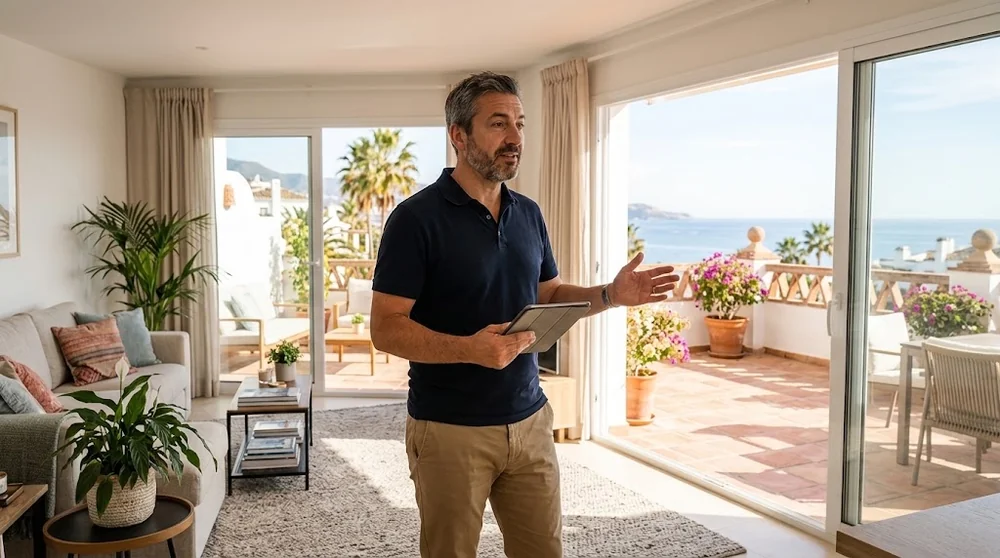
Set an All-In Euro Budget
Set your budget in euros, as an all-in figure, before you shortlist anything. The asking price is only the opening number. Taxes, professional fees, travel, repairs, running costs and a contingency all come out of the same pot, and none of them follows a single Spain-wide percentage or fixed fee.
| Cost item | What it covers | How to estimate it | UK and US considerations |
|---|---|---|---|
| Purchase price | The agreed price, not the asking price | Use your maximum likely offer, not the advertised figure | Your home-currency cost moves with the exchange rate until you pay |
| Transaction taxes | ITP on resale, or IVA plus AJD on a qualifying new home; IGIC in the Canary Islands | Ask a tax adviser for the treatment of that specific property and transaction | Region, transaction type and eligibility for any relief determine the applicable treatment; nationality alone does not establish the rate |
| Professional fees | Lawyer, notary, Land Registry, surveyor, any translator or mortgage broker | Obtain written quotes from each professional | Budget for document translation and apostilles where needed |
| Travel | Viewing trips, notary appointment, key handover | Price realistic return flights and accommodation | Count days against your short-stay allowance |
| Initial repairs | Defects found by survey, furniture, appliances | Use your surveyor’s findings, not the agent’s estimate | Remote project management can cost more than doing it yourself |
| Recurring costs | Community fees, IBI property tax, insurance, utilities, non-resident tax filings | Request actual bills and community budgets | Ask a cross-border tax adviser about UK or US reporting |
| Contingency | Currency swings, surprise works, delays | Choose a reserve you could genuinely afford to spend | Larger if you depend on a mortgage or a sale back home |
Which purchase taxes apply
A resale home in Spain normally attracts transfer tax, Impuesto sobre Transmisiones Patrimoniales (ITP), at a rate set by the autonomous community, so Andalusia, Catalonia, Madrid, the Valencian Community and the Balearic Islands can each apply different rules. A qualifying first supply of a new home by a developer attracts IVA instead; under Article 91 of Spain’s VAT Law 37/1992, qualifying dwellings in the territory where IVA applies are generally taxed at 10% (as of October 2026), plus stamp duty on the deed, Actos Jurídicos Documentados (AJD), at a regional rate. Garages or storage sold separately may be taxed differently. Tenerife sits in the Canary Islands, outside the IVA territory, where the regional IGIC regime applies instead. A tax adviser should confirm the treatment for the specific property and completion date.
Currency and lending
Here is a hypothetical example, not a live rate. A €300,000 all-in budget costs about £260,870 at an assumed €1.15 to the pound, but about £272,727 at an assumed €1.10, almost £11,900 more for the same home. The arithmetic works identically for dollars. If you need a mortgage, get a lender’s or broker’s assessment before treating any property as affordable; non-resident criteria vary by bank and applicant, and a lender’s valuation protects the bank rather than surveying the home for you.
Shortlist Neighbourhoods Before Individual Homes
Shortlist neighbourhoods before individual homes, because no amount of marble flooring fixes the wrong street. Holiday memories are poor evidence: a resort that buzzes in July may be shuttered in January, and the café you loved may close for the winter. Test each area against how you will actually live there.
- Winter services: which shops, pharmacies, restaurants and bus routes operate between November and March, not only in summer.
- Healthcare: distance to the nearest health centre and to a hospital with an emergency department, and how you would reach them without a car.
- Groceries: whether a supermarket, bakery and pharmacy are a realistic walk while carrying shopping.
- Walking routes: the actual route to those places, including pavement width, crossings, lighting after dark and building works.
- Slopes and steps: gradients that look charming in photographs and rather less charming with two heavy bags at seventy-eight.
- Public transport: buses, trains or metro that run at the times and seasons you would use them.
- Parking: on-street availability, residents’ schemes and whether a space is included or rented separately.
- Flight practicality: the journey to the relevant airport and whether year-round routes serve your home airports in the UK or US.
- Noise: main roads, bars, schools, building sites, flight paths and weekend nightlife.
Street-level mapping helps, but check the capture date shown on the imagery before trusting it. A street photographed several years ago may now have a new block, a closed shop or a building site. Ask an agent or local contact for a short weekday video walk at an ordinary time, such as a Tuesday morning, showing the route from the front door to the nearest shop and bus stop.
The locations below are different search contexts, not a ranking. Barcelona and Madrid are large cities where commuting, building age, lifts and street noise often decide the matter. Valencia may mean the city or the wider Valencian Community. Malaga may mean the city or the province, which includes most of the Costa del Sol; Marbella is one municipality on that coast, with central apartments and hillside urbanisations that can be car-dependent. Alicante may mean the city or the province along the Costa Blanca. Mallorca is a Balearic island where some resort areas quieten markedly in winter. Tenerife, in the Canary Islands, has notably different climates in the north and south, plus its own tax regime.
Short-term holiday letting eligibility is a property-specific check. Regional law, municipal planning, licence registers and the building’s community rules can all restrict it, and some cities, Barcelona among them, tightly limit tourist-flat licences. A previous owner’s lettings or an advert saying “ideal investment” proves nothing.

Turn Portal Listings into Comparable Property Records
Portal listings become useful only when you convert them into one comparable record per physical property. Portals such as Idealista and Kyero are sensible starting points for a search for Spanish property from the UK or a hunt to find property in Spain from the USA, but in my experience no portal shows every home for sale. In practice, local agents may hold stock that never reaches the portals, or that appears there late or under several brands. Treat portal results as a sample of the market, not the whole of it.
One record per physical home
For each home, record the date you checked it, its confirmed availability, the current asking price, the confirmed location, every listing reference and the agent responsible for each advert. Asking prices are what sellers want, not what buyers have paid, so never treat them as achieved prices. Ask each agent to confirm availability in writing, because adverts often remain online after a reservation.
Here’s where people usually come unstuck: they compare three adverts and think they are comparing three homes. Ten years on the Costa del Sol have taught me that identical photographs, the same view from a terrace or recycled description wording often reveal one flat marketed by several agents, sometimes at different prices.
Different listing references do not necessarily mean different homes. Ask the agents to confirm the match, then merge the records, keep the price discrepancy visible and ask which figure the seller has actually authorised.
Compare like-for-like space
Spanish adverts may quote superficie construida, the built area including walls and sometimes a share of communal areas, or superficie útil, the usable internal floor area. Terraces may be covered, uncovered or partly enclosed, and an included parking space or storage room is sometimes folded into a headline figure. Never compare built area in one advert with usable area in another. Record each figure separately, note its source, and compare euros per square metre only when the measurements match. Where the listing, Catastro and registry figures disagree, mark the discrepancy as unresolved and ask your lawyer or surveyor to explain it.
Respect privacy and registry rules
Ask the agent for the cadastral reference or registry details through the proper channel, ideally once you are seriously interested. Registry information is requested for a legitimate interest, such as a prospective purchase, and should never be used to trace or contact owners behind an agent’s back.
Ask for a Live Viewing That Tests the Listing
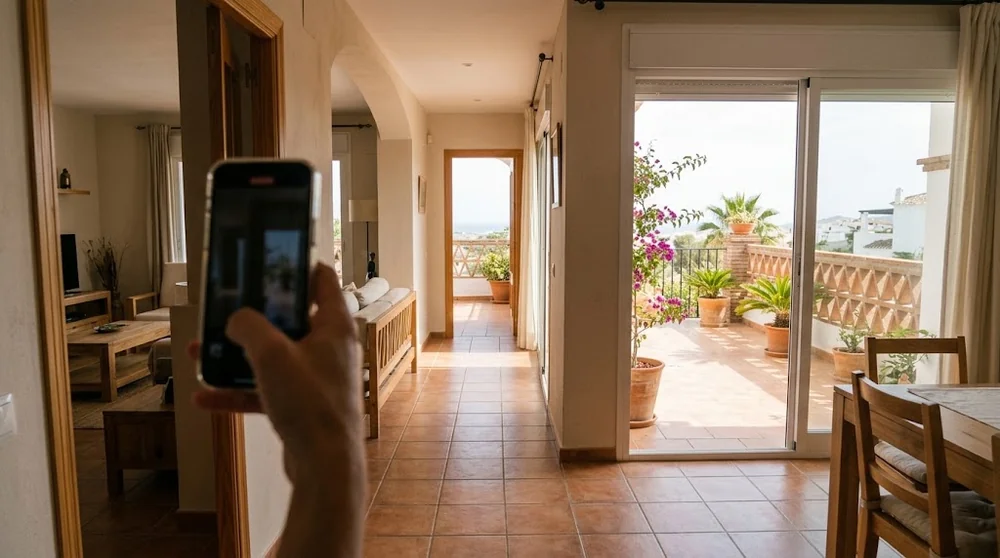
A good virtual property viewing in Spain tests the advert rather than repeating it. Ask for a live video call, confirm before it starts that everyone consents to any recording, and give the agent your script in advance so nothing is skipped.
- Street and approach: start outside, pan both ways along the street and walk the route from parking or the nearest bus stop.
- Entrance and building: show the front door, intercom, lift, stairs and corridor to the flat without stopping the camera.
- Continuous room sequence: walk through every room in one unbroken take so you can see how spaces genuinely connect.
- Measurements: hold a tape against the main bedroom walls, the living area and the usable depth of the terrace.
- Windows and orientation: open windows, show the view straight ahead and down, and read the direction from a compass app.
- Walls, ceilings and visible defects: pause on corners, ceilings below bathrooms and terraces, window frames and any patches of fresh paint.
- Fixtures and services: run taps, show the water heater, air-conditioning units and electrical panel, and confirm what is included in the sale.
- Common areas: show the pool, gardens, garage, storage room, roof and any scaffolding or works notices.
- Accessibility and surroundings: show thresholds, steps, door widths and shower access, then stand outside silently for a minute to listen.
Live, edited or interactive 360-degree
An edited marketing video is chosen footage, cut to flatter the home. An interactive 360-degree tour helps with layout, but its images were captured on one day in chosen conditions. A live walkthrough is the most useful format for shortlisting, because you direct the camera and can ask for the awkward corner the edit missed.
What video cannot prove
Video can show what a room looks like, but it cannot prove structural soundness, damp causes, acoustic comfort or winter sunlight. Phone microphones often suppress background noise, so a busy road may sound oddly calm. A sunny afternoon says little about light in January, and a running tap says nothing about pipework. Use the call to eliminate homes and to list questions for your surveyor.
Book the call in two time zones
Confirm the date, the local time and both participants’ locations in writing. Mainland Spain and Mallorca run one hour ahead of the UK for most of the year, while Tenerife and the rest of the Canary Islands keep the same clock as the UK. Europe and the United States change their clocks on different dates, so the gap shifts for a few weeks each spring and autumn; in 2026, Europe’s autumn change falls on 25 October and the US change on 1 November. A New York buyer booking a Malaga call in that window should double-check.
Request Documents Before Moving Beyond the Shortlist
Before a home moves from your shortlist to a final viewing or an offer, request the documents that test what the advert claims. Your independent lawyer will carry out full due diligence later, but early evidence stops you spending a flight and a weekend on a property with an obvious problem.
| Evidence requested | What it helps establish | Limitation | Appropriate checker |
|---|---|---|---|
| Recent nota simple from the Registro de la Propiedad | Registered owners, description, mortgages, embargoes and registered restrictions | An informational snapshot; it does not show planning breaches, unregistered works or most unpaid bills | Independent lawyer |
| Catastro record and cadastral reference | Official description, use, surface and location for tax purposes | Catastro, registry and listing figures can differ; cadastral value is not market value | Lawyer, with surveyor for physical discrepancies |
| Municipal planning status | Whether the building and alterations are lawful or subject to proceedings | Requires a municipal check; registry entries are not planning clearance | Lawyer, sometimes an architect |
| Occupancy documentation | Authorisation for residential occupation | Names and procedures vary by region; may not cover later extensions | Lawyer |
| Energy performance certificate | Energy rating and estimated consumption | Not a condition survey | Seller supplies; surveyor interprets |
| Comunidad de propietarios charges, minutes and budget | Current fees, special levies and planned works | Preliminary information only; future works may not yet be approved or costed | Lawyer; surveyor for building condition |
| Certificate of outstanding community debts | Whether the seller is up to date with community payments at the point of sale | Issued by the community’s secretary or administrator for completion; fee summaries and minutes are not a substitute, rules can differ by region, and any waiver needs legal advice first | Lawyer and notary |
| Latest IBI receipt and utility bills | Running costs and whether bills are paid | Bills show history, not future rises | Lawyer |
| Intended-use permissions | Whether planned letting or use is permitted | Rules differ by region, municipality and building; licences may not transfer | Lawyer |
| Seller authority | That the people selling are entitled to sell | An agent’s assurance is not proof | Lawyer and notary |
| Occupants and vacant possession | Who lives there and whether the home will be delivered empty | Tenancy rights may survive a sale | Lawyer |
What the nota simple does and does not tell you
Always ask for the nota simple before you commit. The Colegio de Registradores describes it as an informational extract of what the Land Registry holds, which differs from a formal registry certificate. A nota simple is not a structural survey or planning clearance. Hidden debts deserve particular care, because certain unpaid community charges and local property tax can follow a property to its new owner. For community charges, the certificate of outstanding debts in Table 2 is the document that matters at completion; at shortlisting stage you are only gathering early warning signs. As of October 2026, under the national ITP rules as amended in 2021, the taxable base for a resale purchase may be the Catastro reference value (valor de referencia) rather than your agreed price if that value is higher, and the reference value is not the same thing as the cadastral value. Your lawyer or tax adviser can obtain the reference value for the specific property from the Catastro.
Illegal works, occupation documents and authority
Illegal building work is a real risk on parts of the Spanish coast, from an enclosed terrace to a whole extra bedroom. Where works were carried out without the necessary permission, their legal status and any limits on future use or works depend on regional and municipal rules, so only a lawyer checking the specific property can establish what you would actually be buying. Occupation documents vary too: a licencia de primera ocupación, a cédula de habitabilidad or a regional declaration may apply depending on location and age. Check seller authority carefully when a property is inherited, jointly owned, company-owned or sold through a representative.
Defence zones for non-EU buyers
As of October 2026, under Spain’s Law 8/1975 on zones and installations of interest to national defence, published in the BOE, purchases by non-EU nationals in certain designated areas can require military authorisation. Since Brexit, that can affect British buyers as well as Americans. The rule applies to specific zones, including parts of some islands and certain coastal or rural areas; it does not mean every island purchase needs permission. Your lawyer should check the specific property.
Score Suitability and Evidence Separately
The most reliable way to shortlist properties in Spain is to score how well each home suits you separately from how confident you are in the evidence.
Let me put it plainly: a gorgeous home with missing paperwork is not a strong candidate, it is an unanswered question. My advice to every British buyer is to let the evidence, not the photographs, decide what goes on the plane with you.
The weights below are an adaptable editorial method, not a legal or financial standard: location 30, layout and accessibility 25, total cost 25, condition 20. Score each criterion as a share of its weight: 90–100% means it fully meets your brief, backed by written evidence; 60–89% means it meets the brief with minor compromises; 30–59% means significant compromises; below 30% means it barely suits you. Score only what is evidenced and leave unknowns unscored. Rate evidence confidence separately. High means the core items (written availability, live viewing, nota simple, measurements and community costs) come from the original source, are dated within the last month or so, are complete and agree with each other. Medium means most core items are present but one is missing, dated or slightly inconsistent. Low means a core item is missing or the evidence contradicts itself. High confidence applies only to preliminary shortlisting evidence; it does not mean legal or technical due diligence is complete.
| Hypothetical home | Location (30) | Layout and access (25) | Total cost (25) | Condition (20) | Evidence confidence | Key unknowns | Decision |
|---|---|---|---|---|---|---|---|
| Home A: photogenic Costa del Sol penthouse with large terrace | 27 | 22 | Not scored: levy unconfirmed | Not scored | Low | No nota simple supplied; enclosed terrace lacks planning evidence; community works levy unconfirmed | Hold |
| Home B: plain second-floor flat in Malaga with lift | 22 | 20 | 22 | 15 | High | Winter light on lower floor; survey still needed | Progress |
| Home C: Alicante townhouse on three levels | 18 | 8 | 20 | 12 | Medium | Steep internal stairs fail the stated mobility need | Reject |
In this method, reject means the home fails a deal-breaker or a hard stop that cannot reasonably be fixed. Hold means the home may suit you but key evidence is missing or contradictory, so it waits until that evidence arrives. Progress means the home has enough suitability and evidence to justify a final viewing and professional checks.
Home A scores well on the fields that can be assessed, and its photographs are excellent. It stays on hold because the identity of the registered owners, the legality of the terrace and the community costs are unknown, which is also why its total cost is left blank rather than guessed. Home B looks ordinary in its photographs but answered every request, so it progresses. No lifestyle score can override unresolved identity, title, planning or payment concerns. The table selects your next steps; it does not approve a purchase or predict value.
Choose Your Agent and Plan the Final Checks
Choose an agent who confirms in writing who they act for, how they are paid and what their service includes, then appoint your own lawyer and surveyor separately. In Spain, an agent marketing a property is commonly paid under an agreement with the seller, although arrangements vary, so ask whether any fee is charged to you and whether the agent receives payments from other parties. A written scope avoids misunderstandings about searching, viewings and negotiation. Your lawyer and surveyor should work for you and be chosen by you; an agent’s introduction can be a convenience, but their independence is what you are paying for.
A brief that helps an agent search properly should include the following.
- Intended use, occupants and any mobility needs.
- Accepted areas and rejected areas, with reasons.
- Your all-in euro ceiling and the maximum purchase price within it.
- Viewing-trip dates and your home time zone.
- Your top three priorities and your deal-breakers.
- Homes already seen or rejected, with listing references, to prevent duplicates.
- Outstanding evidence for each shortlisted home.
As an editorial starting point, three to five evidenced finalists suit a focused viewing trip, adjusted for distances and access. That makes a sensible Spain property viewing trip checklist: finalists, neighbourhood walks, a repeat visit to your favourite, and meetings with your lawyer.
Searching by video requires no power of attorney. If you later complete remotely, a suitably drafted poder notarial can authorise a representative, and your lawyer will explain its scope and any legalisation needed where it is signed abroad. The Spanish notary is a public official with an impartial legal role, not merely a witness to signatures.
Got a written brief and a few listing references already? Send them to me on WhatsApp and we can talk through which evidence still seems to be missing before you book any flights.
Do not pay a reservation deposit or sign a contrato de arras until your independent lawyer has reviewed the terms. Arras contracts can mean losing your deposit if you withdraw, and there is no automatic refund right or standard US-style inspection contingency unless conditions are written in. Verify the recipient’s bank details independently by phoning a known number, because payment fraud targets international buyers. The UK FCDO’s guidance on buying property in Spain, published on gov.uk, also urges independent advice, although it was last updated in May 2021, so treat its details as background rather than current law.
Remote Property Search in Spain: FAQ
Can I search for and buy property in Spain without travelling there?
You can research listings, speak to agents and arrange live viewings from the UK or US. A purchase can also be completed through an appropriately authorised representative, subject to the required notarial and tax formalities. Searching remotely does not remove the need for independent legal and condition checks. Visiting shortlisted homes and their neighbourhoods remains sensible whenever practical.
Does a virtual viewing replace an in-person property visit?
A virtual viewing can eliminate unsuitable homes and help you decide which properties deserve a visit. It cannot reliably establish structural condition, damp causes, acoustic comfort or planning compliance. Ask for a continuous live walkthrough and neighbourhood context, then arrange the appropriate independent inspections. Treat the video as evidence for shortlisting, rather than proof that a home is ready to buy.
Do I need a NIE before viewing properties in Spain?
A NIE, the foreigner identification number, is not normally needed merely to browse listings or attend property viewings. It is relevant to the purchase and associated tax formalities, so discuss timing with your lawyer once your search becomes serious. Procedures and appointment availability depend on where you apply. Obtaining a NIE does not itself grant any residence rights in Spain.
How many properties should I shortlist before visiting Spain?
There is no official ideal number. Three to five well-screened finalists can be a practical starting point for a focused visit, provided they are close enough to inspect properly. Allow time for neighbourhood walks, repeat visits and professional meetings. A smaller shortlist supported by evidence is more useful than numerous listings with unresolved basic questions about price, space or availability.
What documents should I request before paying a reservation deposit?
Ask your independent lawyer to review current registry information, seller authority, relevant planning and occupancy evidence, and the proposed reservation terms before payment. Community costs, debts and intended-use permissions may also need checking. A nota simple alone is insufficient. Confirm the recipient, refund conditions, deadlines and outstanding checks, and do not assume every reservation deposit is refundable.
How can I compare Spanish properties advertised by different agents?
Create one record per physical home and compare confirmed asking prices, availability, usable space, included parking, recurring charges and evidence dates. Duplicate photographs or similar descriptions may reveal repeated advertisements, but confirm the match with the agents. Separate verified information from claims and unknowns. Different listing references do not necessarily identify different properties in Spain.
Your Next Step: Review the Shortlist
Before you book flights, check that your shortlist is ready. Your all-in euro budget should be confirmed, including currency and lending assumptions. Each neighbourhood should fit ordinary weekday and winter life. Every finalist should have current, written availability and a live viewing on record. Outstanding questions should be listed rather than forgotten, and each professional check should have a named, independent person responsible for it.
Not sure whether your search is ready for a viewing trip? Take our short quiz to see which parts of your brief, budget and evidence still need work.
If any of those checks is still open, that is fine; it simply tells you where to spend the next week, rather than the next flight.
Fazit
A shortlist is ready when its unknowns are visible and assigned, not when its photographs look best. A remote search gives British and American buyers a genuine head start: you can rule out the wrong streets, the duplicated adverts and the homes that cannot answer basic questions long before you pack a suitcase.
What a remote search cannot do is replace independent legal, technical and tax checks, or protect you from terms you agree to before those checks are done. Keep the method simple, keep the evidence dated, and let professionals who work for you have the final word.
This article is general information as of October 2026 and is not legal, tax, financial or immigration advice. Rules vary by region and property and can change, so take independent Spanish legal, technical, tax and immigration advice as appropriate before committing to any purchase.
Leave a Reply