
You have spotted a flat in Estepona online, the agent has offered a video call, and you are sitting in Leeds or Boston wondering whether that is enough to start sending money. A screen can tell you whether a property deserves your attention, but it cannot tell you whether it deserves your deposit. This guide separates what video can show from what only documents, independent professionals and, occasionally, your own two feet can confirm.
Virtual property viewings in Spain can help you shortlist homes and buy remotely, but video alone cannot establish ownership, planning legality or structural condition. Before committing money, arrange independent legal checks and an on-site technical inspection. A properly drafted power of attorney can let your representative complete the purchase while you remain abroad.
What Virtual Property Viewings in Spain Can Establish
I swapped Manchester drizzle for Marbella sunshine more than a decade ago, and ten years on the Costa del Sol have taught me that even a perfectly honest video has limits. The agent can film every room in good faith and still show you nothing about the title, the planning history or what is going on behind the plaster. Trouble starts when a buyer asks a video to prove things it never could. A remote purchase has three decision stages: shortlist (is this worth investigating?), investigate (is it legally and physically sound?) and commit (am I prepared to pay and sign?). Each stage needs a different kind of evidence.
| Method | Purpose | What it can show | What it cannot establish |
|---|---|---|---|
| Prerecorded tour | Early shortlisting | Layout, finish, light and general style | Current condition, editing choices, rooms left out, the surroundings off camera |
| Buyer-directed live video viewing | Testing the shortlist | A continuous route, visible defects you request, real-time answers | Ownership, legality, hidden damp, structural movement or true noise levels |
| Independent technical inspection | Physical investigation | Professional assessment of structure, installations and visible or detectable defects | Title, debts or planning status, unless specifically instructed and documented |
| Legal due diligence | Legal investigation | Registered owner, charges, planning and tax position, community debts | The physical condition of the building |
Let me put it plainly: a video cannot prove ownership, lawful construction or structural soundness. A live video viewing is an excellent filter, but the second and third stages belong to a Spanish lawyer acting for you and an independent arquitecto técnico (a qualified building surveyor) who physically visits the property.
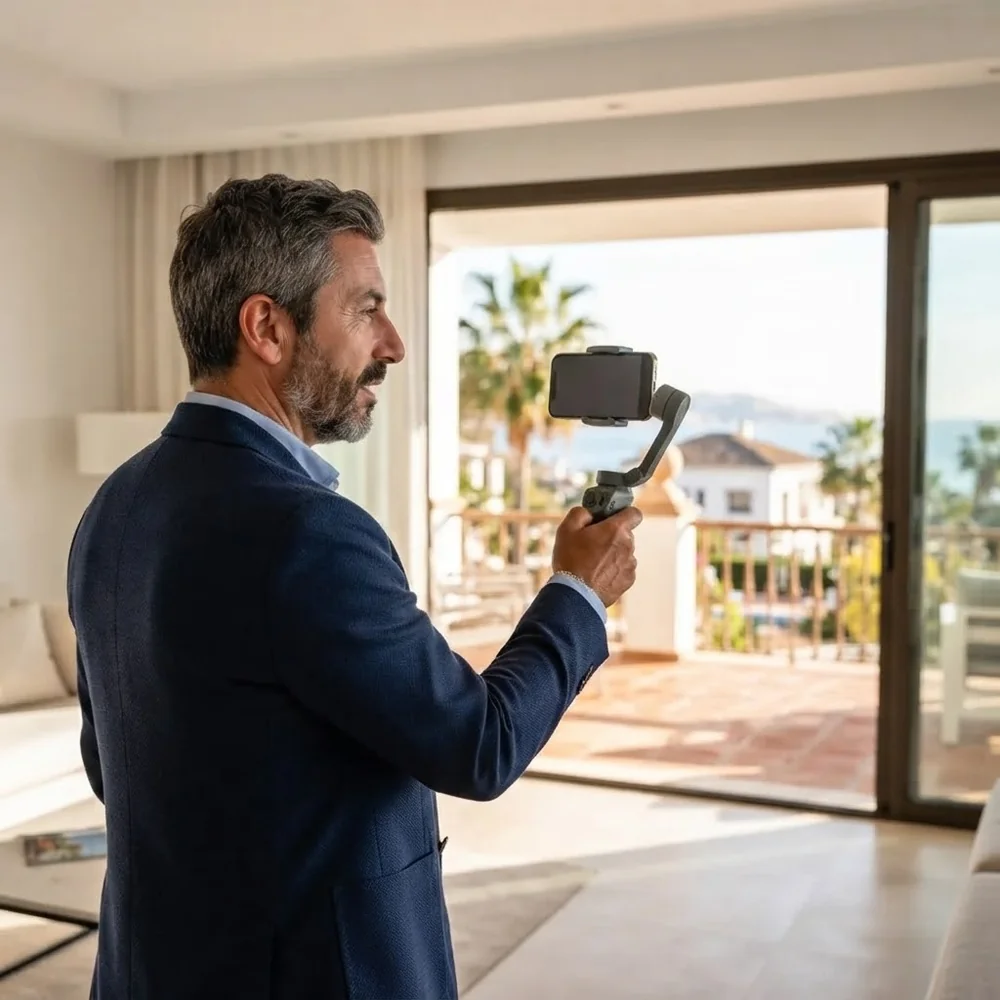
Your Live Video Viewing Checklist
A good live viewing is directed by you, not choreographed by whoever holds the phone. Send your requests in writing before the call, so nothing gets “forgotten” and you have a record of what you asked to see.
Preparation before the call
- Ask for a continuous route from the street or building entrance to the front door, then through every room without cuts. Gaps in footage are where inconvenient things live.
- Confirm the property’s identity privately: the agent can show the door number, the floor and the building entrance so you can match them against the listing and, later, the registry description. Ask them not to film the seller’s letters, ID or other personal documents.
- Agree before the call whether it may be recorded. Ask for consent from the agent and any occupant, and keep the recording for your own reference.
- Request a tape measure or laser measure, and list the spaces you need measured: bedrooms, the kitchen run, the terrace, the parking space and the storage room.
- Schedule the call in good daylight and ask for a stable connection; a frozen screen in the bathroom tells you nothing. If damp, the roof or drainage are a concern, ask for extra photos or a short video during or just after rain as well, because a sunny afternoon is when leaks hide best.
Room-by-room checks
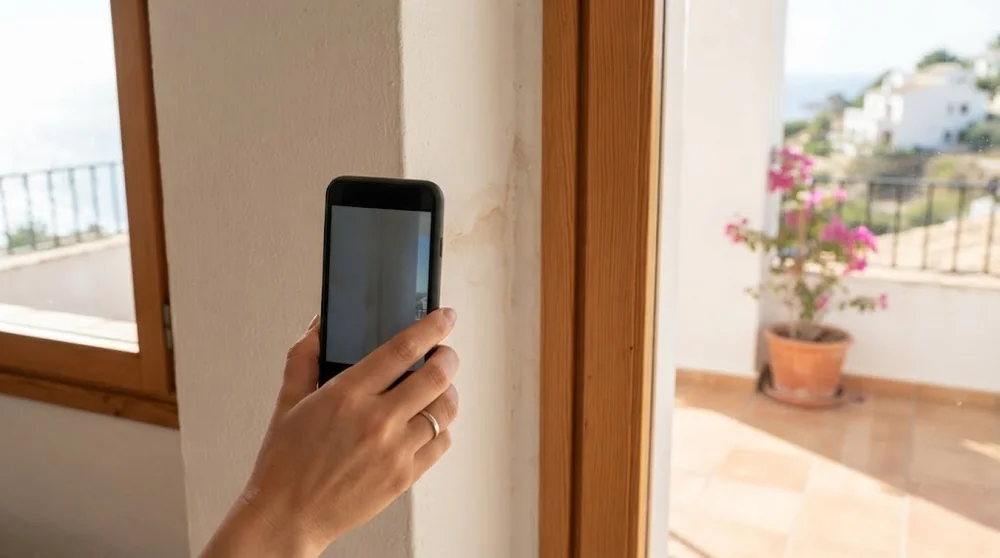
- Slow, close views of ceilings, corners, skirting boards and window frames, looking for staining, bubbling paint, fresh patches of paint or cracks.
- With the owner’s permission, run taps, flush the toilet, operate shutters (persianas), open windows and switch on air conditioning so you can see whether things actually work.
- Look inside wardrobes and under sinks, where damp and leaks tend to show first.
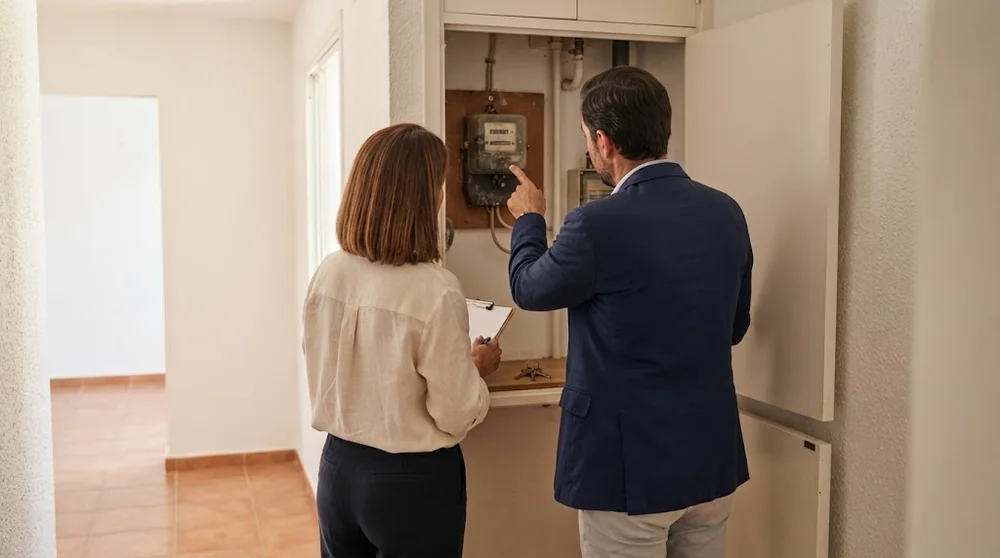
- Check the electrical panel and boiler or water heater visually, without asking anyone to open covers or handle installations.
- Note accessibility: steps to the entrance, lift size, stair width and whether furniture will realistically get in.
Exterior, neighbourhood and the second visit
Ask the agent to show the parking space and storage room actually included in the sale, the stairs, the lift, the pool and gardens, and any communal areas run by the community of owners. Then ask them to step outside and pan slowly around the street: neighbouring bars, building sites, main roads, steep hills. Here’s where people usually come unstuck: they view a Fuengirola flat at eleven on a Tuesday morning and buy above a terrace bar that only wakes up at midnight. Arrange a second viewing at a relevant time, such as a weekend evening, the school run or, for summer lets, high season.
Be honest about technology’s limits. Phone microphones suppress background noise, wide-angle lenses make rooms look bigger, and screens flatten colour, so damp stains and fresh paint can look identical. Rain can reveal leaks that sunshine hides, and vice versa. If the footage contradicts the floor plan or the photos, or a room is suddenly “not available to show”, treat it as a question for your lawyer and surveyor rather than a detail to wave away.
Verify the Nota Simple and the Physical Property
The nota simple is an extract from the Registro de la Propiedad (the Land Registry) showing the registered owner, the registered description and the charges recorded against the property. A nota simple has informative value only: it is not a survey, not a certified registry certificate and not complete planning clearance. The Catastro is a separate cadastral register used mainly for tax purposes, recording location, surface area and use; it does not prove ownership. Problems often sit in the gaps between the registry, the Catastro and what is physically on the plot. Always ask for the nota simple before you commit.
The table below links each risk to the evidence you need, who issues that evidence, who checks it for you and what happens if it fails. Documents should come from the issuing body through your lawyer, not as a forwarded PDF from the seller’s side.
| Risk | Evidence | Issuer / authoritative channel | Verifier | Escalation |
|---|---|---|---|---|
| Seller lacks authority | Seller ID, nota simple, any power of attorney, probate or company documents | Registro de la Propiedad; authorising notary; Registro Mercantil for companies | Buyer’s lawyer; notary at signing | Hold payments until every owner or heir signs or is validly represented |
| Mortgages, embargoes or other charges | Recent nota simple; lender payoff statement | Registro de la Propiedad; the lending bank | Buyer’s lawyer | Written cancellation arrangement at completion, with funds retained if needed |
| Registry, Catastro and reality disagree | Nota simple, cadastral certificate, survey measurements | Registro de la Propiedad; Catastro; commissioned technical report | Lawyer and arquitecto técnico | Written legal and technical assessment, then regularisation before completion. A discount does not cure unlawful construction, missing title or an unregistrable alteration, so accept any unresolved discrepancy only after that written assessment |
| Illegal extensions or alterations | Licences and planning records | Ayuntamiento urbanismo department | Lawyer; technical professional | Formal urbanismo enquiry; specialist planning advice |
| Missing occupancy documentation | First occupation licence, declaración responsable or cédula, depending on region | Ayuntamiento or regional housing authority | Lawyer | Clarify utility and resale consequences before signing |
| Unpaid IBI (municipal property tax) | Latest receipts plus a municipal debt enquiry or certificate | Municipal tax office or provincial collection agency | Lawyer | Document settlement before completion or a retention from the price |
| Community debts and future levies | Debt certificate, recent minutes, approved works | Community secretary-administrator, with the president’s approval | Lawyer | Agree who pays approved levies in the contract |
| Tenants or occupants | Leases, possession confirmation | Seller; landlord’s records; lease registration where applicable | Lawyer | Make vacant possession a condition of completion |
| Hidden physical defects | Commissioned technical report with photos, scope and exclusions | Your independent arquitecto técnico | Surveyor; lawyer for contractual consequences | Further specialist investigation, renegotiation or withdrawal within agreed conditions |
| Coastal boundary or easement | Deslinde records, registry entry, plan of the plot | State coastal authority (Demarcación de Costas); Registro de la Propiedad | Lawyer; technical professional for plot position | Written assessment of restrictions before signing; withdraw if the use you need is not permitted |
| Military authorisation in restricted zones | Authorisation or documented exemption for the exact property | Ministry of Defence | Lawyer; notary and registry at completion | Obtain authorisation or a confirmed exemption before completion; make it a contractual condition |
| Off-plan stage payments | Building licence, bank guarantee or insurance policy per payment, special account details | Ayuntamiento; issuing bank or insurer | Lawyer, checking directly with the bank or insurer | No stage payment until each guarantee is confirmed by its issuer |
| Rental or tourist-letting permission | Regional register entry, municipal confirmation, community statutes and minutes | Regional tourism authority; Ayuntamiento; community of owners | Lawyer | Treat rental income as unproven until permission for your own future use is confirmed in writing |
Community debts deserve special attention. Under the national Horizontal Property Act (Ley de Propiedad Horizontal), where applicable, article 9.1.e makes the purchased home itself answerable for unpaid general community charges attributable to the elapsed part of the year of purchase and the three preceding calendar years (as of October 2026). The same provision requires the seller to provide a community debt certificate before the deed is authorised, unless the buyer expressly waives it. Some regions have their own civil-law rules on communities, so ask your lawyer to check which regime applies, particularly in Catalonia, where the Catalan Civil Code governs. My advice to every British buyer is never to waive the certificate, and to read the minutes too: an approved but not-yet-billed levy for a new roof will not necessarily appear as a debt.
Three different professionals answer three different questions. Your lawyer acts for you and investigates title, debts, planning and the contract. The notary is impartial: they authorise the escritura pública (the public deed of sale), check identities and legal formalities and advise both parties, but they do not act for you or inspect the building. The independent technical professional reports on physical condition within an agreed scope.
In my view, the most expensive words in a remote purchase are “the agent said it’s all legal”. An agent can gather documents and arrange access; independent clearance has to come from your own lawyer and surveyor.

Buying Remotely from the UK or US
Buying property in Spain remotely usually means appointing someone, often your lawyer, to sign on your behalf under a poder notarial (a notarial power of attorney). Start early with the NIE, the foreigner identification number you will need for the purchase, taxes and utilities; your lawyer can advise whether it can be obtained through a Spanish consulate or a representative in Spain. The power of attorney itself should be transaction-specific, drafted in Spanish or bilingual form, and approved by the completing Spanish notary before you sign it.
| Route | How it works | Extra steps | Watch for |
|---|---|---|---|
| Spanish consulate | Signed before the consul acting as notary | Normally no apostille, as it is a Spanish instrument | Appointment availability |
| Local notary plus Hague Apostille | Signed before a UK notary public or a US notary | Translation of the instrument, notarial certification and apostille as required by the receiving Spanish notary; bilingual wording alone does not settle acceptance | Spanish notary’s prior approval of wording and format |
| Video before a Spanish notary | Power for specific acts authorised by videoconference | Electronic identification and signature | Not available for general powers; the notary decides suitability |
As of October 2026, article 17 ter of Spain’s Notaries Act (Ley del Notariado), added by Law 11/2023, allows certain instruments, including powers of attorney for specific acts, to be authorised by videoconference, while general and preventive powers are excluded. That is not the same as personally signing your property deed over video: remote representation is the established route for completion, and whether any particular act can be done online is for the notary to confirm.
Buying from the UK
Post-Brexit, British buyers are non-EU nationals in Spanish law. A power signed before a UK notary public normally needs an apostille from the FCDO Legalisation Office, plus translation where required. Brexit also brings two practical consequences: possible military authorisation in restricted zones (covered below) and the fact that time in Spain counts against short-stay limits. Owning a Spanish home does not, by itself, give you the right to live in Spain. As of October 2026, the property investment residence route ended on 3 April 2025 under Organic Law 1/2025, so residence needs a separate visa route.
Buying from the US
American buyers usually sign before a local notary, but apostille authentication depends on the issuing jurisdiction, typically the competent authority of the state where the document was notarised; federal documents follow a different route through the US Department of State. The US State Department’s apostille guidance explains which office handles which document. Do not assume one office covers the whole country. Ask your Spanish lawyer to confirm in writing the exact chain the receiving Spanish notary will accept, and get that notary’s approval of the wording before you sign or pay for anything.
Whichever route you choose, limit the authority: identify the property, set a maximum price, list the permitted acts (signing, paying taxes, registering, connecting utilities), decide whether sub-delegation is allowed, consider an expiry date where appropriate, and remember that a power can be revoked through a notary.
Before Paying a Reservation Fee or Arras
The pressure to “secure it today” peaks exactly when you know least. Use these gates before any money leaves your account:
- Verify the professionals. Confirm your lawyer is a practising member of a Spanish bar association and that your surveyor is suitably qualified, using sources you found yourself.
- Obtain essential evidence. At minimum a recent nota simple, seller identity, and confirmation of charges and community debts.
- Have the exact contract reviewed. Your lawyer should read the reservation document or contrato de arras that you will actually sign, not a template.
- Define outstanding conditions. List the checks still pending, the survey access you need, deadlines, and any negotiated refund conditions.
- Confirm the payee independently. Check who receives the money, their authority to receive it, and the bank details through a trusted channel.
- Document your approval. Give written payment instructions only after your lawyer confirms the gates are met.
Reservation fees and arras are contract-specific, and no reservation payment is automatically refundable. As of October 2026, article 1454 of the Spanish Civil Code recognises penitential arras, under which the buyer may withdraw by forfeiting the deposit and the seller by returning double. That mechanism applies only where the contract clearly agrees it; confirmatory or penalty arras work differently, and courts look at the actual wording. A reservation fee paid to an agent may follow different terms again.
Bank-detail fraud is the quiet threat to remote buyers. Criminals intercept email chains and send convincing “updated” account details at the last minute. Treat any change of payment instructions as suspect until confirmed by phone, using a number you already held. Prepare source-of-funds evidence early, because banks and notaries apply anti-money-laundering checks, and ask for written fee quotations from every professional.
If you are facing a reservation contract or a power of attorney and want help organising the evidence and preparing the right questions, a short one-to-one conversation can get you ready for your lawyer. Interpreting the contract and approving the power of attorney remain the job of your independent Spanish lawyer and the receiving notary.
Currency exposure matters too: a few weeks of sterling or dollar movement between reservation and completion can change your real cost, so discuss timing and transfer options with a regulated provider before you commit to dates.
When Location or Property Type Requires More Checks
Spain has national laws, regional laws and municipal planning, so the same checklist is a starting point rather than a finish line. Each local legal question should go to your lawyer and, where needed, the Ayuntamiento urbanismo department (the town hall planning office).
Regional documents
Occupancy documentation varies by region. A resale flat in Barcelona will usually involve a cédula de habitabilidad under Catalan rules, while a home in Marbella or Malaga sits within the Andalusian system, and properties in Alicante or Valencia follow the Valencian regime. Madrid has its own arrangements again. Your lawyer should confirm which document applies and whether it is current.
Rural, coastal and island homes
Rural villas inland from Marbella or in the Alicante countryside call for planning history, legal road access, water supply and drainage checks; a lovely video of a pool says nothing about whether the pool was licensed. Seafront property may be affected by coastal law restrictions: ask your lawyer to establish where the official boundary of the maritime-terrestrial public domain (the deslinde) runs and whether the plot falls within a protection or access easement, checking the registry entry and the coastal authority’s records rather than relying on the listing.
On the islands, Mallorca and Tenerife buyers should ask early about restricted zones: as of October 2026, Law 8/1975 on zones of interest for national defence can require military authorisation from the Ministry of Defence for non-EU buyers, now including British nationals, in designated areas. Whether the land is legally documented as urbanised can affect whether authorisation is needed at all, a point addressed in the registry resolution of 27 November 2025, published in the BOE on 9 March 2026 (BOE-A-2026-5490). Exemptions and practical treatment depend on the specific property and location, so your lawyer should establish which exemption, if any, applies to the exact property and what supporting evidence the notary and registry will require.
Occupied homes, off-plan and rental claims
An occupied home needs lease review and a clear vacant-possession condition. Off-plan purchases need confirmation of the building licence from the Ayuntamiento, plus the bank guarantee or insurance policy covering each stage payment and the details of the special account those payments go into; your lawyer should check these documents with the issuing bank or insurer before you pay a penny. A rendering or show-home video is not evidence about the exact unit you are buying.
Rental income claims deserve scepticism. Ask to see the actual tourist-letting registration for the property in the regional register, confirm with the Ayuntamiento whether local restrictions or moratoriums apply, and have your lawyer read the community statutes and minutes. As of October 2026, where the national Horizontal Property Act applies, articles 7.3 and 17.12 require a new tourist-letting activity to have the community’s prior express approval, by three-fifths of the owners representing three-fifths of the participation quotas. Lets already operating before that rule took effect may fall under a transitional exception, but that needs separate legal analysis for the specific flat. And do not assume an existing registration automatically passes its operating rights to you as the buyer: that depends on regional and municipal rules. Barcelona is notably restrictive, and buying, residence and letting permission are three separate questions.
Before you even reach these checks, it helps to narrow your search to areas and property types that suit your budget, intended use and tolerance for paperwork.
If you are still deciding between the Costa del Sol, the Costa Blanca or the islands, a short questionnaire on budget, region and buying goals can turn a vague wish list into a focused shortlist.
A tighter shortlist also means fewer live viewings, fewer surveys and less money spent investigating homes that were never right for you in the first place.
From Remote Shortlist to Completion and Handover
Here is the workflow I recommend, with the caveat that timings are case-dependent estimates and can stretch with mortgages, inheritance issues or regularisation.
- Shortlist using prerecorded tours, then hold buyer-directed live viewings at two relevant times.
- Instruct an independent lawyer and obtain the nota simple and core documents.
- Commission an on-site technical inspection with an agreed written scope.
- Pass the pre-payment gates, then sign the reviewed reservation or arras contract.
- Arrange the NIE, the approved power of attorney, funds and source-of-funds evidence.
- Arrange a final on-site condition check shortly before completion, by your surveyor, lawyer or a trusted representative, with photos and an agreed inventory if furniture is included.
- Complete before the notary, with charges cancelled and debts settled as agreed.
- Take possession: collect all keys, fobs and remotes, record meter readings and transfer utilities.
- Follow up registration in the Registro de la Propiedad and the delivery of your deed and tax receipts.
Stop and reassess if survey access is refused, documents and reality do not match without explanation, refund terms are unclear, someone pressures you to pay before checks, or bank details change without verification. A personal visit is worth arranging for rural plots, major renovations, high-value homes, contradictory footage or a neighbourhood you genuinely do not know.
As a general observation, the buyers who sleep best are not the ones who saw the most video. They are the ones who said “not yet” when the evidence was incomplete.
Frequently Asked Questions
Can I buy a property in Spain without travelling there?
You can arrange a Spanish property purchase through a representative holding an accepted notarial power of attorney. That does not remove the need for independent legal checks, identification requirements or a physical inspection of the home. Not every bank or administrative task is guaranteed to be available remotely, so your lawyer and the completing notary should confirm the documents needed for your transaction.
Is a virtual viewing enough to buy a property safely?
A virtual viewing helps you assess layout, visible condition and surroundings, but it cannot establish legal title, planning compliance or hidden defects. Combine a buyer-directed live visit with documentary checks and an independent on-site technical inspection. If significant questions remain unresolved, postpone commitment or arrange a personal visit before accepting the risk.
What should I ask the agent to show during a live viewing?
Ask for a continuous walk from the entrance through every room, followed by terraces, parking, storage and communal areas included in the sale. Request close views of visible cracks, staining and repairs, plus measurements of important spaces. Check surrounding streets at another time, remembering that video and microphones can distort space, light and noise.
How do I arrange a Spanish power of attorney from the UK or US?
Start with wording approved by your Spanish lawyer and the notary handling completion. Depending on the available route, you may execute it at a Spanish consulate or before an appropriate local notary, with apostille and translation where required. US apostille procedures depend on the issuing jurisdiction. Confirm acceptance before signing or paying for the foreign document.
Should I pay a reservation deposit before the legal checks?
Have your independent lawyer review the proposed agreement and essential property evidence before you pay. A reservation payment is not automatically refundable, and arras agreements can have different consequences. Clarify outstanding checks, deadlines and any negotiated refund conditions in writing. Verify the recipient and bank details independently, especially after any request to change payment instructions.
Do I need an independent survey if the video looks fine?
A clear video does not rule out concealed damp, roof problems, unsafe installations or structural movement. Commission a suitably qualified independent professional to inspect on site and agree the report’s scope and exclusions. Older homes, alterations and visible defects may require specialist investigation. The survey and your lawyer’s documentary checks answer different questions.
Conclusion
Virtual property viewings in Spain are a genuinely useful tool: they save flights, sharpen shortlists and let you test a property before spending serious money. Video supports selection; independent legal and technical evidence supports commitment. Keep those two jobs separate and buying from the UK or US becomes a manageable process rather than a leap of faith. My own rule of thumb comes down to three signals. Go when your lawyer has a clean nota simple, confirmed charges and community debts, and the reviewed contract; your surveyor has inspected on site with no unexplained defects; and the payee and bank details are verified through a channel you trust. Pause when a document is still on its way, the survey scope is unclear, refund terms are vague, or footage and paperwork disagree in a way that might have an innocent explanation. Stop when survey access is refused, the seller cannot show authority to sell, an unlawful extension or missing permission surfaces, or bank details change without independent confirmation.
If you would like a buyer-directed live viewing and a written evidence checklist for a specific property, send a note with your intended use, preferred location, travel constraints and financing needs. I can arrange access and help you organise the paperwork, but independent legal clearance must come from your own Spanish lawyer and the physical assessment from your own surveyor.
This article provides general information as of October 2026 and is not legal, tax, financial or technical advice. Rules vary by region, municipality and individual circumstances. Before committing to any purchase, consult a suitably qualified Spanish property lawyer and an independent qualified technical professional.
Leave a Reply