
Buying a house in Spain is a chain of commitments, and each one is a little harder to undo than the last: who will own the property, how you will pay for it, what you sign and when your money leaves your account. Get the order right and the process is far calmer than the horror stories suggest. Get it wrong and you can lose a deposit or inherit a terrace the town hall never approved. I’m David, a Mancunian who has lived in Marbella for more than ten years, and this is the order I walk English-speaking buyers through.
Buying a house in Spain involves setting a full budget, choosing a property, arranging identification and finance, checking ownership and planning, agreeing protected contract terms, and completing before a notary. Check the property before committing a deposit. After receiving the keys, complete tax filings, registration and utility transfers; requirements vary by region.
Buying a House in Spain: The 12-Step Overview
This roadmap assumes a residential resale purchase, the most common route for British buyers. Where a cash purchase, a mortgage or a new build changes things, the relevant step says so. The steps follow the order of commitment rather than a strict calendar: getting your NIE, lining up funding and appointing a lawyer usually run in parallel from the first week.
- Define your budget, use and location, including total costs and who will own the property.
- Shortlist homes and inspect the area, finishing with written questions rather than a deposit.
- Appoint an independent abogado with a written scope and fee quote.
- Arrange your NIE and payment documents, including source-of-funds evidence.
- Confirm finance before making commitments (mortgage branch; cash buyers prove funds instead).
- Make a conditional written offer.
- Check title, debts and planning, which is the main due-diligence stop point.
- Review any reservation contract, which is optional.
- Agree the contrato de arras, usually the first major binding commitment.
- Finalise the mortgage (financed buyers only) and the completion pack.
- Sign the escritura before a notary and receive the keys.
- File taxes and register the purchase.
Money or binding obligations usually change hands at three points: any reservation payment, the arras contract and completion. New-build and off-plan purchases branch off at Steps 2, 7 and 9, where extra safeguards apply. An unresolved problem found at Step 7 should stop you before you sign anything at Step 9. That single rule prevents most of the expensive mistakes I see.

Step 1: Define Your Budget, Use and Location
Start with what the house is for. A main home, a holiday home and a retirement move lead to different decisions about location, ownership and running costs. A holiday home in Marbella that sits empty in February needs a different budget from a year-round family home in Madrid with school runs to think about.
Next, decide who will own it. Sole ownership, joint ownership with a spouse or partner, and the shares each person holds all affect inheritance, tax and the paperwork every owner must produce. Settle the buying parties before any offer, because changing names after the arras contract is signed can be awkward or impossible.
Your budget must cover far more than the price. Purchase taxes, notary and registry charges, legal fees, a survey, any valuation and bank charges all come on top. If your savings are in sterling, currency movements between offer and completion can change what the house costs you; a specialist payment provider or your bank can explain options for fixing a rate. Then budget for ownership itself: IBI (the annual municipal property tax), community fees, insurance, utilities and maintenance.
Purchase tax depends on the property type and the region. As of October 2026, the Agencia Tributaria (AEAT) states that the first qualifying supply of a new home generally attracts IVA, Spain’s VAT, at 10%, plus AJD (stamp duty on documented legal acts) at the regional rate. A private resale generally attracts ITP, the regional property-transfer tax, instead. The Canary Islands, including Tenerife, use IGIC rather than mainland IVA, so the correct rate must be confirmed for the specific property.
| Location | Autonomous community | Taxes and local checks to confirm |
|---|---|---|
| Barcelona | Cataluña | Regional ITP rate and reliefs; Catalan civil law, which can differ on deposits and community debts |
| Madrid | Comunidad de Madrid | Regional ITP rate and reliefs; municipal planning and community checks |
| Valencia and Alicante | Comunitat Valenciana | Regional ITP rate and reliefs; local rules before relying on holiday-letting income |
| Málaga and Marbella | Andalucía | General ITP 7% and AJD 1.2%, subject to conditions and reliefs; occupation documentation; coastal and rural planning |
| Mallorca | Illes Balears | Regional ITP scale and reliefs; rural-land and holiday-letting restrictions |
| Tenerife | Canarias | IGIC instead of IVA on qualifying new builds; regional ITP on resales; local letting rules |
Here is a hypothetical example. You buy a €300,000 resale home in Andalucía, and the taxable base is assumed to be €300,000. At the general 7% rate, ITP comes to €21,000, before separately quoted notary, registry, legal, survey and bank costs. The taxable base is not always the price: under the reference-value rules, ITP is generally calculated on the higher of the declared value and the valor de referencia, a figure set by the Dirección General del Catastro. If that reference value were a hypothetical €320,000, the ITP would rise to €22,400. The valor de referencia is a separate figure from the older cadastral value used for IBI, so do not mix the two up.
A common planning shortcut is to allow 10–15% on top of the price for taxes and fees. Treat that as a rough estimate, not a quote. Ask your lawyer for an itemised figure once you have a specific property.
Step 2: Shortlist Homes and Inspect the Area
Most searches start on property portals and with local agents. Here’s where people usually come unstuck: the same house often appears on several portals at different prices, listed by different agents, sometimes with old photographs. Ask which agent holds the instruction and compare listing details before you fall for the pool.
On a viewing trip, judge the area as much as the house. Use this checklist:
- Visit in the evening and, ideally, out of season; a lively coastal street in August can be shuttered in January.
- Check road access, parking and whether a car is essential for shops, healthcare and transport.
- Listen for noise from bars, main roads, building sites and flight paths.
- Assess accessibility: steps, steep drives and lifts matter more at seventy than at fifty.
- Ask about water supply, internet, rubbish collection and drainage, particularly for rural homes.
- Note visible maintenance issues such as damp, cracks, flat-roof wear and pool equipment.
- Ask the agent for the cadastral reference, community fees and annual IBI.
A viewing is not a legal or structural check. It tells you whether you like the house; it cannot tell you whether the extension is legal or the roof is sound. If you are considering a new build or off-plan home, extra safeguards apply, such as how stage payments are protected, the building licence and the developer’s position, and these need specialist verification. Step 2 ends with a shortlist and a written list of questions for your lawyer, not a deposit.

Step 3: Appoint an Independent Abogado
An abogado is a qualified Spanish lawyer, and the word that matters is independent. Your lawyer should act only for you, not for the seller, the developer or the agent who found you the property. Check that the lawyer is registered with the local Colegio de Abogados, the regional bar association, and ask for a written engagement letter setting out the scope of work and the fee before anything else. A fixed fee or a clearly stated percentage is fine; a vague quote is not.
It helps to know who does what. The agent markets the property and is usually paid by the seller. Your abogado reviews documents, negotiates contract terms and advises you. The notario is a public official who must remain impartial: the notary identifies the parties, checks their capacity, checks the registry position, records the payment methods, explains the deed and carries out legal checks that the law imposes. The notary’s role is serious, but it does not replace advice given only in your interest. A gestor handles administrative filings, and a technical inspector, often an arquitecto técnico, examines the building itself.
Remote purchases are common. A limited power of attorney (poder notarial) lets your lawyer or another trusted person sign specific documents on your behalf. Keep it narrow: name the property, the acts permitted and the price limits. A power signed before a UK notary usually needs an apostille under the Hague Convention, and possibly a sworn translation, before a Spanish notary will accept it. Here is a hypothetical example: a retired couple in Leeds signs a power covering only the purchase, mortgage and tax filings for one named Alicante flat, so their lawyer can complete without a second flight.
My advice to every British buyer is to hire the lawyer before you fall in love with a house, not after. A lawyer chosen in a hurry, on the agent’s recommendation, the day before a deposit is due, is not much of a safeguard.
Step 4: Arrange Your NIE and Payment Documents
The NIE (Número de Identidad de Extranjero) is the tax and identification number that every foreign buyer needs to sign the deed and pay taxes in Spain. You can apply through a Spanish consulate, at a police office in Spain, or through a representative with a power of attorney. Appointments can take weeks in busy areas, so start in parallel with your search.
An NIE is an identification number, not permission to live in Spain. Prepare these documents early:
- A valid passport for every buyer, with names spelled exactly as they will appear on the deed.
- The NIE application form and supporting evidence of the reason for applying, such as a reservation or a lawyer’s letter.
- Proof of address and, where relevant, marriage certificates or a prenuptial agreement.
- Source-of-funds evidence: savings statements, sale proceeds, pension or inheritance documents.
- Sworn translations or apostilles where your lawyer or bank requires them.
Spanish banks and notaries carry out anti-money-laundering checks, so evidence that your funds came from legitimate sources is not optional. Mismatched names between passport, NIE and bank account cause delays, so check them now. A Spanish bank account is practical for paying taxes, utilities and IBI by direct debit, and a Spanish lender may require one, but it is not a universal statutory requirement for every purchase.
For British buyers, the post-Brexit picture separates ownership from residence. Owning a Spanish home gives you no right to live in Spain. As of October 2026, ordinary British short stays generally follow the Schengen rule of 90 days in any 180-day period; longer stays need a visa or residence permit. New applications for Spain’s investor visa, the so-called golden visa, ended on 3 April 2025 under Organic Law 1/2025, with transitional rules for applications already in progress. GOV.UK’s guidance on living in Spain also notes that non-EU buyers may need a military permit for property in designated restricted areas, so your lawyer should check this for the specific location.
Step 5: Confirm Finance Before Making Commitments
Mortgage buyers should approach a lender or broker before making an offer. An early assessment reviews your income, pension, existing debts, tax residence and the documents the lender needs from a non-resident. Let me put it plainly: an indicative assessment is not mortgage approval. It is a lender’s preliminary view, given before the property is valued and before your file passes underwriting. Lending limits for non-residents vary by bank and circumstances, so ignore any website promising a fixed percentage for everyone. Cash buyers skip the mortgage but still need clear proof of funds and source-of-funds evidence.
Here is a hypothetical cash-flow example. You agree a €300,000 purchase and a lender agrees in principle to lend €180,000. You need €120,000 of your own money towards the price, plus taxes and fees. If you pay a €30,000 arras deposit, that €30,000 is part of your €120,000 equity, not an extra cost, so €90,000 of price equity remains due at completion. Using the Andalucía example from Step 1, you would still need around €21,000 for ITP, plus separately quoted fees, on top of the €120,000.
The danger lies in valuation. Banks usually lend against the lower of price and valuation. If the tasación (the bank’s valuation) comes in low and the lender’s hypothetical offer falls from €180,000 to €168,000, you must find €12,000 more. Make sure the arras deadline leaves time for formal approval and that any finance condition covers a valuation shortfall.
Step 6: Make a Conditional Offer
Put your offer in writing, even if the negotiation began on WhatsApp. A good written offer records the price, the full names of buyers and sellers, the property’s address and cadastral reference, the furniture and fittings included, the proposed reservation and completion dates, the requirement for vacant possession and the checks still outstanding.
The legal effect of an offer depends on its wording and on how the seller accepts it. Some offers are simple expressions of interest; others, once accepted and signed, can bind the parties. Do not assume that every Spanish property offer is automatically non-binding.
Before you sign any offer or transfer any money, ask your lawyer to set out explicit conditions: approval of finance on stated terms, a satisfactory survey, and satisfactory results from the legal checks in Step 7. At this stage the preliminary checks are basic: a current nota simple, the seller’s identity and a first look at debts and planning. Full due diligence comes before any unconditional commitment. The deliverable from Step 6 is a lawyer-reviewed written offer with clear conditions.
Step 7: Check Title, Debts and Planning
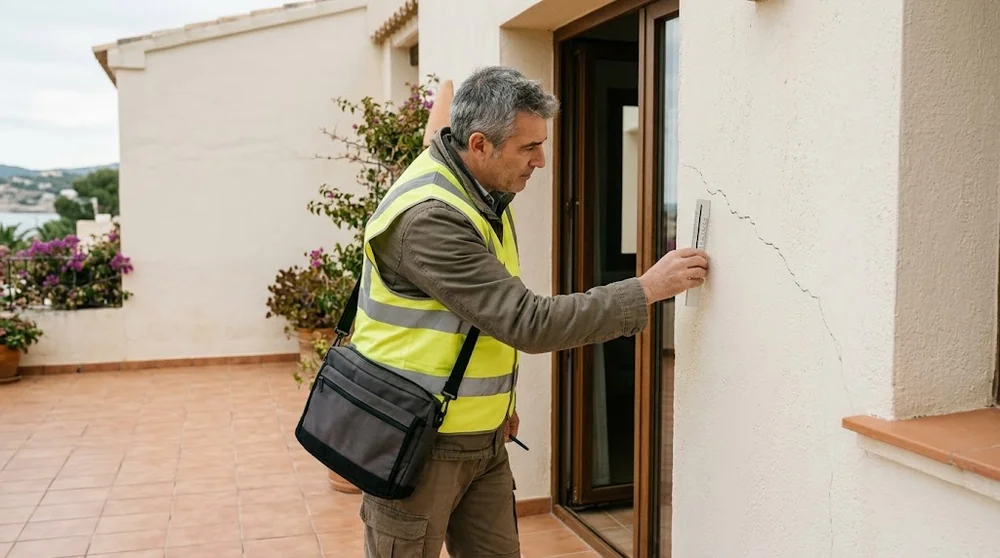
This is the step that protects you most. Always ask for the nota simple before you commit. The nota simple is an extract from the Registro de la Propiedad, the Land Registry, showing the registered owner, the description and any registered charges such as mortgages or embargoes. It is essential, but it does not prove structural condition or reveal every planning problem. Each check below answers a different question, so treat each one separately.
| Check | Evidence | Responsible professional | If unresolved |
|---|---|---|---|
| Title and seller authority | Recent nota simple, seller identities, powers or probate documents | Abogado | Do not sign arras until every registered owner can sell |
| Charges and easements | Nota simple entries, lender redemption statement | Abogado | Require cancellation at completion, written into the contract |
| Registry, Catastro and physical match | Nota simple, cadastral certificate, plans, site visit | Abogado and technical inspector | Clarify discrepancies and agree who corrects them before arras |
| Extensions and planning status | Town hall planning certificate, licences, plans | Abogado, with technical input | Renegotiate, require legalisation or walk away |
| Occupation or habitability | Occupation licence or the regional equivalent | Abogado | Check utility, mortgage and letting consequences before proceeding |
| Structural condition | Written survey report | Technical inspector | Obtain repair quotes; renegotiate or withdraw within the conditions |
| Energy certificate | Certificado de eficiencia energética | Seller, checked by abogado | Require it before signing the deed |
| IBI and local charges | Latest IBI receipt and debt confirmation | Abogado or gestor | Seller pays or amount is retained at completion |
| Community debts and assessments | Debt certificate from the comunidad’s administrator, recent minutes | Abogado | Seller settles; clarify who pays approved works |
| Tenants and possession | Lease review, seller declaration, site visit | Abogado | Require vacant possession as a completion condition |
The Catastro, the tax property register, describes boundaries and built area for tax purposes; the Registry protects ownership rights. On the Costa del Sol it is common to find a house whose registered size, cadastral size and actual size all differ because of an undeclared extension or an enclosed terrace. An illegal alteration can mean fines, difficulty obtaining a mortgage or, in serious cases, demolition orders, so planning legality is a check in its own right.
Apartments and many urbanisations belong to a comunidad de propietarios, the owners’ association that manages shared areas. Under national Horizontal Property Law, the property can answer for certain unpaid community fees from the current year and the three preceding years. Catalonia applies its own civil code, so a Barcelona purchase needs confirmation of the applicable rule. Read the recent minutes for approved works, such as a new lift or roof, which can mean a large bill shortly after you buy.
Location adds checks where relevant: Coastal Law (Ley de Costas) easements near the shoreline, rural-land restrictions inland, and the restricted-area permits mentioned in Step 4. Complete due diligence before any unconditional commitment.
Ten years on the Costa del Sol have taught me that hidden debts and paper-less extensions are rarely hidden from someone who looks properly. The trouble almost always comes from nobody looking until the money has gone.
Step 8: Review Any Reservation Contract
A contrato de reserva is a short agreement in which the buyer pays a reservation fee and the seller takes the property off the market for a set period. A separate reservation is optional, and its effect depends entirely on the wording. The preferred route is to complete the checks in Step 7 before paying anything. If an agent insists on a reservation while full checks are pending, have your lawyer review written safeguards first.
Check these points before paying a reservation fee:
- Refund triggers: the fee should be refundable if title, debts, planning or finance checks fail.
- Recipient: who receives the money, and in which account it is held.
- Holding arrangements: whether funds are held by a lawyer or released straight to the seller.
- Exclusivity: a clear commitment that the property is withdrawn from sale.
- Expiry: a fixed date after which the reservation lapses and the refund position is clear.
- Payment evidence: a receipt naming the parties, the property and the purpose of the payment.
Never assume a reservation fee is held in escrow or refunded automatically. Decline to pay, or ask for amended terms, if the document is missing refund conditions, names the wrong parties or sends money to a personal account without explanation. Any reservation fee should be credited against the price in the arras contract.
Step 9: Agree the Contrato de Arras
The contrato de arras is the private purchase agreement in which the buyer pays a deposit and both parties commit to completing on agreed terms. It is normally signed once due diligence is complete, and it is far more significant than a reservation. A deposit of 10% of the price is common practice, but no law sets that figure; the amount is negotiated. Any reservation fee already paid normally counts towards the total agreed deposit, so a €3,000 reservation followed by a €30,000 agreed deposit means €27,000 more, not €30,000.
Spanish law and practice recognise different types of arras. Confirmatory arras treat the payment as part of the price and leave contractual remedies open. Penalty arras set a sum payable on breach. Withdrawal arras, known as arras penitenciales, allow either party to walk away at a price. As of October 2026, Article 1454 of the Spanish Civil Code provides that, where withdrawal arras have been agreed, a withdrawing buyer loses the deposit and a withdrawing seller returns it doubled. Article 1454 consequences apply only where the contract actually creates withdrawal arras. Do not treat every Spanish deposit as withdrawal arras, and confirm whether a regional civil law, such as Catalonia’s, changes the analysis.
Finance protection must be written into the contract. A conditional clause might say: if the buyer’s mortgage of a stated amount is refused in writing by a stated date, or the valuation falls below a stated figure, the deposit is returned in full. Without such a clause, a mortgage refusal does not automatically release the buyer or guarantee a refund. The arras contract should also set the completion deadline, how extensions are agreed, what happens on default, and which fixtures and furniture stay.
If you have an arras draft in front of you and are unsure what the finance clause actually protects, a short one-to-one conversation before you sign can clear up the taxes, deadlines and legal steps for your case.
Ask David a question on WhatsApp
Whatever you decide, keep a copy of the signed arras contract and the deposit transfer receipt together. Both are needed at completion and again when taxes are filed.
Step 10: Finalise the Mortgage and Completion Pack
Financed buyers now move from indicative terms to binding documentation. Cash buyers skip only the mortgage-specific tasks; every legal check still applies.
- Tasación versus survey: the bank’s valuation tells the lender what the property is worth as security; a technical survey tells you about the building’s condition. One does not replace the other.
- FEIN and FiAE: under Law 5/2019 on real-estate credit contracts, the lender must provide the FEIN (Ficha Europea de Información Normalizada, the standard European mortgage information sheet) and the FiAE (Ficha de Advertencias Estandarizadas, a warnings sheet on key clauses).
- Documentation period: as of October 2026, Law 5/2019 sets a national minimum of ten calendar days between receiving the documentation and signing; check whether a longer regional requirement applies.
- Notarial advice: before signing, you attend a notary, free of charge, who checks the documentation and explains the loan in a recorded transparency act.
- Expense allocation: Banco de España guidance distinguishes mortgage expenses generally borne by the lender, such as mortgage-deed notary fees, mortgage registration and the AJD on the mortgage deed, from your own purchase expenses, such as ITP or IVA, sale-deed costs and the valuation.
- Refreshed title check: your lawyer obtains an updated nota simple shortly before completion.
- Draft deed: your lawyer reviews the draft escritura against the arras contract.
- Funding: the mortgage funds and your equity are confirmed and arranged in the agreed form.
- Seller’s charges: arrangements to cancel any existing seller mortgage at completion.
- Interpretation: arrange an interpreter if you are not fluent in Spanish.
- Final inspection: visit before signing to confirm condition, inventory and vacant possession.
A lender’s early assessment is not final approval; only the binding offer and the documents above commit the bank.
Step 11: Sign the Escritura and Receive Keys
Completion happens at the notary’s office with the signing of the escritura pública de compraventa, the public deed of sale. You attend in person or are represented under the power of attorney from Step 3. The notary confirms identities, reads or summarises the deed, records the price and the payment method, and checks that legal requirements are met.
- Payment method: the deed records how the price is paid, commonly by bank draft or bank transfer.
- Payment instructions: verify any bank details by telephone through an independently confirmed number; never trust account changes sent by email alone.
- Discharge: any seller mortgage is repaid from the proceeds, with arrangements for its formal cancellation.
- Possession: keys are handed over on the terms agreed, normally at signing.
- Handover: check the inventory, collect all keys, gate remotes and alarm codes, and photograph the meter readings.
- Vacant possession: confirm that the property is empty if that was agreed.
Where the seller is not tax-resident in Spain, the buyer must generally withhold 3% of the price and pay it to the AEAT using Modelo 211 within one month of completion, as of October 2026. The 3% withholding comes out of the seller’s proceeds and is not an extra cost on top of the price. In a hypothetical €300,000 purchase, the buyer pays €291,000 to the seller and €9,000 to the tax agency, so the buyer’s total remains €300,000. The deed should name who files Modelo 211, normally the buyer’s lawyer.
Receiving keys means you are in possession, but registration in the Registro de la Propiedad is a separate task that follows.

Step 12: File Taxes and Register the Purchase
Under Spanish law, ownership generally passes through a valid contract together with delivery, which the signing of the public deed usually achieves. Registration protects your title against third parties. Receiving the keys is not the same as completing registration. Your lawyer or gestor should handle these tasks and confirm each one in writing:
- Deed presentation: the notary usually sends the deed electronically to the Registry on the day of signing.
- Purchase tax: file and pay ITP, or AJD on a new build, with the regional tax office within its deadline; confirm the regional deadline rather than assuming one national rule.
- Modelo 211: where the seller is non-resident, file within one month of completion, as of October 2026.
- Registration: after the tax filing, the Registry records you as owner; obtain an updated nota simple as evidence.
- Catastro: confirm any cadastral notifications required for the change of owner.
- Utilities: transfer electricity, water, gas and internet contracts into your name.
- Insurance: arrange buildings and contents cover from completion; lenders often require it.
- Community: notify the comunidad’s administrator of the new owner and payment details.
- Ongoing taxes: diarise IBI and, for non-residents, annual non-resident income tax filings.
The deliverable for Step 12 is written confirmation from your lawyer or gestor that every filing has been completed, with copies of the receipts.
How Long Does Buying a House in Spain Take?
No Spanish law fixes the length of a whole purchase. Many guides estimate around 8–12 weeks from accepted offer to keys for a straightforward resale, with longer estimates where a mortgage is involved. That figure is a planning estimate, not a legal period, and it assumes you started on your NIE and funding early.
| Stage | Indicative timing | Common delay triggers |
|---|---|---|
| NIE and documents | Days to several weeks (estimate) | Appointment shortages, translations, apostilles |
| Offer to arras | One to three weeks (estimate) | Missing seller documents, planning discrepancies |
| Mortgage approval and valuation | Several weeks (estimate) | Income evidence, valuation shortfall |
| Mortgage documentation period | At least ten calendar days (Law 5/2019 minimum, as of October 2026) | Late FEIN delivery, notary availability |
| Completion | Date set in the arras contract | Payment compliance checks, cancelling seller charges |
| Tax filing and registration | Weeks to months after completion (estimate) | Registry queries, missing filings |
Off-plan purchases are different again: completion depends on the developer finishing the building and obtaining the required documentation, which can take a year or more after signing.
The practical conclusion is simple. Start the paperwork early, check before you pay, put every protection in writing and name who files what after completion. Buyers who follow that order rarely face the nasty surprises that fill expat forums.
If you are still working out which region, budget and type of property suit your goals, a short purchase-readiness check can help you build a realistic shortlist before you book a viewing trip.
Get a tailored selection of properties in Spain
There is no obligation attached to that, and the steps above work just as well with any independent lawyer you choose. What matters is that each check happens in the right order.
Disclaimer: This article provides general information on Spanish property law, tax and finance as of October 2026. It is not legal, tax or financial advice. Rules, rates and deadlines vary by region and can change, so consult an independent lawyer, tax adviser or lender about your circumstances before making commitments.
Buying a House in Spain: Frequently Asked Questions
Can British citizens buy a house in Spain after Brexit?
British citizens can generally buy residential property in Spain without becoming residents. Ownership does not grant residence or extend permitted visitor stays. As of October 2026, ordinary short stays generally follow the Schengen 90-days-in-180 rule, and new investor visas ended on 3 April 2025. A lawyer should check property-specific restrictions, including permits in designated military areas.
How long does it take to buy a house in Spain?
A straightforward resale purchase is often planned over roughly eight to twelve weeks from an accepted offer to completion, but this is an estimate, not a legal deadline. NIE appointments, mortgage approval, missing documents and planning problems can extend the process. Your contract should set a realistic completion date and explain how agreed extensions will work.
What documents do I need to buy a house in Spain?
Buyers normally need identification, an NIE and evidence supporting the source of their funds. Mortgage applicants also need lender-specific income and financial documents. The property file should include title information, relevant planning and occupation evidence, energy documentation and debt checks. Your lawyer should confirm the exact list for the property, region and way you are buying.
How much extra should I budget when buying a house in Spain?
Budget for the price plus applicable taxes, legal work, notary and registration charges, and any survey, valuation or payment costs. A rough allowance of 10–15% is only a starting point. The actual total depends on location, property type, taxable value and agreed fees. Reservation and arras payments normally count towards the price rather than adding another purchase cost.
Can I get my deposit back if my Spanish mortgage is refused?
A refused mortgage does not automatically entitle every buyer to a refund. Recovery depends on the contract, the applicable law and any valid financing condition. Before paying, have your lawyer agree what happens if lending is refused, the valuation is too low or approval arrives late. Do not rely on an agent’s verbal assurance that the deposit is protected.
Do I need a Spanish bank account and a lawyer to buy property?
A Spanish bank account is often practical and may be required by your lender, but it is not a universal statutory condition for every purchase. Using an independent lawyer is generally a protective recommendation rather than a universal legal requirement. Ask your lawyer and bank to confirm acceptable payment arrangements and who will handle contracts, taxes and registration.
Final Thoughts
Buying a house in Spain follows a clear sequence: budget for the full cost, get your NIE and finance moving early, appoint an independent abogado, and finish every title, debt and planning check before signing an arras contract. Deposits count towards the price, a non-resident seller’s 3% withholding comes out of their proceeds, and a mortgage refusal protects you only if the contract says so.
In my professional view, the buyers who do best are not the ones who move fastest but the ones who insist on paperwork at every stage. The keys are a lovely moment, but the job is finished only when the taxes are filed, the Registry shows your name and someone has confirmed it to you in writing.
Leave a Reply