
You have a shortlist of two or three Spanish second homes, a holiday-sized dream and a very real budget. The decision in front of you is not which flat has the nicest terrace. It is whether any of them has earned an offer, needs a lower price, deserves paid checks first, or should be dropped. I moved from Manchester to Marbella over ten years ago, and the buyers who sleep best treat an offer as the start of verification, not the end of it.
Before offering on a second home in Spain, check ownership, registered charges, planning legality, occupancy documents, physical condition and community debts. Confirm the full purchase and annual running costs, your permitted length of stay and any rental restrictions. Have an independent lawyer review the proposed commitment before you sign or pay.

Your Second Home Buying Checklist for Spain
Here are ten checks, in the order I would run them. Each one needs evidence, not reassurance from a seller or an agent.
- Intended use and stay rights: how many weeks, in which months, and whether any letting is planned.
- All-in budget: purchase costs plus a yearly ownership budget that assumes no rent.
- Seller and title: who owns the home, who may sell it and what is registered against it.
- Registry versus reality: the Registro de la Propiedad (Land Registry) and the Catastro (the state property cadastre) compared with the actual home, garage and storage room.
- Planning and occupancy: lawful residential use, any extensions, and the habitation document that applies in that region.
- Community debts and works: arrears, minutes, budgets and planned levies.
- Survey and insurance: an independent technical inspection and indicative insurance terms.
- Rental permissions: checked only if letting is part of your plan.
- Finance and funds: written lender approval, source-of-funds evidence and a currency plan.
- Offer terms: the wording reviewed by an independent lawyer before you sign or pay.
When checks must be finished
An exploratory offer says you are interested. A reservation payment holds the property for a period. A contrato de arras, the Spanish deposit contract that commits both sides towards the sale, can bind you far more tightly, depending on its wording. Full checks should therefore precede any unconditional commitment. Where checks remain open, a lawyer-drafted condition should protect you. Always ask for the nota simple before you commit.
Who proves what, and what the statuses mean
Verified means a named professional has seen a dated document or inspected the home and recorded the result. Unresolved means evidence is pending, conflicting or only verbal. Unacceptable means the evidence shows a defect or incompatibility that you will not accept unless it is cured before signing.
| Check | Evidence | Verifier | Deadline | Status |
|---|---|---|---|---|
| Ownership and charges | Recent nota simple, seller identity | Your lawyer | Before any reservation payment | Record one status |
| Planning legality | Town hall confirmation or architect’s report | Lawyer and architect | Before arras | Record one status |
| Occupancy document | Licence or certificate valid in that region | Your lawyer | Before arras | Record one status |
| Community debts | Administrator’s certificate, statutes, minutes | Your lawyer | Before arras, refreshed before the deed | Record one status |
| Condition | Written survey with repair estimates | Independent surveyor | Before arras | Record one status |
| Finance | Written lender approval | Lender or broker | Before arras | Record one status |
Check How You Will Use the Home
A legally clean flat that you cannot reach, heat or manage is still a poor second home. Test your real pattern of use before you test the paperwork.
Holidays
Count the door-to-door journey, not the flight time. Check winter flight schedules from your nearest airport, because summer timetables flatter many Spanish routes. Visit outside peak season if you can, and see which shops, restaurants and services stay open in January. Mobility matters too: a lovely fourth-floor flat without a lift is a different proposition at sixty-five.
Extended stays
Ownership and immigration permission are separate things. Owning a Spanish property does not give you a right of residence or extra visitor days. As of November 2026, British visitors without an applicable residence status or exemption are generally limited by the Schengen 90/180-day rule: no more than 90 days in any rolling 180-day period across the whole Schengen area. Check the UK government’s Spain entry requirements guidance and the Spanish consular guidance for your own circumstances, and note that the EU is introducing new border systems whose start dates change. Tax residence is a separate analysis. It does not turn on one day-count alone, so take advice before you plan long winters.
Mixed use with letting
If you plan to let the home for part of the year, your usage calendar must work around bookings, handovers and cleaning. Heating, cooling, healthcare access and a reliable keyholder matter more when you are not there. Decide who manages the home in your absence before you offer, not after you collect the keys.
Set Your Purchase and Annual Ownership Budget
Buyers often compare asking prices and forget that a Spanish home has two budgets: what it costs to acquire and what it costs to keep. I want both on one page, with no rental income propping up the sums.
Acquisition costs
| Item | What to confirm |
|---|---|
| Negotiated price | Written price, inclusions and furniture list |
| Resale transfer tax (ITP) | Rate set by the autonomous community; confirm with the regional tax authority |
| New-build taxes | VAT-type indirect tax plus stamp duty (AJD), with the AJD rate set regionally |
| Canary Islands | A separate indirect-tax regime applies; have it calculated locally |
| Legal and technical fees | Written fee quotes and scope |
| Notary and registry | Estimate and allocation between the parties |
| Valuation, currency, repairs, furnishing | Lender valuation fee, exchange cost, priced repairs, furnishing allowance |
Two values are easy to confuse. The valor de referencia is a value the Catastro publishes for property transactions, and tax authorities use it as a minimum base for ITP and AJD, so the taxable base can exceed your agreed price. The valor catastral is the separate cadastral value used for IBI (Impuesto sobre Bienes Inmuebles, the annual municipal property tax) and for the non-resident imputed-income calculation. Ask your adviser which value applies to your purchase.
Annual ownership costs
Annual rows are IBI, waste charges, community fees, any extraordinary levies, insurance, utilities, maintenance, management and the non-resident tax. The Agencia Tributaria (AEAT) explains on its official website that non-residents owning a home for private use may owe tax on an imputed income under the Modelo 210 return. As of November 2026, AEAT guidance gives 19 per cent for residents of the EU, Iceland, Norway and Liechtenstein and 24 per cent for other taxpayers, including British residents. The imputed income is commonly 1.1 or 2 per cent of the valor catastral, depending on its revision date. Have a tax adviser confirm your case.
Illustrative annual budget with zero rent
The figures below are assumptions for a hypothetical €300,000 apartment, not quotes or local averages.
| Line item | Assumption | Annual (€) |
|---|---|---|
| IBI | Assumed bill | 450.00 |
| Community fees | €150 per month × 12 | 1,800.00 |
| Waste charge | Assumed bill | 120.00 |
| Insurance | Buildings and contents, assumed | 350.00 |
| Utilities | Standing charges and light use | 900.00 |
| Maintenance | Allowance | 1,500.00 |
| Management and keyholding | Assumed | 600.00 |
| Non-resident tax | €90,000 assumed valor catastral × 1.1% = €990, then × 24% | 237.60 |
| Total | Excludes levies and rent | 5,957.60 |
That total is about €496 a month, or just under 2 per cent of the assumed price. Rates, fees and levies vary by region and building, so replace each assumption with dated local evidence before you rely on it.
Read the Nota Simple and Verify Possession
The nota simple is an informational extract from the Registro de la Propiedad. It is quick and cheap, and it tells you what the register says on the day it is issued. It is not a guarantee of everything about the property.
- Sellers and authority: the registered owners must match the people selling. Co-owners, heirs, companies and attorneys each need documentary proof of authority.
- Charges: look for mortgages, attachments (embargos), easements and usufructs, which are rights of use that can belong to someone other than the owner.
- Description: compare the registry and Catastro entries with the actual home, garage, storage room and boundaries. A mismatch needs explaining. An unregistered feature does not automatically mean it cannot be owned, but it does need legal analysis.
- Dates: note the issue date, because charges can be registered afterwards.
Possession is a separate question
Here’s where people usually come unstuck: a clean nota simple is read as proof that the home is empty, legal and debt-free. It proves none of those. An absence of a registered lease does not prove vacancy, so ask separately about tenants, family occupiers, informal arrangements and existing holiday bookings. Your lawyer should check vacant-possession obligations in the contract and what happens to bookings already taken.
The limits of a title check are practical. It will not show hidden structural defects, unpaid utility bills, community arrears or planning breaches. Those sit in other documents, which the next sections cover.
Verify Planning and Occupancy Documents
Planning legality
- Confirm that residential use is permitted for the property and plot.
- Check extensions, enclosed terraces, pools and outbuildings against approved plans.
- Ask the town hall (ayuntamiento) whether any disciplinary or enforcement proceedings exist.
- Do not treat a cadastral entry, a utility connection or the passage of time as proof of full legality. Each can exist for a building that has planning problems.
Occupancy evidence
Spanish habitation documents differ by region. A licencia de primera ocupación is a licence granted by the town hall confirming a new or substantially rebuilt home matches its permit. A cédula de habitabilidad is a habitability certificate used in some regions, with its own conditions and validity. The names, issuing bodies and legal effects are not interchangeable, so ask your lawyer which document applies to this home in this region and whether the seller has a valid one.
Special property risks
Some triggers need extra work: rural land (suelo rústico) with restricted building rights, coastal land subject to coastal protection rules, and listed or protected buildings with limits on alterations. Check them only where they are relevant to the home. Ten years on the Costa del Sol have taught me that a lovely illegal extension is still illegal, however good the view from it.
Regional variation is real here. Planning limitation periods, fines and regularisation routes differ between autonomous communities, so a rule you read about for one region should not be applied to another without local advice.
Check Community Debts, Rules and Major Works
Most Spanish flats belong to a comunidad de propietarios, the owners’ association that runs the shared parts. Its legal framework is the Ley de Propiedad Horizontal (LPH, Law 49/1960), published in the BOE, Spain’s official gazette, and you can read the consolidated text on the BOE website. Request these items before you commit:
- A current community debt certificate from the administrator.
- The statutes and house rules, including pet, noise and letting restrictions.
- Recent meeting minutes, the budget and the reserve fund position.
- Any litigation involving the community.
- Approved or proposed derramas, which are special assessments for major works.
Arrears versus future levies
Seller arrears and future special assessments are different risks. Under article 9.1.e of the LPH, as the current national text stands in November 2026, a buyer’s property answers for community expenses left unpaid by previous owners for the unpaid part of the current year plus the previous three calendar years. The seller must declare the position in the deed and provide a debt certificate, unless the buyer expressly exempts them. I would not waive that certificate. Catalonia has its own civil-law rules, so verify them separately before applying this period to Barcelona or elsewhere in Catalonia.
Works and who pays
Lifts, façades, roofs, pools and accessibility works can cost thousands per owner. The contract should say who pays any derrama approved before the deed, and your lawyer should review minutes for works that are discussed but not yet voted. Everything you can quantify belongs in the price conversation, and anything you cannot quantify is a reason to ask more questions.

Survey the Property and Price Absence Risks
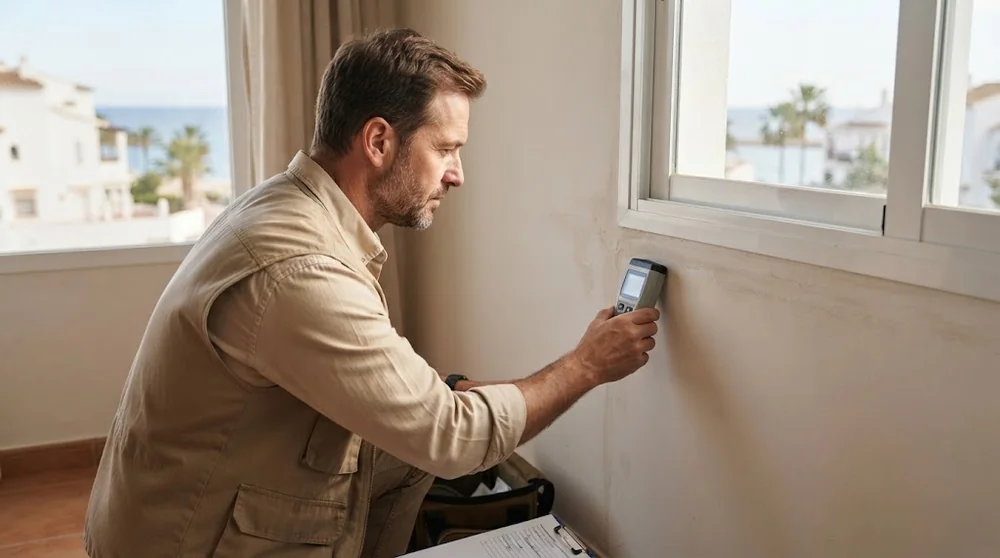
A lender’s valuation protects the lender by testing whether the property supports the loan. An independent condition survey protects you by describing what is wrong with the building. They answer different questions, and the first cannot replace the second.
- Damp and structure: look for cracks, moisture, mould and signs of movement. A Mancunian knows damp when he sees it, and Spain has plenty, especially in ground-floor and north-facing homes.
- Roofs and drainage: check flat roofs, terraces, gutters and drains, because water finds the weak point eventually.
- Systems: electrical installation, heating and cooling equipment, and the energy performance documentation required for sale.
- Pool: condition of the shell, pumps, safety features and running costs.
Price the findings
Obtain written repair estimates and indicative insurance terms before you commit. If an insurer will not cover the building, or will cover it only with heavy exclusions, that is a decision point, not a footnote.
Environmental exposure
Screen the specific address for flood, wildfire and coastal exposure using official mapping and a specialist assessment. No region is uniformly safe or unsafe, so assess the plot, not the postcode.
Absence planning
A home left empty for months needs a plan. Read the policy’s unoccupancy conditions, arrange a keyholder, and set up leak checks, ventilation and routine maintenance for the periods when nobody is there.
Verify Holiday Letting Before Counting Income
This section matters only if you plan to let the home. Owning a property and being allowed to let it to tourists are different things. Permission can depend on regional tourism law, municipal planning restrictions, community statutes and a registration process, and an advert or platform listing does not show that all of those are satisfied.
What to confirm
- The regional tourism rules for short lets, and whether the property qualifies.
- Whether municipal planning allows tourist use in that building or zone.
- Whether the community statutes or a vote restrict letting.
- The status of any existing authorisation or registration number, and what happens to it when ownership changes.
Jurisdiction-check matrix
| Location | Jurisdictions to check |
|---|---|
| Barcelona | Catalan regional tourism rules; Barcelona city council |
| Madrid | Community of Madrid tourism rules; Madrid city council |
| Valencia, Alicante | Valencian regional tourism rules; the relevant city council |
| Málaga, Marbella | Andalusian regional tourism rules; the relevant town hall |
| Mallorca | Balearic regional rules; the island authority and municipality |
| Tenerife | Canary Islands regional rules; the relevant municipality |
I am not asserting a rule for any of these places, because local rules change and I have not verified current details for each. Treat rental income as zero in your affordability sums unless independent, dated evidence supports it.
Confirm Finance and Review Offer Conditions
Finance and identity
Plan your NIE (Número de Identidad de Extranjero, the foreigner’s tax identification number) early, because it is needed for the purchase and later tax filings. I would not say it is universally required just to submit an offer, so ask your lawyer what the particular deal needs. Expect identity and source-of-funds checks from the notary, the bank or your lawyer. A Spanish bank account is practical for paying local bills and may suit a lender, but it is not legally mandated for every foreign buyer.
Indicative eligibility from a broker is not lender approval. Ask for approval in writing, and ask what happens if the lender’s valuation falls below the price, since you would have to fund the gap. If your income and savings are in sterling, decide how you will manage the exchange rate between offer and completion.
What an offer can do
The legal effect of an offer, a reservation agreement or arras depends on the wording and the circumstances, not on the document’s label. Some reservations are simple holding deposits, while some arras clauses allow withdrawal at a cost and others work as part payment of a binding sale. Article 1454 of the Civil Code, which you can find on the BOE website, gives a default rule for withdrawal arras, but it is not a universal deposit guarantee and I would not rely on automatic double repayment.
Conditions to put in writing
- Finance, survey and legal-check conditions, each with a deadline.
- Refund terms stated clearly, not assumed.
- Inclusions and exclusions, including furniture and appliances.
- Vacant possession, tenancies and existing bookings.
- Payment instructions checked by phone with a known number before you transfer any money. Email fraud targeting property deposits is a recognised risk.
Decide: Proceed, Renegotiate or Stop
| Situation | Decision | Typical next step |
|---|---|---|
| Evidence satisfactory | Proceed | Sign with agreed conditions |
| Quantifiable issue with an agreed remedy | Renegotiate | Adjust price or add a contract condition |
| Essential evidence missing | Pause | Do not commit until it arrives |
| Lawful use incompatible with your plans | Stop | Walk away or change your plan |
| Finance or insurance unworkable | Stop | Withdraw before binding commitment |
Three hypothetical examples
These are illustrations, not client cases.
- A Costa del Sol apartment has a clean nota simple, but the survey prices roof repairs at a fixed amount. The buyer asks for a price reduction and agrees a deadline.
- A villa has an undocumented extension. Without planning evidence, the buyer stops.
- A second home depends on tourist letting, but permission cannot be verified. The buyer removes the income from the sums and re-tests affordability.
Document pack to request
Ask for a recent nota simple, seller identification and authority, the Catastro description, the planning and occupancy documents, the community debt certificate with statutes and minutes, the latest IBI receipt, the energy certificate and any letting authorisation.
If you would like a second pair of eyes, you can send me your shortlist and the documents you still lack, and I will help you decide what to ask for next. Specialist legal and technical checks would still sit with your independent Spanish lawyer and surveyor.
Second Home Buying in Spain: FAQs
What should I check before making an offer on a second home in Spain?
Check the seller’s title, registered charges, planning position, occupancy documents, community debts and physical condition. Build a purchase and annual ownership budget, and confirm that your intended stays and any letting are lawful. Have an independent lawyer review the proposed offer and identify unresolved checks before you sign or pay anything.
Should I get a nota simple before making an offer?
Yes, request a recent nota simple early enough to review registered ownership and charges before you commit. It shows what the register says on its issue date. It does not establish planning compliance, physical condition or vacant possession, so your lawyer, surveyor and own enquiries must cover those separately.
Do I need an independent lawyer to buy a second home in Spain?
An independent lawyer is strongly advisable, though not compulsory for every purchase. Agree scope and fees in writing, covering title, planning, debts, occupation and contract terms. A notary has a statutory role that does not replace advice tailored to you, and a lender’s valuation does not replace a survey.
Can I rent out my Spanish holiday home when I am not using it?
Not automatically. Letting can depend on regional tourism rules, municipal planning, community statutes and registration, and an existing advert is not proof of permission. Your lawyer should check each layer and any ownership-change requirements. Do not include rental income in affordability sums unless it is independently substantiated.
What taxes do I pay on a second home in Spain?
Acquisition taxes depend on the region, whether the home is resale or new build, and your circumstances. Ongoing taxes include IBI and, for qualifying non-residents, income tax on imputed income via Modelo 210. Community fees, insurance and maintenance are costs, not taxes. A tax adviser should calculate your position.
How long can I stay in Spain if I own a holiday home?
Owning a Spanish home does not itself give you residence rights or extra visitor days. As of November 2026, British visitors without an applicable residence status or exemption are generally limited to 90 days in any 180-day period across the Schengen area. Count all Schengen stays and take individual advice before planning longer visits.
Final Thoughts
My advice to every British buyer is to make the paperwork earn your offer. Keep the evidence, the status of each check and the deadline in one place, and let the table above tell you whether to proceed, renegotiate or stop. A calm, slightly boring verification process is what lets you enjoy the terrace afterwards.
This article is general information, current as of November 2026, and is not individual legal, tax or financial advice. Rules vary by region and change over time. Consult an independent Spanish property lawyer, a suitable technical adviser and a tax adviser about your own purchase.
Leave a Reply