
A holiday home is bought with the heart and then has to be owned with the head, and the gap between those two is where most of the regret happens. A flat that feels perfect in August can be damp, noisy or half-empty in February, and a villa that looks like a bargain can carry planning problems that only surface at resale. Ten years on the Costa del Sol have taught me that, in my experience, many of the costliest errors are made early, before the buyer has paid much more than a small reservation. This guide walks through the ten I see most often, what evidence settles each one, and who should provide it.
When buying a holiday home in Spain, avoid paying before independent checks, budgeting only for the price, assuming holiday letting is permitted, and confusing ownership with residency. Check title, planning status, building condition, community liabilities and annual taxes. Test affordability without rental income and assess the location outside peak season.

The 10 holiday-home buying mistakes at a glance
Buying a home for your own holidays is a different exercise from buying one that must earn rent to stay affordable. In the first case, the main risks are usability, title, condition and running costs. In the second, permissions and cash flow become the make-or-break issues. Here is the full list, and each item has a matching check you can complete before any binding commitment:
- Buying the holiday feeling instead of year-round usability.
- Paying before independent legal and contract checks.
- Treating the nota simple as a complete legal clearance.
- Skipping the survey and environmental checks.
- Budgeting for the price rather than the purchase.
- Ignoring community debts and major works.
- Assuming holiday letting is automatically permitted.
- Expecting rent to cover every ownership cost.
- Confusing ownership, visiting rights and tax residence.
- Leaving maintenance, inheritance and resale until later.
1. Buying the holiday feeling instead of year-round usability
A holiday home must work on the days you actually use it, not only on the sunny week you viewed it. Seasonal patterns differ: a Marbella or Malaga apartment may be lively in winter, while parts of Alicante, Mallorca or Tenerife can be quiet or shuttered in the off-season. I am not ranking places here; I am saying you should visit the specific street out of peak season. Always test a property in the months you really intend to use it.
Here is a low-season viewing checklist:
- Time the real door-to-door journey from your home, including the airport transfer and the drive from the arrival airport.
- Check winter flight frequency from your regional UK airport, since schedules thin out considerably.
- Walk to the nearest open supermarket, pharmacy and health centre on a weekday in January.
- Count the stairs, check lift reliability, parking and step-free access if mobility matters now or in ten years.
- Ask about heating: many Spanish homes are built for summer and feel cold and damp in winter.
- Visit on a summer Saturday night to hear the bars, the traffic and the neighbours.
Then be honest about annual use. If you will stay five weeks a year, compare your full ownership costs against renting similar accommodation for those weeks. My advice to every British buyer is to write down the weeks you will genuinely use the property, then price them both ways. If renting wins, that is useful information, not a failure.
2. Paying before independent legal and contract checks
The most expensive mistake is handing over money before anyone independent has read the paperwork. Every professional in a Spanish purchase has a different job. The estate agent markets the property and brokers the sale. Your independent lawyer works for you, checks the seller, the title and the contract, and handles tax filings. The lender values the property for its own security. The notary is impartial: they give both parties legal information, check the identity and capacity of the signatories and the legality of the deed, but they do not act for you and do not replace your own adviser. Agency help with paperwork never replaces your own lawyer.
You will need an NIE, the foreigner’s tax identification number used for property, tax and utilities. Start the application early and ask your lawyer exactly when it is needed for your transaction, because the timing depends on how the deal is structured. Your lawyer will also ask for source-of-funds evidence, because Spanish banks and notaries apply anti-money-laundering checks, and delays here can push a completion date.
The next document is usually a reservation agreement and then a contrato de arras, the private contract that binds both sides before the deed. Article 1454 of the Código Civil on the BOE website deals with penitential arras: where that type of arras has been agreed, a buyer who withdraws loses the sum and a seller who withdraws returns it doubled. Not every deposit is automatically governed that way, so the wording decides. Likewise, a deposit of 10% is a negotiated practice, not a legal requirement for every sale.
Before signing or paying, have your lawyer review:
- the type of arras and the refund or forfeiture consequences;
- any finance clause and due-diligence conditions, with dates;
- the completion deadline and what happens if it slips;
- who is receiving the money, confirmed through verified bank details, never by email instruction alone.
Let me put it plainly: a deposit paid before your lawyer has read the contract is a decision, not a formality. In my opinion, the weeks you save by hurrying are rarely worth the rights you give up.
3. Treating the nota simple as a complete legal clearance
A nota simple is an informative extract from the Registro de la Propiedad, the land registry, showing the registered owner, the property description and recorded charges such as mortgages or embargoes. It is not a formal registry certification, and it is not a clearance of the whole property. Always ask for the nota simple before you commit, and make sure it is recent.
Here’s where people usually come unstuck: they assume the registry tells the whole story. It does not. Registration, cadastral entry and planning legality are three separate things.
What the nota simple cannot prove
- Planning legality: a building can be registered, or appear in the Catastro (the cadastral property database), and still have unauthorised extensions. The municipal planning department holds that evidence.
- Layout and size: the registry description, the Catastro record and the physical property can all differ.
- Occupancy documentation: the certificates proving a home may be occupied have different names and requirements by region, so ask your lawyer which applies.
- Access and services: rights of way and utility connections may need separate checks.
Compare the three sources against what you see on site. Pools, enclosed terraces, added storeys and garden buildings are classic discrepancies. Some owners cheerfully tell you “everyone does it”, which is exactly when I reach for the planning file.
Coastal properties need one more layer. The Ley de Costas, published in the BOE, creates protection zones along the shoreline that can limit works, extensions and in some cases the use of existing buildings. Whether a given plot is affected is a property-specific question for your lawyer and the relevant authority.
4. Skipping the survey and environmental checks
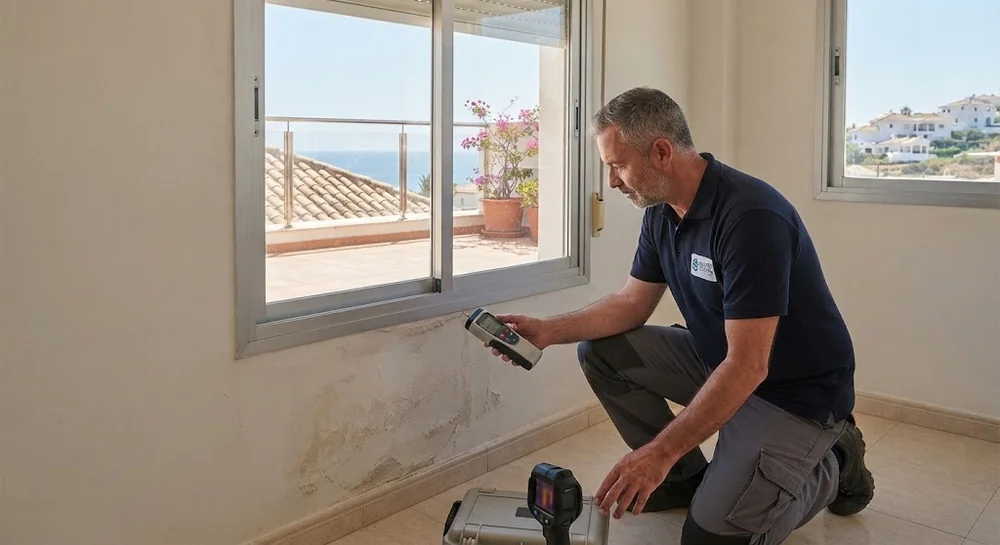
A mortgage valuation tells a lender what the property is worth as security; it is not a condition survey and says little about defects. A buyer-commissioned inspection by a qualified architect or technical architect is the only check aimed at your interests. Never treat a lender valuation as proof the building is sound.
Ask the surveyor to cover:
- Damp: a diagnosis of cause, whether condensation, leaks or rising damp, not just a note that it exists.
- Roofs and terraces: waterproofing condition, drainage and evidence of past leaks.
- Coastal corrosion: balcony rails, window frames, reinforcement exposed by spalling concrete.
- Installations: wiring, plumbing, water heating, and the cooling and heating systems.
- Flood exposure: an address-level assessment using the official flood mapping, site context and past events. Valencia and Alicante are useful reminders that risk varies street by street, and I am not suggesting whole cities are unsafe.
- Insurability: ask an insurer to confirm cover for that address before you commit.
Agree the scope and fee in writing before the visit, and ask the surveyor to attend with you if you can. A fee of a few hundred euros to a couple of thousand, depending on size and complexity, is small next to a failed roof or a damp problem that needs wall-to-wall remedial work. A good report ranks findings by urgency: safety issues, defects that need fixing within a year or two, and cosmetic points. It also says what the surveyor could not see, such as pipework behind tiling or a roof they could not reach. Those gaps are where surprises hide, so read them as carefully as the findings.
Timing matters as much as the report itself. Book the inspection as soon as the seller accepts your offer, because a good technical architect may need a week or two, and a rushed visit tends to produce a thin report. If the seller will not allow access before you pay a deposit, treat that as information about the seller. I have seen buyers wave through a “recently painted” ceiling that turned out to be hiding a slow leak from the flat above, and the paint was the only thing the seller had actually fixed.
Ask for repair estimates in writing from independent contractors. Then decide with your lawyer whether to retain the deal, renegotiate the price or withdraw under the contract conditions. A defect with a clear price and a clear remedy is something you can negotiate; a safety or structural question nobody can answer is a reason to stop. Get the survey and the insurer’s answer before the arras are signed, or build them into the contract as conditions.
5. Budgeting for the price rather than the purchase
The asking price is only the first line of the bill. There is no single Spanish figure for purchase costs, and quoting 10–12% for everyone is lazy. The right total depends on region, whether the home is resale or new, and the taxable value. Here is the structure, with rates to be confirmed by your lawyer for your region and transaction, as of November 2026:
| Cost line | Resale home | New-build from developer |
|---|---|---|
| Main transfer tax | ITP, set by each autonomous community | IVA, generally 10% for qualifying housing; exceptions apply |
| Stamp duty | Not usually charged in addition to ITP | AJD, a regional rate on the deed |
| Canary Islands | An ordinary private resale generally attracts ITP, not IGIC | Qualifying first deliveries bear IGIC rather than IVA; AJD is assessed separately |
| Notary and registry | Scale-based fees, ask for estimate | Scale-based fees, ask for estimate |
| Lawyer and technical fees | Agreed in advance | Agreed in advance |
| Valuation and arrangement | Only if borrowing | Only if borrowing |
| Works and furnishing | Survey-led estimate | Snagging and furnishing |
Regional differences are real. As a guide to the general resale rate of ITP, as of November 2026: Madrid 6%, Andalusia 7%, the Canary Islands 6.5% and the Valencia region 10%. These are headline rates published by each regional tax authority; reduced rates, surcharges on higher values and buyer-profile reliefs exist, so your lawyer must confirm the rate that applies to you. On a €300,000 resale, the gap between Madrid and Valencia alone is €12,000.
Here is a worked, illustrative budget for a €300,000 resale apartment in Andalusia, using assumptions rather than quotes:
- ITP at 7%: €21,000.
- Notary and registry (assumed): about €2,500.
- Independent lawyer (assumed at about 1% plus IVA): about €3,600.
- Total before survey, works and furnishing: about €27,100, or roughly 9% on top of the price.
Add your survey fee, any repairs and furnishing on top. A mortgage adds valuation and arrangement costs, and a new-build swaps ITP for IVA plus AJD.
The tax base needs care, and the two taxes work differently. For ITP on a resale, the base is generally the highest of three figures: the Catastro’s valor de referencia (the reference value the tax authorities publish for each property), the value you declare, and the price actually agreed. Where no reference value exists or can be certified, the ordinary valuation rules apply instead, and the tax office can check the declared value. AJD is a separate calculation. For the property-based AJD charged on a new-build deed, the valuation used cannot fall below the reference value. So a low price in the contract does not reliably lower either tax, and relief eligibility often depends on the buyer’s profile.
Currency matters, too. Sterling-to-euro movements between signing and completion change what you pay, and a mortgage pre-approval is conditional: it does not guarantee completion funding or a particular loan-to-value. Ask your lender in writing what conditions apply, and ask your lawyer for an itemised completion estimate in your region.
6. Ignoring community debts and major works
Most holiday homes are flats or townhouses within a comunidad de propietarios, the owners’ community that runs shared areas under the Ley de Propiedad Horizontal (LPH), the national condominium law published in the BOE. Debts and planned works in that community can become your problem, so ask for evidence rather than reassurance.
Request these from the seller, through the administrator, before paying a deposit:
- the community’s debt certificate showing whether the unit owes money;
- minutes of recent owners’ meetings, which show disputes, approved works and planned charges;
- the statutes, which may restrict pets, rentals or use;
- current budgets and reserve fund information;
- any planned derrama, an extra levy for major works;
- building inspection reports covering roofs, lifts, pools and façades.
Roofs, lifts, pools and façade repairs can run into five figures for a community. Your share normally follows your participation quota (the percentage shown in your title), unless a valid special allocation applies; the LPH allows contributions according to the quota or to what has been specially established. That is why your lawyer must read the title, the statutes and the relevant resolutions before anyone calculates your exposure. Do not assume an approved assessment automatically belongs to the seller or to you. Liability for debts and for instalments already approved depends on timing, the applicable legal rules and what the contract says, so have your lawyer confirm in writing who pays what and how it is split at completion.
One qualification: the national LPH framework should not be applied automatically in Catalonia, where a separate civil-law regime governs these communities. If you are buying there, ask for advice that addresses that regime specifically.
In my experience, a flat with a lovely terrace and a roof repair already voted through is not a bargain until someone has worked out who pays for the roof.

7. Assuming holiday letting is automatically permitted
Owning a holiday home does not give you the right to let it to holidaymakers. Using it yourself is one thing. Letting it as a tourist rental is a regulated activity, and several layers of permission may apply at once: municipal planning rules for that address, regional tourist authorisation, community rules and national requirements. Each layer can say no independently, so a yes from one does not settle the others.
Start with the address and property type. A flat, a townhouse and a villa can fall under different rules, and so can two streets in the same town. Cities and regions have taken very different approaches. Barcelona, Madrid, Valencia, Malaga, Mallorca and Tenerife all have their own rules and policies, and they change. I will not claim any of them has a blanket ban, because that would be unsupported; the safe step is to check the current official position for your specific address.
Community rules matter just as much. Under the LPH, reforms in force since 3 April 2025 require, where they apply, the prior express consent of the community before a flat can start tourist use. The approval needs three-fifths of all owners who also represent three-fifths of the participation quotas, subject to the applicable regime and transitional rules for existing situations. This national framework should not be exported uncritically to Catalonia, which has its own civil-law regime. Ask your lawyer to review the statutes and minutes against the current rules, as of November 2026.
If you want to check what your lawyer and community documents say before you sign, a short conversation about your specific property can help you ask the right questions.
Finally, the national platform-registration rules have moved. In the consolidated text of Real Decreto 1312/2024 on the BOE website, Articles 8, 9 and 10 (the single rental-registry procedure, the application for a registration number and its verification) and the second additional provision are marked as annulled, following the 2026 Supreme Court rulings noted there. What the consolidated text still contains is the digital-window framework: the Ventanilla Única Digital de Arrendamientos and the duties of online platforms to transmit activity data. I am not describing the annulled registration duty as a current requirement. Whether a replacement national or regional registration regime applies to your address is something I have not verified, so it must be confirmed in current written advice. Also remember that a seller’s old licence or a live platform listing does not prove those rights pass to you. Rental entitlement should be confirmed for you as the new owner, in writing, before you rely on it.
8. Expecting rent to cover every ownership cost
Rent rarely covers everything, and it depends on weeks you can actually let. Start by blocking the weeks you want to use yourself, because they are usually the peak weeks that earn the most. Then separate purchase costs from recurring costs: IBI (the annual local property tax), waste charges, community fees, insurance, utilities, maintenance, and any finance, tax and reserves. Some of those are fixed whether or not a guest ever arrives; others, such as cleaning, linen and management fees, only exist if you let.
Here is an illustrative cash-flow with hypothetical assumptions only, worked in euros because that is the currency the property runs in. It is not a market forecast, a net yield or a promise of returns. The sterling figures use an assumed rate of €1.15 per £1, purely for illustration.
| Line | Assumed amount (EUR) | Illustrative GBP at €1.15 |
|---|---|---|
| Weeks in the year | 52 | – |
| Owner’s own use (peak weeks) | 6 weeks | – |
| Weeks available after personal use | 46 weeks | – |
| Weeks assumed legally rentable and actually let | 12 weeks at €1,000 | – |
| Gross rent | €12,000 | £10,435 |
| Fixed costs (IBI, waste, community, insurance, standing utilities, maintenance) | €4,900 | £4,261 |
| Rental-dependent costs (cleaning, linen, management, platform fees) | €3,000 | £2,609 |
| Remainder before reserve, finance and tax | €4,100 | £3,565 |
| Repair and replacement reserve | €1,700 | £1,478 |
| Remainder before finance and tax | €2,400 | £2,087 |
Notice how few weeks do the work. Of 46 weeks available after your own use, the example assumes only 12 are both rentable and actually booked, which is deliberately modest. If your permissions turn out to allow no letting at all, the rent line is zero and everything below it changes. That is why I ask buyers to run the numbers on the cautious version first and treat any rental income as a bonus rather than the plan.
That €2,400 is still before mortgage interest, income tax and any other costs. Non-resident owners may have Spanish tax obligations through IRNR, the non-resident income tax (the rules sit in the non-resident income tax law published in the BOE), filed on Modelo 210. These can apply to rental income and also to personal-use or vacant periods, as I explain in the FAQ. The rules for deductions differ depending on where the owner is resident, so a tax adviser should run your numbers.
Now stress-test it with zero rental income. The rental-dependent costs disappear, but the fixed costs and the reserve stay: €4,900 plus €1,700 is an outflow of €6,600 a year, or about £5,739 at the assumed rate. If the euro then strengthened by 10% against sterling, that same €6,600 would cost about £6,313, an extra £574 a year, before any change to finance costs. Ask yourself whether you would still be comfortable owning the home in both cases. If not, the property is too expensive for you, whatever the brochure says.
9. Confusing ownership, visiting rights and tax residence
Owning a Spanish home does not change your immigration status. As of November 2026, a British visitor using the ordinary visa-free short-stay allowance can generally stay up to 90 days in any rolling 180-day period across the whole Schengen area, not just Spain. Property ownership and an NIE do not extend that allowance. Time spent in other Schengen countries counts toward the same limit, so the calculation must be done on a rolling basis.
Some people are in a different position. A residence permit or another protected status can change the rules, and your actual status controls what applies to you. If you want to stay longer than the short-stay allowance, that is a separate immigration question to settle with a specialist before you buy, not afterwards.
If you are still deciding which area, budget and type of home suit how you plan to use Spain, a short property-selection questionnaire can narrow the options before you spend money on viewings.
Tax residence is a third, separate question. Spending more than 183 days in Spain in a calendar year is one test for Spanish tax residence, but it is not the only one, and staying just under 183 days does not guarantee you are non-resident. Other connections, such as where your main economic interests lie, and the UK-Spain tax treaty can also matter. Immigration residence and tax residence are separate assessments, so have a tax adviser review your circumstances if you will spend long periods in Spain.
10. Leaving maintenance, inheritance and resale until later
An empty home deteriorates quietly, and inheritance and resale problems are easier to solve before the purchase than after. The plan should cover the property while you are away, the family after you, and your exit.
Here is a practical empty-home plan:
- Insurance: ask the insurer in writing what unoccupied-home conditions apply, such as maximum vacancy periods, water shut-off requirements and inspection duties.
- Keyholder: name a reliable local person with emergency access, and agree who pays for call-outs.
- Inspections: set a visit frequency, with ventilation, a check for leaks and damp, and a look at the water shut-off valve.
- Leak response: agree who can close the water, call a plumber and report to the insurer, and in what order.
- Management scope: put in writing what a manager does and does not cover, including payments and repairs.
On succession, buyers from different countries should coordinate their wills and the law that applies to their estate across jurisdictions. A Spanish will can be useful in some situations, but it is not a universal shortcut, so take professional advice on how it interacts with your home-country documents.
For resale, keep the title deeds, community certificates, tax receipts and any planning papers organised. As of November 2026, when a non-resident sells, the buyer generally withholds 3% of the price and pays it to the tax authority on account of the seller’s tax, using Modelo 211 within one month of the transfer. That withholding is not the final tax, which is settled in the seller’s own tax filing. The same rule matters if you are buying from a non-resident seller: the withholding is your completion responsibility, so your lawyer should confirm the seller’s tax residence early and plan the 3% into the completion funds. Plan for realistic selling costs, too, because a quick sale is never guaranteed.
Here is a hypothetical Marbella scenario, not a real case. A couple buy an apartment, close it in October, and find a burst pipe in March. Because the water was left on and the policy required it off, the claim becomes disputed. A keyholder and a written closing routine could have reduced the risk of the damage and of a coverage dispute, although the outcome would still depend on the policy terms and the actual circumstances.
Your checklist before paying a reservation or deposit
The exact sequence depends on the agreement, but independent review must come before any binding commitment. Use this table with your advisers:
| Check | Evidence | Responsible professional | Payment stage / deadline | If unresolved |
|---|---|---|---|---|
| Title and charges | Current nota simple, seller’s authority | Independent lawyer | Before any reservation payment | Pause |
| Planning and occupancy | Municipal planning evidence, occupancy documents | Lawyer, technical architect | Before arras are signed | Pause until the legal position is answered; do not renegotiate around an unanswered legality question |
| Physical condition | Survey, written repair estimates | Technical architect | Before arras, or as a dated contract condition | Pause on safety or structural questions; renegotiate only once defect and remedy are priced |
| Community exposure | Debt certificate, minutes, statutes, budgets | Lawyer | Before arras are signed | Pause until documents arrive; renegotiate priced levies |
| Rental permissions | Address-specific written confirmation | Lawyer | Before arras are signed | Plan for personal use only |
| Acquisition budget | Itemised regional cost estimate | Lawyer, tax adviser | Before arras are signed | Rebudget |
| Finance | Written lender conditions | Lender, lawyer | Before arras, or as a finance clause | Add finance clause or pause |
| Seller’s tax residence | Seller’s declaration and documents | Lawyer | Before completion | Plan the 3% withholding and Modelo 211 filing |
| Contract conditions | Arras terms, deadlines, refund rights | Lawyer | Before any signature | Do not sign |
Proceed when title, planning, condition, community and budget checks are clean and finance is confirmed. Renegotiate only when a defect, levy or cost has been identified and priced, so you know both the problem and the remedy. Pause when title, planning, safety or permission questions are unanswered. If you would like a second pair of eyes, I am happy to look through your documents with you and point out what to ask your own lawyer.
Buying a holiday home in Spain: FAQs
What are the biggest pitfalls of buying a holiday home in Spain?
The biggest pitfalls are committing money before independent checks, overlooking planning or structural problems, and underestimating acquisition and annual costs. Holiday-home buyers also need to check seasonal usability, community liabilities and rental permissions. A property that suits a week’s holiday may be expensive or impractical to own throughout the year.
How much extra should I budget when buying a Spanish holiday home?
There is no single reliable percentage for every Spanish holiday-home purchase. Your budget depends on the region, resale or new-build status, applicable tax base, financing and professional fees. Ask for an itemised completion estimate, then add furnishing, repairs and an operating reserve. Canary Islands purchases need a separate indirect-tax assessment: ordinary resales generally attract ITP, while qualifying first deliveries bear IGIC.
Can I rent out my holiday home in Spain when I am not using it?
You can rent out a holiday home only if the proposed use meets the rules applicable to that address and property. Check municipal planning, regional tourism requirements and community restrictions, plus any current platform obligations. A seller’s existing listing or licence does not establish that you can continue operating after purchase.
How long can I stay in Spain if I own a property?
For British visitors using the ordinary visa-free short-stay allowance, the general limit is 90 days in any rolling 180-day period across the Schengen area, as of November 2026. Owning a Spanish home does not extend it. Residence permits and other protected statuses can change the position; tax residence is a separate assessment.
Do I pay Spanish tax if my holiday home earns no rent?
A non-resident individual can owe Spanish imputed-income tax on an urban property kept for personal use or left empty, even without rental receipts. This is separate from local property tax and other charges. Calculation depends on cadastral information, ownership and relevant periods. Ask a tax adviser to confirm your Modelo 210 obligations.
What should my lawyer check before I pay a deposit?
Your independent lawyer should review the proposed agreement, seller’s authority, title, charges, planning and occupancy position, community liabilities and relevant rental restrictions. They should explain refund rights, conditions, deadlines and payment arrangements before you commit. A technical professional should separately assess condition; legal due diligence does not replace a building inspection.
What I would do before buying
The pattern behind all ten mistakes is the same: money moves before evidence arrives. Check the title, the planning position, the building, the community and the numbers first, and let each professional answer for their own part. If a check cannot be completed, the right response is to pause or renegotiate, not to hope.
Test the purchase honestly. Visit outside peak season, price your real weeks of use against renting, and make sure you could carry the costs with no rental income. Treat holiday letting as a permission you must prove for your address, not a right that comes with the keys, and keep immigration residence, tax residence and ownership as three separate questions.
In my view, the happy owners are not the ones who found the cheapest place; they are the ones who asked awkward questions early. Buy slowly, document everything, and enjoy the terrace once the paperwork is done.
General information only, as of November 2026. This article is not legal, tax, financial or immigration advice and offers no guarantee of any outcome or return. Rules vary by region and change, so take independent Spanish legal, tax and technical advice on your own property and circumstances before you pay or sign.
Leave a Reply