Blog

  • Living in Barcelona as a Property Owner: Areas and Costs

    Living in Barcelona as a Property Owner: Areas and Costs

    Barcelona sells itself in a long weekend: beach, tapas, Gaudí and a metro that actually turns up. Owning a flat there for the other 358 days of the year is a different proposition, with neighbours to deal with, a tax calendar and a lift that either exists or doesn’t. I’m David, a Mancunian who has helped British buyers across Spain from Marbella for over ten years, and this guide covers what changes once the keys are yours. The figures come from official sources and a dated Idealista report, and my own opinions are labelled as opinions.

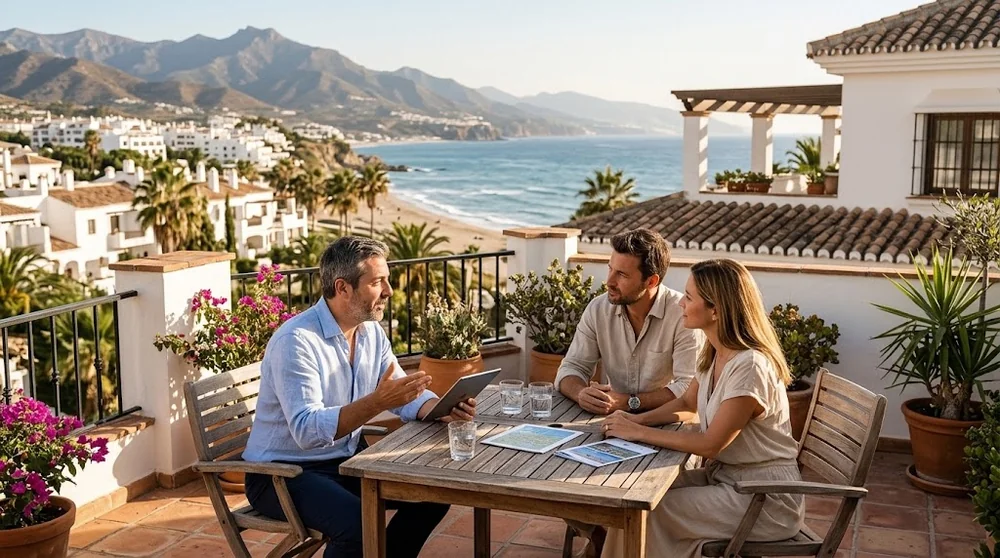
    Property adviser and prospective homeowner looking across Barcelona rooftops from an apartment terrace

    Living in Barcelona as a property owner offers Mediterranean city life, excellent public transport and neighbourhoods ranging from historic Gràcia to family-friendly Sarrià. Owners avoid rent but still face property taxes, community fees, maintenance and utilities. The main trade-offs are high purchase prices, tourist pressure, older buildings and residency restrictions for non-EU citizens.

    What Is Living in Barcelona Really Like?

    Living in Barcelona as an owner means a dense, walkable Mediterranean city where most daily life happens within a few streets, combined with responsibility for a flat, a building and a calendar of bills. A week’s holiday shows you the first half. Ownership adds the second half, and renter-focused expat guides tend to skip it.

    The benefits of living in Barcelona

    • Walkability and transport. Many errands can be done on foot, and metro, bus, tram and suburban trains cover most of the city, so a car is optional for many central households.
    • Beaches and green space. The city has public sand beaches along its seafront, and the Collserola hills give you woodland walking at the edge of town.
    • Food and culture. Neighbourhood markets, long lunches and local festivals give each area its own rhythm. The August street festival in Gràcia is a well-known example.
    • An established international community. English is widely heard in business and tourism, although day-to-day administration runs in Spanish and Catalan.
    • No landlord. Nobody can raise your rent or end your tenancy, which is the biggest emotional difference between owning and renting.

    The everyday trade-offs

    • High purchase prices. Asking prices are high, as the October 2026 data later in this guide shows.
    • Tourist pressure. Crowds concentrate in Ciutat Vella, around the Sagrada Família and along the seafront, and they affect shops, pavements and noise.
    • Noise. Late dinners, terraces, scooters and night-time refuse collection can reach street-facing bedrooms.
    • Summer humidity. After a Manchester upbringing I know damp, but Barcelona’s humid summer nights are another matter, and a flat without cross-ventilation can be stuffy.
    • Responsibility. A leak from the flat above or a vote on roof repairs becomes your business, and a holiday landlord never has to think about that.

    The prices, fares and rules in this guide are sourced and dated. The lifestyle judgements, such as how much noise is too much, are mine and will vary from person to person.

    Best Barcelona Neighbourhoods for Property Owners
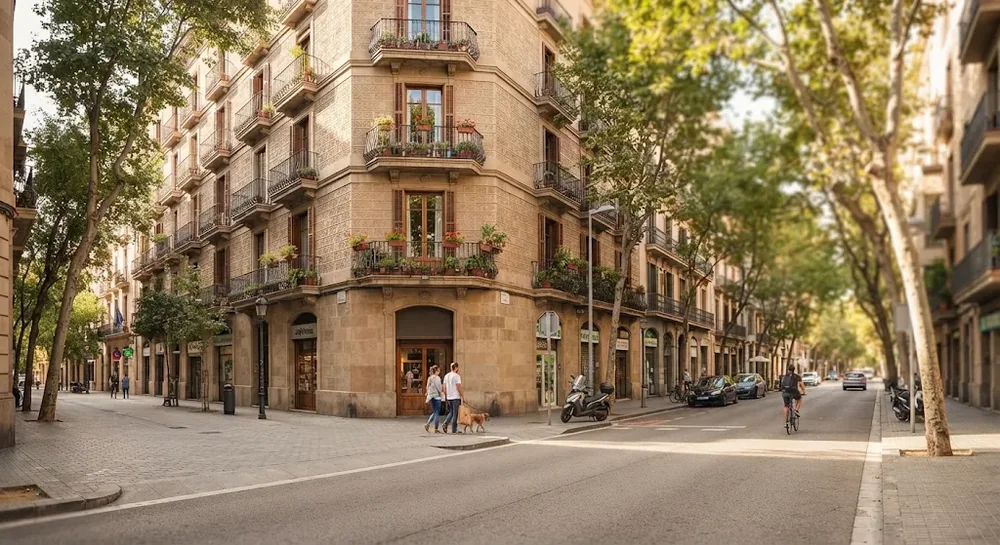
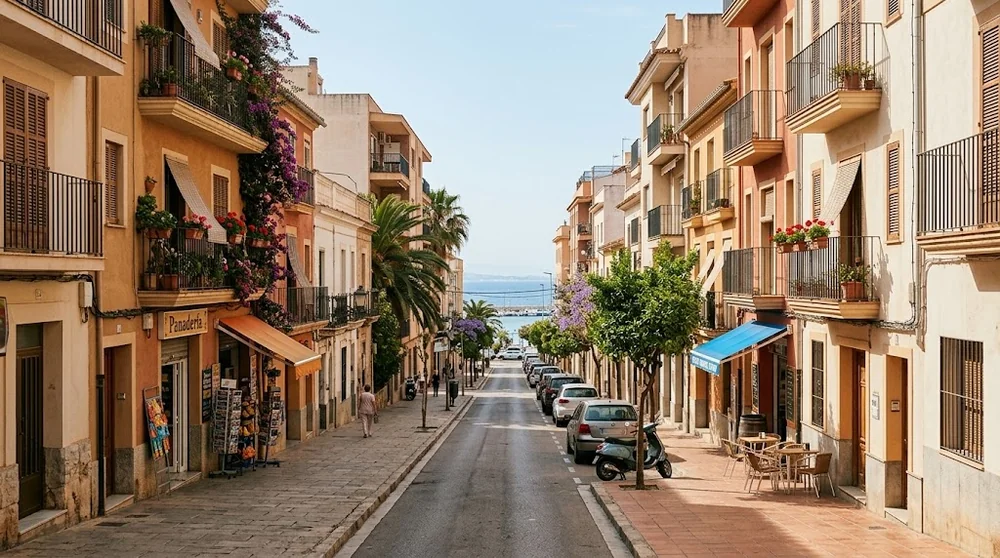
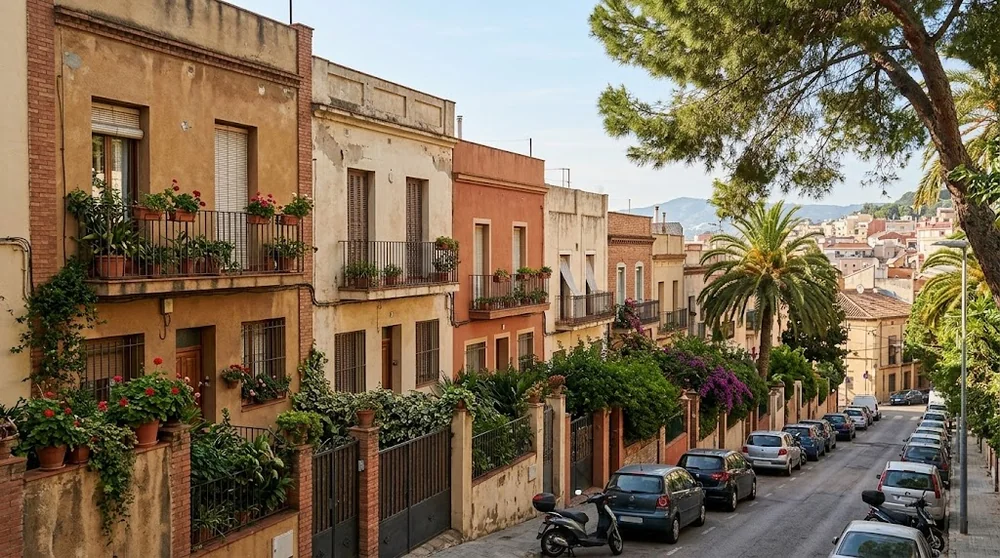
    Residential street in Barcelona's Eixample district with historic apartment buildings and balconies

    The best Barcelona neighbourhood for an owner depends less on the district name than on the building: its age, whether it has a lift, which way it faces and how noisy the street is. The table below compares the main districts on that basis.

    Comparison of Barcelona districts from an owner’s perspective (general observations, not statistics)
    DistrictAtmosphereTypical housingSuitable ownerMain advantageMain drawback
    EixampleCentral, gridded, busyEarly 20th-century apartments; lifts vary by buildingOwners wanting central convenienceServices and transport at the doorTraffic noise; older buildings can bring shared repair bills
    GràciaVillage feel, squares, independent shopsSmaller older flats, often in low-rise buildingsCouples and owners who value local identityStrong neighbourhood characterSmall flats, stairs, summer noise around squares
    Poblenou (Sant Martí)Seafront, creative, flatConverted industrial lofts and newer blocks, often with liftsProfessionals and remote workersBeach access and newer stockBusier near the beach in summer
    Sarrià-Sant GervasiResidential, leafy, calmerLarger family flats and houses on higher groundFamilies wanting spaceSchools and green spaceHighest asking prices in the dataset below; hills
    Les CortsPractical residential, university and business pocketsMid-century and newer blocks, many with liftsFamilies and professionalsEveryday services and transportLess historic charm; event traffic near the stadium
    Ciutat VellaHistoric core, intense street lifeVery old buildings, small flats, narrow streetsOwners who prize characterWalkability and heritageTourist pressure, noise, dark flats, repair liabilities
    Sants-MontjuïcWorking-neighbourhood feel, rail hub, parkMid-century blocks with some newer stockCommuters and budget-sensitive buyersRail connections and lower asking pricesMixed street quality; some flats without lifts
    Nou BarrisResidential, hillside, local communityPost-war blocks, many on slopesBuyers prioritising space and budgetLowest asking price in the dataset belowFurther from the centre; steep streets

    District-wide statistics can conceal large differences between neighbourhoods and even between two streets, so no district name tells you what a particular flat is like.

    Eixample: architecture and central convenience

    Eixample is the gridded 19th- and early 20th-century extension of the city, with tall ceilings, balconies and a shop on nearly every block. The ownership catch is the building: many older blocks have no lift or a small one, and shared facade and stairwell repairs are paid by all owners. Interior flats may be quiet but darker, while street-facing flats get light and traffic noise.

    Gràcia: neighbourhood character

    Gràcia keeps a village atmosphere around its squares, which is exactly why owners love it. Flats are often smaller and in low-rise buildings, so check stairs, natural light and what happens on the square below at midnight in July.

    Poblenou: beach access and newer housing

    Poblenou in the Sant Martí district is flat, bike-friendly and close to the sand, with a mix of converted factories and newer blocks that more often have lifts and better insulation. Newer stock usually means fewer nasty surprises in the walls, though community fees can be higher where buildings share pools or concierges.

    Sarrià-Sant Gervasi and Les Corts: family life

    Sarrià-Sant Gervasi and Les Corts attract households wanting schools, parks and calmer streets, and both have many blocks with lifts. Parking is easier on some streets but not guaranteed. Sarrià-Sant Gervasi is also the most expensive district in the October 2026 Idealista data.

    Ciutat Vella: character and compromises

    Ciutat Vella covers the Gothic Quarter, El Born, El Raval and Barceloneta. Buildings can be centuries old, flats small, and heritage rules and tourist crowds shape daily life. Owners should budget for shared-building works and noise.

    Sants and Nou Barris: practical alternatives

    Sants-Montjuïc and Nou Barris offer lower asking prices and, in Sants, excellent rail links. In hillier parts, step-free access is the question that matters most, because a flat above steep streets and many stairs ages badly with you.

    Barcelona Property Prices and What Your Budget Buys

    The citywide advertised average in Barcelona was €5,463 per square metre in October 2026, according to the Idealista city report, but individual districts ranged from €3,282 to €7,236. These are asking prices from listings, not completed sale prices or valuations.

    Idealista average asking prices, Barcelona, October 2026, with an illustrative 80 m² calculation (my own arithmetic, before purchase costs)
    AreaAsking price per m²Illustrative 80 m² flat
    Sarrià-Sant Gervasi€7,236€578,880
    Eixample€6,675€534,000
    Gràcia€5,616€449,280
    Barcelona city (average)€5,463€437,040
    Sant Martí€5,350€428,000
    Ciutat Vella€4,867€389,360
    Sants-Montjuïc€4,601€368,080
    Nou Barris€3,282€262,560

    An 80 m² flat at the citywide asking average comes to roughly €437,040 before taxes, notary and registry fees and any renovation. A real flat can cost materially more or less because condition, floor, lift, light, terrace and street all move the price. Idealista does not publish a Les Corts figure in the data used here, so I have not quoted one.

    Three methodology points stop readers comparing incompatible numbers. First, Barcelona city is not Barcelona province, and the province includes towns with very different markets. Second, district averages are not neighbourhood or street data. Third, Idealista changed its methodology in July 2026, so comparisons with earlier months should be treated carefully. That is also why October 2026 Idealista figures differ from the February 2026 prices in older articles and from Fotocasa’s September 2026 neighbourhood figures: the reporting dates and methods are different. Datasets based on completed transactions, such as those compiled from notary and registry records, measure something else again.

    Let me put it plainly: an asking price is a seller’s hope, not a market verdict. Treat it as a starting point for a conversation and a reason to look at what comparable flats actually sold for. That is my opinion, not a rule.

    Monthly Cost of Living in Barcelona as a Homeowner
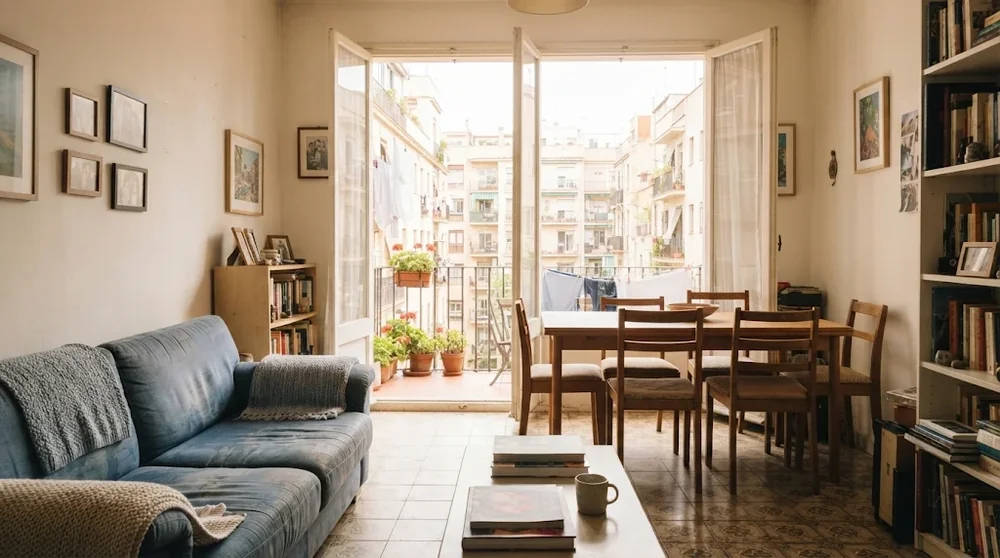
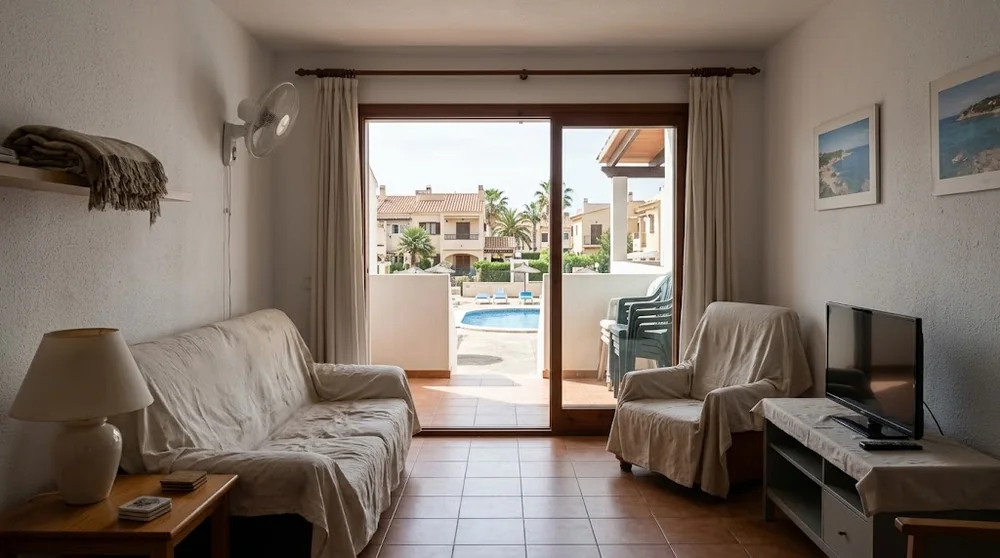
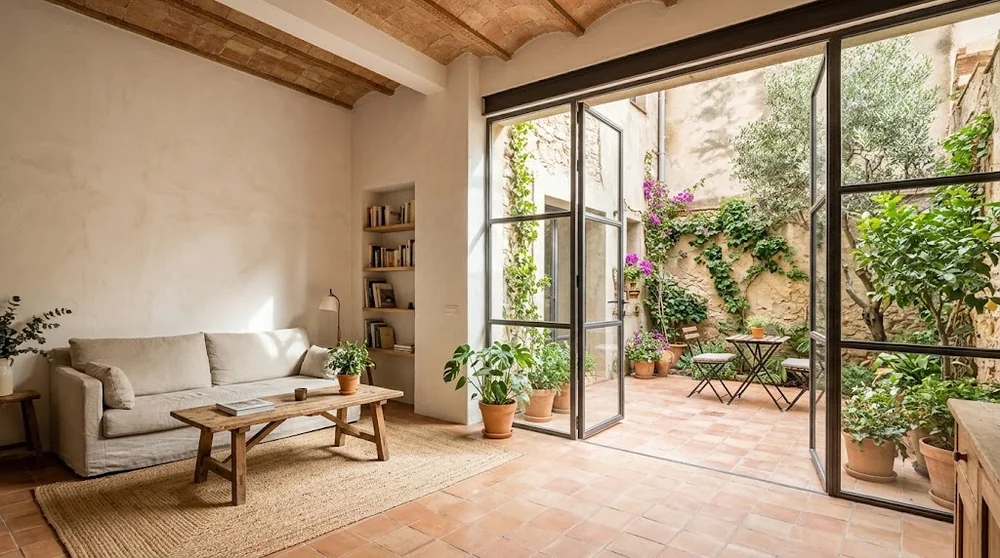
    Living and dining area of a Barcelona apartment with balcony doors overlooking residential buildings

    A mortgage-free owner in Barcelona avoids rent but still pays for food, utilities, transport, property tax, community fees, insurance and repairs, and the table below shows how those categories might look as an illustration. Only the transport fare is an official figure, the one-zone T-usual price for 2026. Every other amount is my own illustrative assumption, not an observed Barcelona average.

    Illustrative monthly budget for a mortgage-free owner-occupier, in euros (assumptions, not statistics)
    CategorySingle ownerCoupleBasis
    Groceries and household250–350450–600Illustrative assumption
    Electricity and gas50–9070–130Illustrative assumption
    Water20–3030–45Illustrative assumption
    Internet and mobile40–6060–90Illustrative assumption
    Transport (one-zone T-usual)22.8045.60Official 2026 fare per person
    IBI property tax provision30–5030–50Illustrative assumption; varies by property
    Community fees60–12060–120Illustrative assumption; varies by building
    Home insurance15–3015–30Illustrative assumption
    Maintenance reserve80–15080–150Illustrative assumption
    Leisure and eating out200–350350–600Illustrative assumption
    Sum of the assumptionsabout 770–1,250about 1,190–1,860Arithmetic only

    The calculation method is simple addition of the low and high assumptions in each column, so you can replace any line with your own quote. The property-related lines (IBI, community fees, insurance and the maintenance reserve) are the same for both households because they attach to the flat, not the people.

    This example excludes mortgage repayments, one-off purchase taxes and fees, major renovation, private schooling, private health insurance, car costs and any exceptional building assessment. It matters because many expat cost-of-living estimates include rent, so they are not homeowner budgets. Subtracting a rent figure from them leaves out IBI, community fees and repairs, which are real costs of ownership.

    Apartment age, household size, energy efficiency and location all move these numbers. A poorly insulated top-floor flat may cost far more to cool in summer than a newer block, and a building with a lift, concierge or communal pool will usually charge higher community fees.

    Property Taxes, Community Fees and Owner Responsibilities

    Owners in Barcelona pay a municipal property tax, contribute to their building’s running costs and may owe Spanish tax even when they are not resident, but not every owner has identical obligations. The main items are below, as of November 2026.

    • IBI (Impuesto sobre Bienes Inmuebles). This annual municipal property tax is linked to the property’s cadastral value and the city’s applicable rate. Ask for the latest IBI receipt before buying, and check whether the cadastral record matches the flat.
    • Comunidad de propietarios (community of owners). Each flat pays a share of the building’s ordinary costs, such as cleaning, lift maintenance, insurance and any reserve fund. Shares depend on the building’s rules and each flat’s quota.
    • Derrama (extraordinary assessment). When owners vote for major works, such as a facade, roof or new lift, each owner pays a share on top of normal fees. Ask whether any derrama has been approved or discussed, and who pays it.
    • Insurance and maintenance. Building insurance is normally arranged by the community, while contents and liability cover for your own flat is a sensible separate decision. Budget for repairs inside the flat.
    • Non-resident income tax. The Spanish Tax Agency sets a general non-resident rate of 24% for non-qualifying non-EU taxpayers and 19% for qualifying EU/EEA cases, as of November 2026. The rate applies to the relevant tax base, which for a home you leave vacant or use yourself is generally calculated from the cadastral value, not from the purchase price. Rules and conditions differ for residents, so confirm your position with a tax adviser.
    • Transfer tax on purchase. For resale homes, the Catalan general schedule starts at 10% on qualifying transfers up to €600,000, with higher marginal rates above that and separate exceptions, as of November 2026. New-build homes are generally taxed differently. The Agència Tributària de Catalunya, the Catalan tax authority, publishes the current rules, and your lawyer should confirm which applies to your purchase.

    Ten years on the Costa del Sol have taught me that tax rates are the first thing British buyers compare, so for context: resale transfer tax in Andalusia is a flat 7%, while Catalonia starts at 10%. As a purely illustrative example, 10% of the €437,040 flat above would be €43,704, assuming a resale purchase and no special rate.

    Before you buy, ask for the nota simple, the latest IBI receipt, the community’s most recent budget and accounts, the last three sets of meeting minutes, and a certificate that no community fees are outstanding. A Catalan or Spanish lawyer should read them with you.

    Everyday Life: Transport, Food, Climate and Community
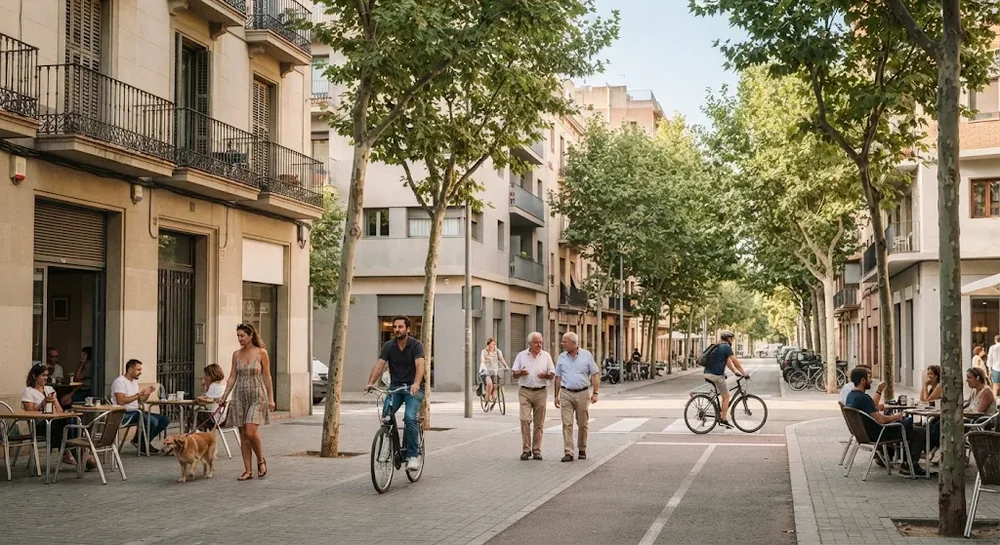
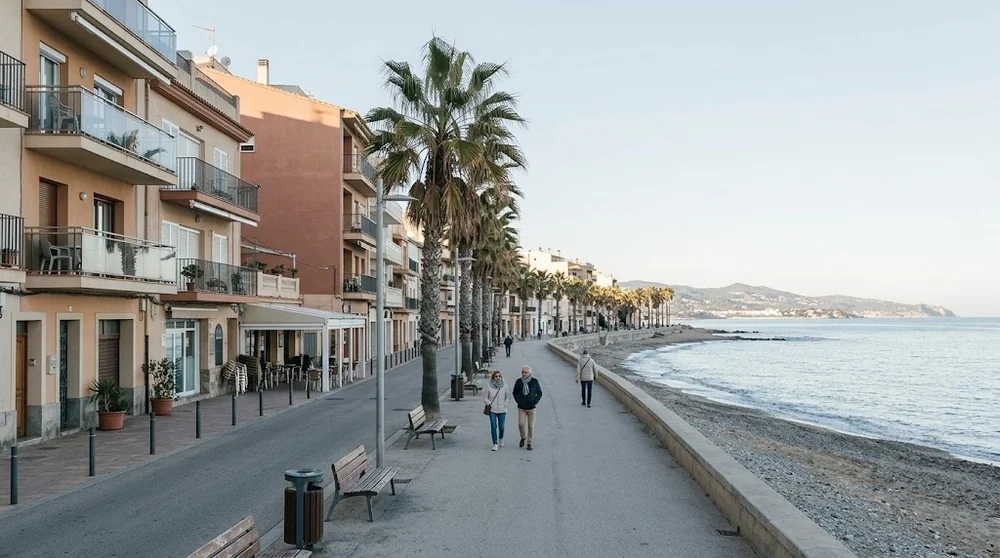
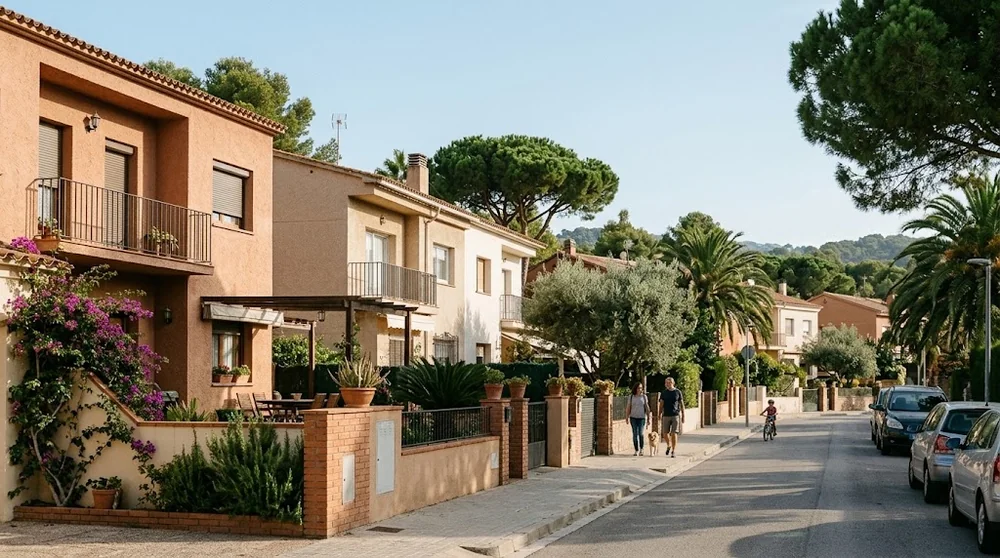
    Pedestrians and cyclists on a tree-lined residential street in Barcelona's Poblenou neighbourhood

    Daily life in Barcelona runs on foot, metro, bus, tram, bicycle and suburban rail, and the official one-zone T-usual pass costs €22.80 for 30 consecutive days of unlimited qualifying journeys, according to the 2026 fares valid from 15 January 2026. Fares change, so confirm the price with the transport operator (TMB) before relying on it. Cycling is easiest in flatter areas such as Poblenou and parts of Eixample, while hillier districts reward electric bikes and good legs.

    Food shopping is local and routine. Municipal markets sell fresh produce, fish and meat in most neighbourhoods, and small shops often close for a lunch break or on Saturday afternoons, so ordinary errands need planning. Lunch is commonly later than in Britain and dinner later still, which is useful to know before you judge a quiet street at 8pm.

    The climate is generous in spring and autumn. Summer is hot and humid, and an apartment without cross-ventilation or air conditioning can feel uncomfortable at night, particularly on a top floor. City beaches are public but get busy in summer, with the seafront and Barceloneta the most crowded. The Collserola hills and the city’s parks offer an escape that visitors often don’t see.

    Language is practical, not decorative. Spanish gets you through most daily life, but Catalan is widely used in schools, local administration and building notices, and community minutes may be in either language. Learning some of both helps you take part in your own building.

    Differences between adjacent streets can be large, and safety, noise and atmosphere vary by block and hour. As in any large tourist city, pickpocketing is a risk in crowded areas, so judge a specific street by visiting it, not by a district reputation.

    Living in Barcelona with Children or in Retirement

    Families, retirees and working professionals want different things from the same city, and the best neighbourhood for each depends on schools, healthcare, step-free access and green space. Quieter residential streets in Les Corts, Sarrià-Sant Gervasi or parts of Horta-Guinardó appeal to many households, though no whole district is uniformly quiet.

    For families, three school types exist: public schools, concertada schools (privately run but publicly funded, usually with fees or contributions), and private or international schools. Admission to public and concertada places follows official criteria, including proximity to home, so buying a flat does not guarantee a particular place. Public schooling is delivered largely in Catalan, which matters for children arriving without it.

    Healthcare access depends on your residence and insurance status. Registration with the Catalan public health system is not automatic for every owner, and a second-home owner on short visits would normally rely on travel or private cover. Check your own entitlement with the relevant authority before assuming anything.

    Retirees should weigh accessibility more heavily than charm. Many older apartment buildings have no lift, narrow stairs or steps at the entrance, and a fourth-floor walk-up that is romantic at 45 is hard at 75. Ask whether the building has a lift, whether it reaches the street without steps, and whether the community has discussed installing one, because that could trigger a derrama. Metro step-free access, nearby clinics and flat pavements matter just as much.

    Working professionals usually trade space for commute and nightlife. Poblenou, Eixample and Sants offer good connections, and a quiet bedroom away from the street is worth more than an extra room.

    Can British Property Owners Live in Barcelona Full-Time?

    No, property ownership does not by itself let a British citizen live in Spain full-time. As of November 2026, British nationals without relevant residence rights or exemptions are generally limited to 90 days in any rolling 180-day Schengen period, and buying a home does not extend that limit. The GOV.UK guidance on living in Spain is the place to check the current position.

    1. Ownership is not residence. The title deed records that you own the flat. It says nothing about your right to stay.
    2. The 90/180-day rule. Time spent in Spain counts towards the Schengen limit, so you must track your days across all Schengen countries, not just Spain.
    3. NIE. The NIE (Número de Identidad de Extranjero) is a tax and identification number you need to buy property. It does not by itself give you residency.
    4. TIE. The TIE (Tarjeta de Identidad de Extranjero) is the card that shows a foreign national holds a Spanish residence authorisation. You need an appropriate immigration route first, assessed individually. People who were lawfully resident in Spain before the end of 2020 may hold different Withdrawal Agreement status.
    5. Empadronamiento. This is registration on the municipal register at your town hall. It records where you live and helps with local services, but it does not create lawful immigration status.
    6. Tax residence. Spanish tax residence is a separate test, often linked to time spent in Spain and where your main interests lie, and it can apply even if your immigration paperwork is not settled. Get specialist advice.

    Here’s where people usually come unstuck: they assume that buying means the right to stay, then find the rules do not work that way. The route that once granted residence for property investment was ended in 2025, so no current property purchase should be assumed to carry a visa. Speak to an immigration professional about your own case.

    If you are unsure how your own circumstances fit these rules, a short one-to-one conversation before you sign anything is cheaper than fixing a mistake afterwards.

    Ask a question on WhatsApp

    Once the residence question is clear, the next job is making sure the building itself will not surprise you.

    Older Apartments, Building Checks and Hidden Problems
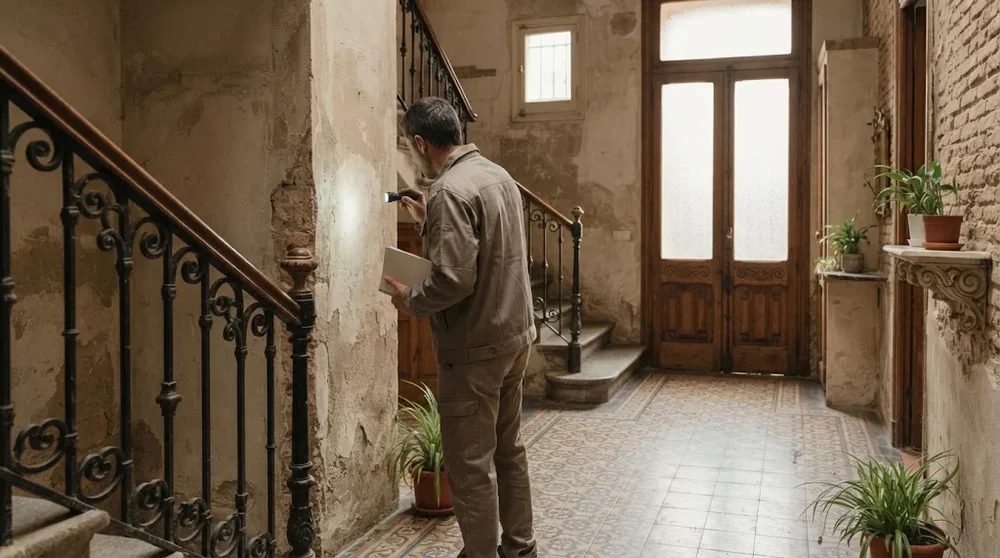
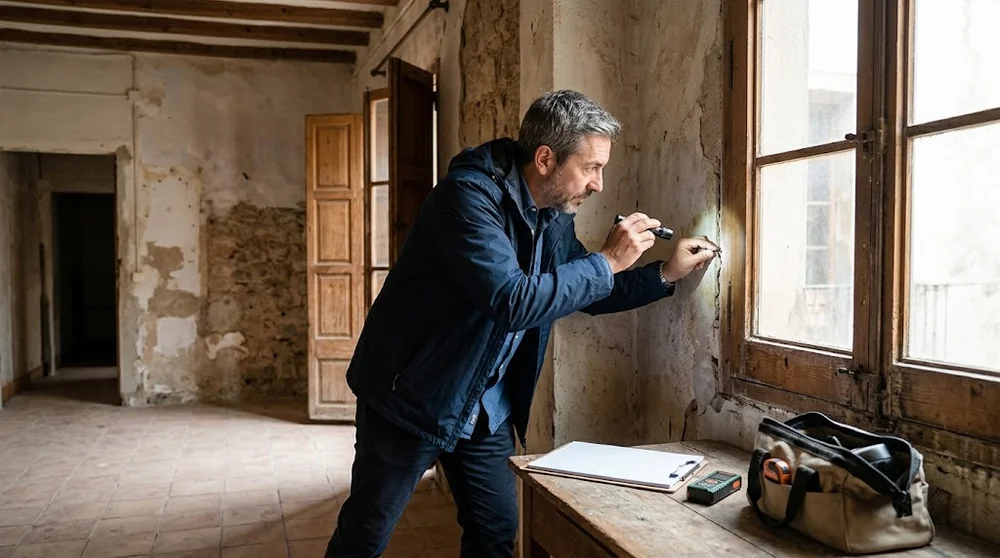
    Building inspector examining the shared stairwell of an older Barcelona apartment block

    An attractive old Barcelona apartment can carry substantial shared-building costs, because the charm of high ceilings and original tiles often comes with limited natural light, interior courtyards, weak insulation, old plumbing, difficult access and a facade that needs repair. A clean title alone does not prove the building is sound. Always ask for the nota simple before you commit, then work through this checklist with independent professionals.

    1. Updated nota simple. This extract from the Registro de la Propiedad (the property registry) shows the registered owner, description, mortgages and charges. Request a recent one.
    2. Description and cadastre. Compare the registered description with the cadastral record and the actual flat, checking size, floor and layout.
    3. Cèdula d’habitabilitat. This Catalan certificate of habitability confirms the home meets minimum living conditions. Check that it exists and is in date, where applicable.
    4. Energy performance certificate. Read the rating and ask what it says about insulation, windows and heating or cooling costs.
    5. Community minutes. Review the last few years of meeting minutes for disputes, planned works and votes.
    6. Fee and debt documentation. Ask for a statement showing the flat has no unpaid community charges, since arrears can follow the property.
    7. Pending derramas. Ask what extraordinary works have been approved, discussed or recommended, and who pays.
    8. Building inspection. Older buildings may be subject to periodic technical inspection requirements, so ask for the latest report and any defects it lists.
    9. Independent technical survey. Commission your own surveyor to check damp, wiring, plumbing, structure and the stairwell, rather than relying on the seller’s or agent’s view.
    10. Use and alterations. Check the flat is permitted for residential use and that any extensions, merged rooms, terrace enclosures or interior reforms were properly authorised.

    My opinion, after years of watching British buyers fall for a lovely stairwell: spend the survey fee before you spend the deposit. Hire a lawyer and a surveyor who work for you, not for the seller.

    Tourist Rentals and Other Barcelona Ownership Restrictions

    Owning a flat in Barcelona does not automatically give you the right to let it to tourists, because short-term tourist letting requires the applicable permissions and Barcelona has tightly restricted new licences. City Hall has announced that it will not renew roughly 10,101 existing tourist-flat licences when they expire in November 2028, a policy that Spain’s Constitutional Court supported in a March 2025 ruling on the Catalan decree behind it. I have not found a later decision that changes that position as of November 2026, but this area moves quickly, so verify the latest legal status with a Catalan lawyer before relying on any assumption.

    Tourist letting is a different legal category from ordinary residential renting, which has its own contract types and rules, including rent regulation in areas declared stressed housing markets. A home let on a standard residential tenancy to a local tenant is not the same as a holiday let. I will not suggest likely earnings here, because rental income depends on permission, rules and demand, and none of those can be assumed. If a seller advertises a flat with holiday-let potential, ask for the licence number and have your lawyer confirm it is valid, transferable and still usable.

    Barcelona or Nearby Towns: Where Should You Own?
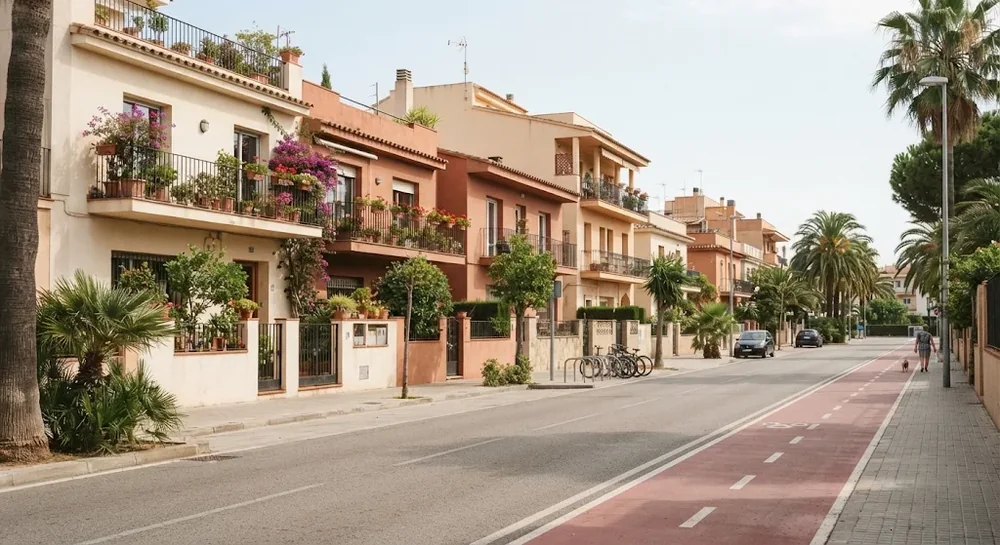
    Quiet residential street with low-rise homes and greenery in Castelldefels near Barcelona

    Barcelona suits owners who want a city on their doorstep, while Sant Cugat, Castelldefels and Sitges offer more space or a quieter pace at the cost of extra commuting. Nearby towns are not always cheaper, and some have similarly high or higher prices than comparable Barcelona districts, so compare current listings.

    Owner-oriented comparison of Barcelona and three nearby towns (general observations, not statistics)
    PlaceResidential atmosphereTransportGreen space and family needsMain trade-off
    BarcelonaDense, varied, city lifeMetro, bus, tram and trains; car optionalCity parks and the Collserola hills; schools vary by districtHigh prices, noise, smaller flats
    Sant CugatSuburban, family-oriented, leafyCommuter rail links to Barcelona; car commonHouses with gardens and international school optionsPrices can match or exceed some city districts; more car use
    CastelldefelsCoastal suburb with a long beachCommuter rail and road links; airport nearbyBeach life and low-rise housingLonger door-to-door journeys; quieter in winter
    SitgesSeaside town with strong tourismCommuter rail link; car usefulBeach, old town and a lively international communitySeasonal crowds and tourist-driven housing demand

    Nominal train journey times are not door-to-door commuting times, since you must add walking, waiting, transfers and parking. I have not quoted travel times here, and you should check current timetables with the operators and test the journey at rush hour before buying.

    How to Decide Whether Barcelona Suits Your Lifestyle

    Barcelona suits you if you can picture a normal weekday there, not just a holiday weekend, and the five steps below turn that picture into a decision.

    1. Select neighbourhoods by lifestyle. Shortlist two or three areas based on how you actually live: schools, commute, quiet, beach, budget and lift access.
    2. Calculate realistic ownership expenses. Use the budget method above with your own quotes for IBI, community fees, insurance, utilities and a repair reserve, excluding the mortgage and purchase costs.
    3. Test the location at different times. Visit on a weekday morning, a Friday night and a Sunday, buy groceries, ride the metro at peak hour and sit in the street after dark.
    4. Check the building and administrative records. Review the nota simple, cadastral record, certificates, community minutes, fee statements and a survey before committing.
    5. Distinguish permanent residence from second-home use. Year-round living affects maintenance, tax and your immigration position, while occasional visits mean bills still arrive when you are away.

    My advice to every British buyer is to rent for a month in your preferred area first, because a month of ordinary routine tells you more than any brochure.

    If you would like a shortlist matched to your budget, region and reasons for buying, a few questions are enough to start.

    Get a personalised selection of properties in Spain

    Taking the time to match the flat to your routine will do more for your satisfaction than any single feature of the property.

    Frequently Asked Questions About Living in Barcelona

    Is Barcelona a good place to live?

    Barcelona suits owners who value walkable neighbourhoods, reliable public transport, a mild climate and a strong cultural scene. Ownership adds responsibilities: IBI property tax, community fees, insurance and repairs. The practical limits are high purchase prices, tourist crowds, summer humidity and older buildings, so the street and building you choose matter as much as the city itself.

    What is the best area to live in Barcelona?

    There is no single best area; the right one depends on household and budget. Eixample offers central convenience, Gràcia a village atmosphere, Poblenou beach access and newer buildings, and Sarrià-Sant Gervasi quieter family streets. Sants-Montjuïc and Nou Barris had lower October 2026 asking prices on Idealista. Building condition, lift access and street noise matter as much as the district name.

    How much does it cost to live in Barcelona if you own a property?

    Without a mortgage, an owner still pays for groceries, utilities, transport, IBI property tax, community fees, home insurance and repairs. Totals vary with household size, apartment age, energy efficiency and lifestyle, so I give illustrative ranges rather than averages: roughly €770–€1,250 a month for a single person and €1,190–€1,860 for a couple, excluding mortgage, purchase taxes and major works.

    Where do families live in Barcelona?

    Families commonly look at Sarrià-Sant Gervasi, Les Corts and quieter parts of Eixample, while others prefer Poblenou or leave the city for Sant Cugat. The decision usually turns on school admission rules, commuting, space, lift access and budget. Public, concertada and private schools work differently, and no home purchase guarantees a place at a particular school.

    Can British citizens live in Spain if they own property?

    Owning a home in Spain does not give a British citizen the right to live there. Without an applicable residence status or exemption, stays are generally limited to 90 days in any rolling 180-day Schengen period, and longer stays need an appropriate immigration route. Property ownership, immigration residence and Spanish tax residence are three separate questions, as of November 2026.

    What are the disadvantages of living in Barcelona?

    The main disadvantages are expensive housing, crowded central streets, tourist pressure, late-night noise and humid summers. Bureaucracy can involve both Spanish and Catalan, and older buildings may carry poor insulation, no lift or costly shared repairs. These problems vary street by street, so viewing a property at several times of day tells you more than judging a whole district.

    What Owning in Barcelona Comes Down To

    Owning in Barcelona gives you a walkable, culturally rich Mediterranean city and the security of no landlord, but you take on the building, the bills and the paperwork that come with it. The neighbourhood sets the lifestyle, and the specific building sets the day-to-day experience, from lifts and light to noise and shared repair costs.

    The October 2026 Idealista figures show asking prices from €3,282 to €7,236 per square metre across the districts quoted, and a mortgage-free owner still has to budget for IBI, community fees, insurance and maintenance. Ownership does not grant the right to live in Spain, and tourist letting cannot be assumed.

    I came to Spain from Manchester more than ten years ago, and the lesson that has held up is to test the everyday before you fall for the view. Visit at odd hours, read the building’s paperwork, hire independent professionals and decide honestly whether you are buying a home or a holiday.

    This article is general information, not legal, tax or immigration advice. Tax, property and immigration rules can change, and individual circumstances differ, so check your position with a qualified Spanish lawyer, tax adviser, technical surveyor or immigration professional before you commit. Figures and rules are stated as of November 2026.


  • Best Places to Buy a Second Home in Spain: 8 Compared

    Best Places to Buy a Second Home in Spain: 8 Compared

    British buyers weighing up the best places to buy a second home in Spain usually end up comparing a beach apartment, a city flat and an island villa without a common yardstick. That is how people overspend, or buy a lovely place that is miserable to reach in February. This guide puts eight destinations side by side using the same questions: what it costs to buy, what it costs to keep, how you get there, and what the rules allow. All legal and tax points are stated as at November 2026.

    The best places to buy a second home in Spain are Alicante for affordability, Málaga and Marbella for Costa del Sol living, Valencia for city-and-beach access, Barcelona and Madrid for urban amenities, Mallorca for premium island homes and Tenerife for winter sunshine. Compare asking prices, flight connections, annual costs and rental restrictions first.

    Property agent discussing a coastal apartment with two buyers on a Mediterranean terrace

    8 Best Places to Buy a Second Home in Spain Compared

    The eight locations below were chosen because they suit different second-home uses, not because they sit on a league table. Nobody can honestly rank Madrid against Tenerife, because a buyer wanting museums and high-speed rail is shopping for something entirely different from a buyer wanting winter sunshine. Treat the table as a map of trade-offs rather than a scoreboard, and note that no location comes with guaranteed returns or price growth.

    The price column mixes different geographical units, because that is what the public data I could attribute gives us. The figures come from Idealista’s October 2026 asking-price index, which is a commercial listings index, not an official government statistical series. It showed a national asking price of €2,955 per square metre, up 11.2% year on year. Where I could attribute a figure to a specific unit it is shown with its label; where I could not, the table says so rather than guessing. Please re-check each Idealista figure against the original dated publication before relying on it. For recorded sales rather than adverts, use the official statistics: the INE (ine.es) publishes a housing price index based on transactions, and the Colegio de Registradores publishes registry-based sales data. Advertised prices and completed sales are different things and I keep them apart throughout.

    LocationTypical buyer scenarioDated price benchmark (asking price, October 2026)Travel accessKey advantageMain compromise
    Alicante (city and Costa Blanca)Budget-conscious families and retirees€2,744/m² for Alicante city municipality only; Costa Blanca towns are not covered by this figureAlicante-Elche airport; UK routes vary by seasonLower entry prices than most of the other sevenQuality and prices vary widely between towns
    Málaga (city)Buyers wanting city amenities with beachesMunicipal figure not verified for this edition; unavailable hereMálaga-Costa del Sol airport; high-speed rail to MadridYear-round city life and cultureSmaller flats, older buildings and tighter tourist-let rules
    Marbella (municipality)Higher-budget lifestyle and villa buyersMunicipal figure not verified for this edition; unavailable hereRoad transfer from Málaga airportGated communities, golf and international amenitiesHigher entry price and heavier running costs
    Valencia (city)Families wanting city and beach together€3,482/m² for Valencia city municipality onlyValencia airport; metro and tram to the beachLarge, liveable city with its own seafrontBuilding-specific rental rules; beach is urban, not resort-style
    Barcelona (city)Culture-led short-break ownersMunicipal figure not verified for this edition; unavailable hereEl Prat airport; extensive rail and metroCulture, transport and year-round demand for city livingHigh costs and strict accommodation regulation
    Madrid (city)Family-visit and urban short-break ownersMunicipal figure not verified for this edition; unavailable hereMadrid-Barajas airport; high-speed rail hubServices, museums and connections all yearNo coastal resort lifestyle
    MallorcaPremium Mediterranean island buyers€5,619/m² for the Balearic Islands region as a whole, not Palma or Mallorca specificallyPalma airport; seasonal flight patternsStrong island setting and premium coastal choiceHigh budgets, upkeep and tourism rules
    TenerifeWinter-sun buyersLocality-level figure not verified for this edition; unavailable hereTenerife South and Tenerife North airportsMild winter conditions in the southMicroclimate differences; IGIC regime differs from mainland IVA

    Five of the eight rows carry no number, and I would rather show that gap than fill it with a guess. Because of it, this table is not a like-for-like price comparison, and you should not read the three figures that do appear as a ranking. Pull current listings for the exact neighbourhood and property type you want, and compare those.

    Málaga and Marbella count separately because they are different municipalities with different housing stock, different buyers and different price levels. Treating the whole Costa del Sol as one uniform market is the commonest mistake I see in online comparisons. Picture a typical buyer scenario for each: a compact flat in a Málaga city block on one hand, a villa on a Marbella urbanisation on the other. Those two scenarios share a coastline and not much else. They are contrasting examples, not a full description of either place, because Málaga has villas and Marbella has perfectly ordinary urban flats. The destination sections below explain each place in turn.

    Spanish coastal apartments beside a sandy beach and promenade

    How We Compare Spain’s Second-Home Locations

    Every location in this guide is judged against the same seven criteria, so you can reproduce the exercise for any other town on your list. The first six are factual or can be checked against a source; the seventh, suitability for different buyers, is my professional judgement and is labelled as such wherever it appears.

    1. Purchase price: the dated asking-price benchmark for the stated geographical unit, where a reliable one exists.
    2. Annual ownership costs: property tax, community fees, insurance, utilities and non-resident tax.
    3. Flight connections: the airport, and how far the schedule thins out in winter.
    4. Ease of winter use: whether the place still works as a home between November and March.
    5. Amenities: healthcare, shops, transport and year-round services.
    6. Legal rental feasibility: whether occasional letting is realistic under regional, municipal and community rules.
    7. Buyer-profile suitability: my personal assessment of who the location suits and who it frustrates.

    I have deliberately not combined these into a single score. A weighted ranking would pretend that a retiree’s priorities and a family’s priorities are identical, and they are not.

    The comparison worksheet

    Here is how each criterion is measured, so you can repeat it yourself. The factual criteria use a named source and a reference date. Criterion 7 is kept apart as opinion.

    CriterionMeasure usedSource typeGeographical unitReference dateMethod
    1. Purchase priceAsking price per m²Commercial index (Idealista); cross-check with INE and registry sales dataMunicipality, or region where statedOctober 2026Quote only where the unit is labelled; otherwise mark unavailable
    2. Annual ownership costsRelative running-cost levelMunicipal IBI rules, community accounts, insurer quotesProperty, not townNovember 2026Low, medium or high band; the €250,000 worked example below gives actual euros
    3. Flight connectionsAirport and seasonalityAirport and airline timetables (AENA publishes traffic data)AirportCheck the season you will travelDirect in all seasons, direct but seasonal, or connection likely
    4. Winter useServices open and climateAEMET climate data, local knowledgeTown or districtNovember to MarchEasy, moderate or demanding
    5. AmenitiesHospital, rail, shopsRegional health service and transport operatorsMunicipalityNovember 2026Checklist of what is within a short drive or walk
    6. Rental feasibilityRegime outlookBOE, regional gazettes, municipal rules, community statutesExact addressNovember 2026Open, restricted or likely unavailable, always confirmed by a lawyer
    7. Buyer suitabilityAuthor’s judgementTen years of client experiencen/an/aOpinion, kept separate from the factual rows

    Applying the worksheet’s consistent categories to all eight places gives the next table. Criteria 2, 4 and 6 are labelled assessments, not measurements, and every cell needs checking at the specific address.

    LocationRunning-cost level (assessment)Winter use (assessment)Tourist-let outlook (as at November 2026; confirm per address)
    Alicante and Costa BlancaLow to mediumModerate: city easy, resorts quietRestricted: regional registration and community approval
    MálagaMediumEasyRestricted: new licences curtailed in much of the city
    MarbellaHighModerateRestricted: regional registration, community approval, local rules
    ValenciaMediumEasyRestricted: building and municipal rules
    BarcelonaHighEasyLikely unavailable for new licences
    MadridMedium to highEasy, but coldRestricted: tightening municipal rules
    MallorcaHighDemanding outside PalmaRestricted: island and municipal limits
    TenerifeMediumEasy in the southRestricted: Canary Islands holiday-let legislation

    Asking prices, transactions and appraisals

    An asking price is what a seller or agent advertises. A transaction price is what was actually agreed and recorded in a deed, and an appraisal is a bank valuation prepared for a mortgage. The three measure different things and can diverge, especially where sellers start high. The Idealista figures used here are asking prices from a secondary, commercial source, not a registry transaction index. In practice, always test any average against recent comparable listings for the exact street.

    Why geographical units matter

    City, municipality, province, region and island statistics cannot be casually combined. A figure for Alicante city does not describe Jávea, and a Balearic regional figure does not describe a flat in Palma. Property type matters just as much: a new-build apartment, a resale flat and a detached villa will rarely sit at the same price per square metre. Every figure in this article is tied to its reference date, which is October 2026 for the Idealista asking-price data, and to its stated geographical unit.

    Alicante and Costa Blanca: Affordable Coastal Choice

    Alicante’s strongest use case is a lower-cost coastal home close to a busy airport; the main trade-off is that the Costa Blanca is not one market, so a city average says little about premium northern towns.

    Start with the labelling. Idealista’s October 2026 asking-price index gives €2,744 per square metre for Alicante city, which is the municipality, not the province. That compares with a national asking price of €2,955 per square metre in the same month. It is an advertised figure, not a recorded sale price. The province of Alicante contains Torrevieja, Guardamar del Segura, Jávea and Dénia, and Alicante city’s average should not be applied to any of them.

    North versus south

    Southern Costa Blanca, including Torrevieja and Guardamar, is generally associated with a large supply of apartments and villas at accessible entry points. Northern towns such as Jávea and Dénia are generally regarded as pricier and more residential in feel, with more hillside villas and a quieter off-season. I have no verified municipal figure for those four towns, so I will not invent one: look at current listings for the specific town and property type.

    Airport, annual use and walkability

    Alicante-Elche airport serves the whole coast, and AENA publishes its traffic data. British services exist all year, but the number of routes and frequencies changes between summer and winter schedules, so check the winter timetable before assuming a cheap Friday flight in January. Alicante city itself is walkable, with a seafront and a historic centre. Many coastal developments further south are easier with a car, so test the grocery run and the airport transfer, not just the pool.

    • Best for: families and retirees wanting affordable coastal apartments and regular visits.
    • Drawbacks: uneven neighbourhood quality, and development density in some resort areas.
    • Buyer tip: compare the same property type in the same town on at least three listings before trusting any average.

    Let me put it plainly: a cheap apartment with high community fees and no lift is not cheap. My advice to every British buyer is to price the first five years, not just the purchase.

    Málaga: A Second Home With City Amenities

    Málaga city’s strongest use case is a second home that works all year with beaches, restaurants and culture on the doorstep; the main trade-off is smaller, older flats and tightening rules on tourist letting.

    Málaga is a proper working city, with urban beaches such as La Malagueta and Pedregalejo, a historic centre, theatres, museums and hospitals. Málaga-Costa del Sol airport has a large British route network, and the city has a high-speed rail link to Madrid. For a buyer who wants to pop over for a long weekend in March and still find restaurants open and neighbours around, this is hard to beat. Neighbourhoods vary considerably: the historic centre is lively and noisy, Malagueta and Pedregalejo are close to the sand, and inland districts such as Teatinos are quieter and more residential, with newer blocks and more lifts and garages.

    Be realistic about the property. Central flats are often compact, in older buildings, and lifts and parking are not guaranteed. Newer blocks in districts like Teatinos are the better bet if you want a lift, a garage and lower maintenance surprises, at the price of a less atmospheric street. I do not have a verified October 2026 municipal asking-price figure for Málaga city, so check current listings for the specific neighbourhood.

    On rentals, the city council has acted to curtail new tourist-flat licences across much of the city, and Andalusian regional registration also applies. As I understand the position at November 2026 this is an enacted restriction, not just an announced one, but its exact reach differs by street and building, so confirm it at the address in writing.

    Málaga city versus Marbella municipality

    Málaga city offers urban life: mostly flats, fewer gated developments, and a mixed community of residents. Marbella municipality offers resort living: many villas, golf, secure developments and a quieter, seasonal rhythm. These are typical patterns, not rules, since each place has the other’s kind of home as well. Their price levels differ, and neither figure should be borrowed for the other. If you want to walk to a market, a museum and a beach in one afternoon, Málaga suits better; if you want a garden, a pool and a gate, look at Marbella.

    • Best for: year-round urban owners and couples wanting a walkable base.
    • Disadvantage: compact apartments and rental restrictions that need checking before you buy.

    Marbella: Premium Costa del Sol Holiday Homes

    Marbella’s strongest use case is a higher-budget villa or resort apartment with golf, security and international amenities; the main trade-off is a higher entry price and heavier running costs.

    Ten years on the Costa del Sol have taught me that “Marbella” is not a single price zone. The Golden Mile, Puerto Banús, Nueva Andalucía with its golf valley, San Pedro de Alcántara and the old town are quite different markets. I swapped Manchester for Andalusia more than ten years ago, and I still tell buyers that the postcode on the brochure and the street outside the front door are two different things. I have no verified October 2026 municipal asking-price figure for Marbella, so use current listings for each area.

    Apartments in complexes versus villas

    Apartments in residential complexes usually come with communal pools, gardens and security, paid for through community fees. Those fees are a recurring cost, and in larger complexes a special assessment (a derrama) can arrive for roof, lift or facade works. Villas give privacy, but the owner pays for pool upkeep, gardening, repairs and often higher insurance. Here’s where people usually come unstuck: an extension built without a licence, or a pool never declared, which can turn into a legal problem at sale. Check planning legality before you commit.

    Who suits Marbella over Málaga

    Marbella suits buyers who want a resort environment with golf, beach clubs and a villa garden, and who can carry higher maintenance bills. Seasonal demand is strong in summer, but some services quieten off-season. Rental income is never guaranteed, and no one can promise returns: licence rules and occupancy vary by property, season and management quality. In my view, the owner who visits eight or more weeks a year gets more out of Marbella than the owner who visits for ten days.

    Modern Marbella villa with a swimming pool and Mediterranean garden

    Valencia: Urban Living Close to the Beach

    Valencia’s strongest use case is a city-and-beach home for families who want daily life and sea air together; the main trade-off is that rental rules depend on each building and the beach is urban, not a resort strip.

    Idealista’s October 2026 asking-price index gives €3,482 per square metre for Valencia city. That is the municipality only, and it is an advertised price, not a completed sale. It sits above Alicante city’s €2,744 per square metre in the same month, so Valencia is not the cheap option, but you get a large city with parks, schools, hospitals, markets and a metro and tram network.

    Beach neighbourhoods and central districts

    Malvarrosa and Cabanyal are the beach-facing districts, and Patacona sits just up the coast in the neighbouring municipality of Alboraya. Central areas such as Ruzafa and the Eixample offer cafés and walkability, but are further from the sand. Valencia airport handles European traffic, and high-speed rail links the city to Madrid, which helps family visits. Winter use is easy because the city never closes for the season. Older beachfront blocks often have lower prices and higher maintenance needs than newer buildings inland, so ask for the building’s inspection record before falling for the view.

    Rental rules and who should choose Valencia

    Tourist letting in Valencia depends on Valencian regional registration, municipal planning rules and, for flats, the building’s statutes and community approval following the April 2025 national reform described later. The city and region have tightened the regime in recent years, but the detail differs between building types and floors, and I have not verified the current implementation at every address. Never assume a flat can be let because the one next door is. Valencia suits buyers who want more city than Alicante offers and a gentler pace than Barcelona. If your dream is a resort with a golf course and a gate, look elsewhere on this list.

    Barcelona: A Metropolitan Second Home

    Barcelona’s strongest use case is a cultural, well-connected city base; the main trade-off is higher costs and strict accommodation regulation, so it should not be bought on the assumption of rental income.

    Barcelona is an urban and cultural purchase, not a traditional beach-resort one. El Prat airport has extensive European connections, and the metro and rail network makes a car optional. Neighbourhoods differ sharply: the Eixample has grand, regular blocks, Gràcia feels like a village inside the city, Poblenou is near the sea, and Barceloneta is lively and compact. I have no verified municipal asking-price figure for Barcelona for October 2026, so check current listings by district.

    Building condition and running costs

    Many central apartments are in older buildings. Ask for the building’s technical inspection records, lift status and any planned facade or roof works, and read the minutes of recent community meetings. Purchase taxes in Catalonia are set regionally and differ from Andalusia, so budget with the regional authority’s current rates rather than a national rule of thumb.

    Tourist-let restrictions

    Do not buy in Barcelona expecting to obtain a tourist-rental licence. Catalan regional rules and the city’s own policy are among the strictest in Spain. The city council has announced a plan to phase out existing tourist-flat licences, and that is a stated policy that remains subject to legal developments, so do not treat it as settled either way. New licences should be treated as unavailable unless a lawyer proves otherwise in writing for that exact address. Barcelona suits those who will use the flat themselves and accept higher costs for convenience.

    Madrid: A Second Home Beyond the Coast

    Madrid’s strongest use case is a year-round city base for short breaks and family visits; the main trade-off is that there is no beach and no resort lifestyle.

    Madrid belongs in a national comparison because many second-home buyers do not want the sea. The capital has major museums, restaurants, healthcare and the largest transport hub in Spain: Madrid-Barajas airport and a high-speed rail network. If your children study in Spain, or you want a base for regular theatre and gallery trips, a Madrid flat makes more sense than a beach apartment you would only use in August.

    Be honest about the climate: AEMET data shows a continental pattern, with hot summers and cold winters, so this is not a winter-sun purchase. I have no verified October 2026 municipal asking-price figure for Madrid, so use current listings for your target neighbourhood. Central districts such as Salamanca, Chamberí and Retiro are polished and pricey, whereas areas further out offer more space and newer buildings for the money.

    Madrid compared with Barcelona and Valencia

    Madrid is more government-and-business oriented than Barcelona and has no sea. Barcelona gives more of a cultural and seaside-city feel at higher regulatory friction. Valencia gives a lower-key city with a beach. Choose Madrid if your use pattern is city-led, and note that the absence of seaside use changes what you should buy: a practical flat suitable for visits by friends and family, with a lift and good transport links, matters more than a pool.

    Paid letting is a separate matter. The city has been tightening its rules on tourist flats, and I would check the municipal position and the building’s statutes for the exact address before relying on any income. Longer-term residential letting is a different legal framework again and should be discussed with a lawyer.

    Mallorca: Premium Mediterranean Island Ownership

    Mallorca’s strongest use case is a premium island home for owners with larger budgets and long stays; the main trade-off is high prices, flight dependence, upkeep and tourism rules.

    The Balearic Islands’ regional asking-price benchmark was €5,619 per square metre in October 2026. That is a figure for the whole Balearic region, covering all the islands and all property types. It is not a Palma figure and not a Mallorca-specific figure, and it should not be quoted as such. The gap between this regional benchmark and the national €2,955 per square metre in the same month shows why island buyers need larger budgets.

    Palma, coast and inland

    Palma is a real city, with a cathedral, restaurants and year-round life, and it suits owners wanting a flat in a lived-in place. Coastal communities such as Port d’Andratx, Pollença, Alcúdia and Santanyí each have their own character and price level. Inland villages and rural properties offer space and quiet, but rural land carries tight planning rules and unlicensed extensions are a real legal risk. Water supply and storage, pool care and roof maintenance all matter, particularly in dry summers.

    My assessment, not a fact: an island home is a beautiful way to turn a simple holiday into a part-time project. Budget for a caretaker.

    Access, upkeep and rental rules

    Palma airport carries most visitors, and winter flight schedules are thinner than summer ones, so verify the timetable for your preferred months. Holiday-let rules in the Balearic Islands have tightened, and Palma has moved to restrict new tourist lets in flats, but the detail differs between the island, the municipality and the type of dwelling. Check the regional and municipal position for the specific property before purchase. Homes left empty through winter in Mallorca also need regular checks for damp and leaks, which links to the unoccupied-home checks later in this guide.

    Mediterranean houses overlooking a rocky cove in Mallorca

    Tenerife: A Second Home for Winter Sunshine

    Tenerife’s strongest use case is a winter-sun home with mild conditions from autumn to spring; the main trade-off is that conditions vary by microclimate and that Canary Islands tax and rental rules differ from the mainland.

    Southern coastal areas such as Costa Adeje, Los Cristianos and Los Gigantes are generally associated with drier, sunnier weather and resort infrastructure. Northern and urban Tenerife, including Puerto de la Cruz, La Laguna and Santa Cruz, is typically greener and cloudier, with a more local feel. AEMET publishes climate data for the islands, and the differences between north and south are real. I have no verified locality-level asking-price figure for Tenerife for October 2026, and I will not apply a Canary Islands average to a particular town.

    Flights and winter use

    Tenerife is served by two airports, Tenerife South and Tenerife North. UK services run throughout the year, but frequencies and routes change with airline schedules and the season. Flight times from the UK are noticeably longer than to the mainland, so a two-night trip is rarely sensible. Longer winter stays make a lot of sense, but note the 90-days-in-180 rule explained later.

    IGIC, management and building rules

    The Canary Islands do not apply mainland IVA. They use IGIC (Impuesto General Indirecto Canario), with its own rates set by the Canary government, so new-build purchase tax assumptions from the mainland do not transfer. Confirm the applicable rate and any resale transfer tax with the regional authority. Many resort developments have strict community rules and property managers. The Canary Islands have adopted their own holiday-let legislation, which I understand to be in force at November 2026, but eligibility turns on the property’s zoning and the building’s rules, so check it at the exact address before relying on any rental plan.

    Getting There: A Short-Stay Accessibility Comparison

    A second home you cannot reach easily becomes a home you do not use. To make the airport column more useful, the table below uses one defined starting point: a London departure, with a named representative area at each destination. The flight times and transfer ranges are approximate planning figures from my own experience, not verified against a November 2026 timetable. Check live schedules before you rely on any of them, and remember that direct-flight availability, frequency and seasonality are three separate questions.

    Destination (representative area)Approx. flight from LondonApprox. airport-to-home transferTwo-night tripFour-night tripExtended stay
    Alicante (city centre)About 2.5 hoursAbout 20 to 30 minutesRealisticGoodGood
    Málaga (central or Malagueta)About 2.75 hoursAbout 20 to 30 minutesRealisticGoodGood
    Marbella (Nueva Andalucía)About 2.75 hours plus road transferAbout 45 to 60 minutes by roadTiringGoodGood
    Valencia (Ruzafa or Cabanyal)About 2.25 hoursAbout 25 to 40 minutes by metro or taxiRealisticGoodGood
    Barcelona (Eixample)About 2.25 hoursAbout 30 to 45 minutesRealisticGoodGood
    Madrid (Chamberí)About 2.5 hoursAbout 30 to 45 minutesRealisticGoodGood
    Mallorca (Palma)About 2.5 hoursAbout 20 to 30 minutesRealistic in seasonGoodGood
    Tenerife (Costa Adeje)About 4.25 hoursAbout 20 to 30 minutesPoorWorkableGood

    The columns for trip length are my assessment, not data. The pattern is simple: mainland airports with year-round British services support the shortest breaks, while the islands and anywhere that needs a long road transfer work better for longer stays. Flights that are direct in July may be indirect or less frequent in January, and I cannot tell you from here which winter routes will run, so check the exact months you will travel.

    What Does a Second Home in Spain Really Cost?

    A Spanish second home costs the purchase price plus acquisition costs, which for a resale on the mainland I would plan at roughly 9% to 12% in many regions, plus annual running costs that arrive whether or not you are in residence. That range is an illustrative planning assumption for resale property, not a general Spanish rule: new builds and higher-tax regions can need materially more, as the new-build example below shows. Everything here is a planning assumption to verify with an independent Spanish lawyer and tax adviser, not a quotation.

    Purchase taxes: ITP, IVA, AJD and IGIC

    Resale properties on the mainland generally pay regional transfer tax (ITP), at a rate set by each autonomous community. New builds generally pay IVA plus stamp duty (AJD), which is also set regionally. As at November 2026, the general IVA rate for qualifying new residential property on the mainland is 10%, per the Agencia Tributaria’s residential-property guidance (agenciatributaria.es). Reduced rates and exceptions can apply to particular property types, so ask your lawyer which applies. The Canary Islands apply IGIC instead of mainland IVA, at rates set by the Canary government.

    Four values people confuse

    Four different numbers get mixed up in Spanish property purchases, and they feed different calculations:

    • Asking price: what the seller advertises. It is a marketing figure.
    • Transaction price: the price declared in the deed. It is the usual starting point for ITP.
    • Valor catastral (cadastral value): an administrative value on the Catastro and your IBI bill. It drives IBI and the non-resident imputed-income tax, and it is often well below market value.
    • Valor de referencia (reference value): a separate value published by the Catastro, based on market data, and used for transfer taxation. Official Catastro guidance says it can determine the taxable base when it exceeds the declared price or consideration.

    The practical point: for ITP, the tax authority compares the declared price, any declared value and the reference value, and the highest applicable amount can become the taxable base. Check the property’s reference value with the Catastro before signing, and ask the seller for the latest IBI receipt. Valor de referencia and valor catastral are not interchangeable.

    Illustrative €250,000 resale in Andalusia

    This is a hypothetical example, not a client case. It assumes a €250,000 resale apartment in Andalusia with a 7% ITP rate (as at November 2026, to be confirmed with the regional tax authority) and a cadastral value of €100,000. It also assumes the ITP taxable base is the €250,000 price, meaning the reference value does not exceed it; the next case shows what happens if it does. Lawyer, notary, registry and administrative amounts are planning assumptions.

    Cost itemWhen it appliesBasis or assumptionIllustrative amount (€250,000 resale, Andalusia)
    ITP (regional transfer tax)At completion7% of a €250,000 taxable base (assumption, verify)€17,500
    Notary and registry (Registro de la Propiedad)At completionPlanning assumption of 0.5% to 1% of price€1,250 to €2,500
    Independent lawyerAt completionPlanning assumption of 1% plus 21% IVAAbout €3,025
    Gestoría, NIE and adminAt completionPlanning assumption€300 to €600
    Acquisition subtotalAbout 8.8% to 9.5% of price€22,075 to €23,625
    IBI (property tax)Following 12 monthsGeneral statutory urban range of 0.4% to 1.1% of cadastral value; the actual rate is set by each municipality€400 to €1,100
    Community feesFollowing 12 monthsVaries hugely by complex€600 to €2,400
    InsuranceFollowing 12 monthsPlanning assumption€250 to €500
    Utilities and rubbish chargeFollowing 12 monthsStanding charges even when empty€600 to €1,500
    Non-resident imputed-income tax (Modelo 210)Following 12 months (filed later)24% on 1.1% or 2% of €100,000 cadastral value; assumes a full tax year of sole ownership and no letting€264 to €480
    Repairs and property managementFollowing 12 monthsPlanning assumption€1,000 to €2,500
    Annual subtotalScenario onlyAbout €3,114 to €8,480

    Here is the arithmetic behind the headline. Purchase price €250,000 plus acquisition costs of €22,075 to €23,625 plus the first twelve months of annual costs of €3,114 to €8,480 gives a combined range of €275,189 to €282,105, or roughly €275,000 to €282,000 in round terms. Only the €250,000 and the acquisition costs are needed at completion. The annual costs are paid across the following twelve months, and the Modelo 210 is filed after the tax year ends. Furnishing, mortgage charges and renovation are extra, and non-resident lending terms are often less generous than those offered to residents.

    Second case: the reference value is higher than the price

    Now suppose the Catastro reference value for the same flat is €280,000, which is above the €250,000 price. If the reference value becomes the taxable base, 7% ITP is €19,600, not €17,500, which is an extra €2,100. Acquisition costs then become about €24,175 to €25,725, or roughly 9.7% to 10.3% of the €250,000 price, and the combined range moves up by the same amount. This is hypothetical and rates and rules should be confirmed, but it shows why checking the reference value before you sign matters.

    New-build example: why 9% to 12% is not a universal rule

    For a €250,000 new-build in Andalusia, assume 10% IVA (€25,000) and AJD at 1.2% (€3,000; assumption, verify), plus the same notary, lawyer and admin allowances. Acquisition costs would be about €32,575 to €34,125, or roughly 13% to 13.7% of the price, and that is above the 9% to 12% range. Regions with higher transfer tax rates push a resale above it too. Always ask your lawyer for a written breakdown for the exact property and region.

    Modelo 210, cadastral value and the 19% or 24% rule

    A non-resident owner who does not let the property still owes imputed-income tax on it, filed on Modelo 210 with the Agencia Tributaria; the tax is generally due in the year following the one it relates to, and the deadline is generally 31 December. The tax base is a percentage of the cadastral value (valor catastral), not market value. The percentage is commonly 1.1% where the cadastral value has been revised in the last ten years and 2% otherwise. The tax rate is 24% for most non-EU/EEA residents, including the UK, and 19% for EU/EEA residents. The Agencia Tributaria’s Modelo 210 page (Modelo 210 guidance) publishes the current form and rules; confirm the 2026 application before you file.

    The table assumes a complete tax year of individual ownership with no letting. In your first year, liability depends on your acquisition date: it is calculated proportionally to the days you owned the property, so a purchase in September would attract roughly a third of a year’s figure. If you let the property for part of the year, the imputed-income calculation applies only to the days it was not let, and the rental income is taxed separately. Ask your adviser to run the numbers for your dates.

    The statutory 0.4% to 1.1% IBI range is a general parameter for urban property, and municipalities set their own rates within it and have exceptions. Rather than estimating from the cadastral value alone, ask the seller for the latest IBI receipt. The seller, not you, normally pays the municipal capital-gains levy known as plusvalía, but ask your lawyer to confirm who pays in your contract, and never assume a Spanish property tax bill will arrive in English.

    Furnished holiday apartment with tiled floors and a balcony

    Can British Buyers Own and Use Spanish Holiday Homes?

    Yes: as at November 2026, British citizens can generally buy residential property in Spain, but owning a home and having the right to live there are two different things. A purchase does not grant residence, a visa or longer stays. The practical position follows.

    1. Ownership: there is generally no nationality bar on a British citizen buying a Spanish home. The deed is registered in the Registro de la Propiedad.
    2. Visiting limit: ordinary British visitors may stay up to 90 days in any rolling 180-day period in the Schengen area, and Spanish days count towards that total alongside trips to other Schengen countries. UK government travel advice for Spain (gov.uk entry requirements) sets out the current position; check it before every trip.
    3. NIE: you generally need a Número de Identidad de Extranjero, a tax identification number, to buy, open utilities and file tax returns. It is not a residence permit.
    4. Longer stays: staying beyond 90 days needs separate immigration permission, and a property purchase does not itself provide it. Residence routes have their own eligibility rules, so take specialist immigration advice rather than relying on a property agent.
    5. Money and travel planning: arrange currency transfers early, keep records of days spent in the Schengen area, and verify entry procedures before each trip, since border systems are changing.

    Let me put it plainly: a second home does not make you a Spanish resident, and the 90-day rule is not an annual allowance you can spend in one go. It is a rolling calculation: on any given day, look back 180 days and count the days you were in the Schengen area; that count must not exceed 90. A couple who fly in on 1 November and stay four consecutive months to the end of February will have spent about 120 days in the zone, well over the limit. They would normally need separate permission or a shorter stay, and a pause in March does not reset the clock. Work out your calendar before you work out your budget.

    If you are unsure which documents and steps apply to your situation, a short one-to-one conversation can save you weeks of guesswork, and you can put your questions about NIE, taxes or the purchase process to us directly.

    Ask a question on WhatsApp

    Whatever you decide, keep your independent lawyer in the loop, because an agent can help you choose and view, but the legal checks belong with a Spanish property lawyer acting for you alone.

    Can You Rent Out a Second Home in Spain?

    Potentially, but rental permission is decided property by property, not town by town. Private use, lawful short-term tourist letting and longer-term renting are three separate things with different rules. The steps below set out what to check, as at November 2026.

    1. Regional rules: each autonomous community sets its own tourist-let regime, including registration and requirements for the dwelling. Some regions have tightened sharply.
    2. Municipal restrictions: councils can limit tourist flats by zone, building type or number, and some have suspended new licences. Barcelona and Palma are examples of strict approaches, and Málaga, Valencia and Madrid have also moved to restrict new tourist flats. Distinguish rules already enacted from policies merely announced, and remember that final eligibility depends on the specific property and address.
    3. Community approval: a national reform of the Horizontal Property Law took effect on 3 April 2025 (consolidated Horizontal Property Law on boe.es). It generally requires express approval of the community of owners to start a new tourist let in a shared-ownership building, with a three-fifths majority of owners representing three-fifths of ownership quotas. Transitional provisions treat activities that were already operating lawfully before that date differently, so ask your lawyer how they apply to your flat. Read the building’s statutes and recent minutes.
    4. National registration: this is a point where the position has changed. Royal Decree 1312/2024 introduced a national single registration procedure for short-term lets in 2025, but the Supreme Court has since annulled substantial provisions of it. The judgments were published in the BOE in 2026 (BOE-A-2026-12300, BOE-A-2026-13893 and BOE-A-2026-15677). Do not treat the national registration procedure as an unconditional current requirement, and do not assume it has disappeared either. What remains operative, including any platform-registration or EU-level data obligations, should be confirmed by a specialist lawyer for your situation. Regional tourist-accommodation registration, municipal permissions and community approval are separate layers and are not removed by those judgments.
    5. Licence transferability: a seller’s existing holiday-let licence does not necessarily transfer to a buyer. Get written confirmation of the licence status and of the right to continue after sale.
    6. Tax: a UK-resident landlord is generally taxed at 24% on gross rent with no expense deductions, whereas EU/EEA residents can generally deduct certain expenses and pay 19% on the net. Confirm with a tax adviser.

    Gross rent is never your result. As an arithmetic illustration only, and not a forecast: if a flat were let for 100 nights at €100, gross rent would be €10,000. A management fee of 20% would take €2,000, cleaning and laundry, utilities, platform fees, repairs and insurance would take more, and tax at 24% on the gross would be €2,400 for a UK-resident owner. Vacancies and low-season weeks then reduce the number further. Coastal resorts and city centres have different demand patterns, and nobody can assume that a licence is available in either.

    If occasional letting is only a nice-to-have, buy a home you would be happy to keep empty. If rental income is essential to the sums, you are speculating, and you should speak to a lawyer before you pay a reservation deposit.

    Choosing the Right Spanish Second Home for Your Lifestyle

    Different buyers reach different conclusions from the same data, so the table below links each profile to the most suitable places, the deciding factor and the main compromise. These are my judgements, kept separate from the factual indicators above. Flight availability changes by airline and season, so confirm the schedule for the months you intend to travel.

    Buyer profileBest matching placesDeciding factorMain drawback
    British familiesAlicante, Valencia, MálagaGood airport access, beaches and school-holiday practicalitySchool-holiday crowds and prices; winter schedules thinner
    RetireesMálaga, Alicante, Tenerife southHealthcare, walkability and mild winters90-day limit on visits unless separate permission is obtained
    Budget-conscious buyersSouthern Costa Blanca, AlicanteLower entry prices than the premium locationsVariable quality; watch community fees and building condition
    Premium villa buyersMarbella, MallorcaGated developments, privacy and international servicesHigher costs and maintenance; caretaker needed
    Winter-sun buyersTenerife south, MálagaMild winters, with flights year-roundMicroclimate differences; IGIC regime and island logistics
    City-break buyersMadrid, Barcelona, ValenciaCulture, rail links and services all yearNo resort lifestyle; Barcelona rules are very strict
    Owners considering occasional rentalsOnly where the address has verified permissionRental rights depend on the building and municipalityLicences may be unavailable; income is never guaranteed

    Practical access matters more than the airport name. Count the transfer at each end, the winter timetable, and what a missed connection costs. A direct flight to Málaga or Alicante makes a long weekend realistic, whereas an island home may need a longer journey and a rented car. Check hospitals, walkability and which restaurants and shops stay open in January, because many resort towns run on reduced hours between November and March. Healthcare for a UK visitor is a separate subject, so check current travel insurance and health cover arrangements.

    Second-Home Risks and Checks Before Buying

    Most problems with Spanish second homes are discoverable before you sign, which is why this checklist matters more than the swimming pool. Always ask for the nota simple before you commit, and have an independent Spanish lawyer and, where relevant, a surveyor review everything.

    1. Title: confirm the seller is the registered owner and has the right to sell.
    2. Nota simple: obtain a current extract from the Registro de la Propiedad showing owners, description and charges.
    3. Catastro: compare the cadastral record with the registry and the real property, including area and any extensions.
    4. Registered encumbrances: look for mortgages, embargoes and other charges, which should be cancelled at completion.
    5. Planning legality: check licences for the house, extensions, pools and terraces. Here’s where people usually come unstuck: an illegal extension may be impossible to regularise.
    6. Occupation or use documentation: the right document varies by autonomous community and by the property’s age and status. A new-build normally needs a certificate of completion and a first-occupation licence or equivalent, while a resale may rely on a different regional certificate or declaration, and older homes may have none in the modern form. Ask your lawyer to verify the correct licence, declaration or equivalent for your region, plus the energy certificate, planning legality and consistency between the registry and the Catastro.
    7. Community arrears: ask for a certificate showing the seller owes nothing to the community of owners.
    8. Special assessments: read the minutes for approved or planned works that will become your bill.
    9. Building condition: commission a technical survey, especially for older city buildings and coastal homes.
    10. Flood risk: check whether the property sits in a flood-prone area or near a dry riverbed.
    11. Rental permission: get written confirmation of any tourist-let status and community approval.
    12. Insurance: read occupancy conditions, which can restrict cover for empty homes.
    13. Maintenance: confirm who maintains roofs, facades, lifts, pools and gardens.

    City flat, coastal apartment, new-build or villa

    City flats put facade, roof and lift costs in the community’s hands, so read the minutes. Coastal apartments add salt air, humidity and often a large community with pools and security. New-builds come with a developer’s guarantees and fresh paperwork, but higher purchase taxes and sometimes snagging issues, while resales can reveal their problems only through a survey. Villas give freedom but make you personally responsible for the roof, pool, garden, boundary walls and any unlicensed building work. The cheaper the villa, the more carefully I would check the paperwork.

    If the home will be empty for months

    A vacant home deteriorates faster than most British buyers expect. Humidity, mould, burst pipes, failed water heaters, pests and break-ins are the usual risks, and standing charges, community fees, IBI and insurance continue to arrive. Arrange a local keyholder, ask the insurer whether an occupancy clause applies, consider turning off the main water supply when away, and budget for a gardener and pool maintenance. The Costa del Sol and Mallorca have plenty of owners who learned this expensively.

    My advice to every British buyer is: pay for the independent survey and the lawyer before you pay the deposit, not after.

    How to Shortlist and View Second Homes in Spain

    A good shortlist starts with how you will actually use the property, not with a listing portal. These six steps are the sequence I would follow.

    1. Define intended use: count the weeks you expect to spend there each year, who will come, and whether letting is essential or optional.
    2. Set an all-in budget: add acquisition costs (roughly 9% to 12% for a resale, more for a new-build) and the first-year running costs to the price.
    3. Shortlist three areas: choose from the destinations above and compare like with like.
    4. Check airport and seasonal access: look at the winter timetable and the real transfer, not just the airport name.
    5. Inspect in person: view outside the summer peak where possible, since a street that is lively in August can be silent in February. Visit at different times of day.
    6. Carry out independent due diligence: instruct your own Spanish lawyer, order the nota simple, and commission a technical survey before any non-refundable commitment.

    Here is a hypothetical example, clearly illustrative and not a client case, with the maths shown. A British family has €250,000 as its total available budget, not a price ceiling. On a resale with roughly 9.5% acquisition costs, that leaves about €228,000 for the price itself (€228,000 plus about €21,700 of costs, on the planning assumptions above). They compare a two-bedroom resale apartment of about 70 square metres in each area. At Alicante city’s October 2026 asking figure of €2,744 per square metre, 70 square metres is about €192,000, which would leave room for a lift building or a garage. For Málaga I have no verified municipal figure, so I cannot calculate it, and I would not trust one I could not source: the family should price three comparable listings in the neighbourhoods they like. The likely outcome, as my expectation and not a fact, is that Málaga buys a smaller or older flat for the same money while offering more year-round city life. If the family will visit mostly in school holidays, Alicante’s apartment complex with a pool might win; if they want long weekends all year, Málaga’s walkable neighbourhood might suit better. The shortlist exercise forces the choice onto their calendar rather than onto a brochure.

    If you would like help narrowing down two or three areas that fit your budget, property type and plans, you can answer a few short questions and receive a tailored selection of properties.

    Get a property shortlist for Spain

    Tell us your budget, preferred region, property type and the number of weeks you expect to use the home, and I can suggest where to look and how to arrange sensible viewings, with no pressure to commit. An agent does not replace an independent lawyer, and you should appoint one before paying any deposit.

    Prospective buyers viewing the living room and balcony of a Spanish apartment

    Frequently Asked Questions About Spanish Second Homes

    Where is the best place to buy a holiday home in Spain?

    There is no single best place; the right choice depends on how you will use the home. As at November 2026, my rough matching is: a lower budget points towards Alicante and the Costa Blanca, city life by the sea towards Málaga, a villa and golf towards Marbella, island living towards Mallorca and winter sun towards southern Tenerife. Compare purchase taxes, annual costs, flight access and rental rules before choosing.

    Where is the cheapest coastal area in Spain to buy property?

    Southern Costa Blanca towns such as Torrevieja and Orihuela Costa are generally regarded as more affordable than Marbella or Mallorca, though prices vary by street and property type. The cheapest advertised apartment is not always the cheapest to own, so compare current asking prices, regional transfer tax, community fees, building condition and airport access, and check figures against recent listings in the month you buy.

    Can British citizens buy a second home in Spain after Brexit?

    Yes. As at November 2026, British citizens can generally buy residential property in Spain, but ownership does not by itself give residence rights or extended stays. Ordinary visa-free visits are limited to 90 days in any rolling 180-day period under Schengen rules, counted back from each day rather than per calendar year. Buyers normally need an NIE tax identification number and should use an independent Spanish lawyer before committing to a purchase.

    How much tax do you pay when buying a second home in Spain?

    Tax depends on the region and the type of home. As at November 2026, resale properties generally pay regional transfer tax (ITP), calculated on the highest applicable value, which can be the Catastro reference value if it exceeds the price. New builds generally pay IVA (10% for qualifying residential property on the mainland) plus stamp duty (AJD), while the Canary Islands apply IGIC instead of IVA. Notary, registry and legal fees add further costs, and ownership brings annual IBI and, for non-residents, imputed-income tax.

    Can you rent out your second home in Spain to holidaymakers?

    Potentially, but the specific property must meet regional, municipal and building-community requirements, and the status of the national registration procedure has changed following Supreme Court judgments in 2026, so take specialist confirmation of what still applies. Since 3 April 2025, many newly established tourist lets in shared-ownership buildings need express community approval under the Horizontal Property Law, generally by a three-fifths majority. An existing licence does not automatically transfer to a buyer, so obtain written confirmation of current eligibility before relying on any rental income.

    Is Costa del Sol or Costa Blanca better for a holiday home?

    Costa Blanca generally offers lower entry prices, particularly around Torrevieja and Orihuela Costa, while Costa del Sol offers established international amenities and wider choice, with premium areas such as Marbella costing considerably more. Prices overlap by property type and street, so the better choice depends on your budget, preferred airport, the months you will visit and the type of home you want.

    My Verdict: Match the Place to How You Will Actually Use It

    After more than ten years working on the Costa del Sol, my view is that the right second home is the one you will use often enough to justify its costs. If you count the visits you will really make, the shortlist usually shrinks to two or three places on its own. Mainland airports with year-round British flights suit short, frequent trips; the islands and resort developments suit longer stays and a bigger maintenance budget. That is my professional opinion, not a ranking and not a guarantee of returns or price growth.

    Three checks matter wherever you buy. Budget for the full acquisition and first-year cost, which on a €250,000 resale in Andalusia comes to roughly €275,000 to €282,000 on my illustrative assumptions, and more if the Catastro reference value is higher than the price or the home is a new-build. Remember that the rolling 90-days-in-180 rule limits how long you can stay, and confirm any rental permission at the exact address before it features in your sums. Instruct an independent Spanish lawyer and read the nota simple before you commit.

    Disclaimer: This article provides general information as at November 2026 and is not legal, tax, immigration or financial advice. Tax rates, immigration rules, tourist-let licensing and property regulations vary by region and municipality, can change, and require property-specific verification by a suitably qualified Spanish lawyer, tax adviser or other specialist. Price figures are commercial asking-price benchmarks, not guaranteed values or recorded sale prices, and nothing here promises rental income or price appreciation.

  • Buying Off-Plan Property in Spain: UK and US Guide

    Buying Off-Plan Property in Spain: UK and US Guide

    A Spanish developer can sell you a flat that currently exists as drawings, a crane and a very confident brochure. That is the appeal of buying off-plan, and it is also the risk. I am a Mancunian who settled in Marbella over ten years ago, and the question I would put first for every buyer is simple: what protects your money until the keys are in your hand? This guide follows the order in which you will meet things, from first checks to handover.

    Buying off-plan property in Spain means committing to a home before construction is complete. UK and US buyers should independently verify the developer, land title, building licence, contract and advance-payment protection before transferring money. Budget for purchase taxes, staged payments and financing risks; ownership does not itself grant Spanish residency.

    Is Buying Off-Plan Property in Spain Right for You?

    Buying off-plan property in Spain suits buyers who can accept delivery risk, fund staged payments and check paperwork before they fall for a show flat. The Spanish phrase is sobre plano, meaning you contract to buy a home from the plans before it is finished.

    Three situations hide under that one label. An off-plan purchase usually means works have not started or have only just begun. An under-construction purchase means the building is visibly rising, so you can inspect the site but not your finished home. A completed new-build is physically finished, so you can inspect the actual flat even if some occupation paperwork is still being processed.

    Off-plan versus completed new-build and resale

    General characteristics of three ways to buy a home in Spain (As of November 2026; no price advantage is implied)
    FactorOff-planCompleted new-buildResale
    AvailabilityWidest choice of units and floors; early buyers choose firstOnly the units left unsoldWhatever is currently on the market
    InspectionPlans, show flat and site visit; the finished home cannot be checkedThe actual home can be inspected before completionThe actual home can be inspected, including wear and past repairs
    CustomisationOnly the choices the contract allows, confirmed in writingUsually noneDone after purchase, at your cost
    Cash commitmentStaged payments during construction, then the balance at completionMost of the price at or soon after signingA deposit, then most of the price at completion
    UncertaintyDelivery date, final specification, developer solvency, valuation at completionLower delivery risk; occupation paperwork still to confirmTitle, debts, condition and past works

    I have left out discounts and price growth on purpose, because neither is standard. The price of an off-plan home depends on the developer, the location and the market on the day you sign, and no figure can be promised in advance.

    Here’s where people usually come unstuck: they compare brochure prices rather than the cash they must find and the dates they must find it. A resale home asks for most of its cost on completion day. An off-plan home asks for money in stages, long before you can sleep in it.

    A property adviser and buyers viewing an off-plan residential development on the Costa del Sol

    UK and US Buyers: Ownership, NIE and Residency

    Foreign individuals can generally buy residential property in Spain, and owning it does not give you the right to live there. Ask your lawyer to confirm that the address is not in an area with special restrictions on foreign ownership, such as certain military or border zones.

    Five questions get tangled here, so I keep them apart. Nationality decides which passport rules apply to you. Residence is where you actually live. Tax residence is a separate test, which in Spain generally turns on spending more than 183 days in a calendar year or having your main economic interests there. Mortgage eligibility depends on the lender’s underwriting. Immigration status decides how long you may stay.

    Buyer preparation compared for British and American buyers (As of November 2026; your lawyer and notary set the final document list)
    ItemUK buyerUS buyer
    IdentityValid passport and proof of addressValid passport and proof of address
    NIE (número de identidad de extranjero)Needed for the purchase and tax filings; obtainable through a consulate, in Spain, or via your lawyer under power of attorneySame requirement and routes
    Source of fundsFor example, UK bank statements, a property sale statement or pension evidenceFor example, US bank or brokerage statements or a sale closing statement
    Mortgage documentsIncome, credit and tax records as the lender requestsPay records and tax returns as the lender requests; credit history may not transfer
    Translation and apostilleForeign documents often need an apostille and sworn translationSame; apostille issuer depends on the document
    Power of attorneySigned before a Spanish notary, or abroad with apostille and translation; limit its scopeSame
    Tax adviceCross-border adviser for UK and Spanish treatmentCross-border adviser to confirm whether any US reporting applies to you

    As of November 2026, ordinary British and American visitors who need no visa for short stays are generally limited to 90 days in any 180-day period across the whole Schengen area, not 90 days per country. My advice to every British buyer is to plan as a non-EU visitor, because since Brexit that is what you are. Buying a home does not extend the limit. The UK government’s Spain entry requirements page sets out the current rules for British travellers, and American citizens can check the US State Department travel site for their side.

    New applications for Spain’s property-based investor visa ended on 3 April 2025, and existing cases follow transitional arrangements, so a specialist immigration lawyer should check any earlier application or renewal. A Spanish purchase does not by itself decide whether a US reporting form applies to you, so ask a cross-border tax adviser rather than assuming. The IRS website is the place to read the US side of the rules.

    Before Reserving: Check the Developer and Land

    Before you pay a reservation, collect ten documents and decide, for each, whether it lets you proceed or tells you to pause. Always ask for the nota simple before you commit; it is the Registro de la Propiedad’s summary of who owns the land, what it is and what is registered against it.

    1. Independent lawyer (abogado). Document: an engagement letter from a lawyer who acts only for you. Pause if the developer or agent insists you use theirs.
    2. Seller and signing authority. Document: company details and proof the signatory may bind the seller. Pause if the contracting company differs from the one in the brochure.
    3. Current land title. Document: a recent nota simple from the Registro de la Propiedad. Pause if the seller does not own the plot.
    4. Charges and developer finance. Document: the registered mortgage details and the lender’s written process for releasing your unit. Pause if no release process exists.
    5. Granted building licence (licencia de obras). Document: the licence decision for this phase and unit. An application is not a grant, and a nota simple does not prove planning legality. Pause if you see only a pending application.
    6. Approved plans. Document: plans matching your unit number, floor and orientation. Pause if they do not match the brochure.
    7. Residential use. Document: the licence or a town hall certificate confirming the use. Pause if use is unclear.
    8. Specification. Document: the signed memoria de calidades listing materials and fittings. Pause if it is only a glossy summary.
    9. Account recipient. Document: the account named in the contract and guarantee. Pause if the holder is not the seller.
    10. Reservation refund terms. Document: the reservation form. Pause if refund conditions, credit against the price and expiry are vague.

    Keep dated copies of every brochure, price list and advert, because they show what was promised. Check whether areas are superficie útil (useful floor area) or superficie construida (built area, which includes walls and a share of common space), and how terraces, parking and shared facilities are counted.

    A buyer and lawyer reviewing architectural plans for a Spanish apartment

    Bank Guarantees and Advance-Payment Protection

    As of November 2026, the first additional provision of the Ley 38/1999 de Ordenación de la Edificación (LOE) requires a developer who takes advance payments for homes still to be built to guarantee that money from the moment the building licence is obtained. The guarantee is an aval bancario (bank guarantee) or a seguro de caución (surety insurance), and the advances must go into a cuenta especial, an account kept apart from the developer’s other money. It covers qualifying advances, applicable taxes and statutory interest if the home is not delivered as agreed, subject to its wording.

    Here’s where people usually come unstuck. The protection starts at the licence stage, so money paid before a licence is granted, often a reservation, sits outside this mechanism and depends on the contract. The cuenta especial is a segregated account for the development, not an escrow you control, and an ordinary developer account does not meet the requirement. An agent saying ‘it’s all guaranteed’ is reassurance, not evidence.

    What your guarantee must identify

    • Your name and ID, matching the contract.
    • The specific home, plus any parking space or storage room.
    • The contract date, the advances covered and the tax included.
    • The guarantor, bank or insurer, and the guarantee or policy number.
    • The cuenta especial that must receive your payments.

    An individualised guarantee is issued for you and your unit, not a general certificate covering the whole development.

    What to check before transferring money

    • Your lawyer has seen the granted building licence and its date.
    • You hold the guarantee evidence for this payment and for earlier ones.
    • The account in the transfer instruction matches the contract and guarantee and belongs to the seller.
    • Any change of bank details is confirmed by phone, using a number you found independently, never one in the email announcing the change.
    • The transfer reference names your unit, and you keep the receipt.

    Advance-payment protection is not defects insurance. The guarantee concerns repayment of your advances, while physical defects after completion fall under separate rules, covered below. No guarantee promises recovery either: repayment depends on its wording, the claim conditions and the guarantor’s procedure.

    Off-Plan Contracts and Payment Milestones

    A typical off-plan purchase moves through four stages: reservation, private purchase contract, construction instalments and completion before a notary. At completion you sign the escritura pública de compraventa, the public deed of sale, and pay the balance. The Consejo General del Notariado publishes general guidance on the notarial side of buying a home. No nationwide deposit percentage or payment schedule applies to every project, and I would not assume that a reservation or arras contract lets you walk away for twice the deposit; that depends on the exact wording.

    Contract review table (As of November 2026; drafting varies between developments, so your lawyer must read the actual contract)
    ClauseEvidence to requestRisk if missing
    Price and taxPrice stated with and without VAT, plus the payment scheduleHidden tax shifts your budget
    Delivery dateA fixed date, not ‘approximately’Delay is hard to prove
    ExtensionsDefined reasons and a maximum lengthOpen-ended delay
    Plans and specificationAnnexed plans and signed memoria de calidadesYou cannot show what was promised
    Permitted changesWritten limits on substitutionsCheaper materials without notice
    Area variationStated tolerance and price adjustmentPaying for space you do not receive
    Common facilitiesCompletion commitment for pool, gardens and accessHandover without promised amenities
    Finance conditionsAny mortgage condition and its deadlineObligation to complete without funding
    AssignmentRules on reselling your contractYou cannot exit before completion
    CancellationRefund terms for each stageUnclear loss if you withdraw
    Release of chargesDeveloper’s duty to release the mortgage on your unitTitle delivered with debt attached

    Taxes, Mortgages and Your Cash-Flow Budget

    As of November 2026, the first delivery of an ordinary qualifying dwelling on the Spanish mainland or in the Balearics generally carries 10% IVA, the Spanish VAT, plus regional AJD on the purchase deed. AJD (Actos Jurídicos Documentados, stamp duty on documents) is set by each region. Exceptions exist for some protected housing, non-residential units and special cases, so your lawyer must confirm the treatment for your unit, along with notary, registry and legal fees. The Agencia Tributaria publishes the national guidance on IVA for new homes.

    Taxable advances generally carry IVA when you pay them, so the tax is not all deferred until completion. Purchase-deed AJD is also a different charge from AJD on a mortgage deed, which generally falls on the lender for residential mortgages; ask your lawyer to confirm.

    A hypothetical €400,000 cash-flow example

    The figures below are purely illustrative and are not market data. The reservation is credited within the first instalment, not added on top.

    Hypothetical €400,000 mainland dwelling, instalments exclusive of VAT (As of November 2026; before AJD and fees)
    StageSharePrice excl. VAT10% VATPayment due
    Private contract10%€40,000€4,000€44,000
    During construction20%€80,000€8,000€88,000
    Completion70%€280,000€28,000€308,000
    Total100%€400,000€40,000€440,000

    Financing stress test

    A conventional purchase mortgage generally funds at completion, subject to lender terms, so the first €132,000 (€44,000 plus €88,000) needs separate funding. Now assume a hypothetical loan capped at 60% of the lower of price and valuation. On a €375,000 valuation the loan is €225,000; on a €400,000 valuation it is €240,000. The buyer therefore needs an extra €15,000. This is a model assumption, not a loan offer or a universal loan-to-value limit. The Banco de España publishes customer guidance on mortgages and advance payments.

    Currency and holding costs

    If you pay from pounds or dollars, each instalment is converted at its own exchange rate, so the later payments can cost more or less in your currency than the first. I make no forecast and recommend no product; a regulated adviser can explain the options. Budget also for community fees, annual property tax, insurance and utilities once you hold the keys.

    Regional Checks: Mainland, Mallorca and Tenerife

    Spain is not one tax and licensing jurisdiction, so AJD, occupation documents and letting permission all need address-specific checks. Use the table as a prompt for questions, not as a ranking of destinations.

    Regional questions to ask before reserving (As of November 2026; no regional AJD rates are quoted, so confirm them with the regional tax authority)
    AreaPurchase tax checkOccupation checkLetting check
    Barcelona and CataloniaCatalan regional tax authority confirms AJDTown hall confirms the occupation or habitability documentMunicipal planning and regional tourism rules
    MadridMadrid regional tax office confirms AJDTown hall confirms the first-occupation routeMunicipal rules and community statutes
    Valencia and AlicanteValencian regional tax authority confirms AJDTown hall confirms the occupation documentRegional registration, municipal planning and community statutes
    Málaga and MarbellaAndalusian regional tax agency confirms AJDTown hall confirms the occupation documentRegional tourism register, municipal rules and community statutes
    Mallorca and BalearicsBalearic regional tax service confirms AJDTown hall confirms the occupation or habitability documentIsland and municipal tourist-letting limits
    Tenerife and CanariesCanary tax authority confirms IGIC treatmentTown hall confirms the occupation documentRegional holiday-letting rules and municipal planning

    Tenerife uses IGIC (Impuesto General Indirecto Canario), the Canary Islands’ indirect tax, rather than mainland IVA. The general IGIC rate is 7%, but that figure alone does not establish the tax on a particular dwelling purchase. Buying for holiday letting needs its own licensing and community check, because rental permission is never automatic.

    If Construction Is Delayed or the Developer Fails

    A delayed delivery and a failed developer are different problems, and both are handled by following evidence rather than instinct. This sequence is general, and your lawyer will adapt it to your contract and the applicable regime.

    1. Preserve the evidence. Keep the reservation form, contract, annexes, receipts, guarantee documents, dated brochures, messages and site photographs.
    2. Establish the breach. Identify the contractual delivery date, any valid extension the contract allows, and whether the delay is a real breach.
    3. Take advice before you stop paying. Withholding an instalment on your own can put you in breach.
    4. Compare your options. You may agree a documented extension, with a new date and written confirmation that the guarantee remains valid, or you may seek termination and repayment.
    5. Send a formal demand where appropriate. Your lawyer will choose a method that creates proof of delivery.
    6. Follow the guarantor’s procedure. Identify the bank or insurer, supply the documents it requires and keep every reply.

    Developer insolvency does not by itself cancel a valid guarantee, but its enforceability depends on its wording, the conditions met and the guarantor’s process. I give no universal deadline for claims, because time limits depend on the instrument and the regime, and your lawyer must verify them early. Nobody can promise an immediate refund, and not every consequential cost, such as rent paid elsewhere or currency losses, is covered.

    Handover, Occupation Documents and Building Defects

    Construction reception and your handover are two separate events. The acta de recepción is signed between the developer and the contractor under the LOE, while your handover is the moment you receive the home after completing the purchase.

    • Occupation document. Obtain the licencia de primera ocupación or the valid regional equivalent, confirmed by the town hall.
    • Completion documents. Ask for the certificate of completed works and the building documentation.
    • Title and unit identification. The deed and registry entry must describe your actual unit, parking space and storage room.
    • Finance charges. Confirm that developer mortgage debt on your unit is released or cancelled.
    • Independent snagging. Hire your own inspector, who is not employed by the developer.
    • Utilities and energy certificate. Check the water and electricity connections, and obtain the energy certificate.
    • Keys, manuals and community. Collect all keys and appliance manuals, and learn the community fees and rules.

    Remote buyers can complete through a properly reviewed power of attorney, with an independent inspector reporting on the home in writing and with photographs. Your lawyer should limit what the attorney may sign. Do not hold back completion funds or refuse to complete on your own initiative; take legal advice first.

    As of November 2026, the LOE sets liability periods of one year for finishing defects, three years for habitability defects and ten years for qualifying structural damage. They run from statutory reception without reservations, or from the correction of those reservations where relevant. These are not universal deadlines for filing claims, and they are not three automatic insurance policies, so ask your lawyer which cover exists for your development.

    A building inspector checking a terrace door in a newly completed apartment

    Your Off-Plan Purchase Decision Checklist

    Proceed only when the documents, protection and cash flow all hold up; pause when any one is missing.

    • Proceed when your lawyer has verified the seller, land title and granted licence.
    • Proceed when every advance is protected by an individualised guarantee and paid to the verified account.
    • Proceed when you can afford the staged payments and have a credible plan to fund completion.
    • Proceed when delivery, extension and cancellation terms are acceptable in writing.
    • Pause when a payment is requested before the licence or guarantee evidence arrives.
    • Pause when the account differs from the contract, or someone pressures you to pay quickly.

    If you would like a development comparison and a pre-reservation document checklist, send us your preferred location, budget, intended use and financing needs through the contact options on this site. Development selection support and independent legal review do different jobs, so keep your own Spanish lawyer in the process.

    This guide is general information, not legal, tax or mortgage advice. Take independent advice from a Spanish lawyer, a tax adviser and a mortgage specialist before you commit.

    Buying Off-Plan Property in Spain: FAQs

    Is buying off-plan property in Spain safe?

    Buying off-plan in Spain carries construction, developer and financing risks, and legal protections reduce some of them without replacing independent checks. Before paying, have your lawyer verify the land title, the granted building licence, the contract, the payment account and your individualised guarantee. Protection of advance payments is separate from liability for building defects after completion, which follows different rules.

    Can British and American buyers get an off-plan mortgage in Spain?

    British and American applicants may obtain Spanish mortgage finance, subject to the lender’s eligibility rules, income assessment and property valuation. A conventional purchase mortgage generally funds at completion rather than paying early construction instalments, so arrange separate funding for advances and taxes. An initial indication is not an unconditional future loan, and lenders reassess your finances and the valuation before completion.

    How much deposit do you pay for an off-plan property in Spain?

    Spain has no single statutory deposit percentage for every off-plan purchase. The reservation document and the private contract set the amounts and payment dates. Check whether the reservation is credited against later instalments, whether tax is included, when refunds apply and how each advance is protected. A developer’s advertised schedule describes that project, not a national rule.

    What happens if the developer misses the completion date?

    A missed completion date calls for a review of the contract, any valid extension and the applicable law. Depending on the facts, you may agree a documented extension or seek termination and repayment. Keep payment evidence and take advice promptly about formal demands and guarantee enforcement. Do not assume that stopping instalments is permitted, or that an immediate refund will follow.

    What taxes apply when buying a new-build home in Spain?

    As of November 2026, an ordinary qualifying new-home purchase on mainland Spain or in the Balearics generally attracts 10% IVA plus regional AJD on the purchase deed. Exceptions and reduced rates need individual checks, and taxable advances generally carry IVA when received. Tenerife follows the Canary Islands’ IGIC system, so mainland VAT assumptions should not be used there.

    Does buying an off-plan home give UK or US citizens Spanish residency?

    Buying an off-plan home does not itself grant Spanish residency. As of November 2026, ordinary visa-free British and American visitors remain subject to the 90-days-in-180 Schengen limit unless another status applies. New investor-visa applications ended on 3 April 2025, and existing cases follow transitional rules. Living in Spain longer requires a separate qualifying immigration route.

    What to Take Away Before You Reserve

    Let me put it plainly: an off-plan purchase is safe only to the extent that you have verified it. Check the developer and land, confirm the granted licence, hold an individualised guarantee and pay only into the account the guarantee names. Read the contract for delivery, extension and cancellation terms before any money moves.

    Then stress-test the budget. Staged payments, VAT on advances, a lower valuation and exchange-rate movements can each widen the gap before completion, and a mortgage usually arrives only at the end. Ten years on the Costa del Sol have taught me that the paperwork is rarely the problem; skipping it is.

    Source note: this guide draws on the framework published by the Boletín Oficial del Estado (the LOE and its first additional provision), the Banco de España‘s customer guidance on advance payments, the Agencia Tributaria‘s guidance on new-home taxation, the Canary Islands tax authority for IGIC, and Spanish consular and Ministry of Foreign Affairs entry and visa guidance. Rules and rates change, so ask your lawyer to confirm the current text.

  • Retirement Property Viewing Checklist for Spain

    Retirement Property Viewing Checklist for Spain

    Retirement Property Viewing Checklist for Spain

    A viewing in May sunshine tells you almost nothing about a Spanish home in a January damp spell, or about daily life there once stairs get harder. This checklist is written for retirees and downsizers, mostly British, who want to judge a property for the long haul rather than the first weekend. It separates what you can check with your own eyes from what needs a lawyer, a technician or an official record, and it shows how to compare several homes fairly.

    When viewing a retirement property in Spain, check step-free access, stairs, bathroom safety, year-round comfort, damp, insulation, heating and cooling, and access to healthcare and everyday services. Inspect communal facilities, ask about maintenance costs, and revisit the neighbourhood at different times. Before paying a deposit, arrange independent technical and legal checks, including the property’s title and community debts.

    Property agent showing a bright Spanish apartment with a level terrace entrance to a retired couple

    Retirement Property Viewing Checklist: 20 Essential Checks

    Let me put it plainly: a viewing is a screening exercise. This list helps you decide which homes deserve a lawyer’s time and a technician’s fee, but it is not a legal or structural certification of any property. Print it, tick each box on site, and write down what evidence the seller or agent promises to provide. Anything marked as needing verification goes to your independent professionals later.

    Access and safety

    1. ☐ Step-free route. Walk from the street to the front door and count every step, kerb and slope. Ask whether any ramp is permanent and who owns it.
    2. ☐ Lift. Ride it. Check the cabin fits two people or a walking aid, stops level with the floor, and has a recent inspection sticker. Ask the community administrator for the maintenance contract.
    3. ☐ Internal stairs. Note steps between bedroom, bathroom and kitchen, handrails on both sides, and whether a single-floor life is possible.
    4. ☐ Bathroom. Look for a walk-in shower, non-slip floor, space to turn and room for a seat or grab rails. A bath-only bathroom means budgeting for a conversion.
    5. ☐ Doors and corridors. Check that doorways and hallways could take a walker or wheelchair. A tape measure in your pocket beats an estate agent’s guess.

    Physical condition

    1. ☐ Damp and stains. Inspect ceilings, corners behind wardrobes, window reveals and the lowest walls. Fresh paint over one patch deserves a polite question.
    2. ☐ Roof, terrace and windows. Look for cracked render, failing seals, rusted frames and water marks below terraces. Only a technician can confirm the cause.
    3. ☐ Plumbing and electrics. Run taps, flush toilets and check water pressure. Open the fuse board and note whether it looks old or modified. Ask for any electrical certificate.
    4. ☐ Noise. Stand quietly in each room with windows closed, then open. Listen for traffic, bars, lifts, neighbours and air-conditioning units.

    Comfort

    1. ☐ Orientation. Ask which way the main rooms face and picture them in August afternoons and December mornings.
    2. ☐ Heating and cooling. Find out what is installed, what it costs to run and whether it covers the bedroom as well as the lounge.
    3. ☐ Energy certificate and bills. Ask for the certificado de eficiencia energética and twelve months of electricity and gas bills.

    Location

    1. ☐ Healthcare. Identify the nearest health centre and hospital, then check the real route and travel time rather than the distance on a map.
    2. ☐ Daily shopping. Walk to the pharmacy and supermarket yourself, noting hills, broken pavements and crossings.
    3. ☐ Transport without a car. Check bus stops, frequency, taxi availability and the way to the airport or station.
    4. ☐ Different times. Plan a second visit on a weekday evening and, if you can, in another season.

    Building management and paperwork

    1. ☐ Community fees and minutes. Ask the monthly fee, what it covers and whether the latest meeting minutes (actas) can be shared through your lawyer.
    2. ☐ Planned works. Ask about approved or proposed lift, facade, roof or pool works and any special assessment (derrama).
    3. ☐ Nota simple and Catastro. Compare the seller’s details, the registered description and the cadastral data. Always ask for the nota simple before you commit.
    4. ☐ Permissions and receipts. Ask for the latest IBI receipt and for any occupancy licence, building-inspection record and planning papers that apply to this property.

    Ten years on the Costa del Sol have taught me that buyers forget the boring items first and regret them first. Nobody remembers measuring the shower door on the day they fell for the terrace, yet that door is what they live with every morning.

    Check Accessibility and Future Mobility Needs

    Not every retiree has mobility problems, and plenty of people stay sprightly into their eighties. The sensible approach is to buy a home that still works if your knees, hips or eyesight change, because moving again at 80 is costly. Existing accessibility is what you can see today. Potential adaptations are a separate matter that may need permission and a technician’s assessment.

    Getting in and around the building

    • Entrance and street gradient. Many older streets in Málaga’s historic centre, parts of Barcelona and hillside urbanisations in Marbella are steep. Walk the gradient yourself, ideally carrying shopping bags.
    • Lift reliability. A lift is only useful if it works. Ask how often it breaks down, who services it, and whether the community has discussed replacing it. A small or very old lift may not fit a walking frame.
    • Ground-floor and first-floor trade-offs. A ground floor avoids lift dependence, but check security, privacy and any steps at the front door. Upper floors give light and breeze but rely on the lift.
    • Parking and drop-off. Find out how far the garage is from the lift, whether spaces are wide enough to open car doors fully, and where a taxi or ambulance can stop.

    Inside the home

    • Doorways and corridors. Narrow doors, especially to bathrooms, are the most common obstacle. Measure the clear opening, not the frame.
    • Shower thresholds and floors. Look for a low or flush shower tray, non-slip tiles and enough space for a seat. Polished marble is lovely and slippery when wet.
    • Bedroom access. Check that a bedroom and bathroom are on the same level and that the route between them is clear at night.
    • Kitchen and storage. Note reachable cupboards, space to turn, and whether laundry means carrying baskets up stairs or across a terrace.

    Two practical scenarios

    Imagine a couple where one partner uses a walking stick after a hip operation. A second-floor flat with a small lift and a bathroom door of 60 centimetres suits them poorly, while a ground-floor flat with a wide door and a walk-in shower may need almost no work. Now imagine someone who can no longer manage stairs at all. A villa with bedrooms upstairs may need a stairlift or ground-floor conversion, which can require permission and a technician’s drawings.

    Adaptations and permission

    Changes inside your own flat, such as replacing a bath with a shower, usually need a licence or notification from the town hall, and changes to shared areas, such as a ramp or lift, need the community’s consent. As of November 2026, Article 10 of the Ley de Propiedad Horizontal makes certain accessibility works mandatory for communities when an owner with a disability, or an owner over 70, requests them, within cost limits set in the law. Ask your lawyer how that applies to a specific building, because it does not turn every older block into an accessible one.

    Accessible bathroom with walk-in shower and wide doorway in a Spanish apartment

    Inspect Damp, Structure and Year-Round Comfort

    Spanish homes are often built for summer, with cool tiles and thick walls, and many feel quite different from a British house in winter. A holiday-season viewing hides this, so use your senses and ask for evidence. As a Mancunian, I know a thing or two about damp walls, and I can tell you the Mediterranean has plenty of its own.

    What you can see, smell and feel

    • Staining and mould. Look for brown rings on ceilings, black spotting in corners and behind furniture, and peeling paint along the lowest wall. A musty smell in a closed cupboard is a clue worth following.
    • Cracks. Hairline cracks in render are common. Stepped cracks following brickwork, cracks wider than a coin, or doors that stick can point to movement and need a technician.
    • Windows and ventilation. Check seals, condensation between panes and whether bathrooms and kitchens have working extraction. Poor ventilation is a major cause of winter condensation.
    • Plumbing and electrics. Run several taps together and check hot water arrives promptly. An old fuse board, mixed wiring styles or too few sockets suggest rewiring may be needed.

    Heat, cold and orientation

    • South-facing rooms collect winter sun, which is welcome, but can overheat in summer without shutters or awnings.
    • West-facing terraces and rooms take strong afternoon sun, which may make evenings uncomfortable in July and August.
    • North-facing and ground-floor rooms stay cooler in summer but can be damp and cold in winter.
    • Climate differences matter. Inland areas such as Madrid can be cold in winter and very hot in summer, and the wetter north has different damp problems from the south-east coast. Ask local owners how they heat and cool their homes.

    Energy certificate and bills

    In Spain, sellers must make an energy performance certificate (certificado de eficiencia energética) available when a property is marketed or sold, and it grades the home from A to G. Treat the letter as a rough guide, not a promise of comfort. Ask for twelve months of utility bills, because they show what the home costs in a hot August and a cold January, and ask what heating and cooling equipment is installed and how old it is.

    My advice to every British buyer is to visit once in the middle of the day and once on a damp or very hot day. The home you loved in bright spring light can behave very differently when the weather turns.

    The limits of a visual inspection

    A visual inspection tells you what is visible on the day. It does not reveal hidden leaks, structural movement, poor foundations, roof condition or the quality of wiring behind walls. Here’s where people usually come unstuck: they confuse a pleasant, freshly painted interior with a sound building. For older homes, villas and any property with visible defects, an independent architect or technician should inspect before you pay a deposit.

    Damp staining and ageing window seals in an older Spanish apartment

    Evaluate Healthcare, Transport and Daily Services

    A pretty home that is a 30-minute taxi ride from a pharmacy is a very different proposition at 78 than at 62. Check real routes and real timetables, and plan for the day you might stop driving. The table below turns that into things you can test on a viewing day.

    ServiceHow to check itWhy it matters in retirementWarning sign
    Local health centre (centro de salud)Find its address and walk or drive the route. Ask residents how quickly they get appointments.Primary care is where routine care and repeat prescriptions start.No clear nearest centre, or a long journey by car only.
    Hospital and emergency careTime the journey at different hours and identify the nearest hospital with an emergency department.Minutes count in an emergency, and rural roads can be slow.Single winding road, island ferry dependence or heavy summer traffic.
    PharmacyWalk there from the front door and note opening hours and any duty rota.Regular medication needs a convenient, reliable supplier.Nearest pharmacy is across a steep hill or main road.
    Supermarket and fresh foodDo a real shop and carry the bags back.Daily independence depends on manageable errands.Everything needs a car.
    Pavements and crossingsLook for wide, level pavements, ramps at kerbs, lighting and safe crossings.Poor surfaces raise fall risk and limit walking aids.Broken slabs, steep ramps or parked cars blocking the way.
    Buses and taxisCheck timetables, the nearest stop and how many buses run in winter and in the evening.These become your main transport if you stop driving.Infrequent winter service or no taxis at night.
    Airport or train stationAsk the journey time and cost, and whether a direct route exists.Family visits and hospital trips back home depend on this.Long transfers with luggage or limited services.

    Proximity to a hospital does not give you the right to be treated there. Access to Spain’s public system depends on your status, such as residence with a qualifying route like an S1, or private cover through insurance. Visitors with a UK Global Health Insurance Card (GHIC) can get medically necessary state-provided care during a temporary stay, but that is not the same as long-term entitlement. The section on British residency and healthcare rules below explains this in more detail.

    Try one test before you buy. Pretend you have given up your car and plan a normal week: doctor, pharmacy, groceries, a coffee with friends and a trip to the airport. If the week only works with a car, you have learned something important, and it costs nothing to find out now.

    Walkable Spanish neighbourhood with level pavements, shops and public transport

    Visit the Neighbourhood in Different Seasons

    Many resort areas change dramatically between August and February. Restaurants close, residents thin out and some communal pools and shops go quiet, or the opposite happens and a peaceful street becomes a summer party zone. Two visits at different times of day are the minimum, and a visit in another season is worth the extra flight if you are serious.

    Location typeWhat can change through the yearWhat to check on repeat visits
    Marbella and Costa del Sol urbanisationsBusy summers, quieter winters, and in some urbanisations many homes are holiday or second homes.Open shops and cafés in January, how many neighbours live there year-round, and community pool and garden upkeep out of season.
    Málaga cityTourist pressure in the centre, with noise and holiday lets in some streets.Weekend nights, holiday-let activity in the building, and hills in the area.
    Alicante and Costa Blanca townsSeasonal population changes vary by town, with some very quiet in winter.Winter opening hours, buses and healthcare access outside peak season.
    ValenciaEvents, festivals and construction can create seasonal noise in certain districts.Street noise during local celebrations, and pavement and transport quality.
    Madrid and BarcelonaStrong year-round activity, with noise from nightlife, traffic and building works in some neighbourhoods.Weeknight and weekend noise, lift access in older buildings, and street gradients.
    Mallorca and TenerifeTourism patterns differ between resort areas, towns and the interior, and winter weather differs by side of the island.Winter services, hospital access, and ferry or flight dependence for specialist care.

    None of these entries is a ranking, and every town contains quiet and busy streets, so judge the specific street rather than the postcode. Ask the agent for the building’s holiday-let situation. As of November 2026, recent amendments to the Ley de Propiedad Horizontal give communities more say over tourist rentals, so read the statutes and minutes through your lawyer before assuming a block is quiet.

    On each visit, look for building works, cranes and scaffolding, which can bring noise for months. Talk to someone local, such as a café owner or a resident walking a dog, and ask what winter is really like. A twenty-minute conversation often beats an hour with a brochure.

    Check Community Fees and Planned Building Works

    If you buy an apartment or a home in an urbanisation, you automatically join the comunidad de propietarios, the owners’ association that runs shared areas under the Ley de Propiedad Horizontal. The ordinary fee covers day-to-day costs such as cleaning, lift maintenance, communal electricity, insurance, gardens and often a pool. It does not cover big, one-off repairs, and those are where retirees on fixed incomes get caught out.

    Ask for the last two or three years of community accounts, the current budget and the minutes of recent owners’ meetings. Minutes reveal arguments about debts, planned facade repairs, roof leaks, pool refurbishments or a lift that keeps breaking. Your lawyer can request them from the community administrator, which is more reliable than asking the seller. As of November 2026, the law also expects each community to keep a reserve fund of at least 5 per cent of its last ordinary budget, so ask whether the fund exists and how much it holds.

    If you are unsure which documents you should ask for in your own situation, a short chat before you sign anything can save a lot of money. You can ask me about the legal steps, taxes or community paperwork directly.

    Ask David a question on WhatsApp

    A derrama is a special assessment charged to owners for work the ordinary budget cannot cover, such as replacing a lift, repairing a facade or repairing a roof. Amounts can be large and may be split over months. Ask whether any derrama has been approved, proposed or discussed, and write into the contract who pays charges that have already been agreed but not yet billed.

    The law also protects buyers in one important way. Under Article 9.1.e of the Ley de Propiedad Horizontal, as of November 2026, a new owner can be liable for the previous owner’s unpaid community charges only up to the year of purchase plus the three preceding calendar years, and the flat is legally charged with that debt. The seller must provide a community-debt certificate signed by the secretary with the president’s approval. Confirm the wording against the current consolidated BOE text, because the rule has been amended before. Separate these outstanding seller debts from future costs: old unpaid fees are the seller’s responsibility, but lift replacements and facade works agreed after you buy are yours.

    Lift lobby and communal entrance in a Spanish apartment building

    Verify Property Documents Before Paying a Deposit

    A viewing cannot verify legality. You can see an extension, but you cannot see whether it is registered or permitted. Always ask for the nota simple before you commit. It is an information note issued by the Registro de la Propiedad (the Spanish land registry) that shows the registered owner, the property description and any mortgages, embargoes or other charges. It is the quickest way to find out whether the person showing you the home actually owns it.

    DocumentWhat it establishesWho checks itRed flags
    Nota simpleRegistered owner, description, area and registered charges such as mortgages or embargoes.Independent lawyerSeller’s name does not match, undisclosed mortgage, embargo, or area that differs from reality.
    Catastro record (the official cadastral register)Cadastral reference, tax description and recorded area, used for tax purposes.Lawyer, with technician if areas differBuilt area far larger or smaller than the registry description, suggesting unregistered works.
    Title deed (escritura)How the seller acquired the property and what was transferred.LawyerMissing deed, unclear inheritance or several co-owners who are not all selling.
    IBI receiptThat the annual municipal property tax is paid.LawyerUnpaid receipts or unpaid years.
    Occupancy documents (licencia de primera ocupación or cédula de habitabilidad, where applicable)That the dwelling was approved for occupation. Rules differ by region and property age.Lawyer, with technician where neededNo document where one is normally expected, or documents that do not match the building.
    Planning status and licencesWhether the building and extensions were permitted.Lawyer and architectIllegal extensions, enclosed terraces, pools or extra floors with no permit or registration.
    Energy certificate (CEE)The home’s rated energy performance.Seller provides, lawyer confirms it existsNo certificate available at sale.
    Community-debt certificate and minutesUnpaid fees and any approved works or special assessments.Lawyer via the administratorDebts, refusal to provide it, or large approved works not disclosed.
    ITE or IEE building inspection (where applicable)The building’s condition and required repairs. Rules vary by municipality and building age.Lawyer requests it, technician interprets itUnfavourable report with repairs not yet carried out.

    A lawyer’s legal review and a technician’s physical inspection are different services, and neither replaces the other. The lawyer checks ownership, charges, permits, the contract and community debts. An architect or other suitable technician checks structure, damp, roof, installations and whether what stands on the plot matches what is registered. A bank valuation is something else again, because it only tells the lender how much it will lend.

    You will also need a Número de Identidad de Extranjero (NIE) to complete a purchase, and it is worth applying early. Requirements differ by region and property, so do not assume every document applies to every home. My advice to every British buyer is to appoint your own independent Spanish property lawyer, not the one suggested by the seller or agent, and to ask for the documents before you sign any reservation.

    Budget for Retirement Home Ownership

    The purchase price is only the first number. A retirement budget should cover one-off purchase costs, annual taxes, monthly bills, maintenance, insurance and possible accessibility improvements, because a fixed pension has less room for surprises. The worksheet below uses formulas and labelled illustrations rather than regional averages, because costs vary by region, property and transaction.

    Cost itemTypeHow to estimate it
    Purchase priceOne-offAgreed price. For illustration only, this article uses €250,000 to show the arithmetic.
    Resale tax (ITP)One-offPrice × the regional ITP rate. Illustration: at 7% the tax on €250,000 is €17,500, and at 10% it is €25,000.
    New-build taxes (IVA and AJD)One-offPrice × applicable IVA, plus regional stamp duty (AJD). As of November 2026, the reduced IVA rate on new residential homes is generally 10%, but check the current rate and regional AJD with your lawyer.
    Notary, land registry and legal feesOne-offRequest written quotes from the notary, the registry and your lawyer.
    Technical inspectionOne-offQuote from the architect or technician.
    IBI and rubbish chargeAnnualTaken from the last receipts, which vary by municipality.
    Non-resident taxAnnualIf you are a non-resident owner, a tax adviser can confirm whether you owe annual tax on the property.
    Community feeMonthlyFee × 12, plus a margin for special assessments.
    UtilitiesMonthlyAverage of twelve months of bills, with cooling and heating included.
    Home insuranceAnnualWritten quotes for your specific property.
    Maintenance and emergency repairsAnnual reserveSet aside a sum you decide in advance, higher for villas, pools and older homes.
    Accessibility improvementsOne-off or futureQuotes for a walk-in shower, rails, ramp or stairlift, if any might be needed.

    You will see advertised allowances of 10 to 13 per cent for purchase costs. That is not a statutory national rate. ITP on resale homes is set by each autonomous community, AJD on new homes is also regional, and IVA applies to new builds rather than resales, so the real total depends on region, property type and price. Add your own legal, technical and registry costs and request written quotes before you decide.

    Here’s where people usually come unstuck: they budget carefully for the purchase and then discover the community’s lift replacement was already approved. Put a number in your worksheet for the unknown, because Spanish buildings do produce surprises.

    Compare Retirement Homes Using a Viewing Scorecard

    Viewing three or four properties over a week blurs them together by the second evening. A simple scorecard fixes that. The 100-point model below is an editorial suggestion, not an official standard, so adjust the weights if your priorities differ. Score each home on site, straight after the viewing, using your checklist notes.

    CategoryMaximumProperty AProperty BProperty C
    Accessibility25221524
    Physical condition and comfort20141712
    Healthcare and daily services20171912
    Location through the year1511139
    Ownership costs10786
    Building management10684
    Total100778067
    Legal red-flag status (not scored)n/aNone found so farUnresolved: unregistered extensionCommunity-debt certificate pending

    These scores are hypothetical and exist only to show the method. To score a category, turn your checklist notes into a fraction. If a home passes 4 of the 5 access checks, give it roughly four-fifths of the 25 points. Do the same for each category, then add them up.

    A high number never outranks a serious legal problem. In the example, Property B has the highest score, but an unresolved unregistered extension overrides it until the lawyer confirms the position. Keep legal status in its own column for exactly that reason, and walk away from any property where a serious issue stays unresolved.

    Understand British Residency and Healthcare Rules

    Buying a home in Spain does not give you the right to live there permanently. Since Brexit, British citizens are treated as third-country nationals for most purposes. As of November 2026, GOV.UK entry guidance says visitors can generally stay up to 90 days in any 180-day period across the whole Schengen area without a visa, and anything longer requires meeting Spain’s own requirements. Time spent in Spain on a residence permit does not count towards that limit. Check GOV.UK before travelling, because entry systems such as ETIAS have been due to start and dates have moved.

    Owning a property is not a residence route in itself. The old property-linked “golden visa” scheme closed in April 2025, so retirees who want to live in Spain full-time normally need another type of residence permission, and a qualified immigration specialist can tell you which applies to your circumstances. This article does not give personalised immigration advice.

    If you are still deciding where in Spain suits your budget, lifestyle and long-term plans, narrowing the options before you book flights saves a lot of wasted viewing days. A short quiz can help you build a shortlist of properties that fit.

    Get a personalised shortlist of Spanish properties

    Healthcare is separate again. Some UK State Pension recipients who live in Spain may be eligible for UK-funded healthcare through an S1 form, which is requested from NHS Overseas Healthcare Services and registered with Spain’s social security institute, the INSS. The GOV.UK healthcare in Spain guidance sets out who may qualify and how to register. Eligibility depends on your circumstances, and buying a home does not create it. Many owners who do not qualify take out private health insurance, and the right choice depends on your age, health and residence status.

    What to Do After the Property Viewing

    The hours after a viewing are when good decisions get made or lost to enthusiasm. Follow a sequence and keep emotion out of the paperwork.

    1. Write your notes the same day. Record what you liked, what worried you and what the agent promised, while memory is fresh.
    2. Score each property. Fill in the scorecard for every home, and record legal red flags separately.
    3. Revisit your shortlist. Go back at a different time of day, and in another season if possible, and test the walking route to shops and services.
    4. Request documents. Ask the agent for the nota simple, cadastral data, IBI receipt, energy certificate, community accounts, minutes and any occupancy and planning documents.
    5. Appoint your own independent lawyer. Do it before any reservation is signed, and let the lawyer review the documents and the debt certificate.
    6. Commission a technical inspection where appropriate. For older homes, villas, visible defects or altered buildings, book an architect or suitable technician.
    7. Complete your ownership budget. Fill in the worksheet with real quotes, including taxes, community fees and a maintenance reserve.
    8. Read the reservation and arras terms. A contrato de arras commits money to the deal, and in the common penitential form a buyer who withdraws can lose the deposit while a seller who withdraws may owe double. Have your lawyer explain the conditions before you sign.
    9. Decide: proceed, renegotiate or withdraw. Only proceed once your concerns are resolved in writing.

    Sort your concerns into three groups. Negotiable repairs, such as old windows or a dated bathroom, can be priced and discussed. Pending evidence, such as a missing certificate or unanswered question, should be settled before you commit. Deal-breaking risks include unresolved ownership questions, serious unregistered building, large undisclosed debts or structural problems you cannot afford, and for those you walk away. Walking away costs far less than buying a problem.

    Retired couple reviewing property viewing notes inside a Spanish apartment

    Retirement Property Viewing FAQs

    What should I check when viewing a property in Spain?

    Check the property’s condition, signs of damp, ventilation, heating, cooling, water pressure, windows, noise and communal areas. For retirement, pay particular attention to steps, lifts, bathroom safety and access to healthcare and shops. Ask about community fees and planned repairs. Arrange independent legal and technical checks before making a binding financial commitment.

    What makes a Spanish property suitable for retirement?

    A suitable retirement home stays practical as your needs change. Prioritise manageable stairs, a reliable lift, a safe bathroom, comfortable temperatures all year, and access to medical care, shops and transport. Consider upkeep costs, how active the neighbourhood is outside tourist season, and whether the home would still work if you stopped driving.

    Should I get a survey before buying a house in Spain?

    An independent technical inspection is strongly advisable, particularly for older properties, villas, homes with visible defects or buildings with significant alterations. Spain does not automatically provide the homebuyer-survey process many British purchasers expect. A qualified architect or other suitable technician assesses condition, while a separate independent lawyer checks ownership, planning and contractual risks.

    What documents should I check before buying property in Spain?

    Ask your independent lawyer to review a current nota simple, cadastral information, ownership and registered charges, relevant planning and occupancy documents, IBI receipts and any community-debt certificate. The energy certificate and applicable building-inspection records also matter. Requirements vary by property and region, so do not assume every document is mandatory in every transaction.

    What are the hidden costs of owning a retirement home in Spain?

    Beyond the price, budget for applicable acquisition taxes, legal and registration costs, annual IBI, rubbish charges, insurance, utilities, maintenance and community fees. Apartment owners may face a derrama for lifts, facades or other shared repairs. Retirees should also allow for future accessibility modifications and for keeping a home in good order during long absences.

    Can British pensioners live permanently in a home they buy in Spain?

    Buying a home in Spain does not automatically give British citizens the right to live there permanently. Visitors generally remain subject to the Schengen 90/180-day limit unless they hold residence permission. Eligible UK pensioners may be able to arrange healthcare through an S1, but eligibility and registration must be confirmed separately with the relevant authorities.

    My Closing Advice Before You Book Another Viewing

    The best retirement home is not the prettiest one, it is the one that still works when your life changes. Check access and bathrooms first, test comfort in the worst weather you can, walk the daily routes without a car, and ask hard questions about the community’s money. A scorecard keeps you honest when three flats start to blur together.

    After more than ten years in Marbella and a lot of viewings with British couples, I would say the safe pattern is simple. View, score, revisit, then let an independent lawyer and a technician do what no viewing can. Never pay a deposit while a serious legal question is still open, and never let a charming terrace talk you out of a nota simple.

    Disclaimer: This article gives general information as of November 2026 and is not legal, tax, financial or immigration advice. Spanish rules vary by region and municipality and can change. Consult an independent Spanish property lawyer, a suitable technical professional and a qualified tax or immigration specialist before you commit to any purchase. No legal checks have been carried out on any property mentioned.

  • Second Home Buying Checklist Spain: Before Offering

    Second Home Buying Checklist Spain: Before Offering

    You have a shortlist of two or three Spanish second homes, a holiday-sized dream and a very real budget. The decision in front of you is not which flat has the nicest terrace. It is whether any of them has earned an offer, needs a lower price, deserves paid checks first, or should be dropped. I moved from Manchester to Marbella over ten years ago, and the buyers who sleep best treat an offer as the start of verification, not the end of it.

    Before offering on a second home in Spain, check ownership, registered charges, planning legality, occupancy documents, physical condition and community debts. Confirm the full purchase and annual running costs, your permitted length of stay and any rental restrictions. Have an independent lawyer review the proposed commitment before you sign or pay.

    A property adviser and buyers inspect an apartment terrace in Marbella

    Your Second Home Buying Checklist for Spain

    Here are ten checks, in the order I would run them. Each one needs evidence, not reassurance from a seller or an agent.

    1. Intended use and stay rights: how many weeks, in which months, and whether any letting is planned.
    2. All-in budget: purchase costs plus a yearly ownership budget that assumes no rent.
    3. Seller and title: who owns the home, who may sell it and what is registered against it.
    4. Registry versus reality: the Registro de la Propiedad (Land Registry) and the Catastro (the state property cadastre) compared with the actual home, garage and storage room.
    5. Planning and occupancy: lawful residential use, any extensions, and the habitation document that applies in that region.
    6. Community debts and works: arrears, minutes, budgets and planned levies.
    7. Survey and insurance: an independent technical inspection and indicative insurance terms.
    8. Rental permissions: checked only if letting is part of your plan.
    9. Finance and funds: written lender approval, source-of-funds evidence and a currency plan.
    10. Offer terms: the wording reviewed by an independent lawyer before you sign or pay.

    When checks must be finished

    An exploratory offer says you are interested. A reservation payment holds the property for a period. A contrato de arras, the Spanish deposit contract that commits both sides towards the sale, can bind you far more tightly, depending on its wording. Full checks should therefore precede any unconditional commitment. Where checks remain open, a lawyer-drafted condition should protect you. Always ask for the nota simple before you commit.

    Who proves what, and what the statuses mean

    Verified means a named professional has seen a dated document or inspected the home and recorded the result. Unresolved means evidence is pending, conflicting or only verbal. Unacceptable means the evidence shows a defect or incompatibility that you will not accept unless it is cured before signing.

    CheckEvidenceVerifierDeadlineStatus
    Ownership and chargesRecent nota simple, seller identityYour lawyerBefore any reservation paymentRecord one status
    Planning legalityTown hall confirmation or architect’s reportLawyer and architectBefore arrasRecord one status
    Occupancy documentLicence or certificate valid in that regionYour lawyerBefore arrasRecord one status
    Community debtsAdministrator’s certificate, statutes, minutesYour lawyerBefore arras, refreshed before the deedRecord one status
    ConditionWritten survey with repair estimatesIndependent surveyorBefore arrasRecord one status
    FinanceWritten lender approvalLender or brokerBefore arrasRecord one status

    Check How You Will Use the Home

    A legally clean flat that you cannot reach, heat or manage is still a poor second home. Test your real pattern of use before you test the paperwork.

    Holidays

    Count the door-to-door journey, not the flight time. Check winter flight schedules from your nearest airport, because summer timetables flatter many Spanish routes. Visit outside peak season if you can, and see which shops, restaurants and services stay open in January. Mobility matters too: a lovely fourth-floor flat without a lift is a different proposition at sixty-five.

    Extended stays

    Ownership and immigration permission are separate things. Owning a Spanish property does not give you a right of residence or extra visitor days. As of November 2026, British visitors without an applicable residence status or exemption are generally limited by the Schengen 90/180-day rule: no more than 90 days in any rolling 180-day period across the whole Schengen area. Check the UK government’s Spain entry requirements guidance and the Spanish consular guidance for your own circumstances, and note that the EU is introducing new border systems whose start dates change. Tax residence is a separate analysis. It does not turn on one day-count alone, so take advice before you plan long winters.

    Mixed use with letting

    If you plan to let the home for part of the year, your usage calendar must work around bookings, handovers and cleaning. Heating, cooling, healthcare access and a reliable keyholder matter more when you are not there. Decide who manages the home in your absence before you offer, not after you collect the keys.

    Set Your Purchase and Annual Ownership Budget

    Buyers often compare asking prices and forget that a Spanish home has two budgets: what it costs to acquire and what it costs to keep. I want both on one page, with no rental income propping up the sums.

    Acquisition costs

    ItemWhat to confirm
    Negotiated priceWritten price, inclusions and furniture list
    Resale transfer tax (ITP)Rate set by the autonomous community; confirm with the regional tax authority
    New-build taxesVAT-type indirect tax plus stamp duty (AJD), with the AJD rate set regionally
    Canary IslandsA separate indirect-tax regime applies; have it calculated locally
    Legal and technical feesWritten fee quotes and scope
    Notary and registryEstimate and allocation between the parties
    Valuation, currency, repairs, furnishingLender valuation fee, exchange cost, priced repairs, furnishing allowance

    Two values are easy to confuse. The valor de referencia is a value the Catastro publishes for property transactions, and tax authorities use it as a minimum base for ITP and AJD, so the taxable base can exceed your agreed price. The valor catastral is the separate cadastral value used for IBI (Impuesto sobre Bienes Inmuebles, the annual municipal property tax) and for the non-resident imputed-income calculation. Ask your adviser which value applies to your purchase.

    Annual ownership costs

    Annual rows are IBI, waste charges, community fees, any extraordinary levies, insurance, utilities, maintenance, management and the non-resident tax. The Agencia Tributaria (AEAT) explains on its official website that non-residents owning a home for private use may owe tax on an imputed income under the Modelo 210 return. As of November 2026, AEAT guidance gives 19 per cent for residents of the EU, Iceland, Norway and Liechtenstein and 24 per cent for other taxpayers, including British residents. The imputed income is commonly 1.1 or 2 per cent of the valor catastral, depending on its revision date. Have a tax adviser confirm your case.

    Illustrative annual budget with zero rent

    The figures below are assumptions for a hypothetical €300,000 apartment, not quotes or local averages.

    Line itemAssumptionAnnual (€)
    IBIAssumed bill450.00
    Community fees€150 per month × 121,800.00
    Waste chargeAssumed bill120.00
    InsuranceBuildings and contents, assumed350.00
    UtilitiesStanding charges and light use900.00
    MaintenanceAllowance1,500.00
    Management and keyholdingAssumed600.00
    Non-resident tax€90,000 assumed valor catastral × 1.1% = €990, then × 24%237.60
    TotalExcludes levies and rent5,957.60

    That total is about €496 a month, or just under 2 per cent of the assumed price. Rates, fees and levies vary by region and building, so replace each assumption with dated local evidence before you rely on it.

    Read the Nota Simple and Verify Possession

    The nota simple is an informational extract from the Registro de la Propiedad. It is quick and cheap, and it tells you what the register says on the day it is issued. It is not a guarantee of everything about the property.

    • Sellers and authority: the registered owners must match the people selling. Co-owners, heirs, companies and attorneys each need documentary proof of authority.
    • Charges: look for mortgages, attachments (embargos), easements and usufructs, which are rights of use that can belong to someone other than the owner.
    • Description: compare the registry and Catastro entries with the actual home, garage, storage room and boundaries. A mismatch needs explaining. An unregistered feature does not automatically mean it cannot be owned, but it does need legal analysis.
    • Dates: note the issue date, because charges can be registered afterwards.

    Possession is a separate question

    Here’s where people usually come unstuck: a clean nota simple is read as proof that the home is empty, legal and debt-free. It proves none of those. An absence of a registered lease does not prove vacancy, so ask separately about tenants, family occupiers, informal arrangements and existing holiday bookings. Your lawyer should check vacant-possession obligations in the contract and what happens to bookings already taken.

    The limits of a title check are practical. It will not show hidden structural defects, unpaid utility bills, community arrears or planning breaches. Those sit in other documents, which the next sections cover.

    Verify Planning and Occupancy Documents

    Planning legality

    • Confirm that residential use is permitted for the property and plot.
    • Check extensions, enclosed terraces, pools and outbuildings against approved plans.
    • Ask the town hall (ayuntamiento) whether any disciplinary or enforcement proceedings exist.
    • Do not treat a cadastral entry, a utility connection or the passage of time as proof of full legality. Each can exist for a building that has planning problems.

    Occupancy evidence

    Spanish habitation documents differ by region. A licencia de primera ocupación is a licence granted by the town hall confirming a new or substantially rebuilt home matches its permit. A cédula de habitabilidad is a habitability certificate used in some regions, with its own conditions and validity. The names, issuing bodies and legal effects are not interchangeable, so ask your lawyer which document applies to this home in this region and whether the seller has a valid one.

    Special property risks

    Some triggers need extra work: rural land (suelo rústico) with restricted building rights, coastal land subject to coastal protection rules, and listed or protected buildings with limits on alterations. Check them only where they are relevant to the home. Ten years on the Costa del Sol have taught me that a lovely illegal extension is still illegal, however good the view from it.

    Regional variation is real here. Planning limitation periods, fines and regularisation routes differ between autonomous communities, so a rule you read about for one region should not be applied to another without local advice.

    Check Community Debts, Rules and Major Works

    Most Spanish flats belong to a comunidad de propietarios, the owners’ association that runs the shared parts. Its legal framework is the Ley de Propiedad Horizontal (LPH, Law 49/1960), published in the BOE, Spain’s official gazette, and you can read the consolidated text on the BOE website. Request these items before you commit:

    • A current community debt certificate from the administrator.
    • The statutes and house rules, including pet, noise and letting restrictions.
    • Recent meeting minutes, the budget and the reserve fund position.
    • Any litigation involving the community.
    • Approved or proposed derramas, which are special assessments for major works.

    Arrears versus future levies

    Seller arrears and future special assessments are different risks. Under article 9.1.e of the LPH, as the current national text stands in November 2026, a buyer’s property answers for community expenses left unpaid by previous owners for the unpaid part of the current year plus the previous three calendar years. The seller must declare the position in the deed and provide a debt certificate, unless the buyer expressly exempts them. I would not waive that certificate. Catalonia has its own civil-law rules, so verify them separately before applying this period to Barcelona or elsewhere in Catalonia.

    Works and who pays

    Lifts, façades, roofs, pools and accessibility works can cost thousands per owner. The contract should say who pays any derrama approved before the deed, and your lawyer should review minutes for works that are discussed but not yet voted. Everything you can quantify belongs in the price conversation, and anything you cannot quantify is a reason to ask more questions.

    Communal entrance and courtyard of an apartment building in Spain

    Survey the Property and Price Absence Risks

    A lender’s valuation protects the lender by testing whether the property supports the loan. An independent condition survey protects you by describing what is wrong with the building. They answer different questions, and the first cannot replace the second.

    • Damp and structure: look for cracks, moisture, mould and signs of movement. A Mancunian knows damp when he sees it, and Spain has plenty, especially in ground-floor and north-facing homes.
    • Roofs and drainage: check flat roofs, terraces, gutters and drains, because water finds the weak point eventually.
    • Systems: electrical installation, heating and cooling equipment, and the energy performance documentation required for sale.
    • Pool: condition of the shell, pumps, safety features and running costs.

    Price the findings

    Obtain written repair estimates and indicative insurance terms before you commit. If an insurer will not cover the building, or will cover it only with heavy exclusions, that is a decision point, not a footnote.

    Environmental exposure

    Screen the specific address for flood, wildfire and coastal exposure using official mapping and a specialist assessment. No region is uniformly safe or unsafe, so assess the plot, not the postcode.

    Absence planning

    A home left empty for months needs a plan. Read the policy’s unoccupancy conditions, arrange a keyholder, and set up leak checks, ventilation and routine maintenance for the periods when nobody is there.

    A surveyor checks damp near a window in a coastal apartment

    Verify Holiday Letting Before Counting Income

    This section matters only if you plan to let the home. Owning a property and being allowed to let it to tourists are different things. Permission can depend on regional tourism law, municipal planning restrictions, community statutes and a registration process, and an advert or platform listing does not show that all of those are satisfied.

    What to confirm

    • The regional tourism rules for short lets, and whether the property qualifies.
    • Whether municipal planning allows tourist use in that building or zone.
    • Whether the community statutes or a vote restrict letting.
    • The status of any existing authorisation or registration number, and what happens to it when ownership changes.

    Jurisdiction-check matrix

    LocationJurisdictions to check
    BarcelonaCatalan regional tourism rules; Barcelona city council
    MadridCommunity of Madrid tourism rules; Madrid city council
    Valencia, AlicanteValencian regional tourism rules; the relevant city council
    Málaga, MarbellaAndalusian regional tourism rules; the relevant town hall
    MallorcaBalearic regional rules; the island authority and municipality
    TenerifeCanary Islands regional rules; the relevant municipality

    I am not asserting a rule for any of these places, because local rules change and I have not verified current details for each. Treat rental income as zero in your affordability sums unless independent, dated evidence supports it.

    Confirm Finance and Review Offer Conditions

    Finance and identity

    Plan your NIE (Número de Identidad de Extranjero, the foreigner’s tax identification number) early, because it is needed for the purchase and later tax filings. I would not say it is universally required just to submit an offer, so ask your lawyer what the particular deal needs. Expect identity and source-of-funds checks from the notary, the bank or your lawyer. A Spanish bank account is practical for paying local bills and may suit a lender, but it is not legally mandated for every foreign buyer.

    Indicative eligibility from a broker is not lender approval. Ask for approval in writing, and ask what happens if the lender’s valuation falls below the price, since you would have to fund the gap. If your income and savings are in sterling, decide how you will manage the exchange rate between offer and completion.

    What an offer can do

    The legal effect of an offer, a reservation agreement or arras depends on the wording and the circumstances, not on the document’s label. Some reservations are simple holding deposits, while some arras clauses allow withdrawal at a cost and others work as part payment of a binding sale. Article 1454 of the Civil Code, which you can find on the BOE website, gives a default rule for withdrawal arras, but it is not a universal deposit guarantee and I would not rely on automatic double repayment.

    Conditions to put in writing

    • Finance, survey and legal-check conditions, each with a deadline.
    • Refund terms stated clearly, not assumed.
    • Inclusions and exclusions, including furniture and appliances.
    • Vacant possession, tenancies and existing bookings.
    • Payment instructions checked by phone with a known number before you transfer any money. Email fraud targeting property deposits is a recognised risk.

    Decide: Proceed, Renegotiate or Stop

    SituationDecisionTypical next step
    Evidence satisfactoryProceedSign with agreed conditions
    Quantifiable issue with an agreed remedyRenegotiateAdjust price or add a contract condition
    Essential evidence missingPauseDo not commit until it arrives
    Lawful use incompatible with your plansStopWalk away or change your plan
    Finance or insurance unworkableStopWithdraw before binding commitment

    Three hypothetical examples

    These are illustrations, not client cases.

    1. A Costa del Sol apartment has a clean nota simple, but the survey prices roof repairs at a fixed amount. The buyer asks for a price reduction and agrees a deadline.
    2. A villa has an undocumented extension. Without planning evidence, the buyer stops.
    3. A second home depends on tourist letting, but permission cannot be verified. The buyer removes the income from the sums and re-tests affordability.

    Document pack to request

    Ask for a recent nota simple, seller identification and authority, the Catastro description, the planning and occupancy documents, the community debt certificate with statutes and minutes, the latest IBI receipt, the energy certificate and any letting authorisation.

    If you would like a second pair of eyes, you can send me your shortlist and the documents you still lack, and I will help you decide what to ask for next. Specialist legal and technical checks would still sit with your independent Spanish lawyer and surveyor.

    Second Home Buying in Spain: FAQs

    What should I check before making an offer on a second home in Spain?

    Check the seller’s title, registered charges, planning position, occupancy documents, community debts and physical condition. Build a purchase and annual ownership budget, and confirm that your intended stays and any letting are lawful. Have an independent lawyer review the proposed offer and identify unresolved checks before you sign or pay anything.

    Should I get a nota simple before making an offer?

    Yes, request a recent nota simple early enough to review registered ownership and charges before you commit. It shows what the register says on its issue date. It does not establish planning compliance, physical condition or vacant possession, so your lawyer, surveyor and own enquiries must cover those separately.

    Do I need an independent lawyer to buy a second home in Spain?

    An independent lawyer is strongly advisable, though not compulsory for every purchase. Agree scope and fees in writing, covering title, planning, debts, occupation and contract terms. A notary has a statutory role that does not replace advice tailored to you, and a lender’s valuation does not replace a survey.

    Can I rent out my Spanish holiday home when I am not using it?

    Not automatically. Letting can depend on regional tourism rules, municipal planning, community statutes and registration, and an existing advert is not proof of permission. Your lawyer should check each layer and any ownership-change requirements. Do not include rental income in affordability sums unless it is independently substantiated.

    What taxes do I pay on a second home in Spain?

    Acquisition taxes depend on the region, whether the home is resale or new build, and your circumstances. Ongoing taxes include IBI and, for qualifying non-residents, income tax on imputed income via Modelo 210. Community fees, insurance and maintenance are costs, not taxes. A tax adviser should calculate your position.

    How long can I stay in Spain if I own a holiday home?

    Owning a Spanish home does not itself give you residence rights or extra visitor days. As of November 2026, British visitors without an applicable residence status or exemption are generally limited to 90 days in any 180-day period across the Schengen area. Count all Schengen stays and take individual advice before planning longer visits.

    Final Thoughts

    My advice to every British buyer is to make the paperwork earn your offer. Keep the evidence, the status of each check and the deadline in one place, and let the table above tell you whether to proceed, renegotiate or stop. A calm, slightly boring verification process is what lets you enjoy the terrace afterwards.

    This article is general information, current as of November 2026, and is not individual legal, tax or financial advice. Rules vary by region and change over time. Consult an independent Spanish property lawyer, a suitable technical adviser and a tax adviser about your own purchase.

  • Buying a Holiday Home in Spain: 10 Mistakes to Avoid

    Buying a Holiday Home in Spain: 10 Mistakes to Avoid

    A holiday home is bought with the heart and then has to be owned with the head, and the gap between those two is where most of the regret happens. A flat that feels perfect in August can be damp, noisy or half-empty in February, and a villa that looks like a bargain can carry planning problems that only surface at resale. Ten years on the Costa del Sol have taught me that, in my experience, many of the costliest errors are made early, before the buyer has paid much more than a small reservation. This guide walks through the ten I see most often, what evidence settles each one, and who should provide it.

    When buying a holiday home in Spain, avoid paying before independent checks, budgeting only for the price, assuming holiday letting is permitted, and confusing ownership with residency. Check title, planning status, building condition, community liabilities and annual taxes. Test affordability without rental income and assess the location outside peak season.

    A property adviser and a couple inspecting a holiday apartment terrace on the Costa del Sol

    The 10 holiday-home buying mistakes at a glance

    Buying a home for your own holidays is a different exercise from buying one that must earn rent to stay affordable. In the first case, the main risks are usability, title, condition and running costs. In the second, permissions and cash flow become the make-or-break issues. Here is the full list, and each item has a matching check you can complete before any binding commitment:

    1. Buying the holiday feeling instead of year-round usability.
    2. Paying before independent legal and contract checks.
    3. Treating the nota simple as a complete legal clearance.
    4. Skipping the survey and environmental checks.
    5. Budgeting for the price rather than the purchase.
    6. Ignoring community debts and major works.
    7. Assuming holiday letting is automatically permitted.
    8. Expecting rent to cover every ownership cost.
    9. Confusing ownership, visiting rights and tax residence.
    10. Leaving maintenance, inheritance and resale until later.

    1. Buying the holiday feeling instead of year-round usability

    A holiday home must work on the days you actually use it, not only on the sunny week you viewed it. Seasonal patterns differ: a Marbella or Malaga apartment may be lively in winter, while parts of Alicante, Mallorca or Tenerife can be quiet or shuttered in the off-season. I am not ranking places here; I am saying you should visit the specific street out of peak season. Always test a property in the months you really intend to use it.

    Here is a low-season viewing checklist:

    • Time the real door-to-door journey from your home, including the airport transfer and the drive from the arrival airport.
    • Check winter flight frequency from your regional UK airport, since schedules thin out considerably.
    • Walk to the nearest open supermarket, pharmacy and health centre on a weekday in January.
    • Count the stairs, check lift reliability, parking and step-free access if mobility matters now or in ten years.
    • Ask about heating: many Spanish homes are built for summer and feel cold and damp in winter.
    • Visit on a summer Saturday night to hear the bars, the traffic and the neighbours.

    Then be honest about annual use. If you will stay five weeks a year, compare your full ownership costs against renting similar accommodation for those weeks. My advice to every British buyer is to write down the weeks you will genuinely use the property, then price them both ways. If renting wins, that is useful information, not a failure.

    2. Paying before independent legal and contract checks

    The most expensive mistake is handing over money before anyone independent has read the paperwork. Every professional in a Spanish purchase has a different job. The estate agent markets the property and brokers the sale. Your independent lawyer works for you, checks the seller, the title and the contract, and handles tax filings. The lender values the property for its own security. The notary is impartial: they give both parties legal information, check the identity and capacity of the signatories and the legality of the deed, but they do not act for you and do not replace your own adviser. Agency help with paperwork never replaces your own lawyer.

    You will need an NIE, the foreigner’s tax identification number used for property, tax and utilities. Start the application early and ask your lawyer exactly when it is needed for your transaction, because the timing depends on how the deal is structured. Your lawyer will also ask for source-of-funds evidence, because Spanish banks and notaries apply anti-money-laundering checks, and delays here can push a completion date.

    The next document is usually a reservation agreement and then a contrato de arras, the private contract that binds both sides before the deed. Article 1454 of the Código Civil on the BOE website deals with penitential arras: where that type of arras has been agreed, a buyer who withdraws loses the sum and a seller who withdraws returns it doubled. Not every deposit is automatically governed that way, so the wording decides. Likewise, a deposit of 10% is a negotiated practice, not a legal requirement for every sale.

    Before signing or paying, have your lawyer review:

    • the type of arras and the refund or forfeiture consequences;
    • any finance clause and due-diligence conditions, with dates;
    • the completion deadline and what happens if it slips;
    • who is receiving the money, confirmed through verified bank details, never by email instruction alone.

    Let me put it plainly: a deposit paid before your lawyer has read the contract is a decision, not a formality. In my opinion, the weeks you save by hurrying are rarely worth the rights you give up.

    3. Treating the nota simple as a complete legal clearance

    A nota simple is an informative extract from the Registro de la Propiedad, the land registry, showing the registered owner, the property description and recorded charges such as mortgages or embargoes. It is not a formal registry certification, and it is not a clearance of the whole property. Always ask for the nota simple before you commit, and make sure it is recent.

    Here’s where people usually come unstuck: they assume the registry tells the whole story. It does not. Registration, cadastral entry and planning legality are three separate things.

    What the nota simple cannot prove

    • Planning legality: a building can be registered, or appear in the Catastro (the cadastral property database), and still have unauthorised extensions. The municipal planning department holds that evidence.
    • Layout and size: the registry description, the Catastro record and the physical property can all differ.
    • Occupancy documentation: the certificates proving a home may be occupied have different names and requirements by region, so ask your lawyer which applies.
    • Access and services: rights of way and utility connections may need separate checks.

    Compare the three sources against what you see on site. Pools, enclosed terraces, added storeys and garden buildings are classic discrepancies. Some owners cheerfully tell you “everyone does it”, which is exactly when I reach for the planning file.

    Coastal properties need one more layer. The Ley de Costas, published in the BOE, creates protection zones along the shoreline that can limit works, extensions and in some cases the use of existing buildings. Whether a given plot is affected is a property-specific question for your lawyer and the relevant authority.

    4. Skipping the survey and environmental checks

    A mortgage valuation tells a lender what the property is worth as security; it is not a condition survey and says little about defects. A buyer-commissioned inspection by a qualified architect or technical architect is the only check aimed at your interests. Never treat a lender valuation as proof the building is sound.

    Ask the surveyor to cover:

    • Damp: a diagnosis of cause, whether condensation, leaks or rising damp, not just a note that it exists.
    • Roofs and terraces: waterproofing condition, drainage and evidence of past leaks.
    • Coastal corrosion: balcony rails, window frames, reinforcement exposed by spalling concrete.
    • Installations: wiring, plumbing, water heating, and the cooling and heating systems.
    • Flood exposure: an address-level assessment using the official flood mapping, site context and past events. Valencia and Alicante are useful reminders that risk varies street by street, and I am not suggesting whole cities are unsafe.
    • Insurability: ask an insurer to confirm cover for that address before you commit.

    Agree the scope and fee in writing before the visit, and ask the surveyor to attend with you if you can. A fee of a few hundred euros to a couple of thousand, depending on size and complexity, is small next to a failed roof or a damp problem that needs wall-to-wall remedial work. A good report ranks findings by urgency: safety issues, defects that need fixing within a year or two, and cosmetic points. It also says what the surveyor could not see, such as pipework behind tiling or a roof they could not reach. Those gaps are where surprises hide, so read them as carefully as the findings.

    Timing matters as much as the report itself. Book the inspection as soon as the seller accepts your offer, because a good technical architect may need a week or two, and a rushed visit tends to produce a thin report. If the seller will not allow access before you pay a deposit, treat that as information about the seller. I have seen buyers wave through a “recently painted” ceiling that turned out to be hiding a slow leak from the flat above, and the paint was the only thing the seller had actually fixed.

    Ask for repair estimates in writing from independent contractors. Then decide with your lawyer whether to retain the deal, renegotiate the price or withdraw under the contract conditions. A defect with a clear price and a clear remedy is something you can negotiate; a safety or structural question nobody can answer is a reason to stop. Get the survey and the insurer’s answer before the arras are signed, or build them into the contract as conditions.

    A building surveyor inspecting damp beneath a coastal apartment window

    5. Budgeting for the price rather than the purchase

    The asking price is only the first line of the bill. There is no single Spanish figure for purchase costs, and quoting 10–12% for everyone is lazy. The right total depends on region, whether the home is resale or new, and the taxable value. Here is the structure, with rates to be confirmed by your lawyer for your region and transaction, as of November 2026:

    Typical acquisition-cost lines to verify before committing
    Cost lineResale homeNew-build from developer
    Main transfer taxITP, set by each autonomous communityIVA, generally 10% for qualifying housing; exceptions apply
    Stamp dutyNot usually charged in addition to ITPAJD, a regional rate on the deed
    Canary IslandsAn ordinary private resale generally attracts ITP, not IGICQualifying first deliveries bear IGIC rather than IVA; AJD is assessed separately
    Notary and registryScale-based fees, ask for estimateScale-based fees, ask for estimate
    Lawyer and technical feesAgreed in advanceAgreed in advance
    Valuation and arrangementOnly if borrowingOnly if borrowing
    Works and furnishingSurvey-led estimateSnagging and furnishing

    Regional differences are real. As a guide to the general resale rate of ITP, as of November 2026: Madrid 6%, Andalusia 7%, the Canary Islands 6.5% and the Valencia region 10%. These are headline rates published by each regional tax authority; reduced rates, surcharges on higher values and buyer-profile reliefs exist, so your lawyer must confirm the rate that applies to you. On a €300,000 resale, the gap between Madrid and Valencia alone is €12,000.

    Here is a worked, illustrative budget for a €300,000 resale apartment in Andalusia, using assumptions rather than quotes:

    • ITP at 7%: €21,000.
    • Notary and registry (assumed): about €2,500.
    • Independent lawyer (assumed at about 1% plus IVA): about €3,600.
    • Total before survey, works and furnishing: about €27,100, or roughly 9% on top of the price.

    Add your survey fee, any repairs and furnishing on top. A mortgage adds valuation and arrangement costs, and a new-build swaps ITP for IVA plus AJD.

    The tax base needs care, and the two taxes work differently. For ITP on a resale, the base is generally the highest of three figures: the Catastro’s valor de referencia (the reference value the tax authorities publish for each property), the value you declare, and the price actually agreed. Where no reference value exists or can be certified, the ordinary valuation rules apply instead, and the tax office can check the declared value. AJD is a separate calculation. For the property-based AJD charged on a new-build deed, the valuation used cannot fall below the reference value. So a low price in the contract does not reliably lower either tax, and relief eligibility often depends on the buyer’s profile.

    Currency matters, too. Sterling-to-euro movements between signing and completion change what you pay, and a mortgage pre-approval is conditional: it does not guarantee completion funding or a particular loan-to-value. Ask your lender in writing what conditions apply, and ask your lawyer for an itemised completion estimate in your region.

    6. Ignoring community debts and major works

    Most holiday homes are flats or townhouses within a comunidad de propietarios, the owners’ community that runs shared areas under the Ley de Propiedad Horizontal (LPH), the national condominium law published in the BOE. Debts and planned works in that community can become your problem, so ask for evidence rather than reassurance.

    Request these from the seller, through the administrator, before paying a deposit:

    • the community’s debt certificate showing whether the unit owes money;
    • minutes of recent owners’ meetings, which show disputes, approved works and planned charges;
    • the statutes, which may restrict pets, rentals or use;
    • current budgets and reserve fund information;
    • any planned derrama, an extra levy for major works;
    • building inspection reports covering roofs, lifts, pools and façades.

    Roofs, lifts, pools and façade repairs can run into five figures for a community. Your share normally follows your participation quota (the percentage shown in your title), unless a valid special allocation applies; the LPH allows contributions according to the quota or to what has been specially established. That is why your lawyer must read the title, the statutes and the relevant resolutions before anyone calculates your exposure. Do not assume an approved assessment automatically belongs to the seller or to you. Liability for debts and for instalments already approved depends on timing, the applicable legal rules and what the contract says, so have your lawyer confirm in writing who pays what and how it is split at completion.

    One qualification: the national LPH framework should not be applied automatically in Catalonia, where a separate civil-law regime governs these communities. If you are buying there, ask for advice that addresses that regime specifically.

    In my experience, a flat with a lovely terrace and a roof repair already voted through is not a bargain until someone has worked out who pays for the roof.

    A shared pool and communal façade undergoing maintenance at a Spanish apartment development

    7. Assuming holiday letting is automatically permitted

    Owning a holiday home does not give you the right to let it to holidaymakers. Using it yourself is one thing. Letting it as a tourist rental is a regulated activity, and several layers of permission may apply at once: municipal planning rules for that address, regional tourist authorisation, community rules and national requirements. Each layer can say no independently, so a yes from one does not settle the others.

    Start with the address and property type. A flat, a townhouse and a villa can fall under different rules, and so can two streets in the same town. Cities and regions have taken very different approaches. Barcelona, Madrid, Valencia, Malaga, Mallorca and Tenerife all have their own rules and policies, and they change. I will not claim any of them has a blanket ban, because that would be unsupported; the safe step is to check the current official position for your specific address.

    Community rules matter just as much. Under the LPH, reforms in force since 3 April 2025 require, where they apply, the prior express consent of the community before a flat can start tourist use. The approval needs three-fifths of all owners who also represent three-fifths of the participation quotas, subject to the applicable regime and transitional rules for existing situations. This national framework should not be exported uncritically to Catalonia, which has its own civil-law regime. Ask your lawyer to review the statutes and minutes against the current rules, as of November 2026.

    If you want to check what your lawyer and community documents say before you sign, a short conversation about your specific property can help you ask the right questions.

    Ask a question on WhatsApp

    Finally, the national platform-registration rules have moved. In the consolidated text of Real Decreto 1312/2024 on the BOE website, Articles 8, 9 and 10 (the single rental-registry procedure, the application for a registration number and its verification) and the second additional provision are marked as annulled, following the 2026 Supreme Court rulings noted there. What the consolidated text still contains is the digital-window framework: the Ventanilla Única Digital de Arrendamientos and the duties of online platforms to transmit activity data. I am not describing the annulled registration duty as a current requirement. Whether a replacement national or regional registration regime applies to your address is something I have not verified, so it must be confirmed in current written advice. Also remember that a seller’s old licence or a live platform listing does not prove those rights pass to you. Rental entitlement should be confirmed for you as the new owner, in writing, before you rely on it.

    8. Expecting rent to cover every ownership cost

    Rent rarely covers everything, and it depends on weeks you can actually let. Start by blocking the weeks you want to use yourself, because they are usually the peak weeks that earn the most. Then separate purchase costs from recurring costs: IBI (the annual local property tax), waste charges, community fees, insurance, utilities, maintenance, and any finance, tax and reserves. Some of those are fixed whether or not a guest ever arrives; others, such as cleaning, linen and management fees, only exist if you let.

    Here is an illustrative cash-flow with hypothetical assumptions only, worked in euros because that is the currency the property runs in. It is not a market forecast, a net yield or a promise of returns. The sterling figures use an assumed rate of €1.15 per £1, purely for illustration.

    Hypothetical annual cash amounts (assumptions, not market data)
    LineAssumed amount (EUR)Illustrative GBP at €1.15
    Weeks in the year52–
    Owner’s own use (peak weeks)6 weeks–
    Weeks available after personal use46 weeks–
    Weeks assumed legally rentable and actually let12 weeks at €1,000–
    Gross rent€12,000£10,435
    Fixed costs (IBI, waste, community, insurance, standing utilities, maintenance)€4,900£4,261
    Rental-dependent costs (cleaning, linen, management, platform fees)€3,000£2,609
    Remainder before reserve, finance and tax€4,100£3,565
    Repair and replacement reserve€1,700£1,478
    Remainder before finance and tax€2,400£2,087

    Notice how few weeks do the work. Of 46 weeks available after your own use, the example assumes only 12 are both rentable and actually booked, which is deliberately modest. If your permissions turn out to allow no letting at all, the rent line is zero and everything below it changes. That is why I ask buyers to run the numbers on the cautious version first and treat any rental income as a bonus rather than the plan.

    That €2,400 is still before mortgage interest, income tax and any other costs. Non-resident owners may have Spanish tax obligations through IRNR, the non-resident income tax (the rules sit in the non-resident income tax law published in the BOE), filed on Modelo 210. These can apply to rental income and also to personal-use or vacant periods, as I explain in the FAQ. The rules for deductions differ depending on where the owner is resident, so a tax adviser should run your numbers.

    Now stress-test it with zero rental income. The rental-dependent costs disappear, but the fixed costs and the reserve stay: €4,900 plus €1,700 is an outflow of €6,600 a year, or about £5,739 at the assumed rate. If the euro then strengthened by 10% against sterling, that same €6,600 would cost about £6,313, an extra £574 a year, before any change to finance costs. Ask yourself whether you would still be comfortable owning the home in both cases. If not, the property is too expensive for you, whatever the brochure says.

    9. Confusing ownership, visiting rights and tax residence

    Owning a Spanish home does not change your immigration status. As of November 2026, a British visitor using the ordinary visa-free short-stay allowance can generally stay up to 90 days in any rolling 180-day period across the whole Schengen area, not just Spain. Property ownership and an NIE do not extend that allowance. Time spent in other Schengen countries counts toward the same limit, so the calculation must be done on a rolling basis.

    Some people are in a different position. A residence permit or another protected status can change the rules, and your actual status controls what applies to you. If you want to stay longer than the short-stay allowance, that is a separate immigration question to settle with a specialist before you buy, not afterwards.

    If you are still deciding which area, budget and type of home suit how you plan to use Spain, a short property-selection questionnaire can narrow the options before you spend money on viewings.

    Get a shortlist of properties in Spain

    Tax residence is a third, separate question. Spending more than 183 days in Spain in a calendar year is one test for Spanish tax residence, but it is not the only one, and staying just under 183 days does not guarantee you are non-resident. Other connections, such as where your main economic interests lie, and the UK-Spain tax treaty can also matter. Immigration residence and tax residence are separate assessments, so have a tax adviser review your circumstances if you will spend long periods in Spain.

    10. Leaving maintenance, inheritance and resale until later

    An empty home deteriorates quietly, and inheritance and resale problems are easier to solve before the purchase than after. The plan should cover the property while you are away, the family after you, and your exit.

    Here is a practical empty-home plan:

    • Insurance: ask the insurer in writing what unoccupied-home conditions apply, such as maximum vacancy periods, water shut-off requirements and inspection duties.
    • Keyholder: name a reliable local person with emergency access, and agree who pays for call-outs.
    • Inspections: set a visit frequency, with ventilation, a check for leaks and damp, and a look at the water shut-off valve.
    • Leak response: agree who can close the water, call a plumber and report to the insurer, and in what order.
    • Management scope: put in writing what a manager does and does not cover, including payments and repairs.

    On succession, buyers from different countries should coordinate their wills and the law that applies to their estate across jurisdictions. A Spanish will can be useful in some situations, but it is not a universal shortcut, so take professional advice on how it interacts with your home-country documents.

    For resale, keep the title deeds, community certificates, tax receipts and any planning papers organised. As of November 2026, when a non-resident sells, the buyer generally withholds 3% of the price and pays it to the tax authority on account of the seller’s tax, using Modelo 211 within one month of the transfer. That withholding is not the final tax, which is settled in the seller’s own tax filing. The same rule matters if you are buying from a non-resident seller: the withholding is your completion responsibility, so your lawyer should confirm the seller’s tax residence early and plan the 3% into the completion funds. Plan for realistic selling costs, too, because a quick sale is never guaranteed.

    Here is a hypothetical Marbella scenario, not a real case. A couple buy an apartment, close it in October, and find a burst pipe in March. Because the water was left on and the policy required it off, the claim becomes disputed. A keyholder and a written closing routine could have reduced the risk of the damage and of a coverage dispute, although the outcome would still depend on the policy terms and the actual circumstances.

    A keyholder checking a water shut-off valve in a holiday apartment

    Your checklist before paying a reservation or deposit

    The exact sequence depends on the agreement, but independent review must come before any binding commitment. Use this table with your advisers:

    Pre-deposit checks, evidence, payment stage and next actions
    CheckEvidenceResponsible professionalPayment stage / deadlineIf unresolved
    Title and chargesCurrent nota simple, seller’s authorityIndependent lawyerBefore any reservation paymentPause
    Planning and occupancyMunicipal planning evidence, occupancy documentsLawyer, technical architectBefore arras are signedPause until the legal position is answered; do not renegotiate around an unanswered legality question
    Physical conditionSurvey, written repair estimatesTechnical architectBefore arras, or as a dated contract conditionPause on safety or structural questions; renegotiate only once defect and remedy are priced
    Community exposureDebt certificate, minutes, statutes, budgetsLawyerBefore arras are signedPause until documents arrive; renegotiate priced levies
    Rental permissionsAddress-specific written confirmationLawyerBefore arras are signedPlan for personal use only
    Acquisition budgetItemised regional cost estimateLawyer, tax adviserBefore arras are signedRebudget
    FinanceWritten lender conditionsLender, lawyerBefore arras, or as a finance clauseAdd finance clause or pause
    Seller’s tax residenceSeller’s declaration and documentsLawyerBefore completionPlan the 3% withholding and Modelo 211 filing
    Contract conditionsArras terms, deadlines, refund rightsLawyerBefore any signatureDo not sign

    Proceed when title, planning, condition, community and budget checks are clean and finance is confirmed. Renegotiate only when a defect, levy or cost has been identified and priced, so you know both the problem and the remedy. Pause when title, planning, safety or permission questions are unanswered. If you would like a second pair of eyes, I am happy to look through your documents with you and point out what to ask your own lawyer.

    Buying a holiday home in Spain: FAQs

    What are the biggest pitfalls of buying a holiday home in Spain?

    The biggest pitfalls are committing money before independent checks, overlooking planning or structural problems, and underestimating acquisition and annual costs. Holiday-home buyers also need to check seasonal usability, community liabilities and rental permissions. A property that suits a week’s holiday may be expensive or impractical to own throughout the year.

    How much extra should I budget when buying a Spanish holiday home?

    There is no single reliable percentage for every Spanish holiday-home purchase. Your budget depends on the region, resale or new-build status, applicable tax base, financing and professional fees. Ask for an itemised completion estimate, then add furnishing, repairs and an operating reserve. Canary Islands purchases need a separate indirect-tax assessment: ordinary resales generally attract ITP, while qualifying first deliveries bear IGIC.

    Can I rent out my holiday home in Spain when I am not using it?

    You can rent out a holiday home only if the proposed use meets the rules applicable to that address and property. Check municipal planning, regional tourism requirements and community restrictions, plus any current platform obligations. A seller’s existing listing or licence does not establish that you can continue operating after purchase.

    How long can I stay in Spain if I own a property?

    For British visitors using the ordinary visa-free short-stay allowance, the general limit is 90 days in any rolling 180-day period across the Schengen area, as of November 2026. Owning a Spanish home does not extend it. Residence permits and other protected statuses can change the position; tax residence is a separate assessment.

    Do I pay Spanish tax if my holiday home earns no rent?

    A non-resident individual can owe Spanish imputed-income tax on an urban property kept for personal use or left empty, even without rental receipts. This is separate from local property tax and other charges. Calculation depends on cadastral information, ownership and relevant periods. Ask a tax adviser to confirm your Modelo 210 obligations.

    What should my lawyer check before I pay a deposit?

    Your independent lawyer should review the proposed agreement, seller’s authority, title, charges, planning and occupancy position, community liabilities and relevant rental restrictions. They should explain refund rights, conditions, deadlines and payment arrangements before you commit. A technical professional should separately assess condition; legal due diligence does not replace a building inspection.

    What I would do before buying

    The pattern behind all ten mistakes is the same: money moves before evidence arrives. Check the title, the planning position, the building, the community and the numbers first, and let each professional answer for their own part. If a check cannot be completed, the right response is to pause or renegotiate, not to hope.

    Test the purchase honestly. Visit outside peak season, price your real weeks of use against renting, and make sure you could carry the costs with no rental income. Treat holiday letting as a permission you must prove for your address, not a right that comes with the keys, and keep immigration residence, tax residence and ownership as three separate questions.

    In my view, the happy owners are not the ones who found the cheapest place; they are the ones who asked awkward questions early. Buy slowly, document everything, and enjoy the terrace once the paperwork is done.

    General information only, as of November 2026. This article is not legal, tax, financial or immigration advice and offers no guarantee of any outcome or return. Rules vary by region and change, so take independent Spanish legal, tax and technical advice on your own property and circumstances before you pay or sign.
  • Costa del Sol vs Costa Blanca: Second Home Guide 2026

    Costa del Sol vs Costa Blanca: Second Home Guide 2026

    Costa del Sol and Costa Blanca both sell sunshine, but they sell it at different prices, through different airports, with different winter habits and different bills once you hold the keys. For a home you will use for a few weeks a year, those differences matter more than they do for someone living in Spain full time. I have spent more than ten years helping British buyers on this stretch of the Mediterranean, and the honest answer depends on the town rather than the coast. Here is how the two compare as of November 2026.
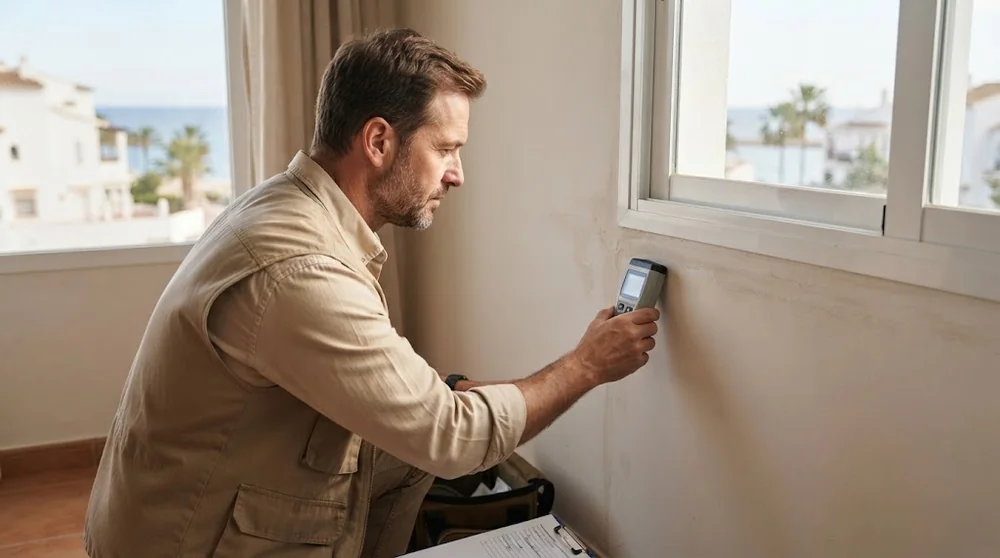
    Costa Blanca generally offers better value for a second home, particularly around Torrevieja, Alicante and Orihuela Costa. Costa del Sol suits buyers prioritising Málaga’s connections, Marbella’s amenities and premium coastal living. Neither is universally better: compare individual towns, purchase taxes, annual running costs, winter accessibility and rental restrictions before choosing.

    Property adviser discussing coastal apartments with a couple on a Mediterranean terrace

    Costa del Sol vs Costa Blanca at a Glance

    The table below compares the two coasts on the points that matter most to second-home buyers. The price figures are provincial asking-price indicators for Málaga province and Alicante province, not coastal-town valuations, and the tax rows apply to standard resale purchases. Treat the “suitability” row as my professional opinion rather than a statistic.

    Comparison factorCosta del Sol (Málaga province)Costa Blanca (Alicante province)
    Geographic settingCoastline from Torremolinos and Málaga west to Estepona, backed by mountains.Coastline from Torrevieja and Orihuela Costa north through Alicante, Altea, Calpe, Jávea and Moraira.
    Price position (asking-price indicator, October 2026)About €4,322/m² for Málaga province, per idealista.About €2,783/m² for Alicante province, per idealista, roughly 35.6% below Málaga.
    Principal airportMálaga-Costa del Sol Airport.Alicante-Elche Miguel Hernández Airport.
    Typical second-home stockApartments, townhouses, golf and hillside villas, and premium new developments.Apartments, bungalows, urbanisation villas and, in the north, premium villas.
    LifestyleInternational resorts, golf, marinas, Málaga city culture and Marbella dining.Large residential resorts in the south, smaller coves and towns in the north.
    Town varietyWide, from city living to exclusive resorts.Wide, from lower-priced resort towns to premium northern coves.
    Winter servicesStrongest in Málaga, Fuengirola and Marbella; quieter in some urbanisations.Strongest in Alicante and Torrevieja; quieter in some coastal villa districts.
    Car dependenceLower in Málaga, Fuengirola and Benalmádena Costa; higher in hillside and golf districts.Lower in central Alicante and Torrevieja; higher in urbanisations and northern villa areas.
    Standard resale transfer tax (ITP), as of November 20267% general rate in Andalusia.9% general rate in the Valencian Community, effective 1 June 2026.
    Rental rulesDepend on the Andalusian framework, the municipality and community rules.Depend on the Valencian framework, the municipality and community rules.
    Second-home suitability (professional opinion)Strong where connections and amenities matter more than entry price.Strong where entry price and running costs matter, if car use and winter are checked.

    A second home, a relocation and an investment property are three different purchases, and many comparisons blur them. A second home is a property you use intermittently for your own holidays. A relocation means living in Spain, which brings residency, healthcare and tax-residence questions. An investment property is bought mainly for rental income or resale. Intermittent use changes the sums: you pay for the home 365 days a year and enjoy it for a fraction of them, so a cheap purchase with high running costs can cost more per night than a dearer, simpler home.

    My quick reading for three types of buyer, again as opinion rather than advice:

    • Budget-conscious buyer: start with Alicante, Torrevieja and Orihuela Costa, then check winter use and car needs.
    • Premium lifestyle buyer: start with Marbella and Estepona, or the northern Costa Blanca towns of Jávea and Moraira.
    • Occasional visitor: start with towns close to the airport and a rail or tram line, such as Málaga, Fuengirola or central Alicante.

    Property Prices: Málaga vs Alicante

    In October 2026 idealista reported an asking-price indicator of about €4,322/m² for Málaga province and €2,783/m² for Alicante province. These are provincial figures built from advertised prices. They are not matched property sales, not beachfront averages and not notarised transaction values. idealista has also reported a methodology improvement from July 2026, so I have not mixed these figures with older series, and you should not either.

    Measure (October 2026 unless stated)Málaga provinceAlicante province
    Asking-price indicator, €/m²€4,322€2,783
    Difference in €/m²€4,322 − €2,783 = €1,539/m²
    Málaga premium, Alicante as denominator€1,539 ÷ €2,783 = about 55.3% higher
    Alicante discount, Málaga as denominator€1,539 ÷ €4,322 = about 35.6% lower
    Notional 80 m² home at the indicator (arithmetic only)€345,760€222,640
    Notional 120 m² home at the indicator (arithmetic only)€518,640€333,960

    The two percentages describe the same gap from different starting points. Málaga is about 55.3% more expensive than Alicante when Alicante is the base, and Alicante is about 35.6% cheaper than Málaga when Málaga is the base. The last two rows are simple multiplication to show scale. They are illustrative arithmetic, not listings, and no real two-bedroom flat or three-bedroom villa is guaranteed to sit at those figures.

    Provincial averages hide a great deal. Málaga province includes Marbella and inland towns, and Alicante province includes Benidorm, Torrevieja and the premium northern coves, so the mix of properties drives each number. Asking prices also differ from sale prices, and both differ from the appraisal values lenders use. Here’s where people usually come unstuck: they see “cheaper province” and assume every Costa Blanca home is cheaper, when a villa in Moraira or Jávea can cost more than a flat in a less expensive Costa del Sol town.

    To compare equivalent property types fairly, I suggest gathering five current listings of the same type in each town you are considering, for example a two-bedroom apartment within walking distance of the beach. Record the date, the size and the asking price per square metre, and then compare the towns rather than the provinces. I have not quoted flat or villa prices here because I would be inventing them without dated comparables.

    Best Second-Home Towns on Each Coast

    Towns on the same coast are priced very differently, so I group them by buyer type rather than by coast. The price comments below are my professional impressions as of November 2026, not dated price rankings, and you should confirm them against current listings for the exact property type.

    Costa del Sol: Málaga, Fuengirola, Benalmádena, Mijas, Estepona and Marbella

    Urban and rail-linked buyers tend to look at Málaga, Fuengirola and Benalmádena. Málaga city offers year-round services, culture and the nearest airport, though parking and older building condition need checking. Fuengirola and Benalmádena Costa are largely apartment markets with walkable seafronts, and the local rail line makes a car optional for many visits.

    Golf and resort buyers usually look at Mijas Costa, Estepona and Marbella. Mijas Costa has many urbanisations where a car is essential, and community fees can be substantial where pools, gardens and security are shared. Estepona combines an old town with newer developments. Marbella sits at the premium end, with high-quality amenities and a correspondingly higher entry price.

    Costa Blanca: Alicante, Torrevieja, Orihuela Costa, Calpe, Jávea and Moraira

    City-and-beach buyers look at Alicante, which has a major airport, a working Spanish city around it and services that carry on all winter. Value-oriented buyers tend to start with Torrevieja and Orihuela Costa, which have large stocks of apartments, bungalows and villas. Torrevieja is a town with year-round life, while parts of Orihuela Costa are residential urbanisations where shops, parking and winter opening hours deserve a visit in January.

    Premium northern buyers look at Calpe, Jávea, Moraira and Altea. Hillside villas, sea views and quieter coves put many of these towns in the same price conversation as some Costa del Sol locations. They are lovely places, but steep streets, limited public transport and quiet winters are common trade-offs.

    TownCoastBudget position (opinion, November 2026; verify with dated listings)Transport to airport and local linksAmenities outside summerCar needed?
    MálagaCosta del SolMid to upper; wide range by districtClosest to the airport; rail and bus linksStrong all yearOften not
    FuengirolaCosta del SolMid; mainly apartmentsRail line to the airport and MálagaStrong all yearOften not
    BenalmádenaCosta del SolMid to upper, by districtRail on the coast; hills need a carGood on the coastDepends on district
    MijasCosta del SolMid to upper; golf-ledRoad-based; bus and carMixed; better in larger hubsUsually yes
    EsteponaCosta del SolUpper; wide rangeRoad-based; bus and carGood in the centreOften yes
    MarbellaCosta del SolPremiumRoad-based; bus and carStrong in central areasOften yes
    AlicanteCosta BlancaLower to mid; city premium in prime districtsClose to the airport; bus and tram optionsStrong all yearOften not
    TorreviejaCosta BlancaLower to midRoad transfer or bus from the airportStrong in the centreDepends on district
    Orihuela CostaCosta BlancaLower to midRoad-basedMixed; check by urbanisationUsually yes
    CalpeCosta BlancaMid to upperRoad-based; longer transferGood in the centreOften yes
    JáveaCosta BlancaUpperRoad-based; longer transferQuieter in winterUsually yes
    MorairaCosta BlancaUpper to premiumRoad-based; longer transferQuiet in winterUsually yes

    Coastal apartment buildings beside a pedestrian street leading towards the sea

    My opinion, not a rule: the cheapest Costa Blanca home and the most expensive one are further apart than any two Costa del Sol towns I would shortlist for a normal budget. Compare towns, not coasts.

    Weather, Beaches and Winter Living

    Both coasts enjoy a Mediterranean climate, and neither is a guaranteed January sun-trap. I have avoided sunshine-day counts because they depend on the station, the year and the method, and brochure figures rarely say which. The Spanish state meteorological agency, AEMET, publishes station-level climate records, and I recommend reading the figures for the nearest station to any town on your shortlist.

    As a broad pattern, parts of Alicante province record less rainfall than some parts of Málaga province, while the mountains behind the Costa del Sol shelter many coastal areas from colder air. Those are generalisations. A south-facing apartment in Fuengirola, a north-facing villa in Jávea and a hillside house above Mijas will feel very different on the same day.

    A pleasant summer viewing may not represent January living. Many Spanish homes have no central heating, and a property that is empty for months can turn damp, with mould appearing on cold external walls. My advice to every British buyer is to visit once between November and February and to check these points:

    • Orientation: sun on the main rooms in winter, and shade from neighbouring buildings.
    • Heating and insulation: reversible air conditioning, radiators or a log burner, and how well the walls, windows and roof perform.
    • Humidity: signs of damp on ceilings, in wardrobes and behind furniture.
    • Services: which restaurants, supermarkets and clinics stay open when the tourists leave.

    Beaches vary as well. Exposed beaches can be rough, and some are narrow or cleared of sunbeds outside the season. Central Málaga, Fuengirola, Alicante and Torrevieja generally keep businesses open all year, while some urbanisations on Orihuela Costa and the northern coves can feel very quiet in winter. That suits some owners perfectly and others not at all.

    Quiet Mediterranean seaside promenade with apartment buildings on a sunny winter day

    Flights, Transport and Car-Free Holidays

    Judging an airport by size misses the point. What matters is whether your airline flies from your UK airport on the days you want, in the months you want, and how long the journey from the terminal to your front door really takes. Flight schedules change every season, so check them for your own dates.

    Transport factorMálaga-Costa del Sol AirportAlicante-Elche Miguel Hernández Airport
    Main areas servedMálaga, Torremolinos, Benalmádena, Fuengirola, Mijas, Marbella, Estepona.Alicante, Torrevieja, Orihuela Costa, and the northern coast towards Calpe, Jávea and Moraira.
    Flight pattern to checkYear-round and seasonal routes from UK airports; compare your own departure airport and weekdays.Year-round and seasonal routes from UK airports; compare your own departure airport and weekdays.
    Rail and public transportThe C1 commuter rail line links the airport area with Málaga and Fuengirola; Marbella and Estepona rely on buses and roads.Buses and a tram network serve Alicante and parts of the north; many villa districts have limited public transport.
    Car-free potentialRealistic in Málaga, Fuengirola and parts of Benalmádena.Realistic in central Alicante and parts of Torrevieja.

    Málaga’s C1 corridor is a genuine advantage for car-free holidays. A flat within walking distance of a C1 station in Fuengirola or Benalmádena Costa can work without hiring a car. Elsewhere, many Costa del Sol urbanisations and Costa Blanca villa districts are car-dependent, with the nearest supermarket a drive away.

    Distinguish airport-to-town from airport-to-property. A town may be close to an airport while the specific street sits up a hill, behind a security gate or at the end of a long urbanisation road. Before committing, run this checklist for the exact address:

    • Check the actual door-to-door journey at the time of day you would usually arrive.
    • Compare taxi, transfer, bus, rail and hire-car costs, including baggage costs for the airline you would use.
    • Confirm the nearest supermarket, pharmacy and restaurant, and whether you could reach them on foot.
    • Look at winter flight schedules, not only summer timetables.

    Ten years on the Costa del Sol have taught me that a half-hour transfer feels very different after a delayed evening flight with two children and four suitcases. Test the journey, not just the map.

    Buying Taxes and Total Purchase Costs

    The rates below apply to standard resale purchases as of November 2026. The general resale transfer tax, ITP (Impuesto sobre Transmisiones Patrimoniales), is 7% in Andalusia as of November 2026. The general ITP rate in the Valencian Community is 9% as of November 2026, effective 1 June 2026. The Valencian Community also applies an 11% rate under a rule for transactions above €1 million, and the exact condition needs verifying for any high-value purchase. Primary-residence reductions do not automatically apply to a second home. For the legal texts, see the official gazette, the Boletín Oficial del Estado (BOE), and have your lawyer confirm any amendments before you sign.

    The tax is charged on a taxable base, which is not always the price in the contract. Spain’s tax authorities can use a reference value (valor de referencia) set by the cadastre, and the base can be the higher of the price and that value. For a worked example, I assume the base equals a €300,000 purchase price.

    Illustrative cost item (€300,000 resale, November 2026)Andalusia (Costa del Sol)Valencian Community (Costa Blanca)
    Purchase price€300,000€300,000
    ITP (7% or 9%, assuming base equals price)€21,000€27,000
    Legal fees (assumed 1%, illustrative)€3,000€3,000
    VAT on legal fees (21%, illustrative)€630€630
    Notary and registry (assumed 0.8%, illustrative)€2,400€2,400
    Administrative extras: NIE, translations, bank (assumed)€500€500
    Total costs on top of the price€27,530€33,530
    Total cash needed (before any mortgage costs)€327,530€333,530

    The ITP difference is €27,000 − €21,000 = €6,000, and it widens as the price rises. The fees in the table are my planning assumptions for illustration, not published tariffs. Quotes vary by lawyer, notary and property, and any mortgage adds valuation, arrangement and registration charges.

    New-build purchases work differently. A qualifying new residential property normally carries 10% IVA (Spanish VAT) on the price, so a contract price of €300,000 before IVA would carry €30,000 of IVA, plus regional stamp duty (AJD). The AJD rate is set regionally, and my understanding is that it commonly sits around 1.2% in Andalusia and 1.5% in the Valencian Community, which you should confirm for your transaction. Resale ITP and new-build IVA do not apply to the same standard transaction, so never add them together.

    Then there is sterling. Your home costs euros, but your savings are probably in pounds. At an illustrative rate of €1.15 per £1, the €327,530 above costs about £284,809. At €1.10 per £1 it costs about £297,755, a difference of roughly £12,946 on the same house. Those rates are examples only. Consider how a rate move between reservation and completion would affect your budget, and speak to a currency specialist about fixing it.

    Annual Costs of Owning a Spanish Second Home

    Annual running costs decide whether a second home feels like a pleasure or a drain. The figures below are hypothetical inputs I have chosen to show the structure of the bill. They are not researched market averages, and actual costs vary by municipality, building and usage.

    Illustrative annual cost (hypothetical, €/year)Apartment with shared poolDetached villa with private pool
    IBI (local property tax, Impuesto sobre Bienes Inmuebles)€350€900
    Refuse and other local charges€150€250
    Community fees (comunidad)€1,500€600
    Home insurance€250€450
    Utilities at low occupancy€600€1,100
    Internet and phone€360€360
    Maintenance and repairs reserve€500€2,000
    Keyholding and property checks€300€500
    Pool and garden upkeep€0 (in community fees)€1,800
    Non-resident tax on imputed income (illustrative)€264€449
    Illustrative total per year€4,274€8,409

    Furnished holiday apartment overlooking a shared residential swimming pool

    Most items are self-explanatory. IBI is the annual municipal property tax. The community fee pays for shared pools, lifts, gardens and insurance in an apartment block or urbanisation. Always check how much is owed and whether any special levy is planned.

    Spanish non-resident tax can apply even if you never rent the property out. For an urban home, owners are generally taxed on imputed income, a notional income based on the property’s cadastral value. The Agencia Tributaria sets the filing route through Modelo 210. The general rates are 19% for qualifying EU/EEA residents and 24% for other taxpayers, and a UK tax resident is generally in the 24% group, which a tax adviser should confirm. The 24% is charged on the taxable base, not on the market value of the home. As an illustration, a cadastral value of €100,000 with imputed income at 1.1% gives €1,100, and 24% of that is €264. The percentage applied depends on whether the cadastral value has been revised, so check the figures on your property’s local tax receipt.

    Now divide by use. At 40 nights a year, the apartment above costs about €4,274 ÷ 40 = €107 per night used, and the villa €8,409 ÷ 40 = about €210. At 100 nights, those fall to about €43 and €84. These figures exclude mortgage interest, purchase costs, flights and the value of the capital tied up. A villa that looks cheap to buy can be expensive to operate if it sits empty for nine months, so low occupancy is the number to watch.

    What British Second-Home Buyers Need to Know

    British nationals can generally buy property in Spain, but owning a Spanish home does not give a right of residence. Let me put it plainly: ownership is a property matter, while your right to stay is an immigration matter. The two are separate, and I regularly meet buyers who assume otherwise.

    1. Count your days. As of November 2026, ordinary visa-free visits by British nationals are limited to 90 days in any rolling 180-day period. That allowance is shared across all Schengen countries, so a week in France and a long weekend in Portugal both count towards the same total. Check the current GOV.UK Spain entry requirements for any new border or travel-authorisation systems before you plan stays.
    2. Do not rely on an outdated investor-residence route. Property ownership alone does not provide residence, and rules for longer stays or residence permits change. Take independent immigration advice before assuming any route is available.
    3. Get your NIE. The NIE (Número de Identidad de Extranjero) is the foreigner identification number you need for the purchase, tax filings and utilities. Your lawyer can usually arrange it.
    4. Prepare proof of funds. Spanish banks and notaries ask where the money came from, so keep statements and records of sales, savings or gifts ready.
    5. Open a Spanish bank account. Many owners use it for utilities, community fees and taxes, and the notary will normally expect payment by bank transfer.
    6. Understand your tax position. Tax residency depends on where you live, not where you own property. A non-resident owner can still owe Spanish tax, as explained above, and may have obligations in the UK too.

    Keep your own records of the dates you enter and leave the Schengen area. Border systems are changing, and you want to be able to show your own count. A property purchase takes weeks rather than days, and the administration is easier when documents are ready in advance.

    If you have a specific question about your purchase steps, tax position or paperwork, a quick one-to-one conversation can save you weeks of guesswork.

    Ask a question on WhatsApp

    Whatever the answer, confirm anything that affects your legal or tax position with a qualified, independent adviser who acts for you alone.

    Can Your Holiday Home Earn Rental Income?

    Ownership does not automatically permit holiday lets. Three scenarios are legally and financially different: occasional personal use, long-term letting to a resident tenant, and tourist accommodation let to short-stay guests. This section describes general principles, not a rule for any particular property, and I have not published yields because they would mislead.

    Tourist letting is regulated regionally. Andalusia and the Valencian Community each have their own registration frameworks, and tightened rules have been introduced in recent years. A national registration number for rentals has also been introduced, and building-community rules can matter: my understanding is that a majority vote of owners may be required in some circumstances, which your lawyer should verify. Municipalities can restrict tourist use through planning rules. Registering a tourist property is not the same as receiving unconditional authorisation.

    Before counting on rental income, work through these checks for the exact property:

    1. Ask whether the property is already registered for tourist use, and what the registration actually covers.
    2. Confirm that the municipality’s planning rules allow tourist use in that building and zone.
    3. Read the community statutes and recent minutes for any ban or restriction on holiday lets.
    4. Check that insurance covers short-term guests and liability.
    5. Ask a tax adviser how non-resident rental income is taxed for you and which deductions, if any, apply.

    Never treat advertised gross yields as income you keep. Here is a hypothetical calculation for a two-bedroom apartment, with every input assumed for illustration:

    Hypothetical annual rental calculation (illustrative only)Amount
    Gross rent: 100 nights let at €100 per night (about 27% occupancy)€10,000
    Management and platform fees at 25%−€2,500
    Cleaning and linen−€1,200
    Extra utilities and consumables−€800
    Fixed ownership costs (apartment from the earlier annual-cost table)−€4,274
    Result before Spanish tax on rental income€1,226
    Possible tax if charged at 24% on gross rent with no deductions (a general rule for some non-EU/EEA residents; confirm with a tax adviser)−€2,400
    Hypothetical result after tax−€1,174

    This example is not a forecast. Different occupancy, prices, costs or tax treatment would give a very different result, and the point is that the outcome is property-specific and uncertain. Resale liquidity is the same: some properties sell quickly and some do not, and no coast guarantees demand or price growth.

    Legal Checks Before Buying on Either Coast

    Most problems I see are avoidable with a few checks done before money changes hands. Work through these seven steps with an independent lawyer who acts for you, not for the seller or the agent.

    1. Request a current nota simple. This is a summary from the Registro de la Propiedad (the Land Registry) showing the registered owner, the property description and any registered charges. Always ask for the nota simple before you commit, and check that the seller named in it is the person selling.
    2. Confirm ownership and charges. Look for mortgages, embargoes or other charges. Debts attach to Spanish property, so unpaid ones can pass to you unless they are cleared at completion.
    3. Obtain a community debt certificate. Ask the community administrator to confirm that fees are paid up and whether any extra levies are planned.
    4. Check IBI and local charges. Obtain proof that the last IBI bills and local charges are paid.
    5. Verify planning legality and licences. Make sure the property matches its planning permission. Extensions, terraces, pools and enclosed porches added without permission are a common problem, and the solution may be costly or impossible.
    6. Compare registry and cadastre descriptions and inspect the building. Cadastral and registry discrepancies in size or layout can delay a sale. Commission a surveyor to assess structural condition, roof, damp and drainage. Near the coast, ask whether coastal protection rules affect the plot.
    7. Review the contract before any deposit. Do not pay a binding deposit before your lawyer has reviewed the private contract (contrato de arras), because its terms on deposit loss and penalties can be severe. If buying off-plan, check the bank guarantee for your stage payments and the developer’s licences.

    An agent’s assurance is not verification. A friendly reassurance that everything is fine does not replace the nota simple, the certificates and your own lawyer’s report. Hold off on any binding deposit until those documents are in your hands.

    Opinion, from the practical side of the table: the dullest documents in the file are the ones that save you money. A day spent chasing paperwork is cheaper than years of fixing a problem you bought without knowing.

    Buyer and property professional inspecting the exterior of a coastal apartment

    Which Coast Suits Your Second-Home Budget?

    Purchase price is not the same as all-in budget. The table below uses three illustrative price points, the 7% and 9% ITP rates as of November 2026 for standard resale purchases, and other costs of roughly 2.2% of the price based on the worked example above. Availability, legal checks and the taxable base must be confirmed for any real property, and none of this is a promise that specific homes exist at these prices.

    Property price (illustrative)ITP Andalusia (7%)ITP Valencian Community (9%)Other costs (assumed, approx.)All-in cash, AndalusiaAll-in cash, Valencia
    €200,000€14,000€18,000€4,400€218,400€222,400
    €300,000€21,000€27,000€6,530€327,530€333,530
    €500,000€35,000€45,000€10,900€545,900€555,900

    What each budget might plausibly look at, subject to current listings:

    • Around €200,000: apartments or bungalows in Torrevieja, Orihuela Costa or parts of Alicante, and smaller or older apartments in Fuengirola or Benalmádena.
    • Around €300,000: larger apartments in Alicante and Torrevieja, or in Calpe, and apartments in Fuengirola, Estepona or Málaga.
    • Around €500,000: villas on Orihuela Costa, apartments in Jávea or Moraira, or apartments in Estepona and Marbella.

    Annual running costs, as in the earlier illustration, then sit on top of those figures, and travel patterns decide how much of the property you actually use. Match the coast to the buyer, not the other way round:

    Buyer profileCosta del Sol towns to check firstCosta Blanca towns to check firstWhat to test
    British family using school holidaysFuengirola, Benalmádena, EsteponaTorrevieja, Orihuela Costa, AlicanteBeach distance, pool, peak-season flight prices, winter use
    Retired couple staying in winterMálaga, Fuengirola, EsteponaAlicante, TorreviejaHeating, healthcare access, services open in January
    Golf-focused buyerMijas Costa, Estepona, MarbellaOrihuela Costa, Alicante surroundingsCourse access, community fees, car needs
    Occasional weekend travellerMálaga, FuengirolaAlicante cityFlight frequency, rail or tram access, walkability

    Each shortlist is conditional. A town only makes the list if a suitable property is actually available, passes the legal checks above and works for your transport needs. Sterling’s value, interest rates and your own plans can change the picture, so I would revisit the numbers before reserving anything.

    To match these budgets to specific towns, property types and your likely travel pattern, a short questionnaire is the quickest route to a tailored shortlist.

    Get a property shortlist for Spain

    The shortlist is a starting point for your own checks, not a recommendation to buy a particular home.

    Costa del Sol or Costa Blanca: Final Verdict

    Neither coast is objectively superior. The right answer comes from your priorities, and my summary below is professional opinion, not financial or legal advice.

    • Costa Blanca usually deserves the first look for affordability. Provincial asking prices were about 35.6% lower in Alicante than in Málaga in October 2026, and standard resale ITP is higher in Valencia at 9% versus 7% in Andalusia, which narrows but rarely erases the gap.
    • Costa del Sol deserves the first look for connections and premium living. Málaga’s airport, rail corridor and Marbella’s amenities suit buyers who value convenience over entry price.
    • The exceptions matter. Premium northern Costa Blanca towns such as Jávea and Moraira can rival Costa del Sol prices, and more modest Costa del Sol towns can be less expensive than prime beachfront anywhere.

    Five questions to settle the choice:

    • What is your all-in budget once purchase taxes, fees and a year of running costs are included?
    • How many nights will you realistically use the home, and how many visits will you make?
    • Will you rely on a car, or do you need rail, tram or walking access?
    • Will you stay in winter, when heating, damp and open services matter?
    • Do you want to let the property, and has its legal eligibility been verified?

    For a first-look shortlist, I would suggest Fuengirola, Estepona and Málaga for connections-led buyers, Torrevieja, Alicante and Orihuela Costa for value-led buyers, and Marbella or Jávea and Moraira for premium-led buyers, all subject to the checks above. If useful, you are welcome to ask for a shortlist that compares towns, estimated total costs, transport and legal-check priorities for your situation. There is no obligation, and I cannot promise savings or any particular result.

    Frequently Asked Questions

    Is Costa Blanca cheaper than Costa del Sol?

    Generally, yes, when measured by provincial asking prices. In October 2026, idealista reported about €2,783/m² for Alicante province and €4,322/m² for Málaga province, so Alicante was roughly 35.6% lower than Málaga. These are not matched property prices, however. A villa in Moraira or Jávea can cost more than a flat in a less expensive Costa del Sol town, so compare similar properties.

    Which is better for a holiday home, Costa del Sol or Costa Blanca?

    It depends on how you will use it. Costa Blanca often suits buyers who want lower entry prices, residential neighbourhoods and plenty of mid-budget apartments. Costa del Sol can suit buyers who want Málaga’s airport connections, golf, international amenities and premium developments. Neither wins outright: test your budget, the number of visits each year, whether you will need a car and how your chosen town operates in winter.

    Which coast has better weather in winter?

    Both coasts have mild Mediterranean winters, but conditions vary by town, elevation and exposure. Some Costa Blanca locations are drier than parts of Málaga province, while sheltered Costa del Sol areas can feel pleasantly mild. Cool nights, damp and limited heating still affect unoccupied homes on both coasts, so check AEMET records for the town and inspect the property’s insulation, heating and orientation.

    Can British citizens buy a second home in Spain after Brexit?

    Yes. British citizens can generally buy Spanish property without becoming Spanish residents, and you will need an NIE (Número de Identidad de Extranjero) to complete the purchase. Ownership does not give a right to live in Spain. As of November 2026, ordinary visa-free visits are limited to 90 days in any 180-day period, shared with other Schengen trips. Longer stays need separate immigration advice.

    How much tax will I pay when buying a second home in Spain?

    For a standard €300,000 resale purchase, the general transfer tax (ITP) as of November 2026 is 7% in Andalusia, or €21,000, and 9% in the Valencian Community, or €27,000, assuming the taxable base equals the price. Notary, registry and professional costs are extra. New-build purchases generally attract IVA, normally 10% for qualifying homes, plus regional stamp duty (AJD), instead of resale ITP.

    Can I rent out my Spanish holiday home when I am not using it?

    Possibly, but owning a home does not automatically permit tourist lets. Eligibility depends on regional legislation, municipal planning rules, registration and sometimes your building community’s rules, so verify the exact property before buying. Judge income after management fees, vacancy, maintenance and Spanish non-resident tax, not on advertised gross figures, and never assume a licence transfers or can be obtained.

    My Takeaway After a Decade on the Coast

    Costa Blanca is usually the better place to start if your priority is a lower entry price and sensible running costs, and Costa del Sol is usually the better place to start if you want Málaga’s connections or premium amenities. The October 2026 indicators of about €4,322/m² for Málaga province and €2,783/m² for Alicante province show the gap, but they are provincial asking prices, so the town and the exact property decide the real numbers.

    Whichever coast you pick, budget for the whole picture: ITP of 7% or 9% on a standard resale, other purchase costs, annual running costs and the nights you will actually use the home. Check winter conditions, the journey to the front door and the legal file before you pay a deposit. Rental income and resale demand are uncertain, property by property, so never build your plan on them.

    I swapped Manchester drizzle for Marbella more than ten years ago and have never regretted it, but I am wary of anyone who says one coast suits everybody. Shortlist two or three towns, compare them with real figures and take independent legal and tax advice before you commit.

    Disclaimer: This article is general information as of November 2026 and does not constitute legal, tax, financial or immigration advice. Tax rates, regional regulations, rental rules and entry requirements change, and the calculations shown are illustrative. Take independent advice from a qualified Spanish property lawyer, a tax adviser and, where relevant, an immigration specialist before buying.

  • Semi-Detached Houses in Mallorca: Costs and Lifestyle

    Semi-Detached Houses in Mallorca: Costs and Lifestyle

    Choosing between a semi-detached house, a townhouse and a detached villa on Mallorca comes down to three things: how much privacy you need, how much upkeep you will put up with, and what the full bill looks like once taxes and community fees arrive. Semi-detached houses in Mallorca, known locally as casas pareadas, sit between the extremes, which is both their appeal and their trap. This guide covers what the shared wall means day to day, what asking prices looked like in November 2026, and which checks belong on your list before you shortlist one. I’m David, a Mancunian who has spent more than ten years helping English-speaking buyers in Spain, so expect plain talk and the odd grumble about paperwork.

    Semi-detached houses in Mallorca (casas pareadas) share one party wall but usually offer private living space and often a terrace, garden or shared facilities, with a different maintenance and privacy balance from a detached villa. Price and annual costs depend on location, condition and community obligations. Budget for Balearic purchase taxes, community fees, insurance and upkeep.

    Property adviser standing outside a semi-detached Mediterranean house with a terrace and small garden in Mallorca

    What Is a Semi-Detached House in Mallorca?

    A semi-detached house (casa pareada in Spanish) is a house that shares one party wall with one neighbouring house and has open elevations on its other sides. That single shared wall is the whole architectural definition. Everything else, including who owns the garden, the pool, the driveway and the roof, is a separate legal question that a listing headline cannot answer.

    Semi-detached vs terraced vs detached

    A casa adosada (townhouse) usually sits in a row. Middle units share walls on both sides, and only the end units share a single wall. A chalet independiente (detached villa) stands free on its plot with no shared structural wall. Mallorcan listings mix these labels freely: an end-of-terrace house is sometimes advertised as a pareado, and a pareado inside a development may be sold as an adosado. Ten years on the Costa del Sol have taught me that agents use the words loosely there too, so the label tells you very little.

    TypeShared wallsPrivate outdoor spacePrivacyUpkeepLegal points to check
    Casa pareada (semi-detached)One party wallOften a garden or terrace on three sides, size variesModerate: one neighbour next doorOwner usually maintains own roof, facade and garden; party wall is sharedOwn plot or part of a community; party wall ownership; exclusive-use areas
    Casa adosada (terraced townhouse)One wall (end unit) or two walls (middle unit)Often a small patio, roof terrace or modest gardenLower, particularly in middle unitsSmaller footprint, often shared services or communal areasFrequently within a community; statutes and fees matter
    Chalet independiente (detached villa)NoneUsually the largest, all sidesHighest, subject to plot size and neighbours’ windowsOwner carries everything: pool, garden, boundary wallsPlot boundaries, licences for pool and extensions
    Dúplex-style listingVaries: may be a two-floor flat in a blockTerrace or balcony, sometimes a roof terraceDepends on neighbours above, below and besideBuilding elements are communalHorizontal property; the building structure is community-owned

    Why a duplex is not necessarily a semi-detached house

    A dúplex describes a layout over two floors, not a wall arrangement. A dúplex can be an upper-floor flat inside a block with neighbours above, below and beside, which is a very different proposition from a house with its own ground-level front door. Conversely, a genuine semi-detached house on three floors is not automatically a “duplex” in listing language. Ask whether the home has its own entrance from the street or plot, and whether anyone lives above or below it.

    Architecture is not ownership

    House configuration does not establish who owns the land or the facilities. Some pareados each stand on their own registered plot with an independent title. Others are units within a development under the Ley de Propiedad Horizontal, where the pool, access road and landscaped areas may belong to the comunidad de propietarios, while a garden may be private or an exclusive-use area of a common plot. Always ask for the nota simple before you commit, because it shows how the registry describes the property and what charges sit on it.

    Two adjoining semi-detached houses with separate entrances and private terraces

    The Everyday Lifestyle: Space, Privacy and Neighbours

    Living in a semi-detached house is mostly about the things you do not notice until you have moved in: the sound of a neighbour’s television through the party wall, where the bins go, and whether your terrace is in shade at five in the afternoon in August. The house is usually laid out over two floors, sometimes three, with living space at ground level and bedrooms upstairs. Gardens range from a paved courtyard to a generous plot with room for a private pool, so never assume a semi-detached house has a garden or shared facilities; confirm each one in the documents.

    Shared-wall noise is the question I hear most. Modern developments generally have better acoustic separation than older village-edge houses, where a single brick or stone wall may carry voices and music. Visit at an evening hour and listen from the bedroom and the terrace. Parking deserves the same scrutiny: a private driveway, a garage, a communal space or on-street parking lead to very different daily lives, particularly in winter when you want to unload shopping in the rain.

    Climate shapes comfort more than most buyers expect. Mallorca summers are hot, so shade, cross-ventilation and orientation matter. A west-facing terrace may be lovely in the evening and unusable in July. Winters are mild but can be damp, and homes with poor insulation, little sun and no heating can feel cold and develop condensation or mould. Check for reversible air conditioning, the type of heating, window quality, roof insulation and signs of damp on the party wall. Here’s where people usually come unstuck: they judge a house on a bright June viewing and never ask how it feels in January.

    Why families choose semi-detached homes

    Families tend to like the combination of a front door at street level, outdoor space for children and, in many developments, a pool or play area shared with neighbours. A semi-detached house often costs less than a comparable detached villa on a similar plot, although that depends on location, and I would not treat it as a rule. Staircases, a garden gate, access to schools and healthcare, and the layout of bedrooms matter more than the headline size. A communal pool also removes the chore of maintaining your own, though not the community fee that comes with it.

    What retirees and second-home owners should consider

    Retirees should examine stairs, the position of bedrooms and bathrooms, step-free access from the parking area, and the distance to a pharmacy and a medical centre. A hypothetical retired couple who love a three-floor house may find that, ten years on, the stairs decide the matter. Seasonal owners face different tests: security when the house stands empty, a reliable key-holder, water and electricity management, and whether the community is busy or deserted in winter. A realistic twelve-month evaluation walks through each season: summer heat and parking, autumn storms and roof drainage, winter damp and heating bills, spring garden growth and pool opening. If the house passes in all four, you have a home rather than a holiday impression.

    My opinion, not a rule: when a buyer can only afford to inspect once, I would rather they see the house on a grey November afternoon than on a sunny day in May.

    Shaded terrace and private garden beside a semi-detached house in Mallorca

    Where to Find Semi-Detached Homes in Mallorca

    Semi-detached homes are not evenly spread across the island. A thinkSPAIN category page for Mallorca named Llucmajor, Calvià and Palma de Mallorca among the places with the most semi-detached villa listings in a November 2026 check, with Marratxí among the cheaper areas. That reflects one portal’s advertised stock and says nothing about every municipality, and some towns will offer only a handful of listings at any moment. Treat the table below as a shortlist aid, not a guarantee of choice.

    AreaResidential characterEveryday amenitiesPotential trade-offsSuitable buyer
    Palma de Mallorca and outskirtsUrban and suburban, year-round lifeMain hospitals, schools, shopping, transport, airport on the city edgeHigher prices, traffic, limited inventory of true pareados in central districtsPermanent residents and families wanting services
    MarratxíSuburban municipality next to PalmaEveryday shopping, schools, road links to the capitalLess sea access, busy commuter roadsFamilies and working residents seeking Palma access
    LlucmajorLarge municipality with varied settings, from town to coastal and countryside urbanisationsTown services in the main centre; coastal areas varyDistances within the municipality are significant; check winter activityBuyers wanting more space and a range of price points
    Calvià and southwest coastCoastal urbanisations and resort districts with established communitiesMarinas, golf, restaurants, international schools nearbySeasonal quiet in resort zones; coastal premiumSecond-home owners and residents wanting coastal access
    Northern MallorcaQuieter towns and coastal developments around Alcúdia, Pollença and the northeastLocal shops and services; seasonal hospitalityFurther from Palma’s hospitals; strong seasonalityQuiet family or second-home buyers

    Palma and Marratxí for year-round convenience

    Palma holds the island’s largest concentration of public and private hospitals and clinics, schools, shops and public transport, and the airport sits on the edge of the city. Marratxí lies immediately beside it and offers a suburban pattern of streets, schools and shops with road access to the capital. For a permanent resident this combination removes much of the winter isolation that worries some buyers. Check school catchments and the language of instruction, because teaching in Balearic state schools is largely in Catalan, and check bus routes and parking in the street rather than assuming them.

    Llucmajor for space and varied residential settings

    Llucmajor is a large municipality, so its character varies from a traditional town centre to coastal and countryside urbanisations. Its portal listings include four-bedroom semi-detached villas with pools at the upper end of mid-range prices, but quality varies, and distances between a particular urbanisation and the nearest supermarket or health centre should be checked on a map and then on the road. Winter activity can be limited in some urbanisations, which suits some owners and frustrates others.

    Calvià and southwest Mallorca for coastal access

    Calvià contains well-known coastal areas such as Santa Ponça and Palmanova, plus smaller developments inland. Its semi-detached villas sit at a markedly higher price point than the island-wide portal average, reflecting the coastal location, and some resort districts are quiet outside the main season. I compare it to parts of the Costa del Sol: lovely in June, and very different in February. Visit out of season before you decide.

    Northern Mallorca for quieter family and second-home options

    Around Alcúdia, Pollença and the northeast, semi-detached homes tend to appear in residential developments close to beaches, with a seasonal rhythm in shops and restaurants. Check healthcare access, local schools, the airport journey by road, and the winter opening patterns of the shops you would use weekly. I have not assumed any journey times here, and you should measure them for the specific property.

    Residential street with semi-detached houses and private driveways in Mallorca

    How Much Do Semi-Detached Houses Cost in Mallorca?

    There is no single official price for semi-detached houses in Mallorca. The figures available are advertised asking prices from property portals, and those are different from completed sale prices, which appear later in registry and notarial statistics. Broad Mallorca house price averages and semi-detached-specific averages are also different datasets, and one should never be quoted as if it were the other.

    Dated portal snapshot (November 2026)

    A November 2026 check of thinkSPAIN category pages gave the following. Categories are labelled by the portal, sample sizes are small, and the figures are mean asking prices, not transaction prices. The Mallorca-wide listing count also moved between pages checked (127 on one, 117 on another), which shows how quickly portal stock changes.

    Portal category and areaListings in sampleAverage asking priceAverage per m²
    Semi-detached villas, Mallorca127€860,791€4,712
    Semi-detached villas, Calvià10€1,450,000€8,055
    Semi/terraced villas, Marratxí12€765,000€4,740
    Semi/terraced villas, Capdepera14€895,000€4,081
    Semi/terraced villas, Santanyí4€530,000€4,108

    The rows are not like for like: “semi/terraced villas” is a broader portal category than “semi-detached villas”, and a sample of four properties tells you almost nothing. The Calvià figure of €8,055 per square metre against €4,712 island-wide shows why one average hides the variation between municipalities. Per-square-metre figures also depend on the area measured, so ask whether the quoted area is built area, usable interior area, or a total that includes terraces and garden. In Spain, terraces are usually valued at a lower rate than interior space, and garden land at lower again.

    What drives the price

    • Location: coastal Calvià or Palma neighbourhoods command a premium over inland Marratxí or Llucmajor.
    • Built area and layout: usable interior space, number of floors and bedrooms.
    • Outdoor space: private garden, terrace, roof terrace, and any private pool.
    • Views and orientation: sea views and a sunny aspect add value; shaded plots reduce it.
    • Parking: private garage or space versus street parking.
    • Condition: new, reformed or needing work, plus insulation and energy rating.
    • Community arrangements: shared pool and gardens affect both price and annual cost.

    An illustrative €600,000 house

    For the examples in this guide, I use a clearly hypothetical resale semi-detached house at €600,000: roughly 125 m² built at about €4,800 per m² (125 x 4,800 = €600,000), with a small garden and terrace. It is a calculation device, not a typical island-wide price and not a listing. Its per-square-metre figure is close to the island-wide portal average above, but a similar house in coastal Calvià could cost much more, and one in an inland village much less.

    Buying Costs: Taxes, Fees and a Realistic Budget

    The agreed price is not the full cost of buying. The purchase tax is the largest addition, and the rate depends on whether you buy a resale home or a new one. As of November 2026, a resale house in the Balearics is generally subject to ITP (Impuesto sobre Transmisiones Patrimoniales), administered by the Balearic tax agency ATIB and governed by the regional consolidated tax text, which is available through the BOE consolidated text of Decreto Legislativo 1/2014. ATIB publishes the current practical guidance on rates and forms, so confirm the figures with them or your adviser before you budget.

    Resale purchase example

    The general ITP scale is progressive, so each rate applies only to the slice of value within its band. As of November 2026, the general bands are as follows. Some portals show the 13% band starting at €3 million, but the consolidated legal text and most tax guides checked show it starting above €2 million, so confirm the current figure with ATIB or your adviser if your purchase is anywhere near those levels.

    Taxable base bandRate on that bandCumulative ITP at top of band
    Up to €400,0008%€32,000
    €400,000.01 to €600,0009%€50,000
    €600,000.01 to €1,000,00010%€90,000
    €1,000,000.01 to €2,000,00012%€210,000
    Above €2,000,00013%Not capped

    For the hypothetical €600,000 resale house, assuming the taxable base equals the price and no relief applies, ITP is €32,000 (8% of €400,000) plus €18,000 (9% of €200,000), which gives €50,000. The taxable base is not always the agreed price: as of November 2026, the general rule is that the tax is calculated on the higher of the price declared and the administration’s reference value (valor de referencia), which is derived from cadastral data. A buyer who agrees a low price against a higher reference value may still pay tax on the higher figure, so check the reference value for the specific property before signing.

    Illustrative itemAssumptionAmount
    Purchase priceHypothetical resale house€600,000
    ITPStandard bands, base equals price, no relief€50,000
    Independent solicitorPlaceholder of 1% of price, VAT excluded€6,000
    Notary and land registryPlaceholder, varies by deed€3,000
    Administration and gestoríaPlaceholder€600
    Technical surveyPlaceholder for an architect or surveyor€800
    Total extra costs50,000 + 6,000 + 3,000 + 600 + 800€60,400
    Total outlay600,000 + 60,400€660,400

    Those professional fees are my illustrative assumptions, not quotations, and your own figures will differ. On these assumptions the extras are about 10% of the price. A deposit, such as 10% (€60,000) paid on signing a private contract, is not an extra cost: it counts towards the €600,000 price and is deducted from what you pay at completion.

    New-build tax differences

    A first sale of a new residential property by a developer is generally subject to IVA (VAT) at 10% as of November 2026, not to ITP. On a €600,000 new-build price that would be €60,000 before any other costs. Actos Jurídicos Documentados (AJD, stamp duty) is charged separately on the notarial deed, and published guides disagree on the exact Balearic rate and its thresholds, so I will not quote a universal figure here. Ask your solicitor to confirm the current AJD rate against the official regional text before you budget.

    Reduced ITP rates and tax benefits exist in the Balearics for certain buyers purchasing a main home within value limits, such as younger buyers or large families. ATIB updated the relevant value thresholds through a regional order published in March 2026, and the figure identified for Mallorca and Menorca effective 14 June 2026 is €331,859.70. That is a threshold, not an entitlement: a British second-home buyer should not assume eligibility, and the specific conditions need checking with ATIB or an adviser.

    Annual Running Costs and Community Responsibilities

    Owning a semi-detached house adds a layer of recurring bills to the purchase price. These differ from property to property, so the worksheet below uses explicit placeholders that you should replace with real documents from the seller. It assumes the hypothetical €600,000 house, with a community fee and a non-resident owner, which makes it a fuller example than many buyers will actually face.

    ItemIllustrative annual assumptionHow to replace it with real data
    IBI (Impuesto sobre Bienes Inmuebles)€900Latest receipt from the town hall
    Refuse charge€150Municipal bill
    Buildings and contents insurance€500Quote based on build size and contents
    Utilities (electricity, water, internet, gas)€2,400 (€200 a month)Last 12 months of bills, including air conditioning
    Community fee€1,200 (€100 a month)Approved annual budget and your participation share
    Maintenance allowance€3,000 (0.5% of €600,000)Survey report and age of roof, windows, installations
    Garden, pool and key-holding for an absent owner€600Local quotes if not covered by the community
    Non-resident income tax on imputed income€1,200Assumes a €250,000 cadastral value, 2% imputed income (€5,000) at 24%
    Total€9,950900 + 150 + 500 + 2,400 + 1,200 + 3,000 + 600 + 1,200

    The last row applies only to non-resident owners who do not rent the property out, and the rate and method depend on residence status, so a tax adviser should confirm it. It is a Spanish tax on imputed income from owning a second home, not a tax on actual profit. As of November 2026, the Agencia Tributaria sets the rules, and its official website publishes the current non-resident forms. Mortgage payments are not included, and an owner who lives in the property permanently will have a different set of tax outcomes.

    What do community fees actually cover?

    Not every semi-detached house belongs to a comunidad de propietarios. Where there is one, the fee typically covers shared pools, gardens, lighting, roads, security, insurance on common areas and an administrator. Shared facilities may lower your personal workload, but they do not guarantee lower total spending: a development with a large pool and landscaped grounds can have a higher fee than a modest apartment block. Ask for the approved budget, the last two or three sets of meeting minutes (actas), the reserve fund balance, and details of any approved or proposed special assessments (derramas) for roof, facade, pool or road repairs.

    The Ley de Propiedad Horizontal also matters when buying. As of November 2026, a buyer of a property within horizontal ownership can be affected by community debts attached to the property from the year of acquisition and the preceding three calendar years. A seller’s verbal assurance is not evidence, so request a signed certificate of community debt from the administrator.

    What repairs remain the owner’s responsibility?

    In a typical semi-detached house, the owner maintains the interior, their own roof, windows, facade and private garden. The party wall is usually shared with the neighbour, and the title or community statutes should say who pays for what. Elements such as drains, shared boundary walls, roofs that run across both houses, and exclusive-use terraces can be unclear. Here’s where people usually come unstuck: they assume the community pays for the roof, when the statutes assign it to the individual owner.

    Professional observation: I have seen community budgets that looked modest until a major repair was approved. Always read the minutes as well as the budget.

    Communal swimming pool and landscaped gardens beside adjoining homes in Mallorca

    Semi-Detached vs Townhouse, Apartment and Detached Villa

    The right property type depends on how you will use the home, not on which label sounds nicest. The matrix below uses conditional wording because outcomes depend on design, condition and community arrangements, so each cell describes a general tendency rather than a rule.

    FactorSemi-detachedTownhouseApartmentDetached villa
    PrivacyModerate, one shared wallLower, especially in middle unitsDepends on building and floorHighest, subject to plot size
    Outdoor spaceOften a garden or terraceOften a patio or roof terraceBalcony or terrace, sometimes communalLargest, all around
    Maintenance controlMostly yours, with shared wall questionsOften shared or managedMostly communityEntirely yours
    Communal expensesOnly if in a communityCommonly in a communityAlmost alwaysOften none
    AccessibilityOften stairs; check bedroomsOften several floorsLevel access if a lift or ground floorSingle-level designs exist
    Security when emptyNeighbour on one side helpsNeighbours on one or two sidesBuilding access control helpsRelies on alarm and key-holder
    Price variabilityWide, depends on locationWideWideWidest
    Parking and storageGarage or space often includedOften limitedOften extraUsually ample

    Here are four hypothetical buyers. None of them is a real client, and each is a thinking aid rather than advice.

    • A relocating family wanting schools and a garden may find a semi-detached house in Palma’s suburbs or Marratxí balances space, price and services better than an apartment or an isolated villa.
    • A retired couple may prefer a single-level apartment with a lift or a bungalow-style detached home, because stairs and upkeep matter more than garden size.
    • A seasonal British owner may value the lock-up-and-leave quality of a semi-detached house in a managed community, provided the fees and key-holding arrangements are sensible.
    • A garden-focused buyer who wants private outdoor space without full villa maintenance may find a semi-detached house with its own garden the sweet spot, though a detached villa will give greater privacy at a greater upkeep cost.

    A detached villa may suit a buyer who needs sound separation, space for guests or a private pool without any community involvement. An accessible single-level apartment may suit someone with mobility concerns. A semi-detached house is not the default answer; it is simply the right answer for people who want a house, accept one neighbour on a shared wall and can live with some community rules.

    Legal and Structural Checks Before Buying

    Spanish property law and Mallorcan planning practice are not identical to the rules I know on the Costa del Sol, so please do not assume a checklist from Marbella transfers cleanly. My advice to every British buyer is to appoint an independent Spanish property solicitor, and an architect or surveyor where the building warrants it, before paying any deposit. The numbered list below is a prioritised starting point, not a replacement for professional advice.

    1. Nota simple from the Registro de la Propiedad. Confirms the registered owner, the description of the property, mortgages, embargoes and other charges.
    2. Catastro consistency. Compare the cadastral reference, built area and plot with the registry description; mismatches signal unregistered extensions.
    3. Legal plot boundaries. Check the title deed and plans for the exact boundary lines and what is private versus shared.
    4. Party wall status. Ask who owns and maintains the shared wall, and whether pipes, beams or roofs cross the boundary.
    5. Extensions, terraces, pools and garages. Confirm each exists in the registry and has planning permission; unlicensed work can create fines or limits on use.
    6. Planning status at the town hall. Ask about land classification, open planning files and any enforcement proceedings.
    7. Occupancy documentation. Request the habitability certificate or equivalent where applicable.
    8. Energy performance certificate. A valid certificate is generally required for a sale.
    9. Private versus common ownership. Verify which gardens, pools, driveways and roofs are private, shared or exclusive-use.
    10. Community statutes. Read the rules on rental, pets, works and who pays for which element.
    11. Approved budget and meeting minutes. Check the last two or three years for disputes, repairs and fee increases.
    12. Debt certificate. Obtain a signed certificate from the community administrator confirming no arrears.
    13. Planned works and special assessments. Ask what has been approved or discussed and who pays.
    14. Independent technical inspection. An architect or surveyor can check structure, damp, roof, electrics and plumbing.

    Item 12 matters because, as of November 2026, Article 9 of the Ley de Propiedad Horizontal makes a buyer of a property in horizontal ownership answerable, through the property itself, for community debts from the year of acquisition and the three preceding calendar years. Never rely on a notary to catch every problem: the notary formalises the deed and checks identity and certain tax information, but is not hired to audit planning history, physical condition or community finances. That is the job of your solicitor and technical adviser.

    Red flags specific to semi-detached homes

    • A party wall that looks thinner, newer or different from the rest, which may signal an altered or illegally moved division.
    • A terrace, garage, extra floor or pool that appears on the property but not in the registry or Catastro.
    • Drains, pipes or roof timbers that cross into the neighbour’s house, without a written arrangement.
    • A “private” garden that the title shows as a common area with exclusive use, and no document to support the exclusivity.
    • A seller or administrator who delays providing the community debt certificate.
    • Visible damp or condensation along the party wall or in north-facing rooms.

    Personal view: if a seller will not show you the registry description, the community minutes and the planning status, treat that as information in its own right.

    British Buyers: Residence and Rental Restrictions

    British nationals can generally buy residential property in Spain, including Mallorca, but ownership does not create immigration rights. That is one of the biggest post-Brexit misunderstandings I deal with. As of November 2026, ordinary visa-free visits are generally limited to 90 days in any rolling 180-day period across the Schengen area. A British owner who wants to stay longer needs an appropriate immigration status, and the routes and conditions change, so check them with a specialist before assuming a plan will work.

    To buy at all, you need an NIE (número de identidad de extranjero), the foreigner identification number used for tax and property transactions. Your independent solicitor can usually obtain it and will act for you, not for the seller or the agent. Some locations in the Balearics can also raise military-authorisation questions for certain non-EU acquisitions, under Spanish national-defence zone rules dating from 1975. Whether authorisation is needed depends on the specific property, its location and any exemptions, and I have not assumed that it applies to any particular semi-detached house. Ask your specialist to verify it before you sign a binding contract.

    If you are unsure which documents, taxes or residence rules apply to your own situation, a short one-to-one conversation can save weeks of guesswork before you commit.

    Ask a question on WhatsApp

    Those answers will also shape how you use the property. It helps to separate three uses: personal use, long-term letting, and tourist accommodation. Tourist rental is the one buyers most often take for granted. Eligibility depends on the applicable Balearic rules, the property’s classification, municipal restrictions and, in a community, the statutes and owners’ votes. The presence of a pool or a location in a tourist area does not grant permission. Never assume an individual semi-detached house can be let to holidaymakers; verify its licence status in writing before you rely on rental income in any budget. All the legal statements in this section reflect my understanding as of November 2026 and may change.

    A Practical Semi-Detached Home Viewing Checklist

    Take this list to every viewing, and use the decision matrix above to remember which factors matter most to you. It is built to turn the earlier points on ownership, comfort, costs and documents into questions you can actually ask on the day, and it is deliberately not a full conveyancing procedure.

    1. Layout: Count the floors and stairs, and check whether bedrooms and a bathroom are on the same level as the living area.
    2. Boundaries: Ask exactly where the plot ends and whether any fence, wall or hedge sits on the line.
    3. Private or shared: Ask which garden areas, driveways and terraces are private, shared or exclusive-use.
    4. Party wall noise: Stand in each room on the shared wall and listen; ask the neighbour’s usual hours if you can.
    5. Sun and shade: Note orientation and visit at the time of day you would use the terrace most.
    6. Damp and insulation: Look for stains, peeling paint, mould in corners, and check windows, roof insulation and heating.
    7. Roof and party wall condition: Look for cracks, patched areas, uneven tiles and signs of water entry.
    8. Cooling and heating: Ask which units exist, their age, and last year’s electricity bills.
    9. Parking: Confirm whether parking is private, communal or on the street, and how easily you can reverse out.
    10. Year-round surroundings: Walk to the nearest shop, pharmacy and bus stop, and check what is open in winter.
    11. Community management: Ask who the administrator is, what the monthly fee covers and whether any special assessment is planned.
    12. Cost documents: Request IBI, refuse tax, utility bills and insurance details for the past 12 months.
    13. Paperwork: Ask the agent for the nota simple, energy certificate, habitability documentation and licences for any extensions.
    14. Extensions and works: Ask what has been built or altered since the house was first registered.

    Pass the answers and documents to your independent solicitor before you reserve or pay a deposit. If the agent cannot answer these questions, that tells you something about the property or the agency.

    Property inspector examining the exterior wall of a semi-detached house

    Frequently Asked Questions About Semi-Detached Living

    How much does a semi-detached house cost in Mallorca?

    Prices vary widely by municipality, size, condition and proximity to the coast. A thinkSPAIN category page for semi-detached villas in Mallorca showed an average asking price of roughly €861,000 in a November 2026 check, but that reflects advertised stock, not completed sales across the island. Compare individual properties and budget separately for purchase taxes and fees.

    Is a semi-detached house the same as a townhouse in Mallorca?

    Not necessarily. A semi-detached house, usually described as a casa pareada, typically shares one wall with another home. A terraced townhouse, or casa adosada, may form part of a longer row. Spanish property advertisements sometimes mix the terms, so check the building layout, plot boundaries, title and community arrangements rather than relying on the listing category.

    Are semi-detached homes suitable for living in Mallorca all year?

    Yes, many semi-detached homes are practical for permanent living, particularly in residential areas with schools, shops, healthcare and transport nearby. Check winter heating, insulation, humidity, parking and noise as carefully as summer outdoor space. For older buyers, stairs and access to bedrooms and bathrooms may matter more than the size of the garden.

    What ongoing costs should I budget for a semi-detached home?

    Annual ownership costs can include IBI property tax, refuse charges, insurance, utilities, repairs and, where applicable, community fees for shared gardens, pools or other services. Some owners also have non-resident tax obligations. Request recent bills, community budgets and details of planned works to produce a property-specific estimate rather than relying on an island-wide average.

    Can a British citizen buy a semi-detached house in Mallorca and live there permanently?

    British citizens can generally buy property in Mallorca, subject to applicable legal checks, but owning a home does not provide automatic residency. As of November 2026, visa-free visits are normally limited to 90 days within a rolling 180-day Schengen period. Longer stays require an appropriate immigration status. Buyers should also ask their solicitor whether any military-authorisation rules apply to the specific property.

    Is a Semi-Detached Mallorca Home Right for You?

    A semi-detached home suits buyers who want a house with its own front door, some private outdoor space and a more manageable upkeep than a detached villa, and who can accept one neighbour on the other side of a shared wall. It works well for families who value services and space, and for seasonal owners who want a lock-up-and-leave property in a well-run community. It is less suitable for anyone who needs complete acoustic privacy, a large private plot, or step-free living, where a detached villa or a single-level apartment may serve better.

    The decision rests on four things: your daily lifestyle needs, your total budget including taxes and annual costs, how long you plan to stay each year, and how comfortable you are with community responsibilities. Let me put it plainly: a house that fits on all four is worth more to you than a bigger one that fails on a single point, such as damp, noise or an unclear title.

    If you would like help narrowing down areas, budgets and property types that match your plans, a short guided questionnaire can turn this guide into a personal shortlist.

    Get a personalised property shortlist

    Whatever you do next, shortlist two or three areas, estimate the total cost for each using the worksheets above, and put the legal and technical checks in the hands of independent professionals before you commit any money.

    Disclaimer: this article is general information as of November 2026 and is not personalised legal, financial or tax advice. Tax rates, thresholds, residence rules and local regulations change, and the cost examples are illustrative assumptions rather than quotations. Consult an independent Spanish property solicitor and, where appropriate, a tax adviser, architect or surveyor before making any purchase decision.

  • Barcelona Townhouse Prices 2026: Trends, Areas and Costs

    Barcelona Townhouse Prices 2026: Trends, Areas and Costs

    Barcelona townhouse prices in 2026 are hard to pin down, because the city is built of flats and a house here is the exception. Overall asking prices kept climbing through the year, with Idealista recording 5.8% growth in the twelve months to September 2026. Yet nobody publishes a clean price index for terraced houses alone. I’m David, a Mancunian who has spent a decade helping buyers from Marbella, so I’ll be upfront: Barcelona is not my home patch. Every Barcelona figure below comes from published statistics, not from my own deals.

    Barcelona townhouse prices remain under upward pressure in 2026, although reliable townhouse-only price indices are scarce. Citywide asking prices reached €5,462/m² in September, up 5.8% year on year. Family houses are concentrated in selected residential neighbourhoods, where location, outdoor space, condition and limited supply matter more than citywide averages. Further gains are possible, not guaranteed.

    Property consultant showing buyers a terraced townhouse with a small garden in Barcelona

    Barcelona Townhouse Market Snapshot: November 2026

    As of November 2026, no verified Barcelona townhouse-only price index exists in the public sources I reviewed. The available figures describe all housing, and they disagree because each one measures something different. Citywide asking prices run from about €4,938/m² to €5,462/m² depending on the portal, while registered sales in the second quarter of 2026 averaged about €5,200/m².

    First, the vocabulary. A Barcelona townhouse (casa adosada) is a terraced house that shares one or both side walls with its neighbours. A casa pareada is semi-detached and shares one wall. A casa aislada is fully detached. Barcelona is overwhelmingly a city of apartments, and houses cluster on hillsides and in old village cores that the city absorbed over the last century. That scarcity is why a citywide average tells a house buyer so little.

    If you are a family weighing budget, location and timing, or an investor looking at an uncommon property type, the table below shows what each number measures. Every figure is citywide and none is townhouse-specific.

    SourceReference periodGeography and property categoryMetric and observed valueInterpretationLimitation
    IdealistaSeptember 2026Barcelona municipality, all residentialAsking price €5,462/m²; +5.8% year on year (€5,165/m² in September 2025)Strong upward pressure on advertised pricesListing prices, not completed sales; not townhouse-only
    FotocasaOctober 2026Barcelona, all residentialAsking-price index €4,938/m²; +1.5% year on yearMuch slower annual growth than the Idealista seriesDifferent methodology; cannot be merged with Idealista
    IndomioSeptember 2026Barcelona, citywide estimate€5,114/m²Falls between the two portal series aboveSeparate methodology; not townhouse-only
    Barcelona City CouncilQ2 2026Barcelona, all completed residential transactionsAbout €5,200/m²; average transaction value €413,400; transaction price per m² about +10.2% year on yearRegistered sales grew faster than the portal asking seriesAll dwellings, mostly flats; not townhouse-only
    Fotocasa terraced-house pageNovember 2025Barcelona terraced-house listingsAverage asking price €873,310Shows the scale of house budgets, not a 2026 levelHistorical, small and selective listing sample; not a sale price

    Why do the numbers disagree? Portals sample whatever is advertised on the day, using their own filters. The council counts deeds that were actually registered. One series was observed in September, one in October and one over a full quarter. Idealista’s September figure is €524/m² (about 10.6%) above Fotocasa’s October one, and that gap comes almost entirely from method.

    The council’s two headline numbers are also revealing. Dividing the €413,400 average transaction value by roughly €5,200/m² implies a typical dwelling of about 80 m². That is a modest flat, not a family house. It is a rough ratio of averages, but it shows why these statistics cannot stand in for terraced-house values.

    The Fotocasa figure of €873,310 is a November 2025 listing average. It is roughly double the council’s average transaction value, but the two measure different things, so I only use the comparison to show that house budgets are far above the city norm. My practical takeaway: treat citywide data as a compass for direction, and price a specific house from comparable houses. Ten years on the Costa del Sol have taught me that a headline average is the least useful number in a property file.

    How Barcelona House Prices Changed in 2026

    Barcelona’s overall prices rose across 2025–2026 on every series reviewed, but the pace depends on the measure. Asking prices rose between 1.5% and 5.8% a year, depending on the portal, and registered transaction prices per square metre rose roughly 10% in Q2 2026. None of these is a townhouse index.

    Asking prices. Idealista’s Barcelona figure moved from €5,165/m² in September 2025 to €5,462/m² in September 2026, the published 5.8% increase. Fotocasa’s October 2026 index sits at €4,938/m², up 1.5% on its own methodology. Same city, same year, a four-point gap in growth. Asking prices are what sellers hope for, so they tend to move before, and sometimes away from, what buyers pay.

    Completed sales. Barcelona City Council’s Q2 2026 housing statistics show an average transaction value of about €413,400, with transaction price per square metre up around 10.2% year on year. Second-hand sales averaged €415,910 across 3,525 registered sales, up 7.4% by average transaction value. Do not mix those two growth rates. A value average can rise because prices rose, or because bigger or better homes happened to change hands that quarter. A €/m² figure corrects for size but not for location or condition.

    Catalonia and Spain. The INE House Price Index for Q2 2026, published on 7 September 2026 by the Instituto Nacional de Estadística, shows national annual growth of 12.2% (12.9% for resale homes) and 10.1% for Catalonia. Those are index movements for all dwellings. They are not Barcelona statistics and certainly not townhouse statistics.

    My view, and it is only a view: the market is tight rather than frothy. Barcelona is squeezed between the sea, the Collserola hills and neighbouring municipalities, so new building land is scarce and families who want space compete for very few houses.

    Mortgage conditions, household incomes and the supply of listings will decide how long the climb lasts. I have not quoted a mortgage rate here, because rates move between my research cut-off of 3 November 2026 and the day you read this. Check a current lender quote rather than relying on any article, including this one.

    Here is the catch for house buyers. Few houses trade, so a district average can jump simply because one unusual property sold, or because several flats of a different type completed in the same quarter. A neighbourhood’s rise therefore cannot be assigned mechanically to an individual townhouse. An index movement describes a basket of homes. It says nothing about what your particular house will be worth when you sell. Nor can the Idealista, Fotocasa, Indomio and council numbers be stitched into one continuous series: they differ in what they count, when, and how.

    Townhouse Prices by Barcelona Neighbourhood

    The neighbourhoods most worth investigating for a townhouse are Sarrià, Sant Gervasi–La Bonanova, Vallcarca i els Penitents, El Coll, Horta, Font d’en Fargues and a few green pockets on the city’s hillside edge. No verified townhouse median exists for any of them. The only dated price indicators I can give are district-level asking-price benchmarks for all property types.

    As of September 2026, Idealista’s district benchmarks were €7,211/m² for Sarrià-Sant Gervasi, €5,654/m² for Gràcia and €4,198/m² for Horta-Guinardó. They are dominated by flats, so they indicate the price tier of an area rather than the cost of a house. They sit above the neighbourhoods in the table because each district contains very different streets. Vallcarca and El Coll belong to the Gràcia district, while Horta and Font d’en Fargues belong to Horta-Guinardó.

    NeighbourhoodDistrict and Idealista benchmark, September 2026 (all property, asking, €/m²)Market character (my reading)Townhouse suitabilityTrade-offsAvailability caveat
    SarriàSarrià-Sant Gervasi, €7,211Old village core turned affluent; calm; schools nearbyGood starting point for a searchPremium prices; older stock often needs updatingVery few houses at any one time
    Sant Gervasi–La BonanovaSarrià-Sant Gervasi, €7,211Leafy, residential, larger plotsPossible, but detached villas are commonTop-tier pricing; terraced houses are the minorityCheck whether listings are truly terraced
    Vallcarca i els PenitentsGràcia, €5,654Hillside, mixed housing, long-running regenerationPlausible for smaller terraced houses and patiosSteep streets; uneven renovation qualityDistrict figure reflects Gràcia flats, not houses
    El CollGràcia, €5,654Quiet hillside, more modest characterPossible for small houses with terracesGradients, transport times, compact plotsThin stock; verify each listing
    HortaHorta-Guinardó, €4,198Historic village feel, low-rise, close to the hillsBetter odds of family houses at a lower benchmarkOlder buildings; party-wall and damp checks matterAvailability varies street by street
    Font d’en FarguesHorta-Guinardó, €4,198Quiet northern hillside pocketPossible for houses with terraces or gardensSlopes, limited parking, bus relianceVery few transactions; unreliable averages
    Vallvidrera and Les PlanesSarrià-Sant Gervasi, €7,211Green hill suburb inside the city limitsHouses with gardens are more commonLonger commutes; premium for spaceVerify the type: many are detached

    Two cautions. First, the character descriptions are my reading of the areas, not statistics, and a district benchmark is not a house price. Second, city and province are different things: Barcelona municipality is one place, and the wider Barcelona province includes towns with very different prices. Check the listing’s actual municipality before comparing numbers. Never assume every district has a deep townhouse market; several of these have only a handful of houses for sale at any moment.

    Row of terraced houses on a tree-lined residential street in Barcelona

    Townhouses Versus Apartments: What Costs More?

    A Barcelona townhouse usually costs more in total than a flat in the same area, because you buy more floor area and private outdoor space. It does not follow that every townhouse costs more per square metre. The answer depends on how you count usable area and what condition the house is in.

    FactorTownhouse (casa adosada)Apartment, comparable location
    Total acquisition budgetUsually higher; more area and landUsually lower
    Price per usable m²Can be lower or higher; depends on area weightingOften easier to compare
    Garden, terrace, parkingOften private and includedShared or priced separately
    Structural maintenanceOwner responsible for roof, facade and party wallsShared through the community of owners
    Refurbishment exposureHigher, especially in older housesOften limited to the interior
    Energy and running costsMore surface area to heat and coolLower, with shared walls on several sides
    Resale liquidityFewer buyers, longer sales; condition mattersDeeper buyer pool

    Engel & Völkers displayed a house indicator of roughly €3,151/m² and an apartment indicator of roughly €4,343/m² in its series updated on 12 October 2026. I treat that as a qualified secondary example only. The house category is not townhouse-only, its geographic coverage differs from the municipal statistics, and it cannot be reconciled with the Idealista or council series. It does illustrate that house-labelled figures can look cheaper per metre than flats. My reading is that location and property mix are probably doing the work: larger, older houses in outer areas are being averaged with different stock.

    Illustrative scenario, all numbers hypothetical. Imagine a 110 m² apartment at €6,000/m², which is €660,000. Nearby is a townhouse with 200 m² of usable area at €5,750/m², which is €1,150,000. The house is €250/m² cheaper but costs €490,000 more in total. Now count the 40 m² basement at half value: the weighted area becomes 180 m², and the same €1,150,000 equals about €6,389/m². The house now looks dearer per metre than the flat. Same property, two defensible answers, depending on the area rules.

    My advice to every British buyer is to compare houses with houses, using usable area you have measured yourself, and to ask what is counted in each figure: the garage, the basement, the stairwell and the terrace all get treated differently.

    The sensible method is a property-specific comparable-sales check: take three to five similar houses sold nearby in the last twelve months, adjust for area weighting, condition, outdoor space and parking, and compare completed prices rather than adverts. A local valuer (tasador) or Barcelona agent can usually help with this.

    Barcelona townhouse living room opening onto a private courtyard garden

    Barcelona Townhouse Price Forecast: Late 2026 and 2027

    No published statistical forecast covers Barcelona townhouses, and a decline in 2027 is neither established nor ruled out by 2026 evidence. What can be said is that citywide asking prices and registered transaction prices were rising in 2026, and that the next move depends on mortgage costs, household affordability and the number of properties for sale.

    Be careful with the prime-market evidence. Savills reported 1.5% capital-value growth for prime Barcelona residential property in the first half of 2026, as of its August 2026 analysis. That covers a different segment and only six months, so it cannot be doubled or substituted for a mainstream townhouse trend.

    Below are three scenarios, built around a hypothetical €900,000 townhouse. Illustrative scenario: not a published forecast. The percentages are editorial assumptions I chose for illustration. The calculation is simply price × (1 + assumed change over 12 months). The base case loosely sits near the slower 1.5% Fotocasa and Savills readings, the upside case near the faster Idealista pace, and the downside case is an assumed reversal with no direct data behind it.

    Scenario (illustrative, not a published forecast)TriggersCounterargumentAssumed 12-month changeHypothetical result on €900,000
    UpsideEasier mortgage conditions, strong family demand, very few houses listedAffordability limits already bind; asking prices may outrun buyers+5%€900,000 × 1.05 = €945,000
    BaseSteady demand, stable financing costs, limited supplySlow selling times could widen the gap between asking and sale prices+2%€900,000 × 1.02 = €918,000
    DownsideWeaker economy, tighter lending, more sellers cutting asking pricesScarce houses may hold value even when flats soften−5%€900,000 × 0.95 = €855,000

    The risk I’d flag is extrapolation. A year of rising citywide numbers does not guarantee another, and a quiet market can look strong in index data for months while individual houses sit unsold. Equally, a market-wide fall does not mean your target house gets cheaper, since a scarce, well-located house can behave differently from the average flat. The range between my upside and downside is wide for a reason. Nobody can honestly narrow it from the data available, and anyone who promises a precise 2027 number is guessing, however confident the chart.

    Where Family Buyers Find Better Townhouse Value

    Families sometimes find better townhouse value outside Barcelona municipality, in the Barcelona Metropolitan Area, but that is not a rule. Sant Cugat del Vallès and Sant Just Desvern are common alternatives, yet I have not verified current townhouse inventory or prices for either, so I won’t claim a saving.

    The key point is the boundary. These towns are separate municipalities with their own councils, local taxes and school allocation. Barcelona’s district figures cannot be compared with theirs without matching property type, size and condition. Catalonia’s transfer tax brackets apply across the region, so ITP does not change when you cross the municipal line, but IBI and local rules do.

    Sant Cugat del Vallès lies north-west of the city, is linked to central Barcelona by the FGC suburban rail network, and is known for houses with gardens. Sant Just Desvern borders the city’s western edge. Test both commutes at rush hour before you fall in love with a garden. Public schools in Catalonia teach mainly in Catalan, so check each school’s language of instruction and its admissions zone. A house can sit in the wrong catchment for the school you want.

    Here’s where people usually come unstuck: they compare a €/m² figure for a suburban house against a city flat and declare victory, without counting commuting, a second car, school journeys and a bigger heating bill.

    Buyer profileMain priorityBarcelona municipalityMetropolitan alternatives
    Central-city lifestyleWalkability, culture, short tripsStrong fit, with few houses and premium pricesWeaker fit; most daily life needs transport
    Family spaceBedrooms, garden, schoolsPossible in hillside neighbourhoodsOften more garden space; check catchments
    Budget efficiencyLower entry price per usable m²Usually harder at the premium endMay suit some budgets; verify with current comparables

    Retirees often care most about step-free access and healthcare distance, which can rule out hillside houses with steep stairs. Investors face a thin resale market in either place. Whatever your profile, compare like with like: net usable area, outdoor space, condition and the true annual cost of ownership.

    Family townhouses with private gardens in a residential area near Barcelona

    What Does Buying a Barcelona Townhouse Really Cost?

    As of November 2026, a resale townhouse in Catalonia typically costs the purchase price plus roughly 12% to 13% in taxes and fees, before any renovation. The biggest item is ITP, which is progressive: a bracket rate applies to each slice of value, not to the whole price. That estimate uses the assumptions in the tables below.

    Under the general Catalonia rules in force in November 2026 (see the consolidated legislation published in the Boletín Oficial del Estado), general resale ITP is 10% up to €600,000, 11% on the next €300,000, 12% on the next €600,000 and 13% above €1.5 million. Check exceptions and reduced-rate eligibility, because you should never assume you qualify.

    Taxable value band (€)General resale ITP rateMaximum tax in this band (€)Cumulative tax at top of band (€)
    0 – 600,00010%60,00060,000
    600,000 – 900,00011%33,00093,000
    900,000 – 1,500,00012%72,000165,000
    Above 1,500,00013%13% of the excess165,000 + 13% of the excess

    Worked examples: €600,000 gives €60,000. €900,000 gives €60,000 + (11% × €300,000 = €33,000) = €93,000. €1,200,000 gives €93,000 + (12% × €300,000 = €36,000) = €129,000. The taxable base is the higher of the price paid and the valor de referencia, the reference value set by the Spanish Cadastre. You can look up the cadastral data on the Cadastre’s online office (Sede Electrónica del Catastro). If your price is lower than that value, the tax is calculated on the higher one, so ask your lawyer to check it before you sign.

    The other lines are my estimates, not statutory charges. I assume notary and Property Registry (Registro de la Propiedad) fees together at 1.0% of the price, an independent solicitor at 1.0% all-in, a survey at a flat fee, and a renovation allowance of 5% of the price. Illustrative scenario: replace each with real quotes.

    Item (€)€600,000 purchase€900,000 purchase€1,200,000 purchase
    General resale ITP (statutory, general brackets)60,00093,000129,000
    Notary and registry (estimate, 1.0%)6,0009,00012,000
    Solicitor (estimate, 1.0%)6,0009,00012,000
    Survey (estimate, flat)1,5002,0002,500
    Subtotal of taxes and fees73,500 (12.25%)113,000 (12.56%)155,500 (12.96%)
    Renovation allowance (assumption, 5%)30,00045,00060,000
    Total outlay including purchase price703,5001,058,0001,415,500

    Mortgage costs are excluded, and so are furniture, removals and currency charges. Annual costs then follow: IBI (the municipal property tax, which depends on cadastral value, so ask for the latest receipt), building insurance, utilities and maintenance. Older houses need more upkeep than flats.

    A new house bought from a developer is taxed differently. A first delivery of qualifying residential property generally carries 10% VAT instead of resale ITP, plus stamp duty (AJD). On a €900,000 net price, 10% VAT is €90,000, but the AJD must be added and I have not verified the exact Catalonia rate here. Confirm it with the tax agency or your adviser before relying on any total.

    Seven Checks Before Buying a Barcelona Townhouse

    Seven checks matter before you pay a deposit: ownership and charges, floor area, permits for extensions, structure, damp and energy performance, terraces and shared elements, and debts. Hire an independent lawyer and a technical surveyor, and never rely on the seller’s agent for any of them.

    1. Nota simple and ownership. Always ask for the nota simple before you commit. This extract from the Property Registry shows the registered owner, the registered area and any mortgages or embargoes. Your lawyer verifies it. The warning signs are an owner who differs from the person selling, an unexplained mortgage or an embargo. If you see one, the sale should not proceed until it is cancelled.
    2. Registered versus cadastral area. Compare the area in the nota simple with the Cadastre record. Your lawyer checks, and a surveyor measures on site. A large gap suggests an unregistered extension or a loft that has been counted differently. Ask the seller to explain it and correct the records before completion.
    3. Permits and extensions. Ask for planning licences and completion certificates for every addition. Your lawyer does this, but urban-planning compliance must be confirmed with the relevant local authority. Here’s where people usually come unstuck: a glazed terrace or an extra floor built without permission can create legal exposure for the next owner.
    4. Structural inspection. A chartered architect or surveyor inspects foundations, beams, roof, staircases and party walls. Warning signs include diagonal cracks, sagging floors and visibly altered load-bearing walls. A serious finding should lead to a written repair estimate, which you use to renegotiate or walk away.
    5. Moisture and energy performance. The surveyor checks for damp on lower floors, roof leaks and party-wall dampness. Request the energy performance certificate. A poor rating is not a reason to walk away, but it tells you the likely heating bill and the insulation work to budget for.
    6. Terraces, gardens, garage and shared elements. Confirm in the registry documents that the garden, terrace and parking are included in the title, and whether any are shared. Check who owns the party walls and what rights neighbours have. A parking space described in an advert but absent from the title is a classic trap.
    7. Debts, community obligations and maintenance. Ask for the latest IBI receipt, utility bills and any community-of-owners certificate. Your lawyer verifies that taxes and community fees are paid, because some unpaid charges can follow the property rather than the seller. Request quotes for known repairs and estimated annual upkeep.

    A composite example, not a real client: on the Costa del Sol I have seen a family fall for a terraced house with a lovely glassed-in terrace. The survey found it was never registered, and fixing the paperwork cost several months. Barcelona rules differ, which is exactly why you need a local lawyer rather than my say-so.

    Building surveyor inspecting the interior wall of an older Barcelona townhouse

    Buying a Barcelona Townhouse as a British Citizen

    British citizens can buy a Barcelona townhouse freely, but owning it gives no right to live in Spain. You need an NIE (Número de Identidad de Extranjero), an independent solicitor, a bank account and a separate residence authorisation if you plan to stay beyond short visits. As of November 2026, that is the practical order of events.

    The NIE is the Spanish foreigner’s tax identification number, and you need it to sign a deed, pay tax and open most accounts. It can be obtained through a consulate or in Spain, and I would allow several weeks. Appoint your own solicitor, not the seller’s, to check title, taxes and contracts. When you can, check documents in English and Spanish and get everything explained before signing.

    Banks will ask for proof of identity, income and source of funds under anti-money-laundering rules. Non-resident mortgages exist, but lenders set their own terms and no loan-to-value percentage is guaranteed. Currency matters too. If your income is in sterling and the price is in euros, the exchange rate can move the cost by thousands between exchange and completion, so ask about fixing it.

    If you want a second pair of eyes on your own documents, tax position or buying steps before you sign anything, a short one-to-one chat can save weeks of back-and-forth with agents and banks.

    Ask a question on WhatsApp

    Now the immigration point, which causes most confusion. Since Brexit, ordinary visits are generally limited to 90 days in any 180-day period under the Schengen rule. Owning a house does not change that. Longer stays need a suitable visa or residence authorisation, and Spain’s golden-visa route for property investors ended in April 2025. Check current options with the Spanish Ministry of Foreign Affairs, your nearest consulate or the UK government’s travel advice for Spain.

    Tax residence is a separate question again. As a general rule, spending more than 183 days a year in Spain can make you tax resident, while non-residents who own a home may owe annual non-resident income tax on imputed income and IBI. Confirm your position with a tax adviser. I swapped Manchester drizzle for Andalusian sun a decade ago, and I’m happy to say the paperwork there was no lighter than here. Allow enough time for it.

    Should You Buy Now or Wait for Prices?

    Whether to buy now or wait depends more on the individual house and your finances than on any citywide forecast. If the home meets your needs for years, the price is supported by comparable sales and you can afford the all-in cost, buying can be reasonable. If not, waiting or negotiating is sensible.

    Waiting for a market-wide correction is a weak plan. Nobody can time it, and your target house may not follow the average anyway. A better question is whether this particular house, at this price, is worth it to you. Negotiation is reasonable when the asking price exceeds comparable completed sales, the survey finds defects, or the property has been listed for a long time.

    The table compares two hypothetical houses with matching location and quality. Illustrative scenario: no predicted return. It assumes a €400,000 deposit for both and shows the all-in amount to fund, not a bank offer.

    Item (€)House A: €900,000 asking, sound conditionHouse B: €840,000 asking, needs works
    General resale ITP93,00086,400 (60,000 + 11% × 240,000)
    Notary, registry, solicitor, survey (estimates)20,00019,300
    Repair budget (hypothetical)20,000120,000 (damp, roof, rewiring)
    Total outlay1,033,0001,065,700
    Amount to fund beyond the €400,000 deposit633,000665,700

    The cheaper-looking house costs €32,700 more all-in. The asking price is only the start; renovation decides the real budget, so get a survey and a builder’s estimate before you negotiate.

    If you would rather start from your budget, preferred area and plans for the house, a short quiz can turn those answers into a shortlist of properties worth viewing.

    Get a property shortlist matched to your budget

    Whichever route you choose, write down your walk-away price before the first viewing. It stops a pleasant afternoon on a sunny terrace from rewriting your budget. Then work through this checklist.

    1. Define your holding period. Planning to stay five years or more suits a house better than a short-term plan, since transaction costs of about 12% to 13% take time to recover.
    2. Test the price against comparables. Compare completed sales of similar nearby houses, not adverts.
    3. Confirm financing. Get written lender terms and test your budget at a higher interest rate.
    4. Set a renovation contingency. Base it on a surveyor’s report, not on optimism.
    5. Compare at least two alternatives. Include a flat or a metropolitan-area house.
    6. Calculate the all-in affordability. Include tax, fees, repairs, IBI and maintenance.
    7. Test your downside tolerance. Ask whether you could hold the house if its value fell 5%, as in the downside scenario above.

    Barcelona Townhouse Market FAQ

    How much does a townhouse cost in Barcelona in 2026?

    There is no sufficiently verified citywide townhouse-only transaction average in the reviewed sources. Fotocasa published an average asking price of €873,310 for Barcelona terraced-house listings in November 2025, but that is not a 2026 sales benchmark. Actual budgets depend on neighbourhood, size, condition and outdoor space. Compare current individual listings and completed local transactions.

    Will Barcelona townhouse prices fall in 2027?

    A decline is possible, but it is not established by the available 2026 evidence. Barcelona’s overall asking prices increased 5.8% year on year in September 2026 according to Idealista. Townhouse prices may behave differently because the stock is limited and heterogeneous. Mortgage conditions, household affordability and local supply will determine whether individual properties continue to appreciate.

    Which areas of Barcelona are best for buying a family townhouse?

    Sarrià, Sant Gervasi–La Bonanova, Vallcarca, El Coll and parts of Horta are sensible starting points for a townhouse search, depending on budget and lifestyle. Compare verified local listings rather than assuming uniform availability. Families should prioritise school journeys, outdoor space, parking, public transport, property condition and the legal status of any extensions or terraces.

    Is it better to buy a Barcelona townhouse now or wait?

    The decision depends more on the individual property than on a citywide forecast. Buying may make sense when the home meets long-term needs, financing is affordable and the price is supported by comparable evidence. Waiting may be preferable when the asking price is excessive, legal checks are incomplete or renovation costs remain uncertain. Neither approach guarantees savings.

    Are townhouses more expensive than apartments in Barcelona?

    Townhouses often require a higher total budget because they may offer more space, private outdoor areas and parking. However, that does not mean every townhouse has a higher price per square metre than every apartment. Location, condition and the treatment of garages, basements and terraces can materially change comparisons. Use comparable usable floor areas and local transactions.

    What taxes do British buyers pay on a Barcelona townhouse?

    British buyers pay the same transfer tax as anyone else: on a resale in Catalonia, general ITP runs at 10%, 11%, 12% and 13% on successive value bands under the rules in force in November 2026. A €900,000 taxable value produces €93,000 before exceptions. New builds generally attract 10% VAT plus stamp duty instead; check the taxable base and any reduced-rate eligibility with an adviser.
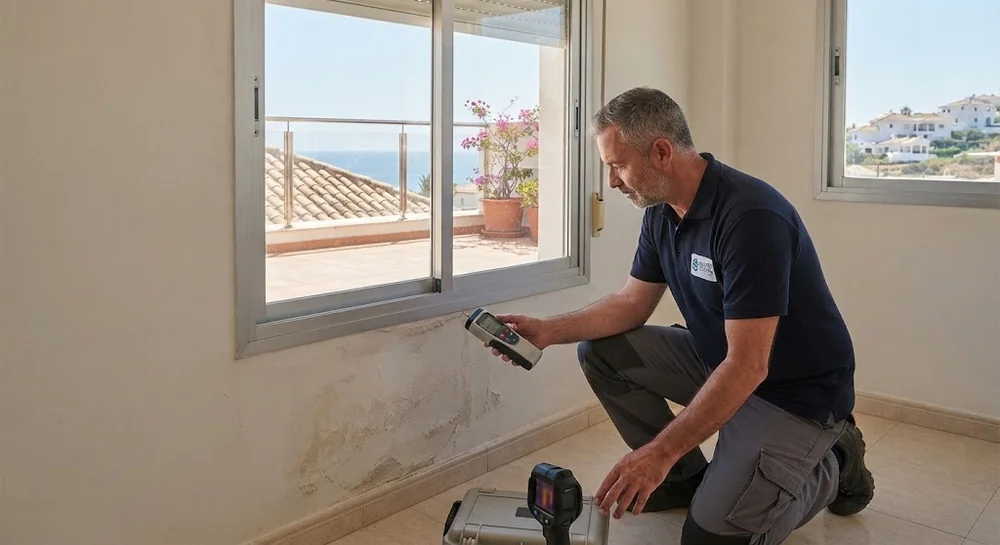
    My Honest Verdict for Buyers

    Barcelona prices were rising in 2026, but the evidence is about flats and the whole housing stock, not terraced houses. My reading is that scarce, well-located townhouses are likely to stay in demand. That is an opinion, not a forecast, and a house with an unregistered extension or a damp party wall can lose value whatever the index does.

    Budget at least 12% to 13% on top of the price for tax and fees at the general resale rates, add a repair allowance from a real survey, and judge each house on comparable sales. If you want a shortlist filtered by budget, district and intended use, the quiz link earlier in this article is the simplest route; I do not claim exclusive access to properties or guaranteed prices. Always ask for the nota simple before you commit.

    Disclaimer: This article is general information as of 3 November 2026 and is not legal, tax, financial or mortgage advice. Statistics are drawn from the named institutions and portals, which use different methods, and none of them is a townhouse-only index. Scenarios and budget examples are illustrative. Tax rules, exceptions and eligibility change, so consult an independent Spanish lawyer, tax adviser and chartered surveyor before buying.

  • Hidden Costs of Buying a Penthouse in Madrid (2026)

    Hidden Costs of Buying a Penthouse in Madrid (2026)

    You have shortlisted an ático in Madrid, the asking price looks manageable, and now you want to know what you will really have to pay. Taxes and deed costs are the predictable part of the budget. Terrace repairs, community debts and finance charges are where budgets usually go wrong. I’m David, and ten years on the Costa del Sol have taught me that the figure on the advert is only the opening line of the budget.

    The hidden costs of buying a penthouse in Madrid include purchase taxes, notary and registry fees, legal checks, mortgage expenses and potential terrace repairs. As of November 2026, resale purchases generally attract 6% transfer tax, while qualifying new homes incur 10% VAT plus applicable stamp duty. Community assessments and annual ownership costs require separate budgeting.

    Property consultant discussing a Madrid penthouse purchase with a buyer on a rooftop terrace

    How Much Extra Does a Madrid Penthouse Really Cost?

    A buyer comparing shortlisted Madrid penthouses needs three separate budgets: the one-off transaction costs, the property-specific liabilities (terrace, roof and community debts) and the annual running costs. Mixing them into one percentage is how people end up short of cash in the month of completion. As of November 2026, the main tax on a standard Madrid resale is the 6% transfer tax (ITP), and the rest of the closing bill is made up of separately quoted professional and registration costs.

    The table below compares a resale penthouse with a qualifying new-build penthouse. The two do not carry the same taxes, and they should never be added together in one budget.

    Cost categoryResale penthouse (as of November 2026)Qualifying new-build penthouse (as of November 2026)Unit and basis
    Main purchase taxITP at a standard 6%IVA at 10% on the price% of taxable base
    Stamp duty (AJD)Not added on top of ITP in an ordinary resaleMadrid AJD rate applies to the deed (0.75% in the ordinary case, to be validated)% of deed base
    Notary (purchase deed)Regulated tariff; hypothetical planning allowance of about €600–€1,000Similar tariff logic, usually larger deed€ per deed, illustrative
    Land registryRegulated tariff; hypothetical planning allowance of about €400–€700Similar, plus new-build registrations€ per registration, illustrative
    Lawyer, gestoría, translationQuoted by each firmQuoted by each firm€ per written quotation
    Terrace and roof repairsConditional on title, rules and cause of damagePotential statutory construction-defect protection, depending on defect type, applicable limitation periods and the circumstances of the development; verify the supporting documents€ per contractor estimate
    Community arrears and derramasDocumentary check requiredFees begin from handover; check the approved budget€ per certificate or minutes

    A warranty on a new build does not remove the need to inspect the terrace or to budget for upkeep. Statutory protection depends on the type of defect and the time limits that apply, and it does not cover wear, poor maintenance or damage you cause yourself.

    You will see national guides quoting 8–13%, 10–12% or 10–13% on top of the price. Those are general Spain-wide estimates, not legal rates for a particular Madrid penthouse, and they blend regions with different transfer-tax rates. For Madrid, the sensible method is to take the verified regional tax rate, add professional costs from written quotations, and then add a separate allowance for terrace and community risks. Here’s where people usually come unstuck: they treat a percentage rule of thumb as a quotation, and then discover that their penthouse has a roof leak that no percentage covered.

    Madrid Penthouse Purchase Taxes: ITP, IVA and AJD

    As of November 2026, the standard Impuesto sobre Transmisiones Patrimoniales (ITP) on a resale property in the Community of Madrid is 6%. It is paid by the buyer, normally by self-assessment, after the escritura pública is signed before the notary. A €600,000 resale therefore produces €36,000 of ITP where the taxable base equals the price.

    A new penthouse bought from a developer is a different animal. A qualifying first supply of new residential property normally carries 10% Impuesto sobre el Valor Añadido (IVA) as of November 2026, plus Actos Jurídicos Documentados (AJD) on the deed. Madrid’s AJD rate is 0.75% for ordinary free-market residential acquisitions in the higher-value bracket, although different rates apply in legally defined circumstances, so the thresholds and case should be validated by your adviser.

    Resale ITP and new-build IVA with AJD are alternatives, not a stack. On a normal resale you pay ITP and generally no separate acquisition AJD on top; on a qualifying new build you pay IVA plus AJD and no resale ITP. Mortgage AJD is a separate matter again: it attaches to the mortgage deed, and under the 2019 mortgage law it is ordinarily the lender’s cost, not the buyer’s.

    A dated note, as of November 2026: the Madrid regional government announced proposed tax reductions in October 2026 in connection with the 2027 budget. Announced proposals are not enacted law. Every scenario in this article uses the rates in force today, 6% ITP and the ordinary 0.75% AJD, so ask your adviser to confirm the position at the date of your deed.

    The reference value trap

    The valor de referencia catastral is an administrative value published by the Catastro for each property. For a resale, the ITP taxable base depends on that reference value, the value declared in the deed and the price actually paid, applying the statutory rules, and in practice it is often the higher of the figures. If you negotiate a price below the reference value, your ITP may be calculated on the higher figure, so a calculation based only on the asking price is not conclusive.

    A simple example: you agree a price of €500,000, but the reference value is €560,000. If the reference value is the applicable base, ITP at 6% is €33,600 instead of the €30,000 you expected. Ask your lawyer to obtain the reference value before you sign anything, and to confirm in writing which base will be used, including any legal exceptions that a Madrid tax specialist should check.

    TaxApplies toRate (as of November 2026)Taxable baseWho pays
    ITPStandard resale in Madrid6%Reference value, declared value and price paid under the statutory rules (often the higher)Buyer
    IVAQualifying new penthouse10%Price excluding IVABuyer, added to the price
    AJD (acquisition)Qualifying new penthouse deed0.75% ordinary case, validate thresholdsDeed value, to be confirmed by your adviserBuyer
    AJD (mortgage)Mortgage deedMadrid rate applies to the loan deedMortgage liabilityOrdinarily the lender (2019 mortgage law)

    Deadlines, reliefs and the seller’s taxes

    In Madrid, the ITP and AJD self-assessment (Modelo 600) is generally due within 30 working days of the deed date, as of November 2026. Your gestor or lawyer usually files it, but the liability is yours, so ask for the filing receipt. Reduced rates and reliefs exist only in legally defined cases with strict conditions. Being foreign neither qualifies nor disqualifies you, and you should never assume that a relief you read about elsewhere in Spain applies in Madrid.

    Two further points catch non-residents out. The seller normally pays the municipal plusvalía tax, but the contract should say so. And when the seller is a non-resident of Spain, the buyer generally has to withhold 3% of the price and pay it to the tax authority on the seller’s behalf, usually through Modelo 211 within one month of the transfer, subject to applicable exceptions. That withholding is taken out of the seller’s consideration, so it should not automatically be added to your total acquisition cost. Ask your adviser to confirm whether it applies to your deal. The official rules sit with the Agencia Tributaria.

    Calculator and property purchase documents arranged on a desk

    Notary, Registry and Legal Fees Beyond the Asking Price

    Deed and professional costs are smaller than the taxes, but they are still real money, and for a penthouse they tend to sit at the upper end of any range. For planning purposes I use hypothetical allowances of roughly €600–€1,000 for the notary and €400–€700 for registration on an average-priced property. These are planning allowances, not binding quotations for a high-value penthouse. Notary and registry tariffs are regulated, but they grow with the deed value and the number of documents, so ask each office for a written estimate.

    ExpenseStatusWho normally paysCost guidance (as of November 2026)
    Purchase deed (notary)Statutory stepCustomarily the buyer in practice; the default civil-law rule differs (see below), so the contract must sayHypothetical allowance €600–€1,000; get a quote
    Land registrationStatutory step for protecting titleBuyerHypothetical allowance €400–€700; get a quote
    Independent lawyerStrongly recommendedBuyerFixed or percentage fee in the engagement letter; VAT usually extra
    Gestoría (filing and registration)Often usedBuyerFixed quote; confirm whether VAT is included
    Sworn translation, apostille, power of attorneyOptional, but needed if you cannot attend signingBuyerQuote per document
    Technical report by an architectStrongly recommended for a penthouseBuyerWritten quotation scoped to terrace and roof
    Agency commissionDepends on the contractCheck the listing agreementNever presume who pays

    On who pays the notary, customary practice and the default rule are two different things. Under Article 1455 of the Spanish Civil Code, the costs of granting the deed generally fall on the seller, while the first copy and the later steps fall on the buyer, unless the parties agree otherwise. In real contracts the buyer very often takes on most of these costs, so do not assume either way: the purchase contract should state the agreed allocation expressly.

    Professional fees depend on the scope and the contract, not on a universal tariff. Many Spanish professional services carry 21% IVA, so check whether a quotation is shown with or without it. My advice to every British buyer is to get the engagement letter before the work starts, with the scope, the fee, the VAT treatment and the expenses all stated. A power of attorney is worth considering if you cannot travel to Madrid for the signing, but it is a sensitive document, so have it drafted by your own lawyer and limited to specific acts.

    Penthouse Terrace Ownership and Hidden Repair Liabilities

    An advert that says “private terrace” is a marketing description, not a legal title. A penthouse terrace in Spain may be privately owned, or it may be a common element of the building reserved for one owner’s exclusive use. Under the Ley de Propiedad Horizontal, roofs and structural elements are ordinarily common property, even where one owner has exclusive access. That means the terrace you walk on and the roof structure underneath can have different legal status, and the difference affects who pays when water gets in.

    ElementWhat it meansDocuments that establish the statusRepair position
    Privately owned terraceRegistered as part of your flat and owned by youEscritura, nota simple, título constitutivoUsually yours for surfaces and installations, subject to the building rules
    Exclusive-use common elementOwned by the community, with use reserved for youTítulo constitutivo, community statutes, minutesA use right does not by itself transfer ownership or all repair liabilities; the statutes and the cause of damage decide
    Structural roof elementsOrdinarily common property, even beneath your terraceTítulo constitutivo and the Ley de Propiedad HorizontalGenerally maintained by the community, with exceptions for owner-caused damage

    The documents that answer the question are the escritura pública, the nota simple from the Registro de la Propiedad, the título constitutivo of the building, the community statutes and any approvals for past alterations. Always ask for the nota simple before you commit. Compare what the registry says with what the advert says, because registered terrace areas are often smaller than the area being marketed.

    Let me put it plainly: on the Costa del Sol, I have seen buyers pay a premium for a terrace they later found was a common element with a restrictive rulebook. Madrid is not my home patch, so treat this as a pattern from Spanish conveyancing generally, and have a Madrid lawyer read the Madrid documents.

    Who pays when the terrace leaks?

    Responsibility for repair depends on the legal classification of the affected element, the governing rules and the cause of the damage. The community generally maintains structural and common elements, while an owner may bear the cost of surface finishes, installations they added or damage caused by their own negligence. Water damage to the flat below adds another layer, because a neighbour may claim against whoever is responsible. None of this is universal, which is why you need written answers for your specific building.

    Take a composite, anonymised scenario. A buyer purchases a penthouse with an advertised private terrace. The tiles are cracked, and a stain appears in the neighbour’s ceiling after the first heavy rain. The community says the waterproofing membrane is the owner’s job, the owner says the roof is common, and the buyer is stuck in the middle. A pre-purchase document check and a technical report would have flagged the question before the deposit was paid.

    What to request before committing

    • The current nota simple and the registered description of the terrace, including its registered area.
    • The título constitutivo and community statutes, to see whether the terrace is private or an exclusive-use common element.
    • Minutes of recent meetings recording any water damage, claims or roof works.
    • Written confirmation from the community administrator on who has paid for past terrace repairs.
    • Licences, approvals or community consents for any glazing, pergola, kitchen or extension on the terrace.
    • Any building inspection report (ITE) and warranty documents for waterproofing works.
    • Insurance policy details showing who has claimed for terrace or roof leaks.

    Penthouse terrace showing tiled flooring, drainage and roof junctions

    Community Fees, Special Assessments and Building Debts

    The comunidad de propietarios charges ordinary fees monthly or quarterly, split according to each flat’s participation quota. A penthouse often has a larger quota than the flats below it, and communal facilities such as a lift, concierge, pool or garage push the charge up further. Ask for the quota percentage, the current fee and the last approved annual budget, because the fee on the advert can be out of date.

    A derrama is a special assessment, approved by the owners’ meeting, to fund works that the ordinary budget cannot cover, such as a roof, lift, façade, structural repair or energy upgrade. Distinguish between works that have been formally approved, works that have only been discussed and works that are simply likely because the building is old. Approved assessments need close scrutiny, but some necessary conservation, safety and accessibility works are legally mandatory even without a prior owners’ meeting resolution. Ask the community administrator whether any compulsory works, official orders or urgent repairs could generate additional contributions. Articles 10 and 17 of Ley 49/1960 draw the line between compulsory works and discretionary improvements, and the second and third categories above should still influence your offer.

    Under the Ley de Propiedad Horizontal, an acquired property can answer for community debts for the current year and the three previous calendar years, as of November 2026. This means arrears left by the seller can attach to the flat you buy, so the community debt certificate matters. The same law requires a reserve fund, set at a minimum percentage of the last ordinary budget (currently 10%), and a small reserve is a signal that major works will be funded by derramas instead. Confirm the wording on the BOE consolidated text.
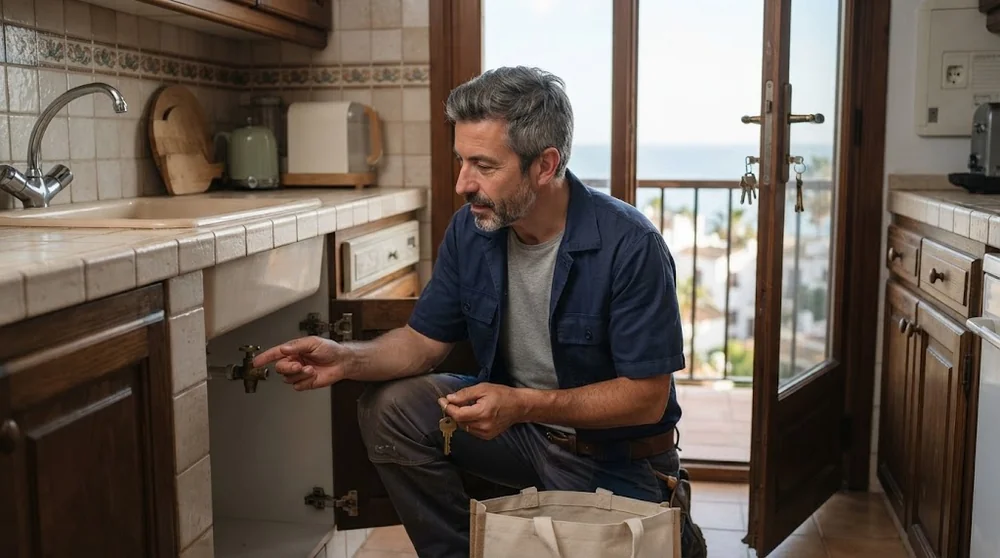
    Here’s where people usually come unstuck: they accept a verbal “the community is all paid up” from the agent. In my experience, a signed certificate costs a few days of waiting and avoids a very expensive surprise.

    • The community debt certificate, issued by the secretary with the administrator’s approval, showing the flat is up to date.
    • The last two or three sets of annual accounts and the current approved budget.
    • Meeting minutes from at least the last three years, including items on works and claims.
    • A list of approved but unpaid derramas, with the payment schedule, and who bears each one under the contract.
    • The reserve fund balance and any quotes for planned works.
    • Any pending litigation involving the community.

    On timing, Article 17.11 of the Ley de Propiedad Horizontal generally places assessments for improvements on the owner at the time the relevant amounts become payable. That is the statutory position towards the community. Between you and the seller, the economic burden can be allocated differently by contract: usually the seller bears instalments due before the deed and the buyer those due after, but that is a negotiated term, not a rule, and it does not bind the community. Ask for the payment schedule, and make sure any agreed allocation is written into the contract. Also check whether you are asked to waive the debt certificate at signing. I would not waive it.

    Survey Costs and Structural Problems Unique to Penthouses

    An independent architect or technical surveyor should inspect the property before you make any non-refundable commitment. A penthouse concentrates the building’s weather exposure on one roof and one terrace, so a general report on the flat is not enough. Ask for a written quotation that names the terrace, roof junctions and drainage in the scope. Keep the inspection fee separate from any repair allowance, because the surveyor’s fee buys information, not repairs. Where the report identifies problems, request written contractor estimates rather than relying on an informal figure.

    1. Waterproofing and ponding. Check the membrane, joints, upstands and any places where water collects after rain, and ask for any waterproofing warranty.
    2. Drains and downpipes. Confirm that outlets are clear, correctly sized and not blocked by planters or decking.
    3. Structural condition. Look for cracks, stains on lower ceilings, corroded steel and signs of past movement, and ask whether an ITE report exists.
    4. Unauthorised enclosures. Compare glazing, pergolas, sheds and extensions against licences and the registered floor area. An unlicensed addition can bring fines or demolition orders.
    5. Roof equipment. Identify air-conditioning units, aerials, solar panels and plant, and establish who owns, maintains and insures them.
    6. Energy and heat gain. Review the energy performance certificate, insulation and shading, since top-floor flats can run hot in a Madrid summer.
    7. Lift and access. Check that the lift reaches the penthouse level, how the final flight works, and whether furniture or a wheelchair can get in.

    In historic parts of Madrid, building protection rules may restrict what can be done on a rooftop, so check the planning position before paying for a terrace extension you cannot legally build. Measure the interior and terrace areas yourself and compare them with the registered and cadastral areas, because a gap is a flag.

    Building surveyor inspecting drainage and waterproofing on a penthouse terrace

    Mortgage, Currency Exchange and Non-Resident Buyer Costs

    Three terms are routinely mixed up. Equity is the part of the purchase price you pay from your own funds, not an extra expense on top of the price. A mortgage is the lender’s finance for the rest of the price. Acquisition expenses are the taxes and fees that sit on top of the price whether you borrow or not.

    ItemWhat it isExtra to the price?Who normally bears it (as of November 2026)
    Buyer equityPrice minus loan, paid from your fundsNo, it is part of the priceBuyer
    Mortgage loanLender finance, set by valuation and policyNo, it is part of the priceRepaid by the borrower
    Purchase taxes and deed feesITP or IVA plus AJD, notary, registryYesBuyer
    Property valuationBank-required appraisalYesBorrower
    Mortgage deed expensesNotary, registry, gestoría and mortgage AJD for the loanNot for the buyerOrdinarily the lender (2019 mortgage law)
    Agreed bank charges and insuranceItems stated in the loan offerYes, if agreedBorrower, as stated in the offer

    Foreign buyers can apply for Spanish mortgages, including non-residents, but the terms depend on income, credit assessment, valuation and each bank’s policy. I cannot promise a loan-to-value percentage or an interest rate, and nobody honest can until a lender has assessed your file. Non-residents often need considerably more equity than residents.

    A valuation can also come in below the price, and then the shortfall is your cash. Here is a transparent illustration using an explicitly hypothetical 60% loan-to-value. On a €1,000,000 penthouse valued at €1,000,000, the loan would be €600,000. If the bank values the same flat at €900,000, the loan falls to €540,000, which means you need an extra €60,000 of equity. Actual lending policies may differ, so treat this as arithmetic, not an offer.

    Sterling buyers also carry exchange-rate risk. Between agreeing the price and completing, the pound can move against the euro, and that moves your euro cost. Agree a transfer method and a rate before the deed if you can, and compare quotes from regulated payment providers. Banks and platforms differ in what they charge, so ask for the full cost in writing. The Banco de España publishes consumer guidance on mortgage information and the allocation of costs.

    You will also need an NIE, the foreigner identification number used for tax and property transactions. Brexit changed immigration, not property rights: a British citizen can buy in Spain, but owning a flat does not grant residence. As I understand it, the residence route for property investment was ended in 2025, and non-EU visitors are generally limited to 90 days in any 180 under the Schengen rules, so check your actual status with an immigration specialist.

    Annual Running Costs of Owning a Madrid Penthouse

    The annual bill has predictable lines and unpredictable ones. Predictable costs come from tax bills, community budgets and utilities; unpredictable ones come from major repairs. The table below shows what to ask for and where each figure comes from. I have deliberately not invented numbers: the real figures should come from the seller’s last bills.

    Annual costWhat drives itWhere to get the real figure (as of November 2026)
    IBI (local property tax)Cadastral value and the municipal rateLast IBI receipt from the seller
    Municipal waste chargeResidential charging formula and property-specific municipal data under Madrid’s 2026 rulesMadrid City Council or the latest notice, not a national estimate
    Community feesParticipation quota, facilities, approved budgetAdministrator’s certificate and budget
    InsuranceSum insured, terrace and water-damage coverWritten insurer quotation
    Utilities and coolingOccupancy, orientation, air conditioningSeller’s last 12 months of bills
    Terrace upkeepPlanting, cleaning, resealing, awningsContractor quotation
    Modelo 210 (non-resident income tax)Cadastral value and residence statusYour tax adviser

    Madrid City Council applies its own municipal rules to IBI and to the waste-management charge. The waste charge depends on the residential charging formula and on property-specific information held by the council, so I will not give you a universal amount. If the penthouse is in another municipality in the Community of Madrid, that town’s ordinances apply instead. Check the council’s website and the bill itself rather than assuming a generic rubbish tax.

    Non-resident owners may have a Spanish tax obligation even if the property is empty. The IRNR (Impuesto sobre la Renta de No Residentes) can impute a deemed income to the owner, reported on Modelo 210, generally calculated as a percentage of the cadastral value. As of November 2026, the percentage is typically 1.1% or 2% depending on the revision date of the cadastral value, and the tax rate is commonly 19% for EU/EEA residents and 24% for others, including UK residents. Tax residence, not nationality, is what matters, and a British citizen living in Spain would follow the resident rules.

    The hypothetical example is this: a cadastral value of €300,000 at 1.1% gives deemed income of €3,300, and 24% of that is €792. It assumes full-year ownership, exclusively personal use, an applicable 1.1% imputation percentage and non-resident tax residence subject to the 24% rate. Verify the cadastral revision criteria for the relevant tax year, and prorate if you own the flat for only part of the year.

    An empty penthouse still costs money: insurance, standing charges, cleaning, humidity control and air-conditioning servicing. Budget those lines even if you plan to visit only a few weeks a year. Keep a separate reserve for major repairs, because those arrive as derramas or contractor invoices and not as a monthly standing order.

    Madrid penthouse living room opening onto a terrace with outdoor shading

    Madrid Penthouse Cost Examples at €600,000 and €1 Million

    The two scenarios below are hypothetical resale purchases. They assume the standard 6% ITP, no reduced rate and no reference-value base higher than the price. Every fee line is an illustrative allowance for arithmetic, not an official tariff or a quotation. A 60% loan is also an assumption, not a lender offer, and the loan is part of the price, not an extra expense.

    Line (€, hypothetical)€600,000 penthouse€1,000,000 penthouseBasis
    Purchase price600,0001,000,000Assumed
    ITP at 6%36,00060,0006% of price
    Notary1,0001,400Allowance
    Land registry700900Allowance
    Gestoría400500Allowance
    Lawyer (1% plus 21% IVA)7,26012,1006,000 and 10,000 plus IVA
    Technical survey1,0001,500Allowance
    Translation and power of attorney500800Allowance
    Total other fees10,86017,200Sum of the six lines above
    Total taxes and fees46,86077,200About 7.8% and 7.7% of price
    Total cost if paid entirely in cash646,8601,077,200Price plus taxes and fees
    Assumed 60% loan360,000600,000Illustrative, not an offer
    Required equity (part of the price)240,000400,000Price minus loan
    Valuation fee500700Allowance
    Total cash to completion with a mortgage287,360477,900Equity plus taxes, fees and valuation

    The arithmetic runs like this for €600,000: 240,000 + 36,000 + 10,860 + 500 = 287,360. For €1,000,000: 400,000 + 60,000 + 17,200 + 700 = 477,900. Terrace repairs, exchange costs and any derrama are not included.

    A contrato de arras deposit of around 10% is often agreed, but it is part-payment of the price, not an additional cost, and it can be lost if you withdraw. Here is how it fits the €600,000 scenario. Assume a €60,000 arras payment: it is an advance against the price and is already inside the €240,000 of equity. Total buyer cash with a mortgage is still €287,360. Of that, €60,000 has already been paid, so the remaining completion balance is €227,360 (180,000 of remaining equity + 36,000 ITP + 10,860 fees + 500 valuation). The totals in the table already include the equity that the deposit represents, so do not add the deposit again.

    The terrace premium has a cash-flow effect worth seeing. If the terrace adds €100,000 to the price, ITP adds €6,000 and, at the assumed 60% loan, equity rises by €40,000. That €40,000 assumes the lender finances 60% of the full additional price. If the bank’s valuation does not recognise the whole premium, you may need more equity than that. Do not treat a renovation as a transaction cost: any works need written contractor estimates before they enter your budget.

    First-year ownership allowance (€, hypothetical)€600,000 penthouse€1,000,000 penthouse
    IBI and waste charge2,2003,500
    Community fees3,0005,400
    Insurance500800
    Utilities2,4003,600
    Terrace upkeep6001,000
    Total first-year allowance8,70014,300

    These annual figures are placeholders, not predictions, and exclude Modelo 210, mortgage repayments and any derrama. Replace them with the seller’s real bills as soon as you have them.

    For a qualifying new build, the comparison changes. Suppose a €600,000 price excluding IVA: IVA at 10% is €60,000 and AJD at 0.75% on an assumed €600,000 deed base is €4,500, so taxes total €64,500. Your adviser must confirm the AJD base. With the same €10,860 of other fees, the total cost is 600,000 + 64,500 + 10,860 = €675,360. With the same 60% loan of €360,000 and a €500 valuation, cash to completion is 675,360 − 360,000 + 500 = €315,860. This is a tax-treatment comparison, not a recommendation to buy new or resale.

    The Due Diligence Checklist Before Paying a Deposit

    Paperwork before the deposit is cheap. Paperwork after it is expensive. Ten years on the Costa del Sol have taught me that most disasters are visible on paper weeks before anyone signs. Work through the list in this order.

    1. Verify the seller and title. Confirm the seller’s identity and authority, and that they are the registered owner.
    2. Obtain a current nota simple. Check owners, registered description, charges, mortgages, embargoes and any pending annotations.
    3. Read the escritura. Compare the registered description with the property being sold, including terrace rights.
    4. Compare the Catastro data. Check cadastral area, use and reference value against the registry and the advert.
    5. Confirm the tax base. Ask your adviser to confirm the reference value and the expected ITP or IVA and AJD.
    6. Request the community debt certificate and minutes. Read the minutes for derramas, claims and planned works.
    7. Commission the terrace and roof inspection. Get it in writing, with a scope that names the terrace, drainage and roof.
    8. Review building and energy documents. Include the energy certificate, ITE report and licences for alterations.
    9. Confirm finance. Get the lender’s written terms and valuation outcome before committing deposit money.
    10. Have an independent lawyer review the contrato de arras. Do not sign the agent’s template without review.

    The contrato de arras is a preliminary contract with a deposit, usually around 10% of the price. Depending on the clause used, a buyer who withdraws may forfeit the deposit, while a seller who withdraws may owe it back doubled. Terms differ, so the wording matters. Protect yourself with conditions: completion subject to mortgage approval, to a clean nota simple, to a clean community debt certificate and to the seller delivering the property free of charges. If a serious title defect is unresolved, do not pay the deposit.

    Property buyer and solicitor reviewing floor plans and purchase documents

    When Hidden Costs Should Change Your Offer

    A hidden cost is only useful for negotiation when you can document it. The matrix below ties each decision to evidence you can verify, not to an arbitrary percentage of the price. Everything below is a general framework, and your lawyer should apply it to your specific documents.

    DecisionDocumentary triggerPractical action
    ProceedClean nota simple, debt certificate in order, terrace inspection shows no material defects, costs fit your budgetMove to the contrato de arras with safeguards
    RenegotiateRepairs or approved derramas are quantified by written estimatesAsk for a price reduction or seller-paid works, in writing
    Pause and seek specialist adviceTerrace ownership, licences or title are unclearInstruct a lawyer or architect before any further payment
    DeclineMaterial defects, unlicensed works or hidden debts remain unresolvedWithdraw before the deposit or invoke a contractual condition

    Ask contractors for written quotations that state the scope, the VAT treatment and the validity period. Then allocate responsibility in the contract: who pays for named repairs, who bears approved derramas and who is liable if hidden defects appear. Avoid any claim that a discount will pay for itself through appreciation or rental income, since nobody can promise that.

    If a seller refuses to produce the documents above, that refusal is itself information. A seller who will not show the community minutes or the registered terrace description is asking you to price a risk you cannot see, and you should price it accordingly or walk away.

    If you would like a second pair of eyes on the costs and documents of a specific Madrid penthouse before you commit, you can ask me a question directly.

    Ask a question on WhatsApp

    I can explain the Spanish process in plain terms, but a Madrid-qualified lawyer, tax adviser and architect should check the property-specific facts before any money moves.

    Frequently Asked Questions About Madrid Penthouse Costs

    What extra costs should I budget for when buying a penthouse in Madrid?

    As of November 2026, a typical resale penthouse in Madrid generally attracts 6% property transfer tax, plus purchase-deed, land registration and professional expenses. A new residential property normally follows a different IVA and AJD tax treatment. You should also allow for independent legal checks, technical inspections, potential terrace repairs and future community assessments. Exact costs depend on the property.

    How much property transfer tax do you pay in Madrid?

    The standard property transfer tax, or ITP, on qualifying resale property in the Community of Madrid is 6% as of November 2026. A €600,000 resale purchase therefore produces €36,000 in ITP if that price is the applicable taxable base. The cadastral reference-value rules can affect the calculation, and reduced rates or reliefs require specific eligibility conditions.
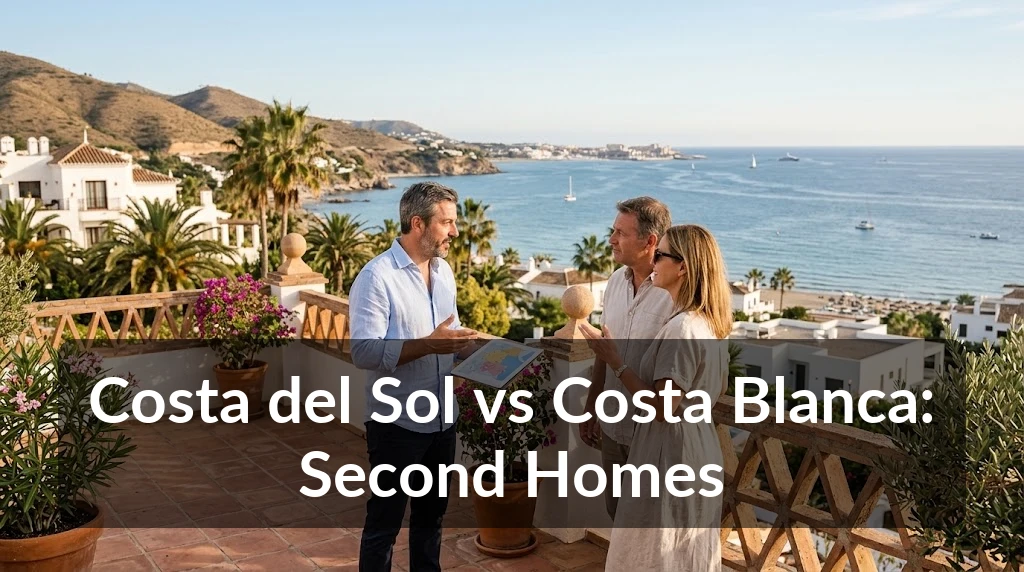
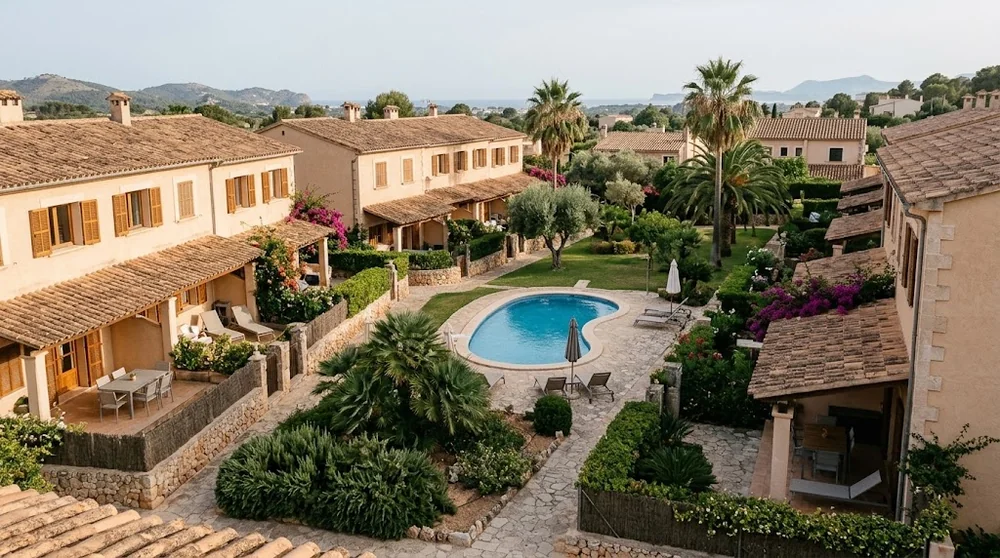
    Are penthouse terraces privately owned in Spain?

    Not necessarily. A penthouse terrace may form part of the private property or be a communal element reserved for one owner’s exclusive use. The roof structure may remain communal even where access is exclusive. Before buying in Madrid, check the registered deed, community statutes and relevant approvals. These documents help determine permitted alterations and responsibility for maintenance and repairs.

    Who pays for roof and terrace repairs in a Spanish apartment building?

    Repair responsibility depends on the legal classification of the affected element, community rules and the cause of the damage. Structural roof repairs may fall to the community, while certain terrace finishes or damage caused by an owner’s negligence may be the owner’s responsibility. Obtain written confirmation from the community administrator and an independent lawyer before committing to a penthouse purchase.

    Can foreigners get a mortgage to buy a penthouse in Madrid?

    Foreign buyers can apply for Spanish mortgages, including when they are non-residents, but lending terms depend on income, credit assessment, property valuation and bank policy. Non-resident borrowers may need considerably more equity than resident buyers. Budget separately for purchase taxes, valuation costs, any agreed lending charges and currency conversion. Property ownership itself does not confer Spanish residence rights.

    What ongoing taxes and community fees do penthouse owners pay in Madrid?

    Madrid penthouse owners should budget for local property tax (IBI), applicable municipal waste charges, community contributions, insurance, utilities and maintenance. Non-resident owners may also have Spanish income-tax obligations, including imputed income reported through Modelo 210 where applicable. Extraordinary assessments for roof, lift or façade repairs can substantially increase expenses. Request property-specific bills and community records before buying.

    Final Budget and Independent Checks Before Completion

    The essential financial decision is simple to state: budget the price, the taxes and fees, the cash you need at completion, and a separate reserve for terrace and community risks. Under the illustrative assumptions in this article, taxes and fees on a standard Madrid resale come to roughly 7.7–7.8% of the price, before any repairs or exchange costs. That figure moves with the tax base, the professionals you hire and the building itself, so it is a starting point, not a quotation.

    The numbers only mean something once the documents back them up. Collect the nota simple, the escritura, the Catastro data, the community debt certificate, the minutes and a written terrace and roof report, and have a Madrid-qualified lawyer, tax adviser, architect and, if you borrow, a mortgage professional review them before you pay a deposit. Every material amount and deadline here is stated as of November 2026 and should be verified, because my view as a Spanish property adviser is a practical guide, not legal or tax advice.

    Whichever property you choose, I would rather you walk away from one flat with a clear reason than complete on a penthouse whose terrace, roof and community records you have not seen.

    If you are still shaping your shortlist and want to match your budget, preferred area and buying goals to suitable properties in Spain, a short questionnaire will give you a starting selection.

    Get a selection of properties in Spain

    Disclaimer: This article is general information, not legal, tax, financial or mortgage advice. Rates, thresholds, deadlines and legal provisions are stated as of November 2026 and may change. Figures in the worked examples are hypothetical and do not represent quotations, bank offers or market data. Obtain independent advice from qualified Spanish professionals before making any commitment.